
Update from our South Africa biodiversity conservation expedition

We are in the groove here in South Africa. Several teams out every day, some with very early starts, some back for more at night, others for all-day trips. All to collect as much data as we possibly can – to bear witness and to help protect this beautiful mountain area in the Western Cape.
No other place on Earth like this
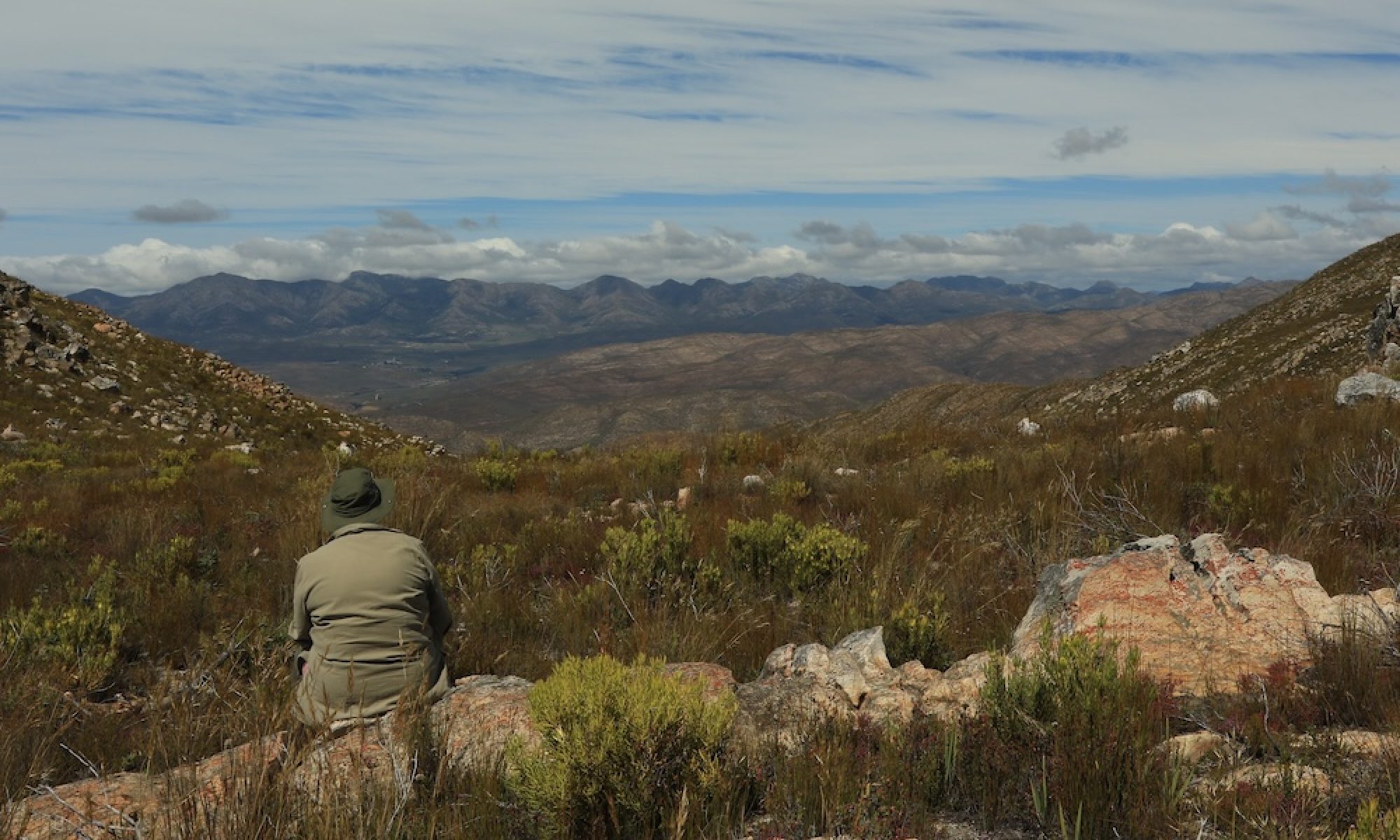
Our study area sits in the middle of extraordinary ecological crossroads, renowned globally as a meeting place for multiple major biomes. To the south, the waves of two oceans (the Southern Atlantic and the Indian) lap against the Cape in endless waves where the skies and the oceans meet. In the north, the ancient Kouga mountain ranges – older than the continent of Africa itself – jut up to 1757 metres – rugged, unforgiving, harsh – on some days with the sun beating down, on others with grey clouds building and streaking across the sky, driven by winds and some spits of rain. We are sandwiched in between, in a transitional ecotone where distinct vegetation types – predominantly Fynbos, Subtropical Thicket (Valley Bushveld), Succulent Karoo, Afromontane Forest and Nama-Karoo elements- converge within a remarkably compact geographical area. There is no place on Earth like this.

This high topographical and climatic diversity creates a mosaic of micro-habitats, ranging from arid, succulent-studded northern slopes to moist, fire-sheltered southern mountain fynbos and deep gorge forests. Such an overlapping convergence of biomes fosters an exceptionally high concentration of endemic plant and animal species, earning the area its status as a vital component of the Cape Floral Region World Heritage Site.
And here we are, privileged to be amongst this natural splendour, and this is what we do:
CAR transects
These are indeed done in a car, but stand for Coordinates Avifaunal Roadcounts. Sometimes a team is out all day on them, driving pre-determined routes on tracks, stopping a intervals, looking for a number of landmark bird species, but also recording wildlife encountered in between – tortoises, riverine rabbits and other target species. No lions or leopards bouncing around here – this is science, not safari.
It’s hot and exhausting work that requires dedication and concentration over a long period.
Camera trapping
We have set quite a few of them up now all across our study site – and checked and maintained others that were already in place. This is where the elusive Cape leopard – much smaller than its savannah cousin – reveals itself. Not by sitting comfortably in a safari vehicle being spoon-fed wildlife like tourists, but by hammering stakes into the ground and attaching camera traps to them. Science, not safari – again.


Honeybush
Honeybush (Cyclopia species) is indigenous to the mountainous fynbos and forms the basis of a growing niche agricultural and export industry centred on its caffeine-free, antioxidant-rich herbal tea. Economically, the sector provides vital rural employment and income generation through both traditional wild-harvesting and an expanding commercial cultivation sector. With strong international demand spanning major markets across Europe, North America and Asia, honeybush serves as a high-value speciality health product that promotes sustainable land use and biodiversity conservation within its unique endemic habitats.
Because of all this, we study the plant and how it reacts to cutting, different soils and much more. It’s hard work on steep slopes, clambering up and down, measuring branches, leaves, yields and more. You guessed it: Science, not safari.

iNaturalist
This is for the keen walkers. Basically, go for a rugged hike and use the iNaturalist app to record biodiversity on the walk. This took Alan and two expeditioners to an area of the mountains that even Alan had not been to. Just on foot, no cushy safari vehicles in sight for indulgent wildlife voyeurism. Instead it’s sliding into ravines by the seat of your pants, walking, observing, recording, the scent of wild thyme in your nose, the sun beating down on your skin, the fine dust of the Karoo settling on everything. Many kilometres and over 120 records later, they are back, exhausted and happy. Did anyone say safari? Never. This is the stuff of expeditions.

Bird netting
This one is for the early risers. Nets have to be up and ready by sunrise. That means starting your day with a 4 in front. As the sun stretches its purple embrace over the land and the birds start becoming active, some of them are caught in the net, carefully extracted by Alan (who is qualified to do this), weighed, measured, identified and a million other things to be typed into Alan’s massive database with thousands of entries in it already. One bird at a time.

And then Alan places the bird into your outstretched palm. It does not move. It plays dead. It is soft, light, warm – a living creature related to the dinosaurs that roamed this landscape 100 million years ago when these mountains were younger and higher. You turn your palm slowly and as the bird is about to drop off, it gives up its ruse and takes flight. No safari will give you this experience.
Night transects
And finally, for the night owls and those who have not had enough yet, there are the driven night transects. The dark African sky above, dusty gravel under the tyres – the only things you can see are in the yellow cone of your lights. You go slowly – and there something stirs and hops. Is it a hare or a rabbit? What kind of rabbit? Is it the riverine rabbit, one of the rarest and most critically endangered mammals in the world, endemic to the Karoo region. Unlike most other lagomorphs, it relies strictly on deep, soft alluvial soils along seasonal river terraces to dig its breeding burrows, making it exceptionally vulnerable to agricultural habitat destruction and overgrazing. Compounded by a notoriously slow reproductive rate – females typically produce only a single offspring per year – this solitary, nocturnal species faces an extremely high risk of extinction, with remaining populations heavily reliant on private landowner stewardship and conservation management. And this is why we are here. Stewardship. A safari would probably not even notice them.

Read also: First I second I third I fourth entry. All entries for the South Africa biodiversity conservation expedition.
Author: Matthias Hammer

Biosphere Expeditions was founded in 1999 by Dr. Matthias Hammer. Born in Germany, he went to school there, before joining the Army, and serving for several years amongst other units with the German Parachute Regiment. After active service he came to the UK and was educated at St Andrews, Oxford and Cambridge. During his time at university he either organised or was involved in the running of several expeditions, some of which were conservation expeditions (for example to the Brazil Amazon and Madagascar), whilst others were mountaineering/climbing expeditions (for example to the Russian Caucasus, the Alps or the Rocky Mountains). With Biosphere Expeditions he has led teams all over the globe. He is a qualified wilderness medical officer, ski instructor, mountain leader, divemaster and survival skills instructor. Once a rower on the international circuit, an amateur marathon runner and Ironman triathlete, he now enjoys less extreme pursuits such as writing and long-distance walks in the wild. More about Matthias.