Azores: gotcha!

It bit choppier than expected yesterday (Thursday), but the lookout had seen sperm whales, so off we went. Once again, we were headed to the south of Pico, off the town of São João.
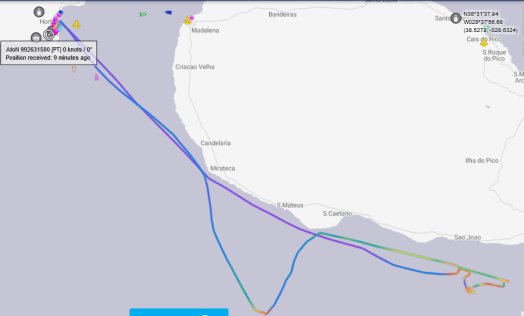
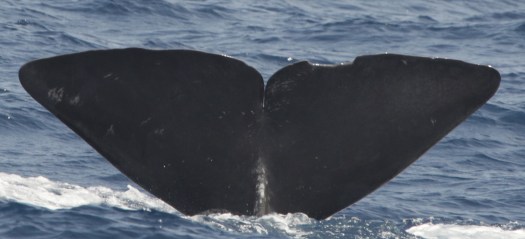
We stopped and put the hydrophone in just to make sure and, yup, we were close. The whales we could hear were a bit farther to the southeast, so we headed that way, only to have the lookout shout “Blow, behind you”! And sure enough about 300 m behind us, a sperm whale had surfaced. When they are getting ready to come up to the surface they stop clicking, which is why it wasn’t detected on the hydrophone. As we maneuvered to get around behind the whale, I thought I recognised the white marks on the dorsal from the other day. Sure enough when it fluked, it was “1198”, one of our well known females that had first been seen in 1989. This was very promising, “1019” has been seen with her the last few years and we missed her the other day. The second and third whales were also well known: “3186” aka “Bearpaw” and “2234”. We then spotted “1198” again, this time she had a calf with her, displaying suckling behaviour; arching up and diving next to the female’s dorsal fin. Then we saw “3186” once again. We decided we would watch one more, before heading back to Horta. Blow, this time a little closer to the shore. The dorsal fin was different to the others we had seen and looked familiar. “1019”!!! Yes! She was first seen in 1988, the same year that I started studying the whales and dolphins in the Azores. So she and “1198” are at least 40 years old, because when they were first sighted, they were identified as adults, rather than juveniles.

This slideshow requires JavaScript.

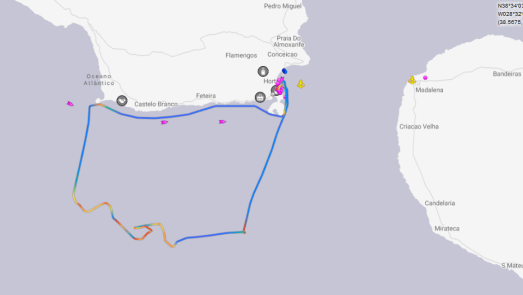
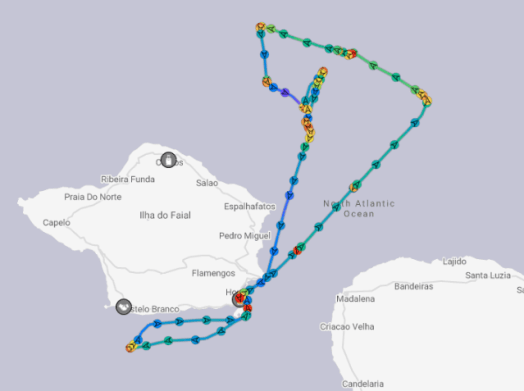
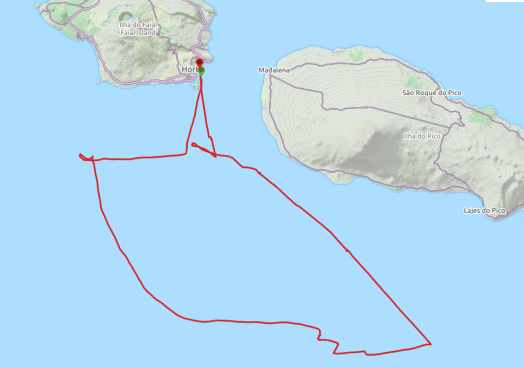
So off we headed back to Horta, with the lookout trying to find dolphins. And find them he eventually did! You can see from the track of the boat when we took a “hard left”! A couple miles further offshore from our course we found a group of spotted dolphin. These were the first spotted dolphin of 2020!! There were some very small calves in the group and they were riding the bow as they travelled towards the west against the waves. What a finale!

This slideshow requires JavaScript.


What will the next trip bring? Watch this space. Thank you once more to Biosphere Expeditions, and everyone who has contributed to their appeal, for the funding to make these outings possible!

All pictures (c) Whale Watch Azores
Azores: busy, busy, busy

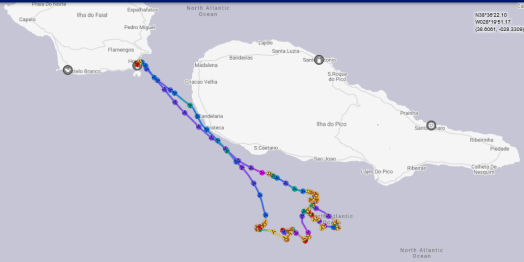
Saturday morning started a bit grey and damp, but the south of Pico was looking brighter. First we spotted a Cory’s shearwater with a damaged wing, at one point it looked like some monofilament was wrapped around it. We called the university and they said someone would come to collect it. But as we fuelled the boat, the bird came closer so once we finished, with no sign yet of the people from the university, we decided to catch it. Using a net, normally used to collect skin or poo samples from whales, we managed on the second attempt. Luckily for us, there was a bird box from the rescue campaign in the autumn, when the young birds can be found on the roads, at the police office in the marina. So we boxed up the bird and left it to be collected later. The bird will be transferred to Pico where hopefully it can be re-rehabilitated and released.

Off we went, just ahead of the rain showers. The lookout, Antero, had seen a sperm whale in front of the vigia at São Mateus, before we left, so that was our destination. As we reached the south, the wind dropped off and the sun came out. It was summer! Removing a couple of layers of clothing, we were scanning the horizon looking for a blow the lookout had directed us to. We found the whale and got the camera out just in time for the fluke. As it dived, I shouted “1198”!! She is one of our very well known females, first seen in 1989. Her group had been seen a few days previously closer to Lajes on Pico. The lookout then said we should go a few miles ahead where there were more whales. I did think this was strange, since usually the “family” of 1198 tend to swim fairly close together. But you don’t disagree with the lookout, so off we went. We just missed a mother & juvenile diving, but soon found another few whales, then another one and so on! We even saw what I think were two young males. By the end of the day, we had 13 different flukes from 16 encounters, but not another member of the 1198 family. So I will just have to wait a little while longer to see “1019”, one of my favorites, first seen in 1988. Apart from one of the animals I suspected were male, all of the other flukes were new to the catalogue. The “male” had been seen by the university in 2004. I will be in contact with them to see if it was identified as a male at the time. I doubt it, because the animal we saw was not a “mega” male, which are the very large, up to 18 m, animals. This was maybe 14 or 15 m most, so in 2004, it would have still been with its family group most likely.

In between some of the sperm whale sightings, we also saw a very energetic group of bottlenose dolphin, with at least one very small calf. We didn’t spend very long with them, because a sperm whale came up to the surface. As we were trying to leave the dolphin, two of them raced in front of the boat and did some amazing, 5-6 m leaps into the air!

About 45 min after the bottlenose dolphin, we came across a group of pilot whales. The group was split into a group of three large animals and another of five or six smaller ones. The three large ones just rested at the surface about 50 m from the boat, waiting for the others to catch up. And when they did, the whole group moved off and dived.

We kept following sperm whales and just as we started to see repeat whales and were thinking of heading for home, I spotted another blow. As we headed over a second whale appeared and they headed towards each other. Heads were coming out of the water, mouths were open and we saw what at first glance appeared to be a turtle that they were playing with. That turtle turned into something much more dangerous, a big tangle of rope. The two juveniles continued to play with if for another five minutes, before moving off, leaving the rope behind. On the boat, we gave a collective sigh of relief. It would have been disastrous if the rope had gotten stuck in one or both of their mouths. Although there is a knife on board as well as a mask, disentangling a whale can be quite dangerous.

Another four whales had come to the surface in the meantime and our two juveniles went over to join the adults, maybe complaining that we had removed their “toy” from the water. It appeared that the group was going to socialise and since the wind had started to pick up, we headed for home. We arrived home, happy and tired after 56.5 miles and 6 hours at sea.

All pictures (c) Whale Watch Azores

This slideshow requires JavaScript.

Azores: the south of Faial strikes again!

The wind has been blowing quite hard from the north all last week and yesterday (Sunday) was the first chance to get out again. The lookout on the south of Pico only saw a few small groups of dolphin, so we decided to stay to the south of Faial, where the waves were a bit smaller than the north side. It was a good choice!

We found a co-operative group of common dolphin, including some very small calves, where you could still see the fetal folds. Fetal folds are the “zebra” like stripes formed from the baby dolphin being bent inside of the womb, before birth. The brighter the stripes, the younger the animal. These marks will fade after a few months.

Just after the dolphin, we saw the second loggerhead turtle of the day! Not in “Turtle Time” for those of you wondering! 🙂 After the turtle dived, we put the hydrophone in for the second time and got a surprise. We had already passed a group of sperm whales! So we headed back the way we came and after about five minutes, I spotted three animals surfacing not too far from the boat! Yes! Then a small calf popped up and joined them and then another two! There were six sperm whales at the surface, including two calves; one suckling and the other not. Two of the four adults had been photographed in 2015, the other two are new to science.

Luckily, they didn’t all dive at the same time; one, then two sequentially and finally the fourth adult left the surface. The small calf was left at the surface and the larger one had shallow dive. WOW!! Now we understood why we hadn’t heard them on the hydrophone the first time we listened, they had all been up at the surface at the same time! We followed their clicks and waited for a second showing of the flukes, just to make sure we got the ID photos. And once they had all gone again, it was time to start back towards the harbour.

We passed very close to the Morro, the big white rock that you have to avoid hitting when landing or taking off from Horta airport! It is very impressive. No more animals were spotted, but I will be going out again soon, tagging along with Rui & Monica from the University of the Azores again. This time, they are going to be trying to tag a sperm whale.

Weather looks good, let’s hope the animals are waiting for us. Today Monday, 8 June is World Oceans Day.

This slideshow requires JavaScript.

Azores: sperm whale day

Sperm whales to the south, sperm whales to the north. Not a lot in between yesterday (Friday).

I joined the University of the Azores again to look for baleen whales. The lookouts had only seen sperm whales to the south of Faial when we left the harbour. Since there was no lookout in the north, we went to search the area which wasn’t covered by a lookout. We spotted the first turtle of the day about 3 miles offshore and then found a mixed group of common and striped dolphin. They were not interested in the boat, so we kept going. Shortly afterwards, we spotted our second turtle of the day. This was a fairly large turtle and Rui decided to launch the drone to get some overhead photos. There is a project planned to have an unmanned aerial drone surveying the waters around the island for wildlife. But before that can happen, they need to write some algorithms to decipher the footage they will get. The photo of the turtle was only taken from 15 m height and it is tiny!

Unfortunately, during the flight one of the engines malfunctioned, so the drone couldn’t be used again during the trip. We kept heading to the NW of the islands, until the lookout on the north called to say he was on duty and and  had spotted sperm whales closer to the coast and couldn’t see anything else, despite good visibility. So we headed in to get some photo-ID of the sperm whales on our way to the south coast. The vigia directed us to a group of three and then spotted a big blow about two miles further out. It turned out to be a male sperm whale and it didn’t wait for us to get in position to get a fluke photo. So we turned towards the south once again, but ran into sperm whales once more! A group of two, then a juvenile and another single all within a mile. So after another three flukes, we finally made it to the south coast, only to find that the wind had slightly changed and increased, making it impossible to do any work. So we had to call it a day. On the way home, we came across another tw loggerhead turtles. Still smiles for me, because although we weren’t actually looking for sperm whales, we found them once again and managed to get five ID photos.

This slideshow requires JavaScript.

Azores: first humpback and more

Wednesday started out very grey and overcast. It was not looking very promising to go to sea, but still we headed out towards a small bank to the south of Faial and just as we arrived and deployed the hydrophone, the first blow was spotted! As we got closer, it was apparent that it was a baleen whale, since the blow was going straight up in the air. The next time the whale surfaced, the white flippers were seen through the water. “Humpback”, I shouted! The first humpback I have seen in 2020.

At this time of year, they should be on their way back north to the feeding grounds. This whale may have been coming from the Cape Verde islands or the Caribbean, likely on its way to Norway or Iceland. I notified the Azores university of the sighting, since they had been waiting for something to be seen before they left the harbour and we continued to track the whale. Unfortunately, it did not show its fluke, but I did manage to get dorsal fin photos and just have to hope that it is distinctive enough to find a match. When the university boat arrived, we left and headed to the West of Faial.

Before we had left in the morning, I was planning to head to the west if the lookouts hadn’t seen anything. I know that the “Winter Whales” usually hang around for a couple of weeks. The unknown factor, was if they had already been hanging around for a while when we saw them the other day or had just arrived. We will never know the answer to that question, but as we approached the Condor Bank, we picked up some sperm whale clicks on the hydrophone. About an hour later we spotted the first blow. As the whale fluked, my hunch proved correct. We had found the “Winter Whales” again! The first two whales we saw were the same two we had seen the other day, but we did manage to get a third fluke that was different. Given the hazy spotting conditions, we were lucky to see each whale twice. The juvenile that we saw a few days ago with one of the females was not seen on this occasion, indicating that it is getting to an age when it starts to forage for itself, only occasionally returning to suckle from its mother.

As it turned out, one of the Winter Whales was 2448, first seen in 2003. The one with the two small nicks on the left end (see photos) is 3483, first seen in 2007.

3483

And the one with the small scallop on the right near the notch is 2808, first seen in 2004.

2808

About five minutes after we started to head for home, I spotted some dolphin splashes . This turned into the first sighting of bottlenose dolphin, one of our resident species. Unfortunately, they were not going to escort us towards Horta, but were on their way to the west, so after about five minutes, we both continued on our separate ways.

Hopefully I can get out again soon, because towards the weekend it looks like a bit of wind before a couple more sea days next week.

This slideshow requires JavaScript.


Azores: oh my!

Friday was one of those days you won’t forget for some time!

The morning started off quite drizzly and wet, so we delayed the departure. I was invited by Rui and Monica from the University of the Azores, IMAR, to join them aboard the boat I had been going out in.

The lookouts hadn’t seen anything and the south of Faial lookout had actually re-located to the north of the island. We headed out to the south-west. Monica and Rui wanted to find a fin whale to attach a short-term tag to, which records any vocalisations and also data during a dive, such as orientation and acceleration.

We had been going for about an hour when a back of a whale was spotted in the swell. We stopped and waited and waited a bit more. Blow! It turned out to be a sperm whale. Not what we were looking for, but we went to get the ID. As it fluked, I was pretty sure that I recognised it. We didn’t wait for any more, instead heading now to the south of Pico where the weather was clearing. We found a small group of common dolphin that came over to the boat and some a little further out appeared to be feeding.

We decided to head a bit further to the southeast, but by 13:30, we hadn’t found anything and started to head back to the harbour.

As we approached Faial, the lookout spotted the sperm whales again, so we headed over to have a look. Another project the university has, is to use a drone to collect samples of the blows, the famous “Snot Bot”! Although in Portugal (and therefore the Azores), drones are not allowed to be used by the general public, the use of this one (as wel as it biopsy darts and application of a tag) is approved under a research license. As Rui and Monica prepared the drone, we followed a whale along the surface. As it dived, I gave an excited shout! This group was the “Winter Whales”, so named, because we have seen them once in December, 2007. Once this encounter was over, we went back to Faial and everyone went their separate ways, but about 30 minutes later, the lookout Anteiro called to say he had seen a mother and baby blue whale! So we all raced back to the boat and off we went again!

The whales were off the South of Faial heading to the west. Monica & Rui prepared the tag and the biopsy dart (to collect a sample of the skin/blubber for analysis). Unfortunately, the mother was not very cooperative and every time we got almost close enough to deploy the tag, she turned away. After a couple of unsuccessful attempts, it was decided to leave the pair to continue on their way. We did get the photo ID shots from both sides for both individuals and they have been sent off for matching.

This slideshow requires JavaScript.

The calf did some absolutely incredible lunges/breaches while we were watching that made for some unbelievable sights. I don’t think I will forget that for a very long time!

We will be out again next week.

Azores: practically perfect

Apologies for the delay. We’ve had some computer issues, which is why this is late.

Satuday was an amazing day! We had a plan to go to the south and west of Faial, because the lookout hadn’t seen anything to the south of Pico when we were leaving. But just as we were about to turn the “corner” to go south of Faial, he called to say that he had seen a baleen whale in front of the vigia. So off we went to the South of Pico.

About 45 minutes later we were watching the first baleen whale of 2020, a fin whale. We stayed long enough to get the ID photos and then we were off to the south of Faial again. But we hadn’t gone very far before the lookout shouted “BLOW”! He had spotted another baleen whale closer to the coast. So we changed our course and headed that way. Just as we were approaching the area he had directed us to, a huge fluke rose out of the sea, as if the whale was saying “Hey, I’m over here”! And by looking at the fluke, we all shouted BLUE WHALE!! And it was indeed, quite a large blue whale. A bit on the thin side, but that is pretty normal at this time of year, when the whales are heading back to the feeding grounds after not eating for a few months on the breeding grounds. It was a fairly co-operative whale, because we were able to get the photo ID shots from both sides. Unfortunately, it didn’t show us the tail again.

Once again, we headed for the south of Faial. This time we actually made it to the area we had originally set out for! And what did we find? A group of sperm whales! We got fluke photos from four individuals and a large calf. Along the way, we passed a group of common dolphin with a lot of calves. And on our way back to port, we came across a mixed group of common and striped dolphin.

All in all, a practically perfect day [and Lisa’s birthday – Happy birthday!, ed.]. And to cap it all off, there have been some matches too. Three whales matched to 2009, one to 2018 and two to last year!

It looks like there is going to be a bit of wind and rain this week, but hopefully we will get out towards the end of the week or the weekend to see what is waiting for us.

This slideshow requires JavaScript.

Azores: sperm whales in the north

A second successful day at sea with 42 miles covered yesterday (Friday). There was a lot of fog and rain showers to the south today, so we headed north.
There was no lookout, but we had high hopes to find sperm whales with the hydrophone.
And success we had! We found a group of five females and a calf. Three of the individuals have been seen since 2009, always together. One of the others was seen in 2018 and a new one this year. We saw one of them three times and a couple of others twice.

This slideshow requires JavaScript.

When it appeared that we had all the individuals of the group identified, we headed back to the harbour. There were no dolphins seen today, although there were some Cory’s shearwaters feeding and a possible tuna also seen.
Once we were on the north coast, the lookout on the south of Pico called to say that two fin whales had appeared out of the fog. It was decided to stick with our plan, rather than risk a long trip back to the south. It turned out to be the right decision.
The weather looks like it should be good on Sunday, so hopefully will get out again. Thanks to Biosphere Expeditions, once again. We were the only boat on the water.

Azores: sperm whales & common dolphins

With the weather looking good for a couple of days and the Port Captain now allowing a registered Maritime Tourism boat to go out to sea, I was off in Thursday in a RIB (rigid inflatable boat) called Risso, with a regular whale watching skipper.

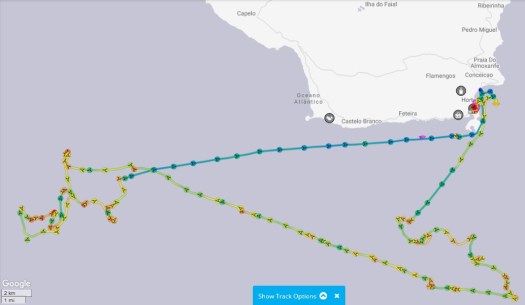
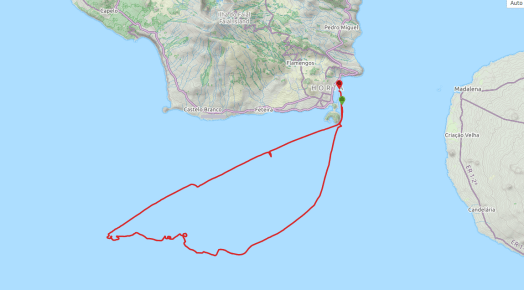
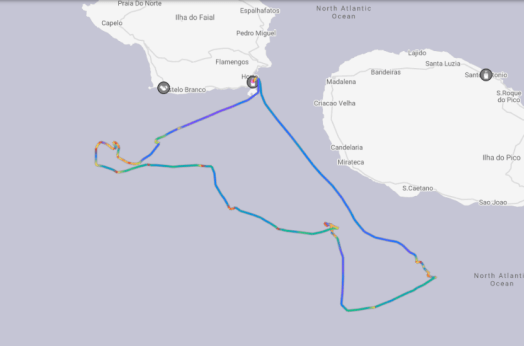
As you can see from our track, we covered a lot of miles, 67.2 to be exact. It was worth it!

Although, the baleen whales (probably two fin whales) eluded us, we did find and photograph sperm whales. Judging by their size, they were most likely young males. I have to give credit to the Vigia (lookout) Anteiro, for giving us the information that the sperm whales had been seen. Also thanks to skipper Pedro Filipe for taking me out for just the cost of the fuel.

It took us over an hour to get to the area and the first whale that was spotted didn’t stay up long enough to photograph. But with the next four animals, they were seen early enough after surfacing, that we could get into position to get the all important photo ID photos! In fact three of them appeared at the surface within 300 m of the boat! We were using a directional hydrophone to listen to their clicks and have the best information on where they might be surfacing. The skipper, Pedro, is an expert at finding sperm whales this way. We were pretty sure that there were four animals in the group and when we got the third different fluke, we decided to try for those elusive baleen whales.

This slideshow requires JavaScript.

After lunch, Anteiro spotted the baleen whales again, this time closer to Faial, so we made a beeline in that direction. Unfortunately, the rain blocked his view for a while and they disappeared. Along the way, we came across a group of around 50 common dolphin, which came over to bowride for awhile. And when the whales were spotted once again, still closer to Faial, off we went again. But the rain interferred once again and for today anyway, it is baleen whales 1 – Lisa 0.

The weather looks good tomorrow and hopefully Sunday too. So we will be back out on the water to see what we can find. The vigias will also be hard at work once again.

Thanks to Biosphere Expeditions, the 2020 season is well and truly under way.


Azores: bad weather week

Unfortunately, I have not been out. There was one small window during the week, but the yacht captain couldn’t go out. The weather has not been co-operative either. It always looks like there will be a day or two of good weather and then the window shuts. I was hoping to go tomorrow, but the forecast has increased wind now, so unlikely. It is driving me mad!

The good news is that two additional, smaller motor boats should be ready to go next week, so there will be more options for me. But the boats are not very large, so there will need to be pretty good weather to use them.

The small directional hydrophone is  ready to go, so if the lookout spots sperm whales, they will not “escape” again!

Another bit of good news is that my official research permit has come through! It is valid until the end of October, so if nothing re-opens here, at least I should be able to get on the water to collect data with the help Biosphere Expeditions have provided (thank you again).

I will keep you posted. In the meantime, here’s a little video: