From our desert expedition volunteering with oryx and wildcats in Arabia (http://www.biosphere-expeditions.org/arabia)

Just a quick note to update a few things relating to the expedition. We now have confirmation from the local vet that he will come out on Sunday to assist our three groups to dart and radio collar three individual oryx.

This slideshow requires JavaScript.

There will be a local photographer here while we are working (a friend of the scientist) who is going to make a short film of the expedition to put to music. He will use a GoPro camera and a drone to take action shots of us driving around the reserve and walking in the dunes in addition to filming the study animals in their natural habitat. He has offered to do this purely to support the conservation activities, so the film will be made available for Biosphere Expeditions to use.

Looking forward to meeting the team at 09:00 tomorrow morning for the start of the expedition!

Continue reading “From our desert expedition volunteering with oryx and wildcats in Arabia (http://www.biosphere-expeditions.org/arabia)”

From our desert expedition volunteering with oryx and wildcats in Arabia (http://www.biosphere-expeditions.org/arabia)

Last night Malika and I spent our first night sleeping under the stars at our base camp in the Dubai Desert Conservation Reserve (DDCR). We planned an early night and a lie-in after our long journeys and were woken by the loud dawn chorus at 6.30 – during the expedition this won’t happen because the expedition team will be the early birds!

Sunset

Early morning is the best time to start our research work as we are more likely to see the study animals and we will need to free any animals that may be caught in our live traps as soon as possible to minimise any (heat) stress to them.

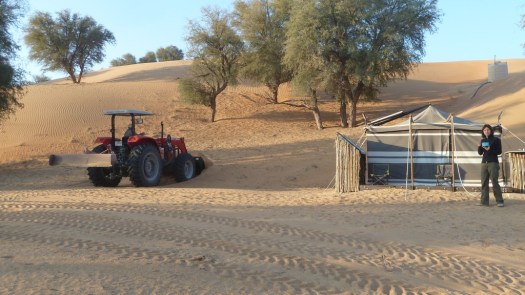
This morning the workers of the DDCR came to prepare an area for our Bedu and then they erected it in record time while we were away from camp collecting all the food for the expedition.

P1070571 (2)

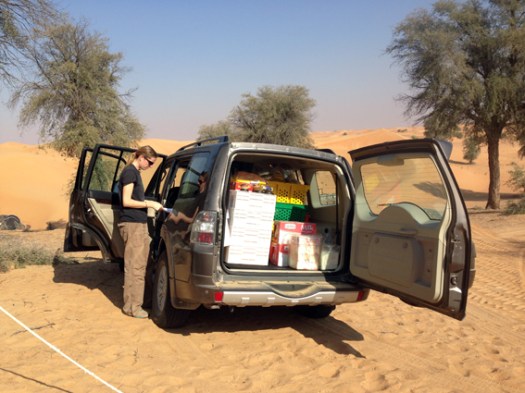
The car was so full of food I think we, like the oryx, will be well fed while we are in the reserve.

food car

This year there will be no body condition scoring of the oryx because the last survey carried out a few months ago by the local scientists showed that they are now all in good condition. Still, we will have plenty to do with the new tasks I mentioned in the last diary entry and if we get time during the expedition, we may even get a chance to fly a drone – the latest piece of equipment to arrive at the DDCR for use in their research work.

The rest of this week we will be busy preparing our equipment and datasheets and setting up camp ready for the arrival of the team on Saturday – no more lie-ins for us!

Continue reading “From our desert expedition volunteering with oryx and wildcats in Arabia (http://www.biosphere-expeditions.org/arabia)”

From our desert expedition volunteering with oryx and wildcats in Arabia (http://www.biosphere-expeditions.org/arabia)

Hello everyone, happy new year and welcome to the first diary entry for Biosphere Expeditions’ fourth Arabia expedition taking place in January 2015. My name is Kate Fox and I will be your expedition leader for this project along with Malika Fettak. We were both in Arabia almost a year ago and are very much looking forward to returning to continue with this valuable research work.

At the moment I am in West Wales (cold and windy), preparing paperwork and equipment, but next Monday I will be flying to Dubai to meet up with Malika for more preparation work in the Dubai Desert Conservation Reserve (currently 27°C and sunny).

On this expedition we will continue to survey and monitor the endangered Arabian oryx and other species in the reserve including sand fox and extremely elusive Gordon’s wildcat. Our survey techniques include setting live traps and camera traps and using GPS to navigate around the reserve by car and on foot – a good chance to burn off all those excess calories after Christmas, tramping up and down sand dunes for several hours a day! Live traps will be set up not only targeting sand foxes, but also a variety of smaller rodents since not much is known about their presence/absence in the DDCR and the behaviour of some of them. We will record everything we see, whether it is the study animals themselves or their tracks in the sand. For the first time during this expedition, we will also be darting Arabian oryx and attaching radio collars to monitor their movements. Three collars are waiting to do their job. The data delivered from the collars will help to build up a picture of their movements and behaviour, how far each herd ranges and what their preferred feeding places are.

Keep an eye out for our next diary entry from Arabia next week and in the meantime Happy New Year!

Kate

Continue reading “From our desert expedition volunteering with oryx and wildcats in Arabia (http://www.biosphere-expeditions.org/arabia)”

Update from our SCUBA diving volunteer opportunity & conservation holiday on the coral reefs of the Musandam peninsula, Oman (www.biosphere-expeditions.org/musandam)

On Wednesday, a beautiful day of surveying, punctuated by two minke whale sightings, the first was at 09:00 on our way to our first survey site. They were far from our boat, so we grabbed masks and snorkels and hopped into the speedboat for a closer look. We followed them at a safe distance for about half an hour watching them blow and dive until they disappeared into the deep.
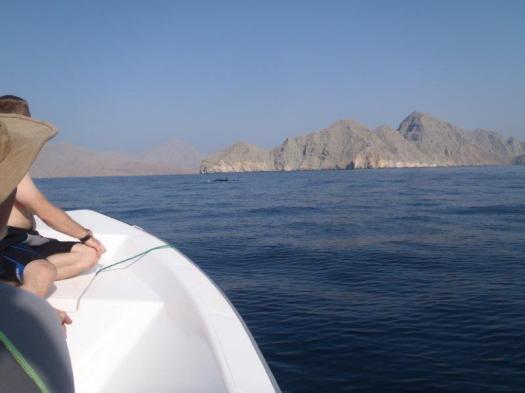
minke whale, Kriss Brandstrom

The surveys were both at Osprey Point, and by the afternoon the swell was so strong that Jean-Luc was given the nickname of Sultan of Swing in reference to the laying of the transect line. The substrate team, Catherine and Nadege, had an equally difficult time reeling it in, but although the team were bashed and tumbled by the waves, the stories were well recounted later!

The surveys on Thursday clarified our hypothesis that the further into the MPA we go, the less coral cover there was due to the environmental conditions, increased siltation, and restricted water movement. Nasser, Kristoffer and Hari went out on the speedboat and documented illegal fishing practices in the area, whilst the rest of the team entered data. The restricted water movement did, however, have a bonus feature in that huge amounts of phosphorescent phytoplankton congregated in Khor Nadj, our overnight mooring area, and with thousands of fish coming in to feed after the moon had set, we were treated to an amazing phosphorescent fish display. It was so beautiful that some of the team were tempted to join in, so donning masks and fins added to the incredible light show – a once in a lifetime experience!

exploring the MPA

Sailing into the remnants of a storm, the sky was hazy and the sea lumpy as we reached our first survey site of Friday, Paradise Point. The coral, though, was good, and the fish life abundant. The afternoon site, named Son of Gargoyle was even better, with ancient porites mounds and prolific grouper. The survey of the MPA was over (for this year at least) and we steamed round the northern tip of the peninsula accompanied by two Indian ocean humpback dolphins, who bow rode with us for a while.
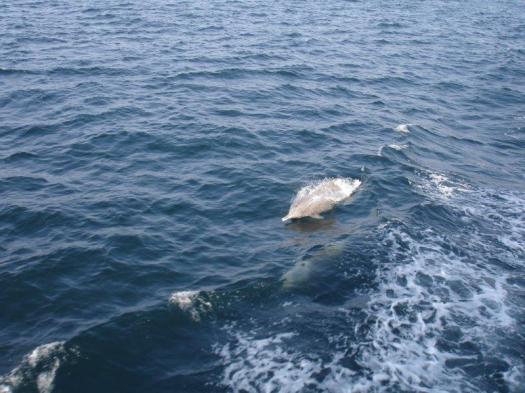
Indian ocean humpback dolphins

Back in Khumsar, as the Mosques called to prayer, we decided to set foot on dry land and visit the village nestled in the rocks with no road in or out, accessible only by boat. It was a great excursion, and gave a little insight into the lives of the local people here – a community reliant on the sea.

excursion to Khumsar

We were woken today, Saturday, at 04:00 by the waves slapping the side of the boat. Nadege, worried for her diving gear, went up on deck and rescued wetsuits and bikinis from being blown overboard. Dawn yoga was a windy affair, and breakfast was tricky with tea literally being blown out of the cups, but we made it back to Khasab, even managing to stop for a dive at Pipi Beach along the way before leaving our trusty survey vessel, the MS Sindbad, after lunch.

Another expedition over, but thank you for a wonderful week, rich in laughter and learning, new experiences and great memories – no one who saw will ever forget the sight of a terrified Hari trying to escape from an innocent turtle! We look forward to Jean-Luc’s report and are grateful for everyone’s involvement. It will be great to see how our understanding of the MPA has developed by this time next year.
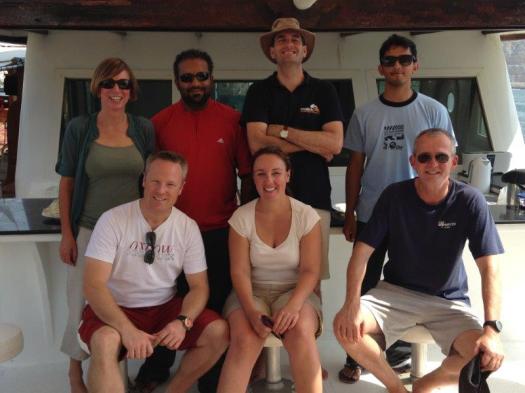
the team

Thank you to everyone who supported this project. Special thanks to the Oman Ministry of Tourism for supporting our efforts to conserve coral reefs through tourism.

logo_sultanate_of_oman

Continue reading “Update from our SCUBA diving volunteer opportunity & conservation holiday on the coral reefs of the Musandam peninsula, Oman (www.biosphere-expeditions.org/musandam)”
Update from our SCUBA diving volunteer opportunity & conservation holiday on the coral reefs of the Musandam peninsula, Oman (www.biosphere-expeditions.org/musandam)

After Saturday night in the desert (at the Dubai Desert Conservation Reserve, our Arabia project partners), we returned to Dubai on Sunday morning, collected the team and set off to the Musandam peninsula.

Surrounded by impressive sandstone mountains, our vessel – the MY Sindabad – took us to our first dive at the glorious Pipi Beach on Sunday afternoon. Dwarfed by massive coral stands, several hundered years old, the team checked out their diving kit and skills and gazed in awe at the underwater scene.

After that great introduction to the Musandam’s underwater world, the team knuckled down to some serious Reef Check training, and with 5 lectures, 2 dives and a test (with 100% pass rate – well done everyone!), the second day (Monday) of the expedition was successfully completed, and the MY Sindabad continued its journey around the peninsula.

This slideshow requires JavaScript.

Now firmly in the MPA (marine protected area) that was partly brought about by Biosphere Expeditions survey work here, we have begun to have a look around. Dive sites vary from heavily silted to abundant coral and fish life. For example, our ID test dive on Tuesday at Osprey Point (complete with osprey nest and feeding chick), was rich in diversity.

Gargoyle Cliffs was the site of our mock survey, and with a strong surge buffeting us, the team collected its first data set. It was more challenging than Nadege and Kristoffer, who were undertaking the fish survey, had imagined it would be, with hundreds of snappers to count whilst avoiding being smashed against the corals!

So, with Reef Check training completed, and a fully qualified EcoDiver team now in action, some decided to celebrate with a night dive.  Nasser and Kristoffer saw (and documented), a cuttlefish spawning – a very rare sight indeed.

This morning, after dawn yoga, and after we said goodbye to Matthias, Kathy, Liesl, Lukas and Sophie, we start our surveys proper, and will endeavour to investigate as many sites in the MPA as we can.

Continue reading “Update from our SCUBA diving volunteer opportunity & conservation holiday on the coral reefs of the Musandam peninsula, Oman (www.biosphere-expeditions.org/musandam)”

Update from our SCUBA diving volunteer opportunity & conservation holiday on the coral reefs of the Musandam peninsula, Oman (www.biosphere-expeditions.org/musandam)

Here’s a paragraph from our scientist about the forthcoming expedition:

The Marine Conservation Society (MCS) will be joining forces with Biosphere Expeditions to undertake the first Reef Check monitoring trip to the two new Musandam (northern Oman) Marine Protected Areas (MPAs) from 26 October – 1 November 2014. The two MPAs (encompassing two inlets – Khor Najd and Khor Hablain – see http://goo.gl/maps/XvZnG) were set up last year, and are detailed in our last expedition report (see www.biosphere-expeditions.org/reports). Biosphere Expeditions has been working with MCS, other regionally-based scientists and government officials over the past five years to undertake systematic surveys of local reefs. Our surveys this year will take in assessments of coral health, fish populations, and fisheries indicator species (such as the regionally important grouper) both inside and outside the new MPAs. The MPAs will restrict all forms of fishing other than handlining.

Musandam surveys 2014

Continue reading “Update from our SCUBA diving volunteer opportunity & conservation holiday on the coral reefs of the Musandam peninsula, Oman (www.biosphere-expeditions.org/musandam)”
From our SCUBA diving volunteer opportunity and conservation holiday on the coral reefs of the Musandam peninsula, Oman (www.biosphere-expeditions.org/musandam)

Hello! My name is Catherine Edsell and I will be your expedition leader in Musandam. I’ve also made a video welcome message…

I’m looking forward to meeting you in Dubai on Sunday 26th October at 09:00 in the lobby of the Holiday Inn Express Jumeirah, from where we will head out by minibus across the border to Oman. I will arrive a couple of days in advance with Jean-Luc Solandt our scientist to meet our local partners and retrieve our equipment from storage, and as soon as I get my mobile phone connected in Dubai, I will email you with my local number (to be used for emergency purposes only, such as missing assembly).

We will be joined by Dr. Matthias Hammer the executive director of Biosphere Expeditions and his family for the first few days while we are embarking on our Reef Check training. On that note, I hope all your preparations are going well and that you’ve had a chance to study all the Reef Check material info available on the website – www.biosphere-expeditions.org/checklist. Other background information you may want to look at are previous expedition reports via www.biosphere-expeditions.org/reports and a press release about the protected areas at http://goo.gl/JbTrKY.

We have a packed schedule planned, so please arrive well prepared, rested and ready to go.

Until then!

Catherine Edsell
Expedition Leader

Continue reading “From our SCUBA diving volunteer opportunity and conservation holiday on the coral reefs of the Musandam peninsula, Oman (www.biosphere-expeditions.org/musandam)”
From our scuba diving conservation holiday with whale sharks and coral reefs of the Maldives (http://www.biosphere-expeditions.org/maldives)

And here is another summary of our expedition from our scientists Dr. Jean Luc-Solandt:

Biosphere Expeditions, in collaboration with the Marine Conservation Society, Maldives Marine Research Centre and Carpe Diem had a very successful survey covering the reefs of North Male’ atoll, Maldives from 6-12 September. We trained three people (one UK, two Maldivian) to become EcoDiver trainers, and seven others to be EcoDivers. We re-surveyed sites previously visited before the ‘98 bleaching event. So in some ways we were looking at resilience since that event.

team-mv

We did patch reef, channel, and outer reef surveys near Summer Island (see map). Patch reefs were most significantly affected (e.g. Deh Giri) that was covered by corallimorphs (Discosoma) carpeting >60% of the seabed. Another (Reethi Rah), where there was a significant COT outbreak, which was concerning, particularly when coupled with the recent disease outbreaks we’ve seen in previous surveys. There also appear to be more coral-eating cushion starfish, and Drupella.

map

Outer forereef slope reefs appeared to show the greatest uniformity of good health (particularly Madi Gaa). Other more sheltered channel and patch reefs showed good coral cover (and recovery) from the 1998 bleaching event in shallow transects (< 6 m), but not for the deeper transect (most commonly at 10 m). This to me is caused by the provenance of rubble fields from the breakdown over the past 15 years of dead coral from the bleaching event, gravity pulling it down to the slightly deeper, more sheltered waters of the reef slopes. We’ve seen this pattern for years in our data now. I believe it is surprising that there aren’t more reefs that have then moved onto a different stable state (such as Deh Giri) that are dominated by opportunistic colonising lifeforms such as Discosoma. The rubble-strewn areas appear to be poor potential recruitment surfaces in the deeper waters for new corals.

Commercial fish species are worryingly absent over these North Male’ reefs. Herbivorous parrotfish were also not that common.

Continue reading “From our scuba diving conservation holiday with whale sharks and coral reefs of the Maldives (http://www.biosphere-expeditions.org/maldives)”

From our scuba diving conservation holiday with whale sharks and coral reefs of the Maldives (http://www.biosphere-expeditions.org/maldives)

Kuramathi Island Resort is running a “Clean up the world” weekend with the support of Rafil Mohammed, a Maldivian who has just been trained up to Reef Check Foundation trainer level during his recent placement on our Maldives expedition. Well done Kuramathi and Rafil. It is great to see our capacity-building efforts come to fruition so rapidly. Please keep us informed about your local efforts. This bottom up, civil society approach is just what the Maldives need.

kuramathi

Continue reading “From our scuba diving conservation holiday with whale sharks and coral reefs of the Maldives (http://www.biosphere-expeditions.org/maldives)”

From our scuba diving conservation holiday with whale sharks and coral reefs of the Maldives (http://www.biosphere-expeditions.org/maldives)

Here’s a summary of first conclusions that our scientist Jean-Luc sent to IUCN, which we thought you might all like to see:

We had a very successful survey covering the reefs of North Male’ atoll. We re-surveyed sites previously visited before the 1998 bleaching event. So in some ways we were looking at resilience since that event.

We did patch reef, channel, and outer reef surveys near summer island (see map). Patch reefs were most significantly affected (e.g. Deh Giri) that was covered by corallimorphs (Discosoma) carpeting > 60% of the seabed. Another (Reethi Rah) where there was a significant crown-of-thorns outbreak, which was rather concerning, particularly when coupled with the recent disease outbreaks we’ve seen in previous surveys. There also appear to be more coral-eating cushion starfish and Drupella. This is all apparent when put together in the RC protocols and datasets.

2014 reefcheck sites

Outer forereef slope reefs appeared to show the greatest uniformity of good health (particularly Madi Gaa). Other more sheltered channel and patch reefs showed good coral cover (and recovery) from the 1998 bleaching event in shallow transects (< 6m), but not for the deeper transect (most commonly around 10m). This to me is caused by the provenance of rubble fields from the breakdown over the past 15 years of dead coral from the bleaching event, gravity pulling it down to the slightly deeper, more sheltered waters of the reef slopes. We’ve seen this pattern for years in our data now. I believe it is surprising that there aren’t more reefs that have then moved onto a different stable state (such as Deh Giri) that are dominated by opportunistic colonising lifeforms such as Discosoma. The rubble-strewn areas appear to be poor potential recruitment surfaces in the deeper waters for new corals.

Commercial fish species are worryingly absent over these North Male’ reefs. Herbivorous parrotfish were also not that common.

If  you want, I can send you the raw data. However, we also have archived reports that put this into context from 2005 to 2013. The Biosphere reports (2011, 2012 and 2013) are on www.biosphere-expeditions.org/reports. Just scroll down the Maldives. The 2012 report details North Ari atoll bleaching recovery assessment of east, north and central Ari sites.

On the capacity-building front, we trained two Maldivians – Rafil Mohammed and Shaha Hashim – to become RC trainers. They are both Male’-based. Our longer term aim is to enable them to start some RC surveys near Male’, and with Shaha and Shameel Ibrahim (the latter from the Maldives Whale Shark Research Programme who trained to be an eco-diver this year, and next we’ll train him to become a trainer) to start some surveys, capacity-building and education down at Dhigurah. I’d very much like them to use RC methods to survey the reefs in and around the islands – either by snorkel or dive. And then to go on and use the RC method called ‘Discover RC’ to raise awareness of their work, and why the reefs are important to whale sharks, fisheries and the very bedrock of their homes.

Continue reading “From our scuba diving conservation holiday with whale sharks and coral reefs of the Maldives (http://www.biosphere-expeditions.org/maldives)”