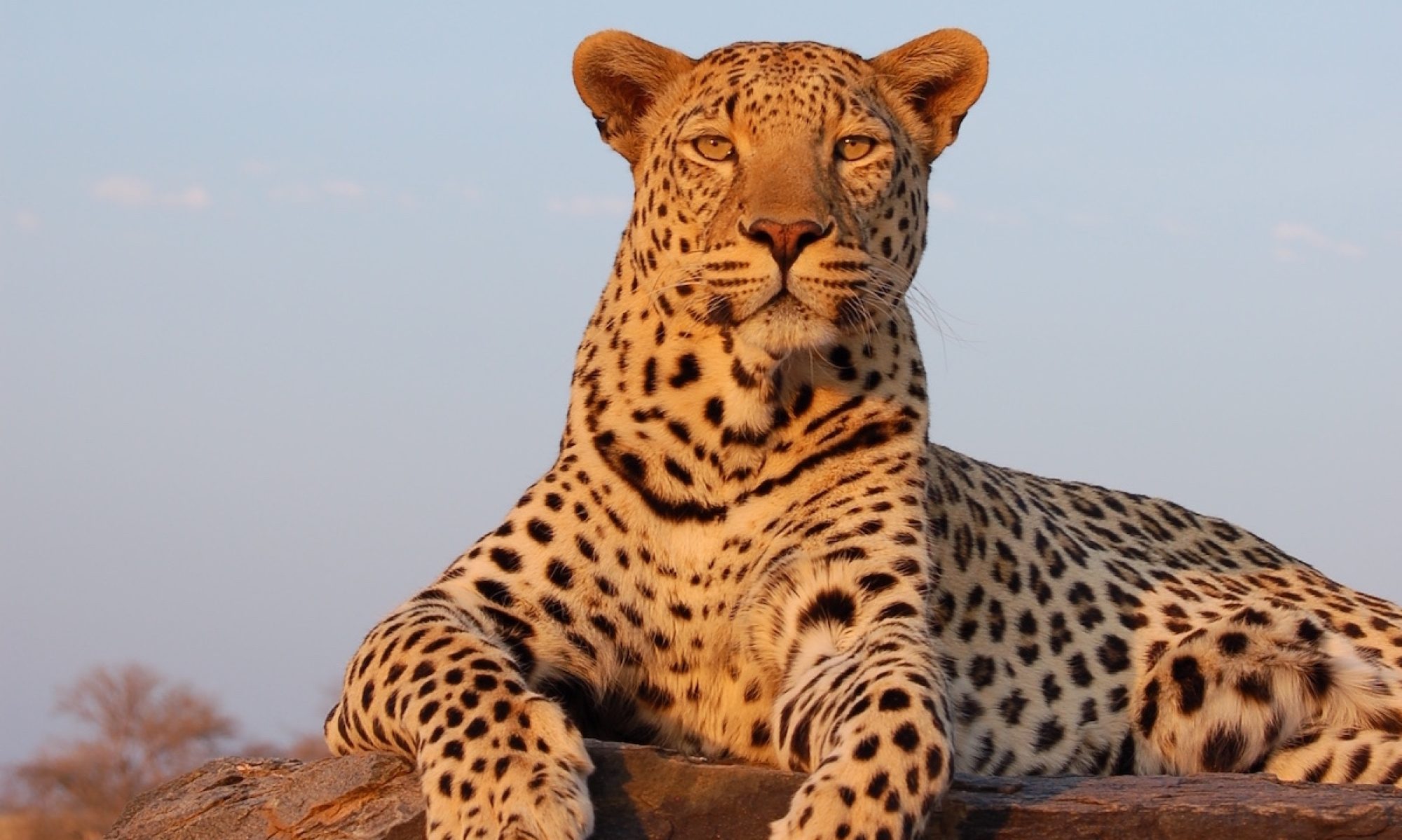
From our working holiday volunteering with leopards, caracals and Cape biodiversity in South Africa (www.biosphere-expeditions.org/southafrica)

Many of us come on a Biosphere Expeditions project with a desire to contribute to field science and conservation. But we also come on expeditions for many other reasons and with different expectations – perhaps to meet new people, experience new places or see wildlife.

The first two often begin to be realised, as soon as you arrive on the expedition site. But the latter takes time and effort and often it is too easy to focus on this at the expense of immersing yourself in the expedition experience as a whole.

Here in the fynbos, we have all been fortunate enough to experience and document new species to each of us, whether, they be grysbok, sengi (elephant shrew), black harrier or some of the many flowering species. They may not always have been what we all hoped for, or expected, but nevertheless they offer something new – new data and new experiences. But this project has given us more; the opportunity to remove our biological blinkers and appreciate the wider setting at Blue Hill.

Our field work, in the form of flush transect surveys and mammal trapping, has allowed us to appreciate the landscape and begin to marvel at the millions of years of geological history beneath our every step – gratefully aided by a presentation from Chris Lee (Alan’s Dad) who is a professional geologist.

This also helps give perspective on the historic people of this land, through the observation of ancient rock art, which seems to adorn every cave wall or rock overhang – showing people, antelopes and big cats. Leading us to speculate as to who was here thousands of years before us, and how they interacted with the wildlife?

And sometimes these differing interests collide. As an aside to our main work, we’ve been deploying a bat detector in the evenings, which has detected, amongst others, the endemic Cape horseshoe bat – a species which is becoming rarer. Alan, knew of a cave roost, but not which species inhabited it – cue a mini expedition to the cave. Whilst we could confirm the presence of horseshoe bats, the use of high power spotlights also revealed more cave art, not seemingly visible in daylight; and not previously known to Alan.

In just a few moments, we had learnt more about the Blue Hill area than any of us expected. But also realised there was so much more to learn.

And at the end of each day, you hopefully get to appreciate the nocturnal landscape. To me, the African night sky is synonymous with stars. Many of us are not always fortunate enough to experience them with such vibrant clarity….and yet here we can ponder on what we still have yet to experience or learn and perhaps dream up where we should next explore…

This slideshow requires JavaScript.


From our working holiday volunteering with leopards, caracals and Cape biodiversity in South Africa.

From our working holiday volunteering with leopards, caracals and Cape biodiversity in South Africa (www.biosphere-expeditions.org/southafrica)

The fynbos is famed for its wildflowers in all their diversity and beauty. There is no doubting we are working in a Floral Kingdom – the Cape Floral Kingdom to be precise.

It is easy to obsess about charismatic species at the expense of others and whilst we may not exactly be tripping over leopards, caracals, kudus or klipspringers, we are surrounded by a wildflower wonderland. And once you start looking at them, I mean really looking in detail, they reveal all manner of shapes, sizes and colours.

In many respects, flowers power the fynbos. Several small mammals (the subject of our trapping studies) are reliant on protea flowers for food. Many species of butterfly, moth and horseflies are specialised for extracting nectar from tubular flowers and at the same time perform a pollination role. While orange-breasted sunbirds and Cape sugarbirds, which are endemic to the fynbos, not only act as pollinators, but the latter relies on proteas and pincushions for food and shelter. All of this is vital as it underpins the charismatic species that we seek.

Once you stop to look at the flowers and your immediate environment, you begin to discover a variety of other species, whether they are birds, insects or amphibians, and interactions between them. An eye for such detail is a great asset for field work.

Such an approach, lead one of our volunteers (Marty), to discover an active nest of the Cape rockjumper – another bird species endemic to the fynbos. This species also forms part of Dr. Alan Lee’s (our project scientist) ongoing studies. The nest had three eggs, which hatched the next day – the first time both have been recorded. And this is only the fourth active nest to be recorded at Blue Hill. All important data.

Camera traps have now been set around the nest to record the chick development, resource provisioning by the parent birds and any nest predation. Time and imagery will advance our knowledge.

It is amazing what you can learn by just looking at the immediate world around you. For all the technology that could be deployed, to record a host of environmental parameters and species movements, there is still no substitute to spending time in the ‘field’, simply observing.

This slideshow requires JavaScript.


From our working holiday volunteering with leopards, caracals and Cape biodiversity in South Africa.

From our working holiday volunteering with leopards, caracals and Cape biodiversity in South Africa (www.biosphere-expeditions.org/southafrica)

We are here to find predators, as the title of this project may suggest – ‘Carnivores of the Cape Floral Kingdom’. Trying to track down leopards, caracals and even wild cats, would normally involve a combination of hard work, patience and luck.

So no easy task; and only the ‘lucky’ will encounter them face to face. However, we have technology on our side, in the form of camera traps. These clever boxes can be deployed to a range of locations and left to merrily take images of whatever happens to walk by them. That way, we can have ‘eyes’ in the field in multiple locations, over a huge area and every hour of the day or night.

One of the jobs of the team has been to deploy yet more camera traps to add to the existing network, collect in others, and begin to analyse several thousand photos already taken. This digital imagery is a gold mine of data.

Once species in images have been identified, and hopefully sexed and aged, we begin to open a new window on the fynbos world. We can begin to deduce what species occur where, their relative numbers and how this changes over time. A large catalogue of images can enable us to deduce patterns of activity over 24 hour periods, and distributions over wider spatial and temporal scales.

Our team have already analysed over 2500 images in the first few days. All providing vital data and insight into the ecology of this unique environment. Yes, the cameras have recorded many of our target species, including grysbok, rhebok and duiker, but they have also revealed lesser known species such as aardvark, honey badger and porcupine.

And one of the recently collected cameras has already documented one of our target predators – African wildcat, whilst we’ve been on expedition. Our knowledge will only advance as we capture and process more images between now and the end of the expedition.

Camera traps are a great tool for conservation, but there is still no escaping the need for fieldwork (fortunately), and the need for hard work, patience and luck.

This slideshow requires JavaScript.


From our working holiday volunteering with leopards, caracals and Cape biodiversity in South Africa.

From our working holiday volunteering with leopards, caracals and Cape biodiversity in South Africa (www.biosphere-expeditions.org/southafrica)

Let the science commence! With the training completed on the various methods, our surveys could begin for real. For the next few days we’ll be ‘hunting’ high and low to find the mammal fauna of the of the fynbos.

The first job of the day is always the leopard trap – a large cage trap, which will hopefully tell us which of the cat species is moving through the local area. But we’ll also get some interesting by-catc, and the last couple of mornings we have trapped grysbok – a small antelope almost entirely restricted to the fynbos vegetation. All are released to continue on their way.

Our day yesterday then continued with flush surveys. Basically a large transect survey, with multiple people, whereby we can document the mammal and birdlife in a specific area. Our first survey was in the Welbedacht section of Baviaanskloof. It also gave the team an opportunity to deploy a few more camera traps to hopefully catch the elusive and wide-ranging leopard.

Whilst the science went to plan, the transportation was a different matter. Our local ranger, Eksteen decided that he and Christine would take the vehicle to meet us at an entirely different point to one agreed with our scientist, Alan. The upshot meant a long walk out of the survey area and a late lunch. Though we took the opportunity to drive through the Nuwekloof pass – a stunning rock canyon where stumbled across two leopard tortoises in a rather noisy embrace!

In addition to getting the flush surveys underway, we also now have 50 Sherman traps deployed with half of them up the now infamous protea slope. Locating the pre-marked trapping points in head height protea bushes is certainly a challenge – think needle in a haystack on a 40 degree slope. But as with much scientific survey work, hard graft usually pays off. We’ve already been rewarded with several captures, including a species not on our provisional list, though we await confirmation.

This slideshow requires JavaScript.


From our working holiday volunteering with leopards, caracals and Cape biodiversity in South Africa.

From our working holiday volunteering with leopards, caracals and Cape biodiversity in South Africa (www.biosphere-expeditions.org/southafrica)

The first volunteers of the inaugural ‘Carnivores of the Cape Floral Kingdom’ expedition all arrived on Sunday with only a minor glitch of getting one vehicle stuck just a couple of miles from the expedition base. Welcome to expedition life!

With initial introductions, risks assessments and briefings completed by Sunday afternoon, we stretched our legs with a brief orientation walk around Blue Hill Nature Reserve – our base for the next 12 days. We passed by (and checked) the leopard trap, which will form a key part of the survey work, and enjoyed some of the local wildlife whilst on route. Sightings included klipspringer, jackal buzzards and an ancient relative of the elephant – the dassie or rock hyrax. This was followed by another orientation walk up a ridge behind our base. The climb rewards you not only with a great view over the fynbos landscape, but also with a mobile phone signal. I have a feeling the path will be well–trodden by some!

Rested and recuperated from Sunday’s travel and briefing exertions, the science training than began in earnest on Monday, with camera trapping analysis and mammal ID work. Practical session came in the form of off-road 4WD training. Our three transport options on the project are either by foot, by 4WD or by mountain bike. All vehicles and drivers returned to base in one piece. So far there have been no riders.

With equipment briefings completed and after-dinner lectures from our project scientist (Dr. Alan Lee) digested, we put things into action on Tuesday. The sunrise activity of trap checking yielded a klipspringer in the trap, which was promptly released. Unfortunately it broke a horn in the box trap, something that happens very rarely, but did this time. Alan was worried, but the klipspringer seems to have been fine. Later in the morning we practised setting 50 small mammal traps in a big group. It took us about three hours, so a couple of people should manage in an afternoon, especially because we have already marked and recorded the fifty locations now, covering a big rectangle of 250 x 1000 m. In the afternoon we conducted our first ‘flush survey’ in a group of seven walking all abreast and 2 m apart, recording vegetation and any animals that are disturbed and ‘flushed’ out of the undergrowth. Christine, who had twisted her ankle just before the expedition, and her husband Prasadu stayed back to go through camera trap pictures collected by Alan in the past. This will be another key activity where we can help Alan do things that he would not be able to do without willing volunteers, in this case because he simply lacks the time to go through 3000-odd camera trap photographs. But split over two weeks amongst seven volunteers working in shifting pairs this task become manageable and the end result, Alan hopes, will be a peer-reviewed scientific publication on “temporal patterns of abundance of medium to large-size mammals from camera trap records” (that already sounds very scientific, doesn’t it ;).

This slideshow requires JavaScript.


From our working holiday volunteering with leopards, caracals and Cape biodiversity in South Africa.

From our working holiday volunteering with leopards, caracals and Cape biodiversity in South Africa (www.biosphere-expeditions.org/southafrica)

Hello and welcome to the South Africa expedition diary. I am Craig Turner your expedition leader and I am writing this on board the flight to Johannesburg. I am due to land in an hour or so and will then meet up with Matthias Hammer, Biosphere Expeditons’ executive director (who will be joining us for the first few days), to fly onto George and eventually Blue Hill by car. We should be there tonight and once we have settled in, I will be in touch again with details of our plans for the expedition, weather updates, emergency conctact details, etc.

I hope your preparations are going well. Safe travels and I look forward to meeting you in due course.

Craig Turner
Expedition leader


From our working holiday volunteering with leopards, caracals and Cape biodiversity in South Africa.

From our working holiday volunteering with leopards, elephants and cheetahs in Namibia, Africa (http://www.biosphere-expeditions.org/namibia)

I received a couple of emails from previous team members asking to show pictures of what rain looks like here and I have attached them. (Evidently they did not believe me that it actually does rain here in November!)

Wednesday Stuart, Sandra and Markus signed up for the all day camera trap team. They kept stumm about it all day, yet at briefing they practically burst with the news: they’d seen a leopard running away from them up in the mountains. Quite a lucky team!

Thursday was our vehicle game count, the last of the season with Biosphere Expedition. It was a terrific way to finish off the expedition – all three teams seeing record numbers of animals and getting to spend one last beautiful morning driving on Okambara. In the afternoon the team helped pack up the expedition – each year the first and last teams have the privilege of unpacking and packing the expedition kit and storing it until the next season.

I’ve also attached a picture of all the groups’ elephants sightings in 2014.

Team 6 has now left the farm, and that wraps up our Namibia expedition for 2014. A huge thank you to everyone who volunteered this year. It was great to meet you all and work alongside you. Your hard work, flexibility, willingness to get dirty and be Vera’s “arms and legs and feet” on Okambara has been immensely helpful. Thanks to you we captured three leopards this year and collared two. Vera’s scientific report on the 2014 expedition will be published in a few months.

Best wishes

Alisa Clickenger
Expedition leader

This slideshow requires JavaScript.

Continue reading “From our working holiday volunteering with leopards, elephants and cheetahs in Namibia, Africa (http://www.biosphere-expeditions.org/namibia)”

From our working holiday volunteering with leopards, elephants and cheetahs in Namibia, Africa (http://www.biosphere-expeditions.org/namibia)

One of the things I love about working in Namibia is that when you start your day, you never know how it’s going to end. Sunday I got wet walking to briefing, something that has never happened to me before here in Namibia because normally we work in the dry spring/summer season. Tuesday night I drifted off to sleep to the deafening sound of all the frogs that had come out to call for mates with the rains.

Saturday was the day off and the teams volunteered to check the box traps. Unfortunately they were all empty. Sunday morning Stuart, Markus, Heidi, Sabine and Karen all helped Vera move the box trap from Frankposten up to Bergposten. We placed the trap where Team 4 had installed one, simply called Bergposten 2. Team 6 was hyper organised and had the trap out of the ditch and up on the track waiting for the truck when Vera arrived. They were back to camp in record time, thanks to said organisation plus the previous work Team 4 did cutting shrubs.

The elephant team did not find the elephants on Monday, but the box trap team did on their way back from the lodge, so we know they are still on the farm 😉 The lead cow’s VHF collar is barely giving a signal – very often we have to be within 300 metres or less to pick up any beeps at all.

Monday Markus and Sandra changed the trap meat in the morning, and Stuart, Christaine and Sabine changed it in the afternoon. Rough work in the afternoon for our resident vegetarians when the intestines we started using in the morning to lay a scent trail to our box traps had become fully ripe in the morning and afternoon sun.

Because of the rains all waterhole teams are reporting seeing very few animals. Tuesday we figured out why: we saw lots of puddles of water around the farm, so the animals do not have to go to the water holes where they are extremely vulnerable. Rather, they can grab a drink along the way and not have to congregate in the “danger zone”. Our territorial sable bull doesn’t seem to consider the bush camp water hole a threat, however…

_G8Q8628 IMG_6181 IMG_6191 IMG_6229

_G8Q8603

Continue reading “From our working holiday volunteering with leopards, elephants and cheetahs in Namibia, Africa (http://www.biosphere-expeditions.org/namibia)”

From our working holiday volunteering with leopards, elephants and cheetahs in Namibia, Africa (http://www.biosphere-expeditions.org/namibia)

Team 6 brought the rain. Not the average almost-evaporates-before-touching-the-ground-rain, but full-on rain. With thunder, lightning and the whole shebang. With nine of the team members out at the 4WD training, we sought shelter under the roof at the scientists’ compound. They have a metal roof in their lapa and it was spectacular. Back at bush camp, merely 6 kms away, Heidi had been out checking box traps with Ligeus and wondered what all the fuss was about because no rain fell there. Such are the vagaries in the non-rainy season in Namibia.

Team 6 also brought the rhinos, two of them at their first dinner here in camp. The rhino pals were so comfortable near us, they laid down for a while, so we got a really nice front-row encounter in the comfort of our own home.

Monday was our box trap training up at the CS House box trap, and afterwards we split into three groups to check all the traps. Markus, Astrid and Christiane came with me and got the grand tour of the farm on the first day, because we were responsible for checking the Lodge trap (where we found hyaena prints walking just beside the trap) and the Mountain trap (where I forgot there is a camera trap so there will be nice pictures of my lower legs for the next data entry team to see).

This slideshow requires JavaScript.

Today, Wednesday, the teams are working independently and enjoying the fruits of their two days of training. First order of business is changing the meat in the box traps, so it will be interesting to hear at tonight’s briefing how they’ve combined all their navigational, equipment, box trap and data sheet training for a successful day in the field. Most volunteers comment on how they cannot believe that after two days of training that we let them loose to work on their own in the field. Yes, we trust them. All the volunteers are so important, because we’re able to do so much more work all over the farm.

This morning the elephants gave Markus, Astrid, Christiane, Karen and I a merry chase. We searched for 4+ hours with no luck. We did telemetry in the north, south, east and west, and not a single beep. Yes, we even had fresh batteries in the telemetry receiver. Christiane and Markus even climbed up the Boma treehouse to have a listen. Well, no data are still data, so we have to record those as well.

On the way back from searching for the elephants, our team came across a large group of giraffe. Take a close look at the horns on the wee one. You’ll notice that they are crooked. That’s because when giraffes are born their nubs aren’t yet connected to their heads. Over time they grow and adhere to the animal’s head, becoming fully fused at 4-4.5 years (~7 years in females). But at birth they are loose and lie flat so they’ll ease through the birth canal.

Continue reading “From our working holiday volunteering with leopards, elephants and cheetahs in Namibia, Africa (http://www.biosphere-expeditions.org/namibia)”

From our working holiday volunteering with leopards, elephants and cheetahs in Namibia, Africa (http://www.biosphere-expeditions.org/namibia)

Thursday was our weekly vehicle game count. What a difference a week can make. Last week we were frozen solid on the backs of the trucks and counting game like crazy, and this week the weather was much warmer and the animal counts much less. The mountain team consisting of Mark, Helen, Uli and Ashley didn’t see much game on the game count, but they did see a lot of tracks. In fact, one track they followed led them straight to out box trap! There the leopard put on paw in the trap, then proving how very clever they are decided it was a bad idea and stepped out again without activating the trap. We can’t wait to see what leopard it was when we view the camera trap pictures!

Elephant observation teams were extremely unlucky after the first encounter. We scoured the farm for four days never finding them, getting random beeps but never seeing them. Finally on day 5 we went out and found followed their signal (and them) to the Sandposten waterhole. We had a lovely encounter for more than an hour, unfortunately never observing any feeding behaviour because they were so absorbed in the water. What was very interesting to all of us was how they chased off the cows: they blow water at them!

elephants

Vera’s game count team of Mara, Paul, Emma and Bruce didn’t see much game at all according to Helen and Uli doing data entry to my right, but they reported seeing the rhinos on the way back home. My team of Louize, Di, Vibeke and John on the east side of the farm didn’t see the bat eared foxes this week, but we did see a plentiful amount of the beautiful and delicate Steenbok. (Our data sheets were so full we didn’t want to brag that we also saw the rhino family group plus the big male.) We also counted among our animals a sable antelope.

evening light

The rest of the week’s activities hummed along swimmingly well. The teams worked hard even though it has been quite hot these past two weeks. We’ve changed around the activities a bit so that we’re doing the more sedentary activities in the afternoons, but for some activities like box traps and changing the bait meat in the traps, it’s just a hot, sweaty, smelly business no matter what time of day you do it.

team 5

A hearty thanks goes out to all the Team 5 volunteers. We wish you safe travels home.

Team 6? See you at the Josephine Gate on Sunday!

Continue reading “From our working holiday volunteering with leopards, elephants and cheetahs in Namibia, Africa (http://www.biosphere-expeditions.org/namibia)”