From our scuba diving conservation holiday with whale sharks and coral reefs of the Maldives (http://www.biosphere-expeditions.org/maldives)


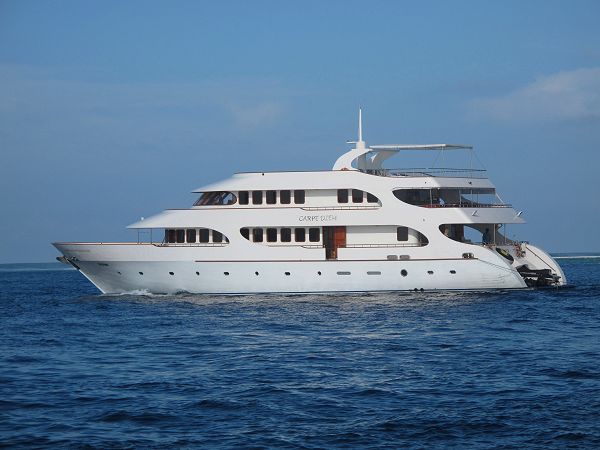
With all team members present and correct, we made our way to the Carpe Diem, our magnificent research vessel.

Boat 2010 (1)

Ours is a busy schedule, so without further ado, briefings were given and the Reef Check programme initiated, whilst we cruised to our training site at Baros to complete our first dive.

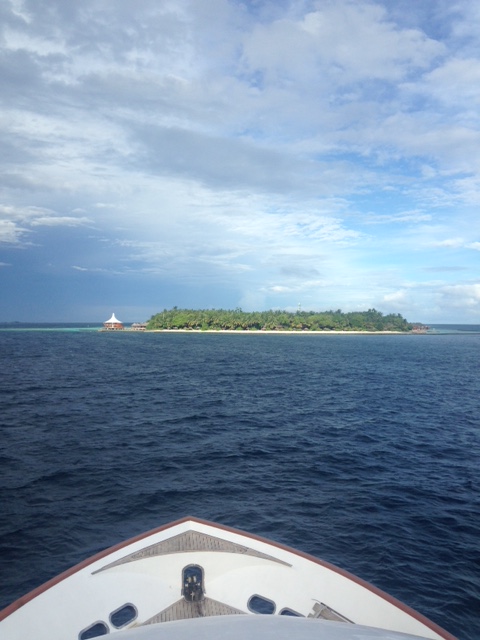
Baros, as with many islands in the Maldives, is a resort island and boasts well-kempt house reefs complete with megafauna.

baros from carpe diem

Though here, unlike many of the resorts, Reef Check training is offered to their guests. Ronny and Karin, the managers of the Baros Dive Centre, uphold the ethos of Reef Check and fully understand the benefits of long-term monitoring. Sadly, this is all-too uncommon around the Maldives, a country which depends on reefs for everything from its existence to substanance to tourist income.

The team had a great first dive and for some, who hadn’t dived in a while, it was a chance to become reacquainted with the ocean – some even saw their first shark, a white tip that moved silently through the group and off into the blue.

Rob Byron

Tomorrow the pressure is on with training lectures and dives all day, and the first test tomorrow evening!  Now though, it’s been a long day, so time for a good night’s rest.

Continue reading “From our scuba diving conservation holiday with whale sharks and coral reefs of the Maldives (http://www.biosphere-expeditions.org/maldives)”

From our scuba diving conservation holiday with whale sharks and coral reefs of the Maldives (http://www.biosphere-expeditions.org/maldives)

I’ve arrived in Male’ – descending through stacks of cumulonimbus to be greeted by spectacular sights of atolls framed by a turquoise sea. It’s hot and sunny –  30 degrees celsius in the shade, but the forecast shows a front on the way, so we may meet some cooling showers during the week.

Shidha and I have met, shared our expectations for the expedition and discussed the week’s programme – she is familiar with the route we are taking and looking forward to training you, as am I.

Shidha and Catherine

I have a Maldivian phone number now – (+960) 768 3387, so if you need to contact me in an emergency this is the number to call.

Wishing you all a safe journey, and see you tomorrow at 11.00 at the Coffee Club

Catherine

Continue reading “From our scuba diving conservation holiday with whale sharks and coral reefs of the Maldives (http://www.biosphere-expeditions.org/maldives)”

From our scuba diving conservation holiday with whale sharks and coral reefs of the Maldives (http://www.biosphere-expeditions.org/maldives)

Biosphere Expeditions 2015 reef survey of the Maldives is on ‘bleaching alert’

In 1998 there was a significant global El Niño event that virtually stopped water circulation in the Pacific and Indian Oceans, resulting in floods in west, north and south American arid regions, and drought in the Australian and New Guinea rainforests, eventually resulting in forest fires. It upset the Asian subcontinent monsoons and led to crop failures and food shortages in the tropical nations of the world.

In the ocean, the ‘blocking’ of the equatorial oceanic gyre of currents led to significant warming of the shallow seas of the tropics, failure of the anchovy fishery of Peru, and the death of many coral reefs. The Maldives reefs suffered at least 90% coral mortality, because a lens of hot water, about 3-5 degrees (Celcius) above the usual maximum (that is 30-31 degrees Celsius) lay over the reefs of the country for four weeks. This stressed the corals and led to significant ‘bleaching’. Bleaching is a process where stress to the corals results in them expelling their colourful symbiotic algae (called zooxanthaellae), thus going pure white and exposing their calcium carbonate skeletons. It is often the initial cause of death to the corals as the symbiotic algae give up to 80% of the energy to the corals from the sugars they produce by photosynthesis. Corals can survive initial bleaching, but only if the hot water stays over the corals for a short period, or at a lower temperature. In these circumstances, corals can reabsorb zooxanthellae into their tissues from the water column. However, the 1998 Maldives bleaching event was so severe, that it killed most corals outright. The recovery of the reefs has been from juvenile corals settling on the dead coral reefs, and re-growing.

Biosphere Expeditions has in collaboration with the Marine Conservation Society (MCS) has been doing four things since 2011:

1. Monitoring the recovery of the 1998 bleaching event at reefs that were first surveyed before the event, in order to see the amount of live coral that now exists at shallow depths.

2. Re-surveying sites first visited by MCS in 2005, such that we have indications of reef health, fish populations, and any large megafauna such as whale shark, manta rays, turtles, large fish and reef sharks. We recorded a ‘new’ whaleshark in 2011.

3. Training, via Biosphere Expeditions’ placement programme http://www.biosphere-expeditions.org/placements, of local Maldivians from government and civil society to monitor their own reefs and providing training and funding, courtesy of LaMer and the Rufford Foundation, for exceptional individuals to become Reef Check trainers themselves. These individuals trained up three local Reef Check teams since 2014 and undertook the first ever all-Maldivian Reef Check survey in November last year.

4. We have published four technical reports on the condition of the reefs since 2011.

This and last year are also El Niño years, where the east–west surface current movements of water across the planet’s equator is stalling and stopping. This results in the sun heating up surface waters in some locations, such that bleaching events have occurred. They have occurred in the tropical west pacific, Hawaii, French Polynesia, and to a lesser extent, the Maldives. Northerly Indian Ocean reefs (around the Arabian Gulf, Thaliand and Andoman and Nicobar Islands) appeared to have had the brunt of the hot water, but the Maldives remains on high alert, as this El Niño event is not over yet, and indeed could strengthen.

This year’s expedition is therefore ‘highly tuned’ to looking for bleaching events in the Maldives, or evidence of recent bleaching events (where the whitened corals start to be overgrown by algae). We are re-visiting sites we first surveyed in 2005 and four other sites that have been regularly monitored (once every two years) since 2011, going down the beautiful Ari Atoll from north to south. We have a survey team of eleven individuals, two trainers – one British and one Maldivian – and nine trainees (including two Maldivian placement recipients). The two placements are from the local NGO ‘The Maldives Whaleshark Research Programme’ and a local marine consultancy. The trainers on the expedition have both been trained by Dr Jean-Luc Solandt of the Marine Conservation Society, a Reef Check Course Director and the national coordinator of Reef Check for the Maldives.

Continue reading “From our scuba diving conservation holiday with whale sharks and coral reefs of the Maldives (http://www.biosphere-expeditions.org/maldives)”

From our scuba diving conservation holiday with whale sharks and coral reefs of the Maldives (http://www.biosphere-expeditions.org/maldives)

My name is Catherine Edsell and I will be your expedition leader for this years Maldives expedition. Coral reef conservation is one of my passions and I led the Maldives expedition in 2014, so look forward to continuing our ongoing research with you. As you are aware, Dr. Jean-Luc Solandt is unable to join us due to personal reasons, but Mariyam Shidha Afzal, formerly from the Marine Research Centre of the Maldives, a marine biologist and experienced Reef Check Trainer will be taking his place, giving us the added benefit of her local knowledge.

I’m very much looking forward to meeting you in Male on Saturday, 12 September at 11:00 at the NEW meeting point in front of the Coffee Club at Maldives Airport. I will be arriving in Male on 10 September and as soon as I get my mobile phone set up, will email you my Maldivian phone number (to be used for emergency purposes only, such as missing assembly).

Our survey route for the week is below

I hope all your preparations are going well and that you’ve had a chance to study all the Reef Check material and whale shark info available on the website as this will not only save you revision time on board, but also stand you in good stead for a fruitful expedition. We have a packed schedule planned, so please arrive rested and ready to go.

Until then!

Catherine Edsell
Expedition Leader

Continue reading “From our scuba diving conservation holiday with whale sharks and coral reefs of the Maldives (http://www.biosphere-expeditions.org/maldives)”

Update from our SCUBA diving volunteer opportunity & conservation holiday on the coral reefs of the Musandam peninsula, Oman (www.biosphere-expeditions.org/musandam)

On Wednesday, a beautiful day of surveying, punctuated by two minke whale sightings, the first was at 09:00 on our way to our first survey site. They were far from our boat, so we grabbed masks and snorkels and hopped into the speedboat for a closer look. We followed them at a safe distance for about half an hour watching them blow and dive until they disappeared into the deep.
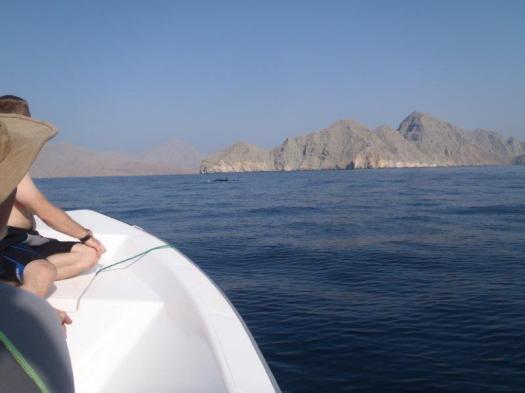
minke whale, Kriss Brandstrom

The surveys were both at Osprey Point, and by the afternoon the swell was so strong that Jean-Luc was given the nickname of Sultan of Swing in reference to the laying of the transect line. The substrate team, Catherine and Nadege, had an equally difficult time reeling it in, but although the team were bashed and tumbled by the waves, the stories were well recounted later!

The surveys on Thursday clarified our hypothesis that the further into the MPA we go, the less coral cover there was due to the environmental conditions, increased siltation, and restricted water movement. Nasser, Kristoffer and Hari went out on the speedboat and documented illegal fishing practices in the area, whilst the rest of the team entered data. The restricted water movement did, however, have a bonus feature in that huge amounts of phosphorescent phytoplankton congregated in Khor Nadj, our overnight mooring area, and with thousands of fish coming in to feed after the moon had set, we were treated to an amazing phosphorescent fish display. It was so beautiful that some of the team were tempted to join in, so donning masks and fins added to the incredible light show – a once in a lifetime experience!

exploring the MPA

Sailing into the remnants of a storm, the sky was hazy and the sea lumpy as we reached our first survey site of Friday, Paradise Point. The coral, though, was good, and the fish life abundant. The afternoon site, named Son of Gargoyle was even better, with ancient porites mounds and prolific grouper. The survey of the MPA was over (for this year at least) and we steamed round the northern tip of the peninsula accompanied by two Indian ocean humpback dolphins, who bow rode with us for a while.
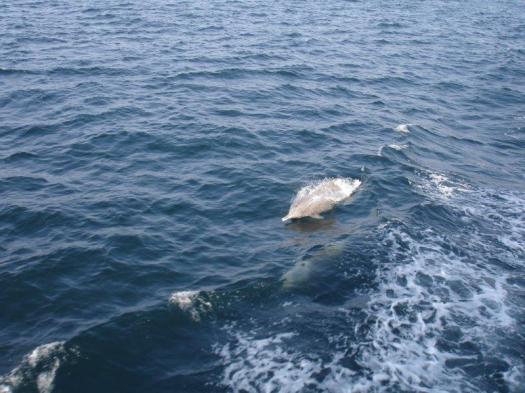
Indian ocean humpback dolphins

Back in Khumsar, as the Mosques called to prayer, we decided to set foot on dry land and visit the village nestled in the rocks with no road in or out, accessible only by boat. It was a great excursion, and gave a little insight into the lives of the local people here – a community reliant on the sea.

excursion to Khumsar

We were woken today, Saturday, at 04:00 by the waves slapping the side of the boat. Nadege, worried for her diving gear, went up on deck and rescued wetsuits and bikinis from being blown overboard. Dawn yoga was a windy affair, and breakfast was tricky with tea literally being blown out of the cups, but we made it back to Khasab, even managing to stop for a dive at Pipi Beach along the way before leaving our trusty survey vessel, the MS Sindbad, after lunch.

Another expedition over, but thank you for a wonderful week, rich in laughter and learning, new experiences and great memories – no one who saw will ever forget the sight of a terrified Hari trying to escape from an innocent turtle! We look forward to Jean-Luc’s report and are grateful for everyone’s involvement. It will be great to see how our understanding of the MPA has developed by this time next year.
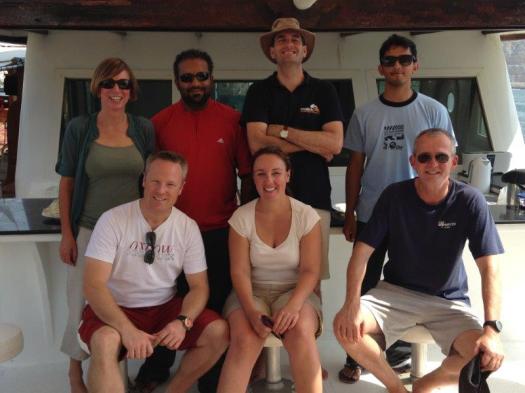
the team

Thank you to everyone who supported this project. Special thanks to the Oman Ministry of Tourism for supporting our efforts to conserve coral reefs through tourism.

logo_sultanate_of_oman

Continue reading “Update from our SCUBA diving volunteer opportunity & conservation holiday on the coral reefs of the Musandam peninsula, Oman (www.biosphere-expeditions.org/musandam)”
Update from our SCUBA diving volunteer opportunity & conservation holiday on the coral reefs of the Musandam peninsula, Oman (www.biosphere-expeditions.org/musandam)

After Saturday night in the desert (at the Dubai Desert Conservation Reserve, our Arabia project partners), we returned to Dubai on Sunday morning, collected the team and set off to the Musandam peninsula.

Surrounded by impressive sandstone mountains, our vessel – the MY Sindabad – took us to our first dive at the glorious Pipi Beach on Sunday afternoon. Dwarfed by massive coral stands, several hundered years old, the team checked out their diving kit and skills and gazed in awe at the underwater scene.

After that great introduction to the Musandam’s underwater world, the team knuckled down to some serious Reef Check training, and with 5 lectures, 2 dives and a test (with 100% pass rate – well done everyone!), the second day (Monday) of the expedition was successfully completed, and the MY Sindabad continued its journey around the peninsula.

This slideshow requires JavaScript.

Now firmly in the MPA (marine protected area) that was partly brought about by Biosphere Expeditions survey work here, we have begun to have a look around. Dive sites vary from heavily silted to abundant coral and fish life. For example, our ID test dive on Tuesday at Osprey Point (complete with osprey nest and feeding chick), was rich in diversity.

Gargoyle Cliffs was the site of our mock survey, and with a strong surge buffeting us, the team collected its first data set. It was more challenging than Nadege and Kristoffer, who were undertaking the fish survey, had imagined it would be, with hundreds of snappers to count whilst avoiding being smashed against the corals!

So, with Reef Check training completed, and a fully qualified EcoDiver team now in action, some decided to celebrate with a night dive.  Nasser and Kristoffer saw (and documented), a cuttlefish spawning – a very rare sight indeed.

This morning, after dawn yoga, and after we said goodbye to Matthias, Kathy, Liesl, Lukas and Sophie, we start our surveys proper, and will endeavour to investigate as many sites in the MPA as we can.

Continue reading “Update from our SCUBA diving volunteer opportunity & conservation holiday on the coral reefs of the Musandam peninsula, Oman (www.biosphere-expeditions.org/musandam)”
Update from our SCUBA diving volunteer opportunity & conservation holiday on the coral reefs of the Musandam peninsula, Oman (www.biosphere-expeditions.org/musandam)

Here’s a paragraph from our scientist about the forthcoming expedition:

The Marine Conservation Society (MCS) will be joining forces with Biosphere Expeditions to undertake the first Reef Check monitoring trip to the two new Musandam (northern Oman) Marine Protected Areas (MPAs) from 26 October – 1 November 2014. The two MPAs (encompassing two inlets – Khor Najd and Khor Hablain – see http://goo.gl/maps/XvZnG) were set up last year, and are detailed in our last expedition report (see www.biosphere-expeditions.org/reports). Biosphere Expeditions has been working with MCS, other regionally-based scientists and government officials over the past five years to undertake systematic surveys of local reefs. Our surveys this year will take in assessments of coral health, fish populations, and fisheries indicator species (such as the regionally important grouper) both inside and outside the new MPAs. The MPAs will restrict all forms of fishing other than handlining.

Musandam surveys 2014

Continue reading “Update from our SCUBA diving volunteer opportunity & conservation holiday on the coral reefs of the Musandam peninsula, Oman (www.biosphere-expeditions.org/musandam)”
From our SCUBA diving volunteer opportunity and conservation holiday on the coral reefs of the Musandam peninsula, Oman (www.biosphere-expeditions.org/musandam)

Hello! My name is Catherine Edsell and I will be your expedition leader in Musandam. I’ve also made a video welcome message…

I’m looking forward to meeting you in Dubai on Sunday 26th October at 09:00 in the lobby of the Holiday Inn Express Jumeirah, from where we will head out by minibus across the border to Oman. I will arrive a couple of days in advance with Jean-Luc Solandt our scientist to meet our local partners and retrieve our equipment from storage, and as soon as I get my mobile phone connected in Dubai, I will email you with my local number (to be used for emergency purposes only, such as missing assembly).

We will be joined by Dr. Matthias Hammer the executive director of Biosphere Expeditions and his family for the first few days while we are embarking on our Reef Check training. On that note, I hope all your preparations are going well and that you’ve had a chance to study all the Reef Check material info available on the website – www.biosphere-expeditions.org/checklist. Other background information you may want to look at are previous expedition reports via www.biosphere-expeditions.org/reports and a press release about the protected areas at http://goo.gl/JbTrKY.

We have a packed schedule planned, so please arrive well prepared, rested and ready to go.

Until then!

Catherine Edsell
Expedition Leader

Continue reading “From our SCUBA diving volunteer opportunity and conservation holiday on the coral reefs of the Musandam peninsula, Oman (www.biosphere-expeditions.org/musandam)”

From our scuba diving conservation holiday with whale sharks and coral reefs of the Maldives (http://www.biosphere-expeditions.org/maldives)

And here is another summary of our expedition from our scientists Dr. Jean Luc-Solandt:

Biosphere Expeditions, in collaboration with the Marine Conservation Society, Maldives Marine Research Centre and Carpe Diem had a very successful survey covering the reefs of North Male’ atoll, Maldives from 6-12 September. We trained three people (one UK, two Maldivian) to become EcoDiver trainers, and seven others to be EcoDivers. We re-surveyed sites previously visited before the ‘98 bleaching event. So in some ways we were looking at resilience since that event.

team-mv

We did patch reef, channel, and outer reef surveys near Summer Island (see map). Patch reefs were most significantly affected (e.g. Deh Giri) that was covered by corallimorphs (Discosoma) carpeting >60% of the seabed. Another (Reethi Rah), where there was a significant COT outbreak, which was concerning, particularly when coupled with the recent disease outbreaks we’ve seen in previous surveys. There also appear to be more coral-eating cushion starfish, and Drupella.

map

Outer forereef slope reefs appeared to show the greatest uniformity of good health (particularly Madi Gaa). Other more sheltered channel and patch reefs showed good coral cover (and recovery) from the 1998 bleaching event in shallow transects (< 6 m), but not for the deeper transect (most commonly at 10 m). This to me is caused by the provenance of rubble fields from the breakdown over the past 15 years of dead coral from the bleaching event, gravity pulling it down to the slightly deeper, more sheltered waters of the reef slopes. We’ve seen this pattern for years in our data now. I believe it is surprising that there aren’t more reefs that have then moved onto a different stable state (such as Deh Giri) that are dominated by opportunistic colonising lifeforms such as Discosoma. The rubble-strewn areas appear to be poor potential recruitment surfaces in the deeper waters for new corals.

Commercial fish species are worryingly absent over these North Male’ reefs. Herbivorous parrotfish were also not that common.

Continue reading “From our scuba diving conservation holiday with whale sharks and coral reefs of the Maldives (http://www.biosphere-expeditions.org/maldives)”

From our scuba diving conservation holiday with whale sharks and coral reefs of the Maldives (http://www.biosphere-expeditions.org/maldives)

Kuramathi Island Resort is running a “Clean up the world” weekend with the support of Rafil Mohammed, a Maldivian who has just been trained up to Reef Check Foundation trainer level during his recent placement on our Maldives expedition. Well done Kuramathi and Rafil. It is great to see our capacity-building efforts come to fruition so rapidly. Please keep us informed about your local efforts. This bottom up, civil society approach is just what the Maldives need.

kuramathi

Continue reading “From our scuba diving conservation holiday with whale sharks and coral reefs of the Maldives (http://www.biosphere-expeditions.org/maldives)”