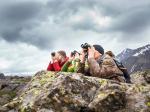
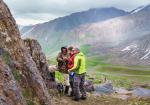
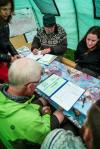
From our working holiday volunteering with leopards, caracals and Cape biodiversity in South Africa (www.biosphere-expeditions.org/southafrica)

With field science the devil is normally in the detail. We may be nearing the end of the expedition, but fieldwork continues apace. Entering the home straight, we still have to continue with camera trapping, mist netting, flush surveys and our programme of small mammal trapping has also commenced. As you may have realised by now, the small things in the fynbos really do matter, as part of understanding the bigger picture.

Assessing the small mammal fauna via the use of live (Sherman) traps enables us to better understand another part of the prey base for some of our resident predators. The various mice and shrew species in the area could form an important part of our feline predators’ diets.

However, we need to know what we have, where, and get a gauge on their relative numbers. Cue the need for yet more empirical science! The team set out 50 sherman traps up and over the ridge line of Signal Hill – so called as it is the nearest place to get a mobile phone signal. This not only gives a gradient of habitat types and aspects, it also means those craving a signal (Scott & Jim) are more than willing to climb the ridge – nothing like motivation!

Similar to our big mammal (leopard) trap, the small mammal traps are checked twice a day, and any captures are documented before being released. The trick is finding them again. The results blew our expectations, both in terms of numbers and variety in any single trapping session. The captures far exceeded those we achieved last year, but again focussed on Namaqua rock mice, striped field mice and Sengi (elephant shrew). Clearly there is still much to learn about the smaller fauna of this area of the fynbos.

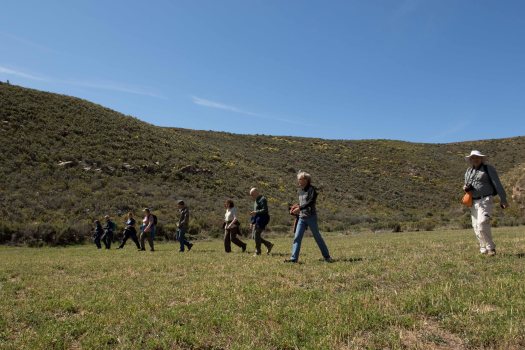
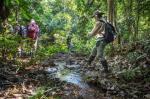
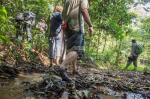
The flush surveys are also proving useful for demonstrating the levels of diversity and abundance of other vertebrate (mammal and bird) species. As well as keeping our team relatively fit – you know when you have walked several kilometres through the fynbos. At least the teams get to ride out to the survey and/or collected courtesy of our Rangers from Ford South Africa.

With our final round of mist netting planned and camera trap collection still to complete, we are slowly beginning to pull together the results from the last couple of weeks. Suffice it to say that simple and well-tested techniques, combined with a bit of hard graft usually deliver results, adding more detailed ‘colour’ to our evolving scientific picture.


From our working holiday volunteering with leopards, caracals and Cape biodiversity in South Africa.

From our working holiday volunteering with leopards, caracals and Cape biodiversity in South Africa (www.biosphere-expeditions.org/southafrica)

A key component of any expedition is focus. We focus on planning, fieldwork and research objectives, amongst many other things. We also focus on target species – often of the larger vertebrate variety.

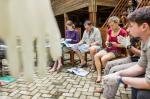
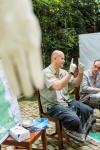
But sometimes it is just as valuable to refocus, and not become blinkered by our obsession to find and document charismatic wildlife. Sunday saw an opportunity to do just this with a walking tour of local rock art sites, which was neatly combined with an evening presentation of the geology of our local landscape, by Chris Lee (Alan’s dad – a retired professional geologist). This of course gives us a wider focus, as we can marvel at the millions of years of geological history beneath our every step.

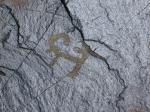
Marrying art and geologic science also helps give perspective on the historic people of this land, through the observation of ancient rock art, which seems to adorn every cave wall or rock overhang – showing people, antelopes and big cats. Clearly we are not alone in our interest in larger wildlife.

The start of the week also gave us an opportunity to appreciate the fynbos biome in another way. For we are not just blessed with two good cooks on this expedition; but Melda and Gurli are also great botanists. The fynbos may be a fire-driven ecosystem, but flower power prevails. There is no doubting we are working in a Floral Kingdom – the Cape Floral Kingdom to be precise.

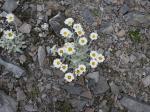
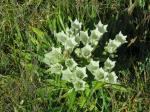
We are surrounded by a wildflower wonderland. Whilst the lack of rain means the flowers may not be at their best, they are still ever present. There is always something in flower year round. And once you start looking at them, I mean really looking, in detail; they reveal all manner of shapes, sizes and colours.

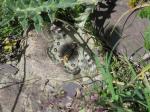
Once you stop to look at the flowers and your immediate environment, you begin to discover a variety of other species, whether they are birds, insects or amphibians, and interactions between them. Observation of wildlife is such a simple pleasure but also vital for any fieldwork.

In many respects, flowers really do power the fynbos. Several small mammals (the subject of our trapping studies) are reliant on protea flowers for food. Many species of butterfly, moth and horseflies are specialised for extracting nectar from tubular flowers, and at the same time perform a pollination role. While orange-breasted sunbirds and Cape sugarbirds, which are endemic to the fynbos, not only act as pollinators, but the latter relies on proteas and pincushions for food and shelter. All of this is vital as it underpins the charismatic species that we seek.

So whilst our focus may be on Cape leopards, caracals and other target species, a broader understanding of our wider environment is key. After all the rocks and vegetation form the foundation of the fynbos on which our focal species depend.


From our working holiday volunteering with leopards, caracals and Cape biodiversity in South Africa.

From our working holiday volunteering with leopards, caracals and Cape biodiversity in South Africa (www.biosphere-expeditions.org/southafrica)

Our quest for our target species has continued over the past couple of days, but seemingly, only with partial success.

Mist-netting has again been combined with flush surveys on consecutive mornings, but the Hottentot buttonquail are proving elusive. We have sighted at least two other individuals, but are yet to catch any more. It is becoming clear why no-one had done this prior to this Biosphere expedition! The work has confirmed locations of this species and enabled us to locate nest sites of Cape rockjumper – another bird species restricted to the fynbos biome.

Another part of our daily routine each morning and evening is to check the leopard trap – a large cage trap, which will hopefully tell us which of the cat species are moving through the local area. Any Cape leopard caught will be fitted with a telemetry collar so we can better understand their movements and habitat use. We’ll also get some interesting by-catch, and over the last few mornings we have trapped a grysbok – a small antelope almost entirely restricted to the fynbos vegetation; and a porcupine – the largest rodent in Africa. All are released to continue on their way.

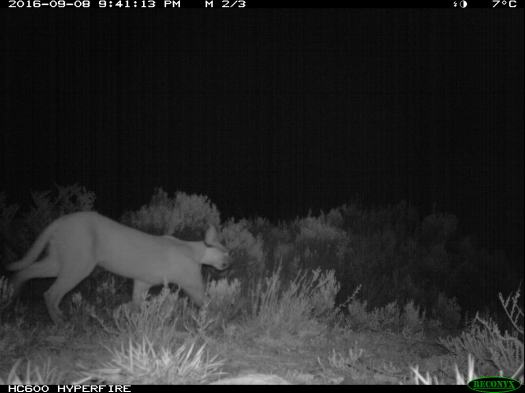
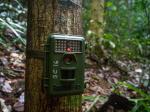
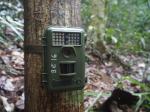
A regular feature in our workload is camera trap servicing and deployment. This provides a great excuse to explore Blue Hill Nature Reserve to its geographic limits; ensuring cameras are deployed in all directions. Hopefully they will give up a few more secrets on our other target species (i.e. Cape leopard, Caracal and African wildcat).

Camera traps can also give you a few surprises. Our team retrieved one remote camera; that has been in the field since it was deployed by last year’s expedition group. Not only was the camera still taking pictures 12 months later (on its original set of batteries), it had also recorded black-backed jackal (another predator not frequently recorded in the area), been attacked by baboons and survived a wildfire! Well done both teams.

And our work is not just limited to the daytime. We have also been deploying bat detectors and using them on transect walks, to better understand what species are present in the area. The detectors are a bit like camera traps, but are triggered by ultrasonic sound, recording a sonogram, which can then be used to identify bat species. This also provides opportunities for face-to-face encounters with other larger wildlife which tends to be more active at night!


From our working holiday volunteering with leopards, caracals and Cape biodiversity in South Africa.

From our working holiday volunteering with leopards, caracals and Cape biodiversity in South Africa (www.biosphere-expeditions.org/southafrica)

Expeditions are often about learning by doing. Our work in South Africa is no different. Tuesday morning saw us head south on a mist-netting quest to catch a Hottentot buttonquail – an endangered, range-restricted fynbos endemic bird, urgently in need of a focussed study into its conservation status.

On route to our bird survey, we took the opportunity to service a few camera traps – change memory cards and batteries, and ensure they haven’t been redistributed by baboons! Camera traps are a vital tool for the project, giving us extra eyes in multiple locations and at all hours of the day and night. On later processing the images from one of these traps, we found out that the last image taken, less than 24 hrs before we serviced the camera was a Cape leopard. It is great to know our main target species is in the vicinity.

Having served our fast-track mist-net apprenticeship on Tuesday, we returned to the same location on Wednesday, and set the nets again. The idea is to then ‘flush’ the target birds in the direction of the nets, so they can be caught, documented and released. So four short flush transects walks later, what did we have in our nets – a Hottentot buttonquail! When your scientist starts dancing around, high-fiving everyone, you pretty much know you have achieved something special!

This was history. This species has never been caught before, ever. Our team had achieved a world first. The individual in question had her biometrics taken, was ringed, photographed and released. The information is vital on many levels, but importantly we now know its weight. So when another individual is caught the correct radio collar could be fitted so the bird can be ‘followed’ and we can learn much more about its ecology, which is vital to inform conservation efforts.

Our achievements have not just been limited to the Blue Hill area. Every day at least one of our volunteers has been helping Matt Macray (our resident Masters student) survey tortoises across the wider fynbos area (also helped by the kind loan of a vehicle from Ford). This not only helps advance knowledge of the distribution of at least four tortoise species, but the study will principally assess the impact of electric fences. These are the scourge of this mixed use landscape, and kill tortoises and other wildlife in unknown and un-necessary numbers. Data are vital to address this problem.

This year’s expedition may be in its early days, but the achievements are beginning to role in. Fingers crossed it continues…


From our working holiday volunteering with leopards, caracals and Cape biodiversity in South Africa.

From our working holiday volunteering with leopards, caracals and Cape biodiversity in South Africa (www.biosphere-expeditions.org/southafrica)

After all the preparation of the past few months, weeks and days, we could finally get the expedition underway. Our team of volunteers arrived not only with bags of energy, enthusiasm and kit, but also boxes of wine! You sometimes get an instant feeling that you have a good group 😉

With initial introductions, orientations and risk assessments completed, we could get down to the real business of field research. This was kicked off by Matt Macray (a Masters student) who is working on the impact of electric fences on leopard tortoises. This was followed by our project scientist (Alan) giving an overview of field research to date at Blue Hill, and outlining the targets for this years expedition.

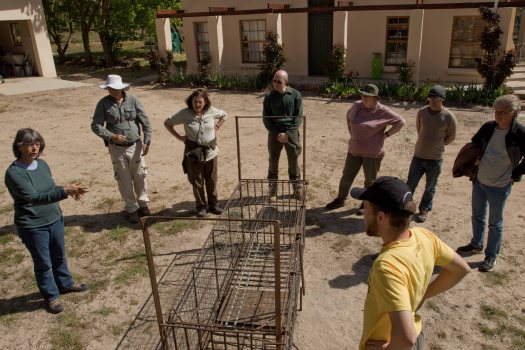
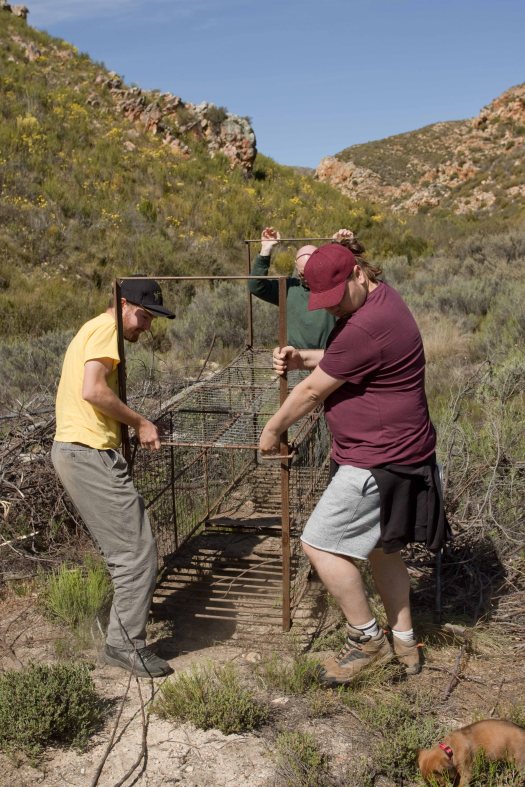
One of these is to trap a Cape leopard, so it can be fitted with a tracking collar, to better understand its movement patterns within the fynbos environment. Cue a field briefing on the cage traps used to trap leopards.

cage-trap-briefing-with-harry leopard-trap-relocation

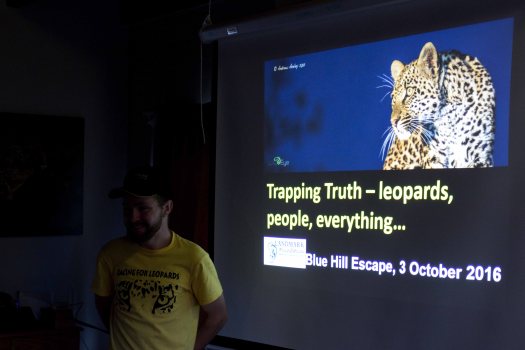
We were also joined by Harry Lewes of the Landmark Foundation, who are working to protect leopards across much of this region of South Africa. Not only was he able to brief our team on leopard capture, but also give an overview on the plight they face in South Africa and the great work that is being undertaken to conserve them across their range. Much of this is reliant on current data, such as the information from Blue Hill.

landmark-foundation-presentation

With some additional practical sessions on field equipment and survey techniques completed, our group are now almost ready to begin the vital data collection, and we are hopeful of some positive early results!

practice-flucsh-survey site-orientation-with-alan


From our working holiday volunteering with leopards, caracals and Cape biodiversity in South Africa.

From our working holiday volunteering with leopards, caracals and Cape biodiversity in South Africa (www.biosphere-expeditions.org/southafrica)

Sorry for the late entry; the internet has been down at base!

Touch Down. Four flights later and I finally made it to George. It is great to be back. My first afternoon was spent collecting our second 4WD (thank you Ford South Africa for the loan), picking up our cooks (Melda and Gurli), who have just got in from Cape Town, and doing  a supply run – I can’t remember the last time I bought so many vegetables!

We could then enjoy the two hour drive north to Blue Hill; our expedition base for the next two weeks. As George disappears into the distance, the roads deteriorate from tarmac to dirt, whilst the views become ever more expansive, and so the sense of anticipation increases. You know you are heading somewhere special, away from much of the world.

img_8741

It has been great to catch up with Alan (and his family) and meet Matt (a Masters student who will be working with us – all will be revealed). The research plans are prepared, the equipment is tested and ready to go, and our expedition base is ready to welcome our volunteers.

img_8619

And the good news is that many of our target species are also beginning to make an appearance. On checking a couple of the camera traps along the east road from our base camp, there have been recent records of leopard, caracal and African wildcat. Some of the latter from just two days ago!

img_0186 img_0233 img_0341

We look forward to meeting you all and hope you bring the good weather and lucky cat charms!

See you soon.


From our working holiday volunteering with leopards, caracals and Cape biodiversity in South Africa.

From our scuba diving conservation holiday with whale sharks and coral reefs of the Maldives (http://www.biosphere-expeditions.org/maldives)

Bleaching and crown of thorns wreak havoc on Maldives reefs – but is this a temporary blip?

Coral reefs have existed for around 300 million years. Today they are under severe threat and the island nation of the Maldives, whose economy and very existence is based on corals, is no exception. Biosphere Expeditions and the Marine Conservation Society report.

Both coral bleaching (where hot water stresses corals) and Crown of Thorns starfish can be considered ‘natural’ events. But when these events happen often and with increased severity, reef survival is threatened, and therefore the very survival of coral reef nations such as the Maldives.

Recent dive surveys by an international and Maldivian team of divers (Biosphere Expeditions, the Marine Conservation Society and Maldivian partners) have revealed a worrying reduction in the amount of Maldivian live coral over the past year. Healthy coral cover has been reduced to below 10% in more sheltered inner atoll reefs by bhe recent El Niño that has also devastated much of the Great Barrier Reef. El Niño hit the Maldives in May this year with two weeks of 32 degrees centigrade waters – at least 2 degrees above the ‘normal’ upper limit of 30 degrees. Outer reefs that are flushed with deeper, cooler water on a more regular basis have fared better (with an average of 25% live coral cover).

Dr Jean-Luc Solandt the Biosphere Expeditions programme scientist from the Marine Conservation Society says: “Our surveys showed a clear pattern, with reefs inside atolls being the worst affected.” Some of the reefs denuded by the warming have also been hit hard by Crown of Thorns starfish, which eat corals. Solandt continues: “Sadly, one of the reefs that was beautiful with upwards of 70% hard coral some four years ago have their remnant corals now being eaten by Crown of Thorns starfish. These coral-eating starfish have decimated the Great Barrier Reef through geological time, and have been affecting the Maldives for over two years now.”

Shaha Hashim, a Maldivian conservationist and linchpin for community-based survey and reef conservation efforts, took part in the expedition to and adds: “More stringent efforts to conserve and build up the resilience of these marine ecosystems are crucial for our survival as an island nation. Development planning and policies need to put a higher value on environmental impacts, which is the prerequisite for any social or economic harmony.”

Dr. Matthias Hammer, founder and executive director of Biosphere Expeditions, concludes: “We are very concerned for the people of the Maldives. Almost everything depends on healthy reefs: The economy, food, welfare, tourism income. If reefs are threatened, so is the very existence of the country and its social cohesion. We hope the reefs will recover, and whilst coral bleaching cannot be locally managed, fisheries, litter and pollution can be. We urge the government to use some of the income from the heavily consumptive tourism industry to pay back – to invest in the very survival of their islands and nation. Without investment from this sector, we believe the reefs will struggle to return.”

But there is a silver lining: “What gives us hope is that the last big bleaching even in 1998 was hotter, longer and more severe, and many reefs recovered good coral growth within seven years”, says Solandt. Hammer adds: “It is not all doom and gloom. Where officialdom is failing, civil society and committed Maldivians are stepping in. Ever since Biosphere Expeditions started running its annual research trip to the Maldives in 2011, it has educated and trained Maldivians in reef survey techniques as part of the Biosphere Expeditions’ placement programme. This culminated in the first-ever all-Maldivian reef survey in November 2014 and other community-based conservation initiatives since then, the latest in March 2016. Shaha Hasihim, for example, has taken part in several expeditions and is now training her compatriots in reef survey techniques and setting up community-based conservation programmes. So there is hope yet!”.

Biosphere Expeditions and the Marine Conservation Society have published a recommendations and action plan. They recommend – at a national scale:

1. Minimum and maximum landing sizes of reef fish within commercial fisheries (as recommended by the Darwin Grouper project).

2. Ensure that resorts only buy fish above breeding age (much of the data of the size of maturity of reef fish is available from http://www.fishbase.org). Any fish below the size of maturity should be refused by resort marine biologists and catering staff.

3. Enforce protection of grouper spawning grounds, as recommended by scientists under the Darwin Grouper project, and gazetted under Maldivian law.

4. Employ marine enforcement officers at resorts to patrol house reefs, and to make them ‘no take zones’.

5. Only allow ‘catch and release’ fishing for resort guests as a matter of Maldivian law, enforced by resorts themselves with their own marine enforcement officers.

6. Use the economic returns from the tourism sector, and fisheries sector to invest in a proper waste recycling system to avoid the dumping and burning of waste.

7. Ensure that each resort uses tertiary sewage systems to treat waste water.

8. Where possible, use renewable technologies to harness the power of the sun, tide and wind to support the large energy demands of the tourist sector.

9. Use national incentives, such as ‘greenest resort award’ and ‘best reef award’ for those resorts who manage their reefs and environmental impact well. Provide tax breaks for such resorts.


Here is a selection of pictures from this year’s expedition. Thank you to everyone who contributed.

Continue reading “From our scuba diving conservation holiday with whale sharks and coral reefs of the Maldives (http://www.biosphere-expeditions.org/maldives)”
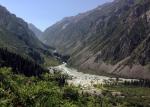
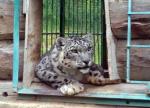
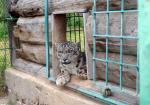
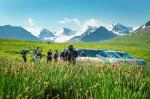
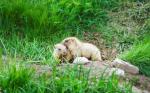
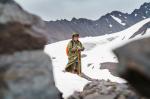
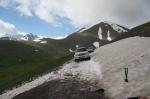
From our snow leopard volunteering expedition in the Tien Shan mountains of Kyrgyzstan (http://www.biosphere-expeditions.org/tienshan)

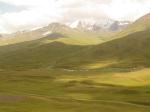
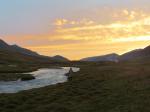
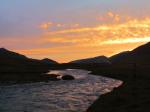
 Here is now a picture selection of the expedition:

Continue reading “From our snow leopard volunteering expedition in the Tien Shan mountains of Kyrgyzstan (http://www.biosphere-expeditions.org/tienshan)”

From our Sumatran tiger conservation volunteering holiday in Indonesia (http://www.biosphere-expeditions.org/sumatra)

Here is now a selection of pictures from the 2016 expedition:


From our Sumatran tiger conservation volunteering holiday with tigers in Sumatra, Indonesia

Update from our SCUBA volunteer vacation / diving conservation holiday protecting the coral reefs of Tioman, Malaysia (www.biosphere-expeditions.org/malaysia)

Strong recovery for Malaysian coral

The El Niño effect this year has devastated coral reefs around the world, but the reefs of one island in Malaysia are fighting back.

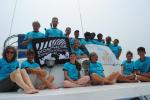
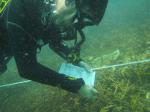
Citizen scientists from Biosphere Expeditions have teamed up with Reef Check Malaysia to survey the coral reefs around the island of Tioman, off the east coast of peninsular Malaysia. The group was assessing the health of the reefs following the devastating rise in sea temperatures that happened in May this year. A temporary rise of 2 or 3 degrees Celcius, caused by this year’s El Niño event, has been causing corals all around the tropics to do something called ‘bleaching’, which can lead to the death of corals and then entire reefs. A coral bleaches when it expels the symbiotic algae that usually live within it. These algae give the coral its colour, without these algae the transparent coral appears white (or bleached) as we see through the animal to its white calcium carbonate structure. Without the algae the animal also loses around 80% of its energy which is usually supplied by the algae photosynthesising sugars. This eventually leads to the death of the coral through starvation.

But the reefs around Tioman island have been taking algae back, and in the months since the reefs were 30 to 40% bleached, they have largely recovered, as the Biosphere Expeditions team has found. The team, comprising citizen scientists from all over the world, also found reefs that were almost back to pre-bleaching states and which were generally healthy. So for these reefs the danger of bleaching has passed for now, but the threats of overfishing and pollution are still there. Very few larger predator fish were found during the surveys, indicating that fishing is still happening, despite Tioman being a Marine Protected Area. The amounts of nutrient indicator algae growing on some of the reefs led the team’s scientist, Alvin Chelliah of Reef Check Malaysia, to speculate on the amount of sewage that may be ending up on the reefs from some of the island resorts. It is through working with the communities on the island, as Reef Check Malaysia does, that the threats to these reefs will be tackled sustainability can be secured.

Pictures from the expedition:


Update from our SCUBA volunteer vacation / diving conservation holiday protecting the coral reefs of Tioman, Malaysia.