Award-winning, non-profit and ethical wildlife conservation volunteering. Advancing citizen science and conservation since 1999 – for nature, not profit.
Author: Biosphere Expeditions
For wildlife, not profit
Our planet is in crisis, with nature under attack like never before. We believe everyone has the power to change this. We are mindful of nature and empower people through citizen science and hands-on wildlife conservation. We are a non-profit, visionary, award-winning and ethical conservation organisation. We are a member of the IUCN and the UN's Environment Programme. Working hand-in-hand with local biologists and communities, we champion change and protect nature. And we succeed - the creation of protected areas on four continents is just one example.
Come and join us! Make your holiday time count and share in our vision of a healthier planet. Whatever your age or background, make your voice heard and spend a week or more on a wildlife conservation expedition with us. Travel with us to remote and beautiful places, learn new skills, meet like-minded people from around the world and experience conservation in action. Together - for nature, not profit - let's act like our world depends on it. Because it does.
The longest day; our last full day of surveying and what an exciting one!
61 miles, 6 basking sharks, 1 minke whale, plus the “usual” harbour porpoises and seals.
As you can see everyone spent time on the deck getting up close and personal with the basking sharks just off Coll and Tiree. Then on our way back towards the mainland we encountered our first whale, a “stinky minke” just off Ardnamurchan. Stinky, because you can smell you are in the presence of the whale. Michael also listened to the clicks of a pod of dolphins when he was using the hydrophone. Although the dolphins must have been quite close unfortunately no one saw them. However, we have another chance tomorrow on our way back to Tobermory, so flippers crossed..
We are now exploring the sea lochs on the west side of Mull (in other words sheltering from bad weather and rough seas) and are back in communication with the outside world! Our route has taken us south as far as Northern Ireland and we spent Sunday night anchored at Rathlin Island, County Antrim before heading north again, stopping off at beautiful Colonsay, and back to Mull.
We have seen lots of harbour porpoises and on Sunday we beat the onboard acoustic detection technology – volunteers 12 : hydrophone 7!
As you can see in the photos everyone has been studying hard to brush up on their sea bird identification skills and the whole team have had a chance to pretend to be a bird by climbing 6 m up the main mast into the crow’s nest.
We have uploaded more photos. As we make our way south and away from the internet you will now hear less of us (good! I hear you all shout). We’ll be back with sightings and other reports in due course.
Today’s “catch” was 17 harbour porpoises and two seals. We’ve had some rough conditions, but nobody was sick. We’ve also had some excellent brownies for “second breakfast” and a great Thai dinner. We’ve come into Craobh Haven for the night to shelter from the strong winds. Tomorrow we’re heading south towards the island of Islay and will see what the weather brings. Videos below
Team 1 has arrived safely and we have had our first 24 hours on the research vessel. Yesterday we had introducations and some safety briefings before going for a last shop and turning into our bunks pretty late, although still light at almost 23:00.
Today we’ve had our science training in the morning and our first survey run. It’s been dry, but overcast, but some bad weather is moving in, so for now we are staying in some sheltered lochs.
Our first sighting today was a harbour porpoise and everyone has been busy switching stations: observer, data relayer, data recorder, listener, etc. We’ve also had our first lunch out of cups on the run/survey.
No more videos for now as we snatch the odd patch of GSM coverage to get this to you. So here are a few pictures from our first 24 hours as we are sailing by Duart Castle.
Yesterday we arrived at Tobermory on Mull and we have brought the rain with us! Stuart the skipper tells us it has been glorious weather for the last week, but it will now be unsettled for a few days. Saturday is forecast to be the worst with high winds, so Stuart has planned a route that will take us into a sheltered loch to hide from the worst of it; better weather is forecast after the weekend..
Preparation: The research yacht is all fuelled up and the crew have been busy loading on all our food for the expedition – as you can see below
18 deg C, overcast during the day, positively beautiful in the evening, no rain! Forecast not so good – see http://www.bbc.co.uk/weather/2635754. Looks like we’ll be feeding the fish with lots of wind an wave action. And the midges are flying high.
Preparation:
The boat is coming in from a research outing as we speak. This year’s first basking sharks sighted.
As you can tell, Kate’s not too comfortable in front of the camera, so we have also added a video of someone who is VERY comfortable, in fact could probably not survive for longer than 48 seconds without a camera lens being pointed at them, to the blog.
You must watch this extremely interesting video of utter relevance to the future of our planet until the end and expect to be tested during the expedition. Or you could watch http://youtu.be/pGifZhozLVA and really learn something.
It has been a while since I arrived at our Okambara study site in Namibia, so it’s time to give you an update on my work here. I have already seen lots of wildlife and let me tell you, it is hard to miss! There hasn’t been one day without seeing an animal but although I was very excited to see rhinos and giraffes for the first time on the farm.
GiraffesRhino
I was still hoping for a leopard, as this is the species I will focus my main research on.
Finally, after a few weeks of waiting (not so) patiently, Fortuna had a female leopard go into a trap, which had actually been set up for capturing cheetahs on another farm! We (that is the people within our research group here in Namibia) took the opportunity to collar her, which will now give us the chance to monitor her movements in the following months. The picture was taken to help us identify her unique fur pattern in case she walks in front of a camera trap or gets captured elsewhere.
Captured leopard
I also learned that the male leopard collared during the 2012 expedition is hanging around in the northern part of Okambara (see his GPS-positions).
Map
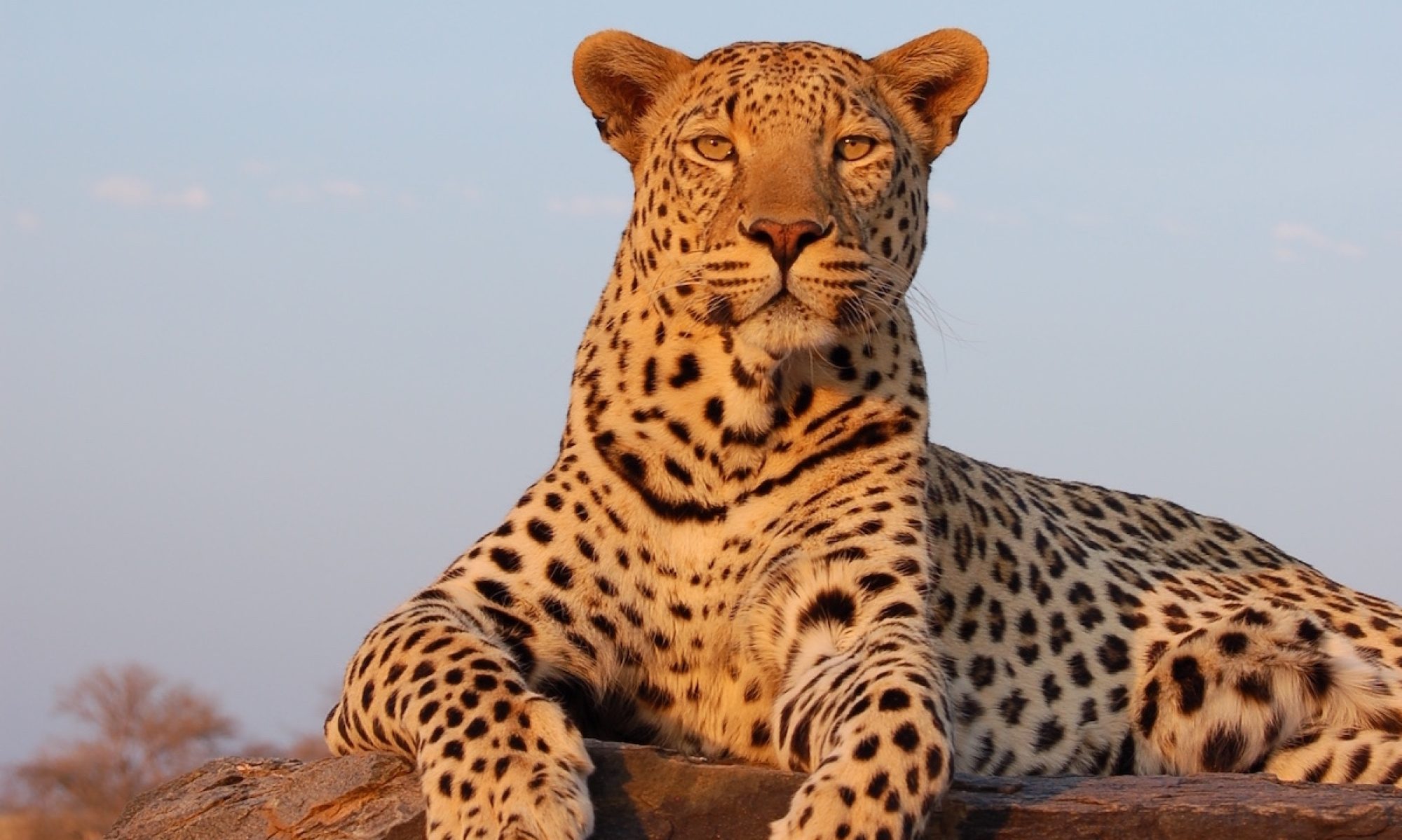
In addition, tracks of a big leopard have also been found in the south as well. Not far from the farm house, we found a hole in the outer farm fence, which could serve as a gateway for all kinds of animals, including a leopard. I have set up a camera trap to find out who/what is using this (no longer) secret entrance to Okambara. My camera trap captured porcupines and warthogs but then…a leopard showed up also. As you can see on the picture, it is quite a big individual and if you look even more closely, you will notice that a part of the upper lip is missing, which may have been caused by territorial fights with other leopards. Box traps have now been set up in various places in order to capture and collar this leopard to find out more about its usage of the area.


 Biosphere Expeditions: blogs from the frontline of wildlife conservation and the fight for a more sustainable planet