We’re here, we’ve set up and all is well. It’s a muggy 30 C and there is rain forecast tonight. This won’t change much over the week.
Here are a few names to remember: Most importantly there’s Dileepa (cook), Randika (waiter), Mox, Antoine, Lorae (dive guides), Lukas (deck hand), Jean-Luc (scientist), Matthias (expedition leader), as well as a few other crew who are here to make sure the expedition runs smoothly.
All it needs now is you, our citizen scientists. Safe travels and we’ll see you at 11:00 at the Coffee Club tomorrow. Be prepared for a mind dump, some hard studying and exams at teh end, before we let you lose on the data collection.
Biosphere Expeditions has continued its long-term partnership with Lilongwe Wildlife Trust, researching and monitoring wildlife populations in Vwaza Marsh Wildlife Reserve.
The Malawi expedition has a particular focus on surveying elephants and hippos, as well as camera trap surveys of other wild animals. Analysis of elephant dung was also carried out to assess whether elephants had been eating crops grown in fields outside the reserve. The 2024 expedition also continued the process started in the earlier expeditions of identifying individual matriarch and adult bull elephants. Building this database of individual elephants will help greatly in mapping the demographics, movements and health of the elephant herds in Vwaza.
The 2024 expedition counted 296 elephants over 34 sightings, 339 hippos over five complete lake-side transects and collected and analysed 24 elephant dung samples (yielding 1743 seeds). The expedition also identified or created 17 ID profiles of elephants, with at least one re-sighting. Seventeen camera traps throughout the expedition provided evidence of hyaena, civet, genet, two species of mongoose and honey badger, amongst other species.
Expedition Leader Roland Arnison, who also led the 2022 and 2023 expeditions in Vwaza, said that “this was another successful expedition, carrying out field research tasks that, practically, can only be carried out by a team of hard-working citizen scientists. I am confident that the results gathered from this expedition will make an important contribution to the conservation of endangered species and biodiversity in Vwaza”.
Head of Research at LWT, Dr Leandra Stracquadanio, who was the expedition scientist, said “the data that we collected during this expedition is invaluable for us to continue our monitoring of elephant and hippo populations, as well as the overall biodiversity within Vwaza. The team did an excellent job and produced high-quality data that will inform ongoing and future conservation planning.”
Citizen scientists feedback:
Roland and Lea and the team really made this entire experience incredible. Kathy H., USA
It’s a great experience and I really felt us being here was useful. Sanne W., Netherlands
Really enjoyed that each day had a different combination of activities. Really positive leadership by Roland and Lea. Pam G., UK
The expedition was well set up and organised and there was not a day that I felt like something was out of place. Glory M., Malawi
This is my fourth expedition to Vwaza Marsh with Biosphere Expeditions. Another wonderful experience, finished off with a very special visit from the elephants and their babies coming right past our campfire as we were having dinner on our last night. Janet B., UK
Biosphere Expeditions, working in collaboration with Björn & Vildmark (bear & wilderness), has completed its fourth citizen science research expedition in Dalarna province, Sweden, gathering field data on brown bears (Ursus arctos), contributing to the conservation of this iconic Scandinavian mammal.
The expedition involves citizen scientists staying at a base camp and, after receiving relevant training, collecting data under the direction of the expedition scientist, Dr Andrea Friebe.
The data collected is used by the trans-national Scandinavian Brown Bear Research Project (SBBRP). Dr Friebe has worked in the SBBRP since 1998 and wrote her master thesis and dissertation about brown bear hibernation and ecology in Sweden. In 2001 she founded the company Björn & Vildmark, as an interface between bear research and information for the public and for managers.
The main focus of the Biosphere Expeditions brown bear research expeditions is locating and surveying winter dens used by bears that have previously been fitted with tracking devices. Once the bears have left in spring, each winter den is then carefully measured by the citizen scientists and a wide range of data are collected relating to the type of den, the surrounding habitat and any evidence of cubs and/or bear scats at the den site.
The expedition team also visits sites where bears had recently spent a significant amount of time, indicating a ‘day-bed’, or a potential kill or scavenging site. These sites also provide a high chance of finding bear scats. Samples of these scats are collected and later analysed to reveal bear diet as well as helping to identify the presence of cubs accompanying female bears.
The data gathered by the expeditions is used by the SBBRP as part of their long-term research programme following the lives of specific bears from birth to death, to gain insights into bear diet, weight development, patterns of movement, colonisation of new areas, choice of den, social behaviour, mortality and reproduction. Inter-species interaction with moose and domestic livestock have also been investigated, as well as the sensitivity of bears to human disturbance and human-bear conflict.
The purpose of this all this is to provide managers in Norway and Sweden with solid, fact-based knowledge to meet present and future challenges by managing the population of brown bears, which is both an important hunted species and a source of conflict, and whose management has been changing rapidly in recent years.
The 2024 expedition ran from 26 May to 4 June 2024, involving two days of practical training followed by seven days of research in the field carried out by nine citizen scientists from Germany, Spain, Poland, the UK and US. The expedition succeeded in locating and visiting 60 sites, including surveying 27 winter dens and collecting 56 samples of bear scats, three of which were ‘first scats of the season’ (especially valuable samples that can reveal a bear’s diet before and during hibernation). Other evidence of bear presence and behaviour recorded by the expedition included bear ‘day beds’, claw scratches on trees, footprints and the remains of prey carcasses, notably moose. The team also used directional radio antennae to reveal the live location of some bears.
“The team did really well this year, working hard in unusually challenging conditions. They also had to deal with some tough hiking in rough wild terrain to find the dens. They all deserve a good rest following the expedition”, says expedition leader Roland Arniston with a wry smile.
Expedition scientist Dr Andrea Friebe was very pleased with the data collected. “I really appreciate the effort that the citizen scientists put into collect the data. I wouldn’t be able to obtain this long-term dataset on brown bears without them. Initial results show a changing pattern of the types of winter dens used by bears, including a trend of increasing use of basket dens by female bears, a type of den more usually favoured by large male bears.”
Andrea will carry out further analysis of the data collected on the expedition, to reveal more detailed results about bear dens, diet and demographics. An expedition report with all analyses and details will be published in due course
Biosphere Expeditions will to return to Sweden in 2025 to continue this valuable contribution to brown bear research and conservation in Scandinavia.
Citizen scientist testimonials:
“The setting of base was beautiful, basic and comfortable. Andrea was amazing to work with. Loved the presentations. The food was EXCELLENT.” Zoe G., UK.
“I enjoyed a really great experience, beautiful landscape, meeting very kind and interesting people. I am very happy that I got the chance to come here.” Almut D., Germany.
“The food that Lousie cooked was VERY good. Andrea’s enthusiasm and expertise are an inspiration. I thought she was amazing and will follow her research. I loved the technical work and strengthening my technical skills.” Kari V., USA.
“The local researcher is very excited about her work and her enthusiasm is contagious. The research felt worthwhile and finding bear dens was very satisfying. I enjoyed the full days.” Maya G., Poland.
“I appreciated the opportunity to work closely with the project scientist and gain more knowledge of bear ecology and how they interact with the human population” Thomas K., USA.
Biosphere Expeditions just completed their 18th expedition, now covering almost two decades of cetacean citizen science monitoring since 2004 in the Azores, a mid-Atlantic hotspot for marine megafauna with no fewer than 25 species. Cetacean data collection take a decade or longer to reveal meaningful patterns. Hence, the true value may not always be in the ‘here and now’, but be realised as future questions and challenges arise.
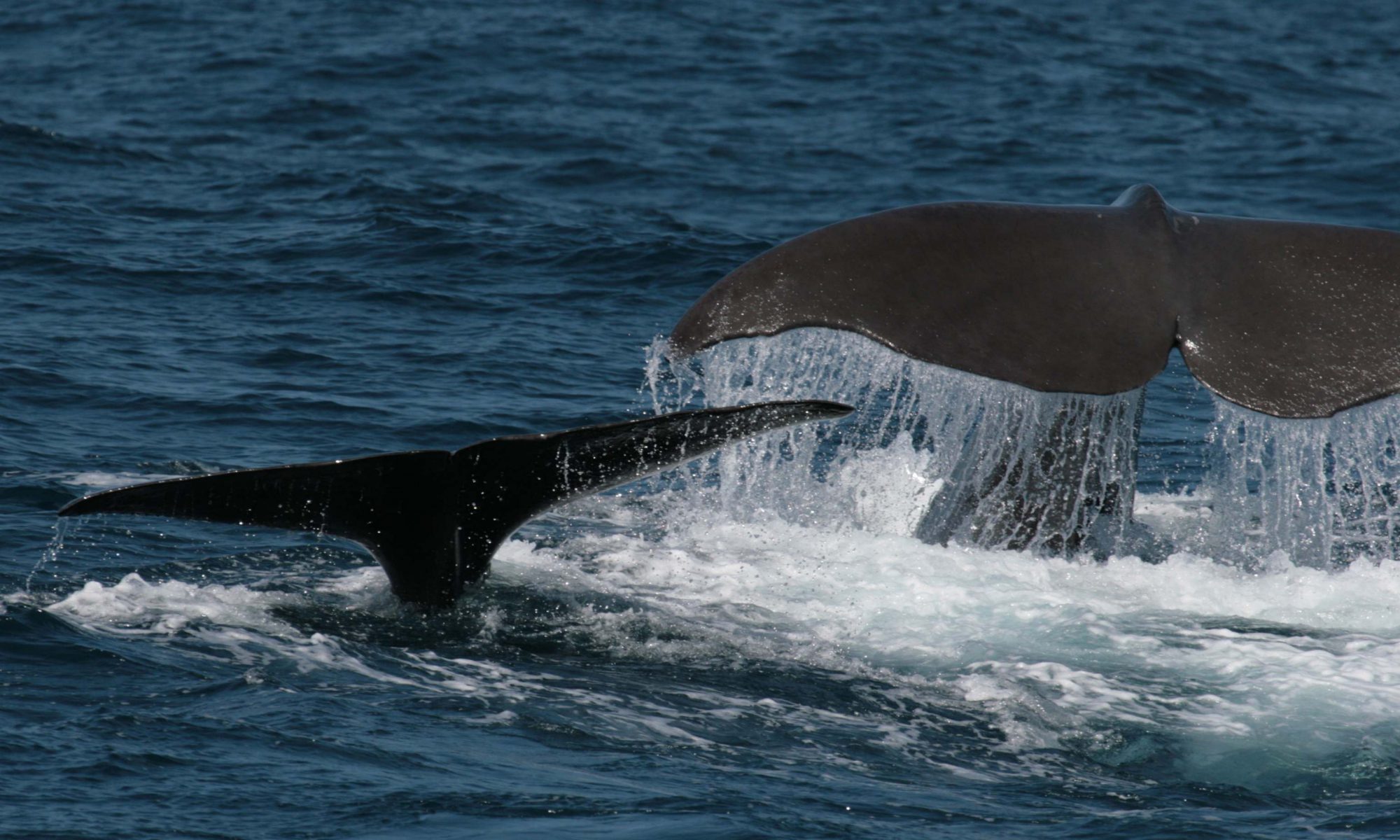
Twenty-nine expeditioners from ten countries, joined the 2024 expedition, completing 16 days out at sea, adding up to 86 sea hours while covering 1,500 km of ocean around Faial and Pico. Our search effort resulted in 92 encounters of nine different cetacean species. Sightings of common dolphins and sperm whales were most abundant. Common dolphin groups were smaller this year, a trend already observed in 2023. With regards to baleen whales, we had ten sightings of ‘feeding’ blue whales, seven of fin whales, one minke whale and one humpback whale. The resident bottlenose and Risso’s dolphins were also seen on several occasions.
In total we confirmed some 20 positive IDs, including several re-sightings of sperm and blue whales. One of the sperm whales we sighted goes as far back as 1988, 35 years ago. Several blue whales observed were seen in previous years in the Azores, showing that they use the same migration route. Some individuals were recorded for the first time, again contributing to an ever-growing growing photo-catalogue and to our understanding of population dynamics. Many more whales have yet to be matched. Studying cetaceans takes patience and perseverance, one photo-ID shot at a time. Yet, these valuable data provide relevant insights into the spatio-temporal movements, migrations, numbers, group structures, and ecology of cetaceans, key to their long-term protection and conservation.
Feedback from the citizen scientists:
‘I was dreaming of seeing a blue whale. Not expecting to see one in four consecutive days!’ Jenny S., UK.
‘Well-organised, safe, learned a lot on marine conservation! Great team work and excellent accommodation. ‘ Skarlet-Ilieva M., UK.
‘An, the expedition leader is exceptional. The breakdown of tasks was good and the daily briefings provided immediate feedback of results. Very well organised.’ Debbie R., Canada.
‘This is my sixth expedition research project and honestly reached the top of my list for so many reasons.’ Lisa C., USA.
‘The group dynamics, the expedition leader and scientist went over and beyond to make sure we had all we needed. ‘ Paulina B., Canada.
On the very last day of this year’s Arabia expedition group 2 discovered a pharaoh eagle owl nest with two fluffy chicks in it. The nest was well hidden in a ghaf tree with one parent always on watch. This discovery was a direct result of our surveys, which led the scientists to believe there was an active nest site somewhere around the west ghaf grove. Further tips and investigations finally led us to the nest. Science is often like a puzzle: Putting together tiny pieces to paint a picture. Great team work, everyone!
Group 2 also completed the DDCR’s annual circular observations project by surveying the remaining quadrats. Once again, two teams completed this inventory by surveying 62 quadrats from a central point by walking many kilometres up and down dunes enduring heat and wind. Well done, all of you! By doing that you have done, you have created yet another piece of the puzzle that will assist in the effective management of the DDCR.
Overall results from both groups include recordings of about 70 different species inside the DDCR. Eighteen new pharaoh eagle owl nesting sites were found, all of which will be monitored for activity. On the bird census the teams recorded more than 45 different species including a first record of a long-eared owl.
Thank you everyone for joining us in the desert and for putting your time, money and efforts into this flagship conservation project. I hope you enjoyed it as much as we did.
First, some exciting news from the desert expedition front: Group 1 discovered a new bird species in the DDCR, a long-eared owl. They spotted the animal on a final morning stroll around camp in a ghaf tree. Matthias and Pete came sprinting back to camp getting their cameras and managed to get good pictures. Only at the computer screen it later became obvious that it wasn’t the expected pharao eagle owl, but a long-eared owl, a species that has never before been recorded in the DDCR. The identification was confirmed by specialists a couple of days ago and will soon be added to the official DDCR bird inventory list. Congratulations for this discovery.
After two intensive training days group 2 is in now full survey mode. We are ticking off remaining quadrant surveys and have extended the pharao eagle owl surveys in order to find actual nesting sites. Scientist Maria received a tip indeed found a nest with chicks in it. If we continue to bring in neatly filled in data sheets and good results, she promised she’d take us to see them! 😉
At camp we had a midnight encounter with an Arabian red fox. The tiny beast somehow managed to push over a big rubbish bin, 10 times bigger than itself, and rummaged through the contents. The rubbish bin has now a heavy log on top and the sighting was added to the random encounter data sheet.
The days are getting hotter and it doesn’t cool down dramatically at night. For the last few days it’s been a little foggy in the morning and we enjoyed amazing desert views on the way to our early morning surveys. We had the camp fire going once in the evening, but from day two on everyone was quite happy to hit their tent straight after returning from dinner… there seems to be a pattern. 😉
Continue reading “Arabia: Long-eared owl discovery”
Group 1 has left – thank you so much for your efforts and being a great group. Group 2 arrived safely at camp on Monday after a tour at the DDCR visitor centre. After the vehicle & driver training, we waved Simon goodbye. Other obligations are calling for his return to Austria – travel safely, Simon!
We will be a smaller group of seven citizen scientists for the next week and are determined to finish up what group 1 started. We’ll be all ready to head out on our own once we have finished Tuesday’s introduction to the science and practical training in the field.
Today is Saturday and we have said farewell to group 1 after an good week with a hidden bonus as we packed up camp this morning, more of which later!
After a week of hard work, the team completed 55 (of 62) quadrat surveys, multiple bird counts (where Matthias and Georgina deserve special mention for passing on their extensive knowledge to other citizen scientists) and the hunt for the elusive Pharaoh eagle owl goes on. Our camera traps captured Arabian red foxes, Arabian hare and jerboa, none of which we spotted during daylight hours.
We did spot and identified 58 different species within the DDRC – it might have been more if some of us had realised we were counting insects too 😉 In total we racked up 44 bird, 8 mammals, 4 reptile and 3 insect species. Highlights included our flagship species, the Arabian oryx, as well as desert foxes and plenty of Arabian and sand gazelles.
Weather has been very pleasant with slightly cooler temperatures than earlier in the week, which enabled us to get more survey work done in in the afternoons. Most of us revisited the highly recommended new Visitors Centre here at the DDRC to help identify what we’d seen, or perhaps it was because it is the nearest Costa Coffee shop…. 🙂
We rounded off group 1’s week with an evening meal at our desert camp. A superb South Tyrolean pasta dish and a pepper side dish produced by the amazing Elisabeth. We all hope she comes on an expedition again 😉
Ah, nearly forgot the bonus. While breaking camp this morning, our birders suddenly got very excited and rushed off to a nearby ghaf tree. There, roosting in the branches, was what we think was a long-eared owl. Photographs were taken and will be sent to the Dubai Birding Committee for confirmation. If we’re right, this would be a huge first for the DDRC. Standby group 2, the location is right next door to camp!
It’s day four on our desert expedition and while I am writing this, everyone else is out in the field collecting data. We work in four teams swapping activities such as circular observation, bird census and pharaoh eagle owl survey. All data collected in the field also need to be typed in to the computer, which makes data entry another activity we will bring in in a couple of days. The daily routine works well: Getting up at 5:30, breakfast at 6:00 and heading out into the field at 7:00. The teams are back at camp in the afternoon for tea, coffee & a refreshing cold shower before the daily de-brief at 17:30, planning the next day and dinner afterwards.
The temperature has increased gradually day by day (30C/15C day/night) and with some cloud cover, we experienced early morning mist today for the first time. I bet the animals and plants very much enjoyed the humid air as much as we did during the early morning survey walks.
You will be hearing from us again once this group is done and we can give you a summary of what we have achieved so far. Tomorrow will be another packed survey day, same as on Friday morning, when we will collect the camera trap SD cards for reviewing.
On Saturday group 1 arrived without mishaps and were treated to a visit to the brand-new DDCR Visitor Centre, its displays serving as an introduction and featuring plenty of Biosphere Expeditions mentions and joint achievements, of which everyone involved in the expeditions over the years can justifiably be proud of. Our staff were happy to see their pictures, handwriting and other “artefacts” on display.
From the Visitor Centre we proceeded into the DDCR. The gazelle and oryx welcome committees were there, as ordered. We stopped off at the office for a quick orientation talk and to explain where all the science gear was, what the maps meant and more.
The final stop was base camp for the safety talk and to pitch tents and get settled in. Then a beautiful sunset, dinner and bed, because we have to be up before the sun rises to get ready for the day. 30C during the day, 8C in the night. Spare sleeping bags were in demand. It’s the desert after all.
More training on Tuesday, first in the classroom on theory and then practice newly learnt skills in the field. The first camera traps are going out into the field as I write this. Well done group 1! I think everyone will sleep well tonight. It’s not a holiday, you know :))