Award-winning, non-profit and ethical wildlife conservation volunteering. Advancing citizen science and conservation since 1999 – for nature, not profit.
We have slight staff overkill on this first full Germany wolf expedition for two years. There’s experienced leader Malika, training An to lead this expedition, our scientist Peter and our founder and executive director Matthias, who happens to be in the area.
There was not a cloud in the sky during the five hour drive up from our German office in Bavaria to our manor house expedition base in Lower Saxony, which sits there like nothing has happened and has done so since 1649. It will probably cloud over by the time you arrive on Saturday, but it should stay warm.
Entrance to the expedition baseMalika packing up
A word about the base: This is run by a charity that involves mentally challenged people as staff, for example those with Down syndrome, who are in the high risk group for Covid. Because of this, management have kindly asked us to wear masks inside when we are with staff, so please make sure you bring enough (for this purpose the thinner medical masks are fine).
About the charity that runs the expedition base
This morning at the expedition base
We’ll spend the next couple of days getting everything ready for you and report back once more before we meet group 1 at Bremen airport on Saturday.
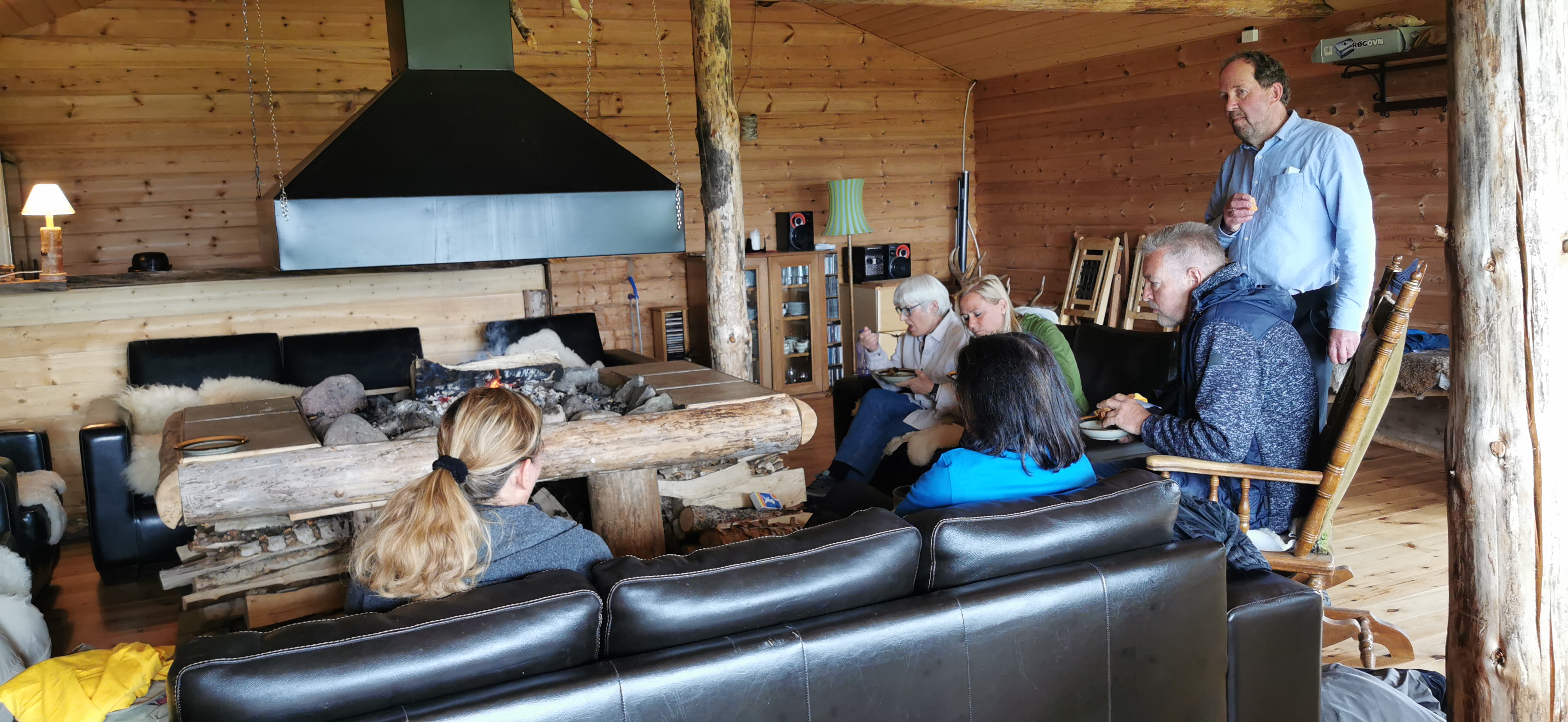
Day 7 was half a day in the field and yet, between all of us, we still managed to achieve three dens, several scats and day beds. We wrapped up the field research by a local beauty spot, where everyone met up for cake, soup, tea and coffee to celebrate our achievements by a fire, reflecting on a week that has flown by.
Back at base, we entered data gathered into a laptop and started to clear up. Andrea gave a ten-minute presentation summing up how we have helped her research and thanked us for this. Here’s the final tally: We documented all 24 dens of the study site, collected over 100 bear scats – which was well beyond Andrea’s target – recorded 30 day beds, 8 carcasses and a multitude of other interesting events such as gnawed antlers, encounters with moose, fox, owls and other animals. Andrea’s words of gratitude were not just a polite ‘thanks’. She explained to us how she absolutely relies on our citizen science contributions to carry out significant parts of her work on brown bear ecology in a changing world of climate change and forestry. Essentially, if we were not here to do it, it would probably not get done.
We in turn want to return the gratitude and say thank you very much to Andrea for being so welcoming and patient with us, and letting us be part of her world for an all too short summer week here in Sweden. In the words of Neil: “We’ll be back”.
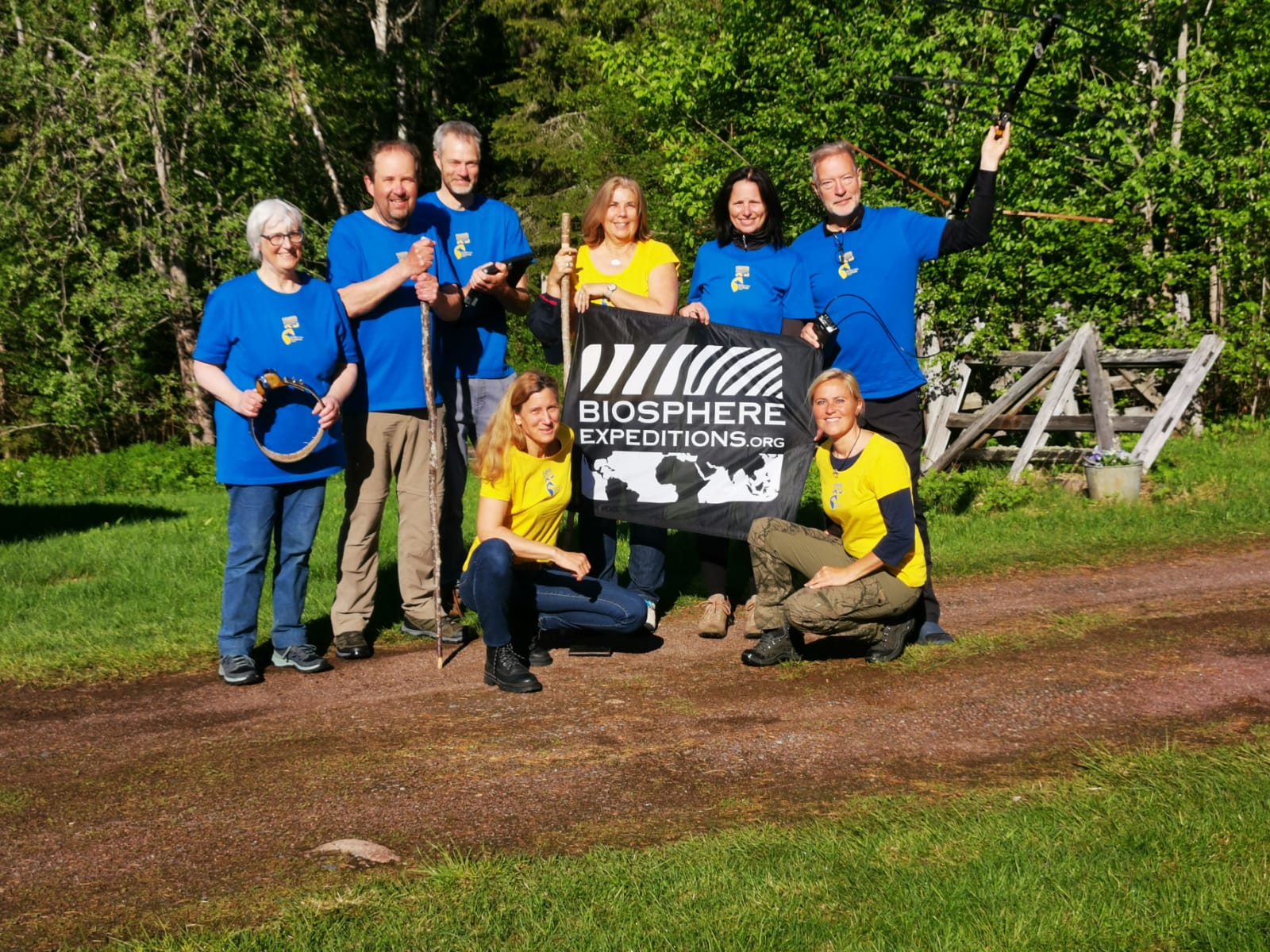
The final tallyThe expedition team 2022Final field lunch
This is Roland, the assistant expedition leader, taking over from Matthias after being shown the ropes and finding my feet.
It is day 6 of our Sweden bear conservation project and we have now settled into the rhythm of each day of brown bear conservation research. Each day proceeds with quiet confident efficiency. We get up early, gather our research tools, are given our tasks for the day by our chief scientist Dr Andrea, and set off in three teams armed with a list of locations to reach. We get as close as possible by vehicle along remote forest tracks and then it’s on foot after that, negotiating bogs, boulders, tree stumps, steep slopes and forests of varying degrees of impregnability to navigate our way to very specific locations. The location of a hibernation den is indicated by a constant, immovable GPS signal that a bear with a GPS collar left all last winter, unknowingly transmitting its co-ordinates – and usually a range of biometric data too – to Andrea via the mobile phone network. A cluster site is simply a place where the GPS data tell us that a bear has recently spent at least a few hours in one small area. Why? We enjoy the detective work needed to answer this question. It may be where the bear killed and ate a moose calf or simply lay down for a rest for a while – a hollow in the ground and flattened vegetation indicates such a ‘day bed’. Above all, a cluster site gives us the best chance of finding bear scat, which is prized by Andrea for its research value.
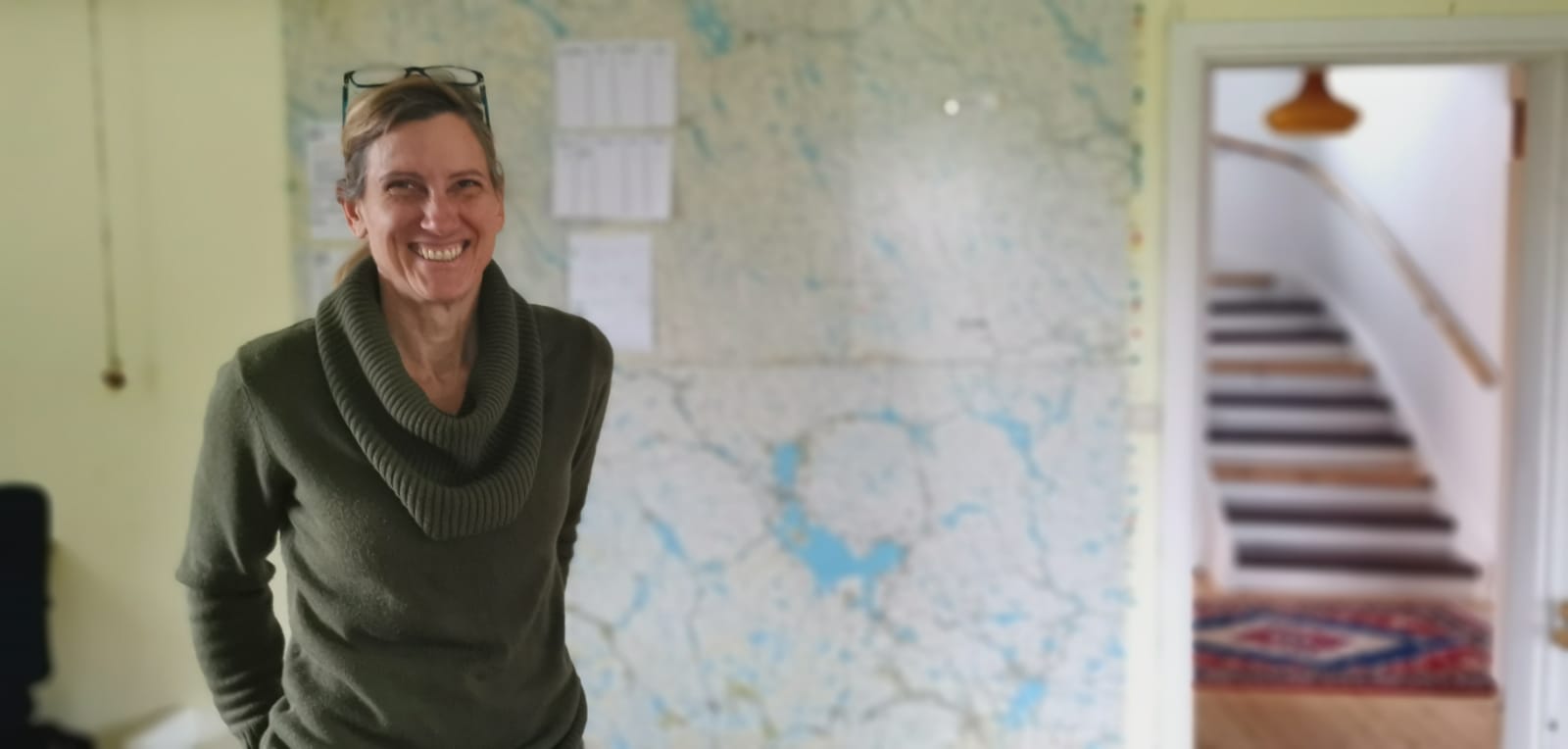
Expedition scientist Dr. Andrea Friebe
So our days are filled with the hunt for clusters and dens – and a myriad of other signs of bears in the landscape, all carefully documented according to Andrea’s research protocols. At the time of writing, we have located and surveyed 17 dens, recorded 23 day beds and bagged up 65 samples of bear scats: all in all a major contribution to the long-term brown bear research project. And we haven’t quite finished yet.
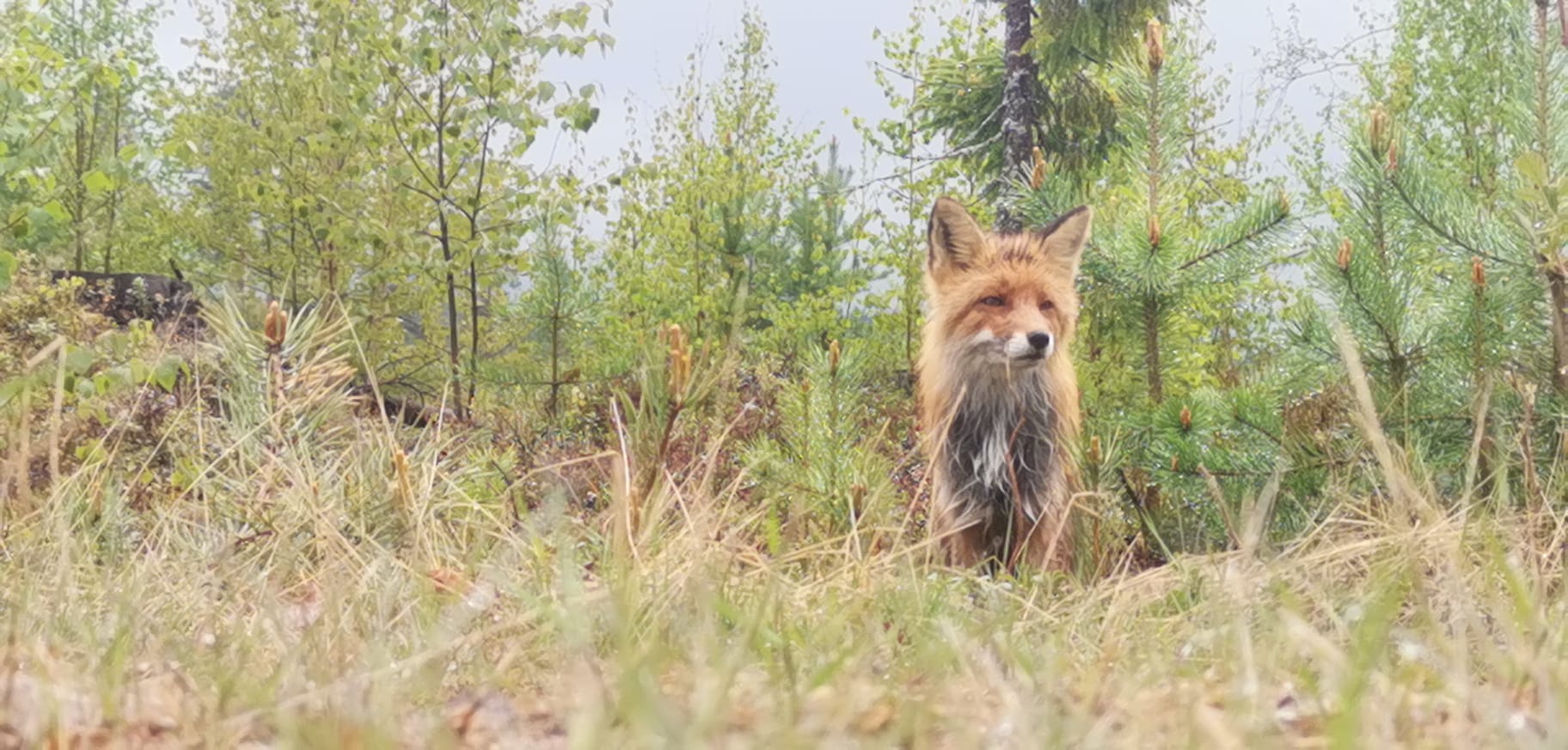
And along the way we have had daily encounters with wildlife: we have spotted owls, capercaillies, a glimpse of an eagle, a friendly fox and occasionally a moose or two wandering through the wetlands.
Fox encounter
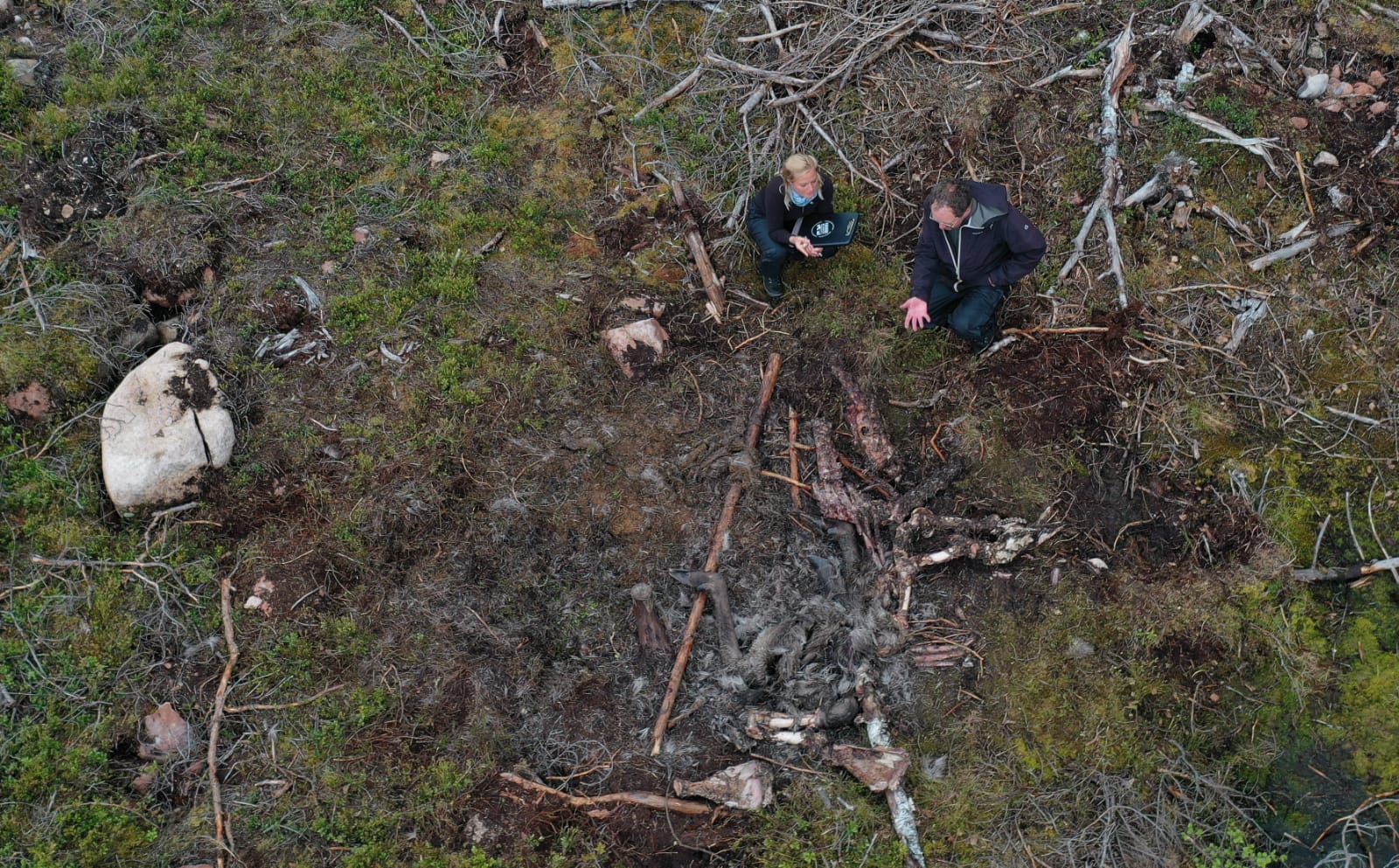
The final cluster site visited today by Team Christiane/Neil/Roland took little detective work to reveal why the tracked bear had spent five hours there. The massive decaying carcass of an adult moose lay unapologetically scattered in a hollow.
Christiane and Neil with the moose carcass
Today is our last day in the field. Half day, actually, because we will spend the other half entering the data we gathered into computers so that Andrea can analyse them – another piece of the puzzle of effective brown bear conservation in Sweden.
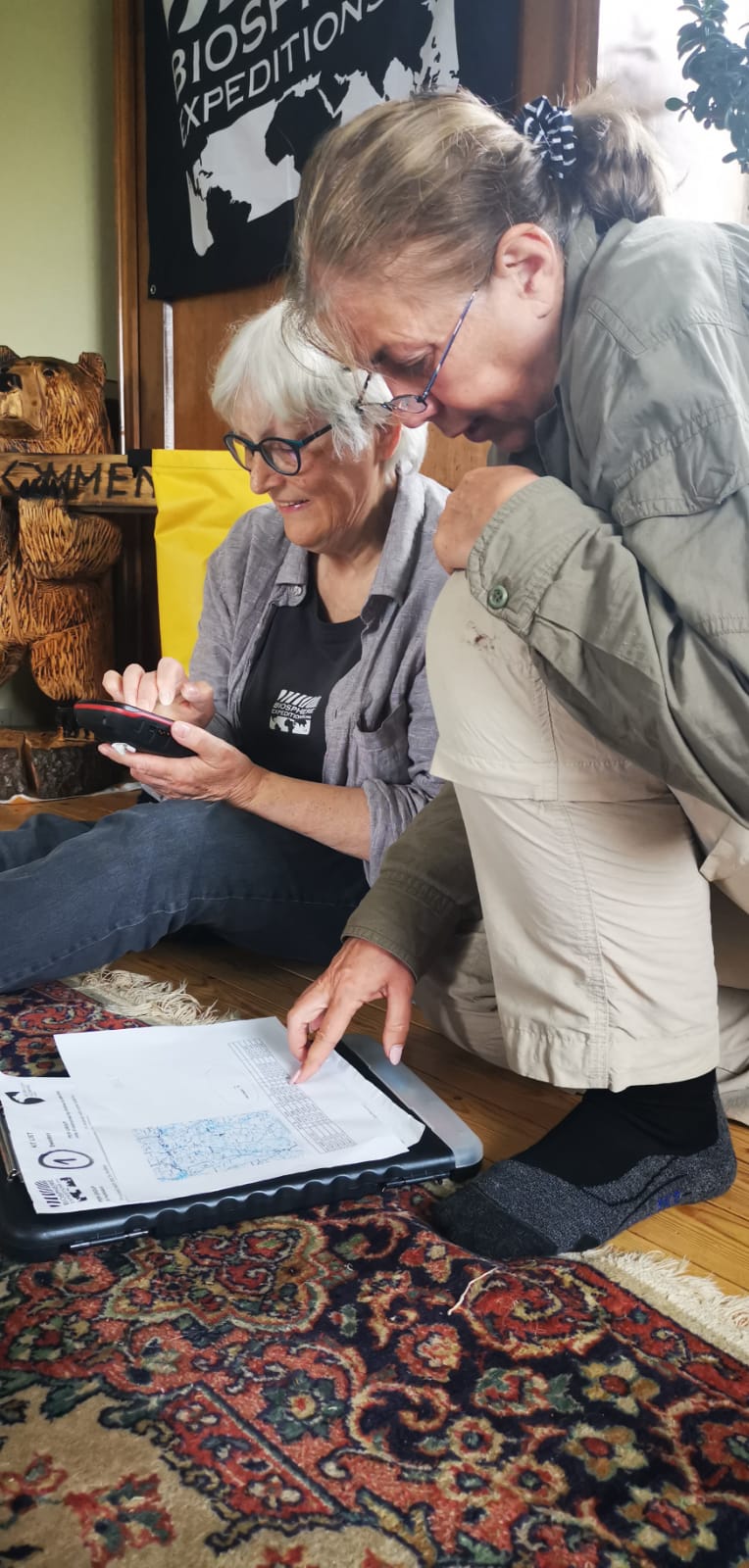
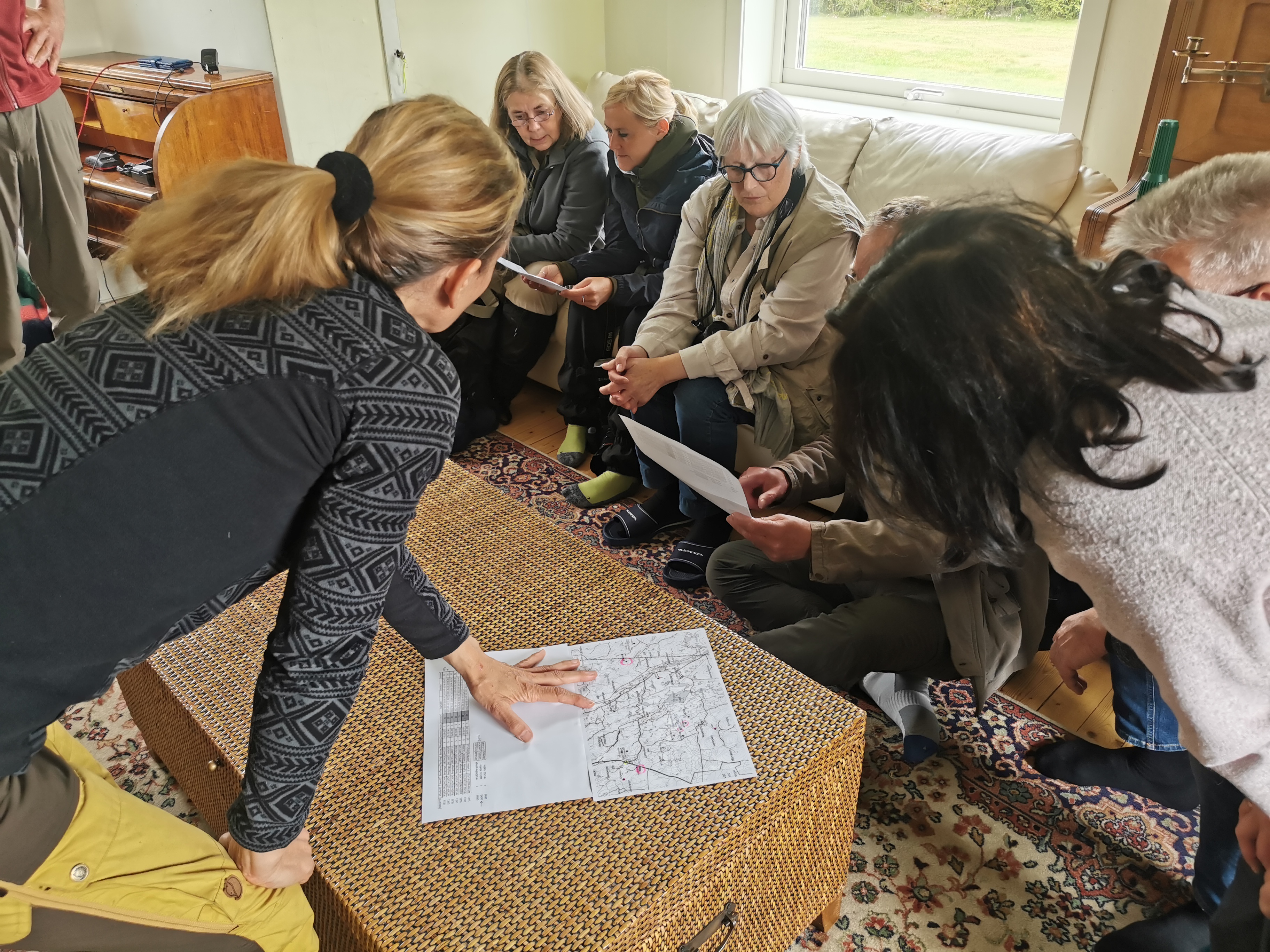
Neil investigating a bear denEvelyn recording bear den dataPat and Evelyn working it all out on a map
As I rise before seven in my cabin, the morning chorus is in full swing. The wood creaks a little from the sun shining on it, fairly high in the sky already. The grass outside is a soft green carpet that caresses my feet as I wander over to the shower block. Fellow citizen scientists greet me sleepy-eyed on the way. A young red squirrel sits on the steps, seemingly unperturbed by all of us around. A crane flies in and settles on the meadow for a morning graze. The sky is blue and white, full of promise of a good day ahead.
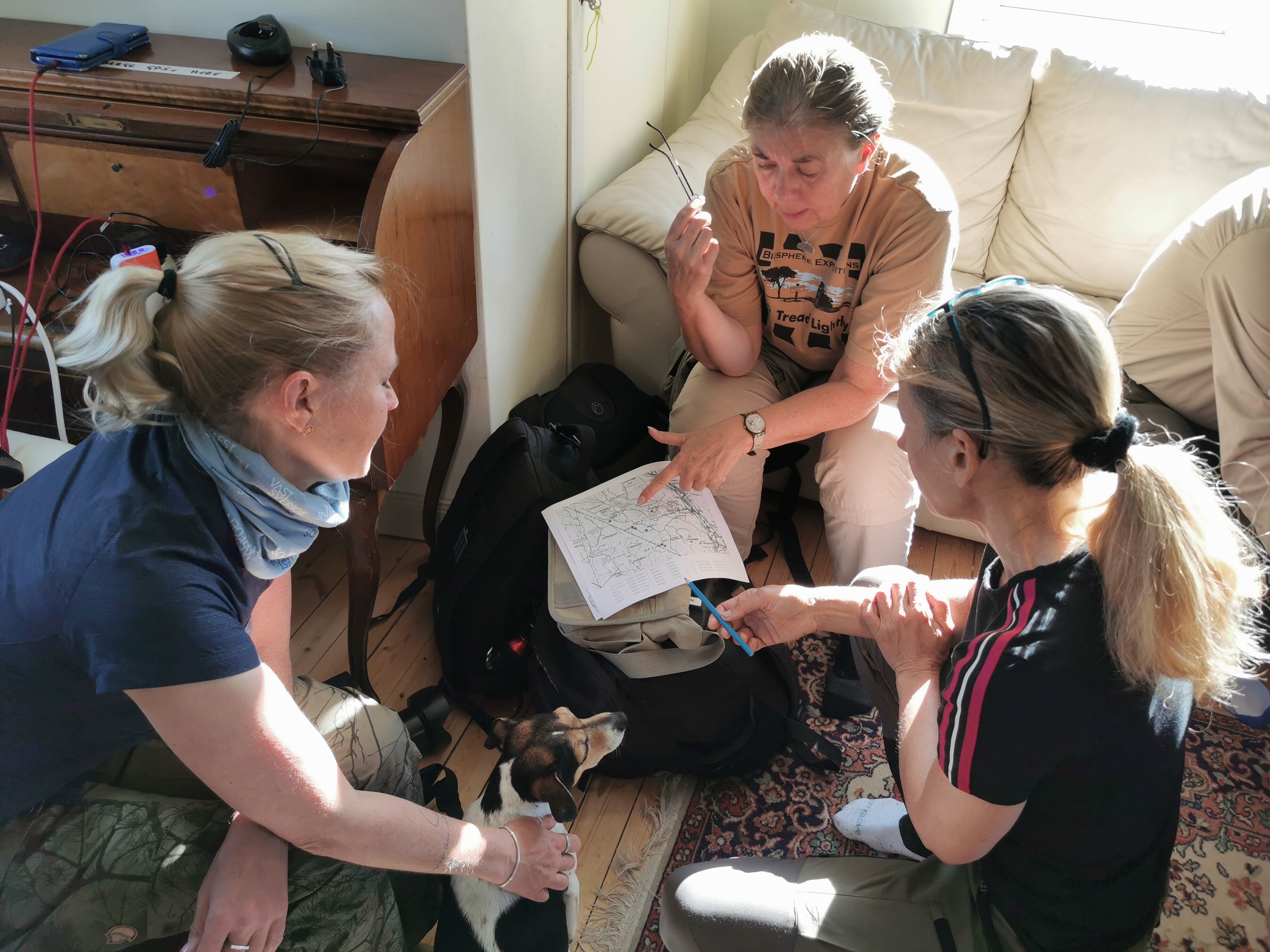
The smell of coffee greets me as I walk into the main house and kitchen, busy with the team having breakfast and making their lunch packs for the day out. Before eight we gather round the map that ominously fills one entire wall, showing how large the study site is and how many bears it can hold in this landscape of forest and water. Andrea, our scientist, has prepared our maps and tasks, a sheet of lines and numbers that would have meant nothing to me only three days ago. Now it holds the keys to my day ahead. Andrea explains where each group should go and briefs them all individually. We then work out the best route to drive there to get us as close as possible to our target sites. Today we have a bear den and a few bear position clusters on our list. The den positions are know den sites that need to be documented. The clusters show where a bear has spent some time in one place. It is our job to find out why it has spent time there. It could be a good feeding site (for example a carcass the bear can feed on). It could be a day bed for a rest. Or something else.
Andrea briefing team 2: Chris and Evelyn.
Today the drive to our first site is about one hour, mainly along a very smooth gravel road and past pretty lakes, waterfalls and seemingly endless forest.
One of the many lakes on the wayWaterfall on the way
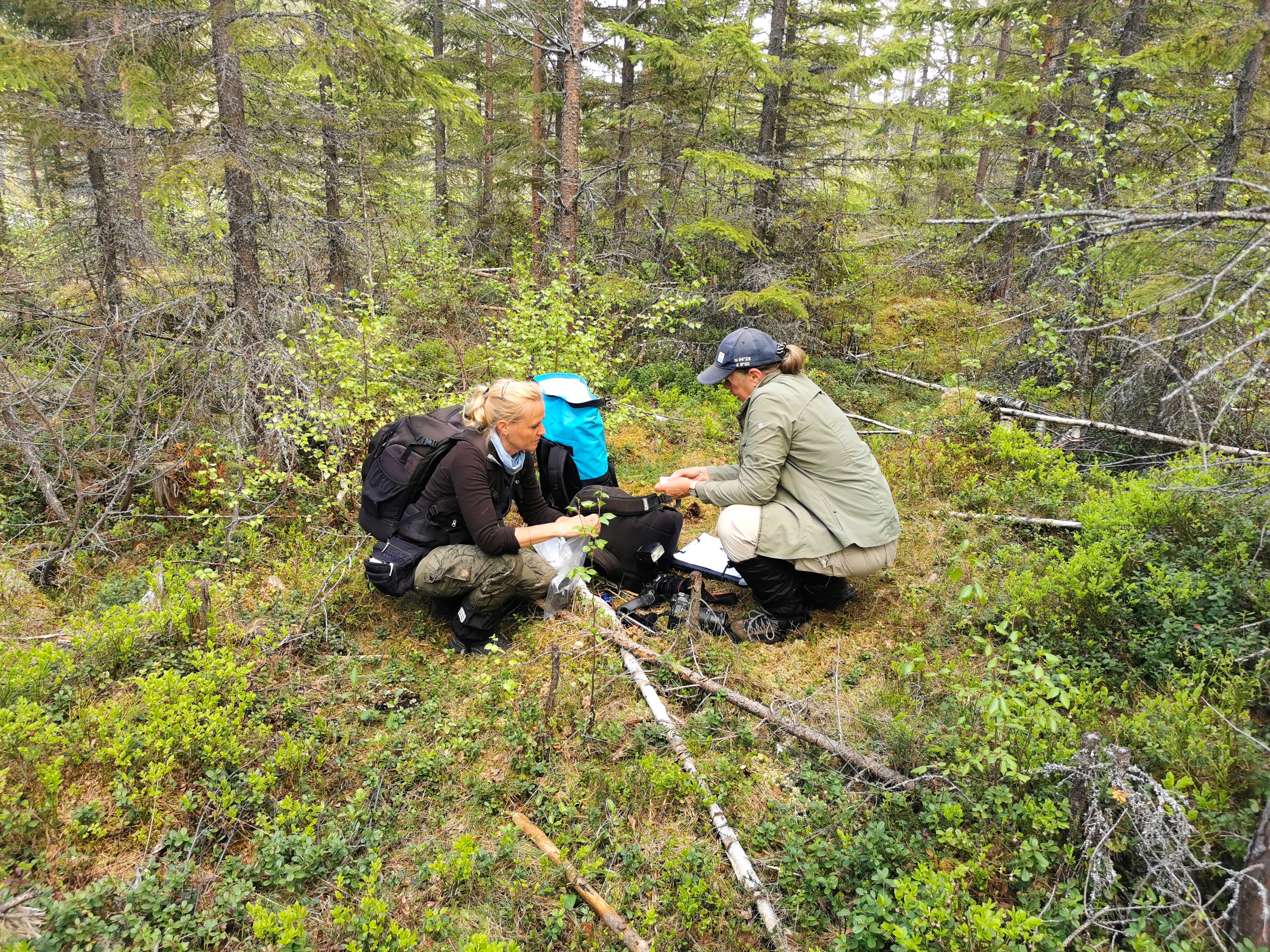
Once at the site, we do two things. First, mark the car position in the GPS so that we can easily find it again. And second – where necessary – check there is no bear at the site. This is done by radio telemetry. If there was a bear nearby, I would hear a clicking beep in the receiver. No sound, so off we go.
Neil checking for bears nearbyPat checking for bears nearby
It’s only 363 m to the den by the GPS. But that can take a while as the going is usually slow over pathless and broken terrain. Today it’s especially tricky as this site has recently been logged, so there are logs, stones, roots and all sorts of other things strewn over the ground. You have to place every footstep carefully and be patient. Actually, I find this meditative, relaxing and mentally taxing at the same time. Once you hit a slow rhythm it’s not bad at all and we get there after 20 minutes or so.
On the way to a bear den
When the GPS beeps to tell us we have reached our target spot, we need to look around the find the den. Sometimes it’s right there and obvious; other times you have to look for it for a while. This one’s easy today. It’s right there, a nest in the ground, shaded and hidden by two small pines.
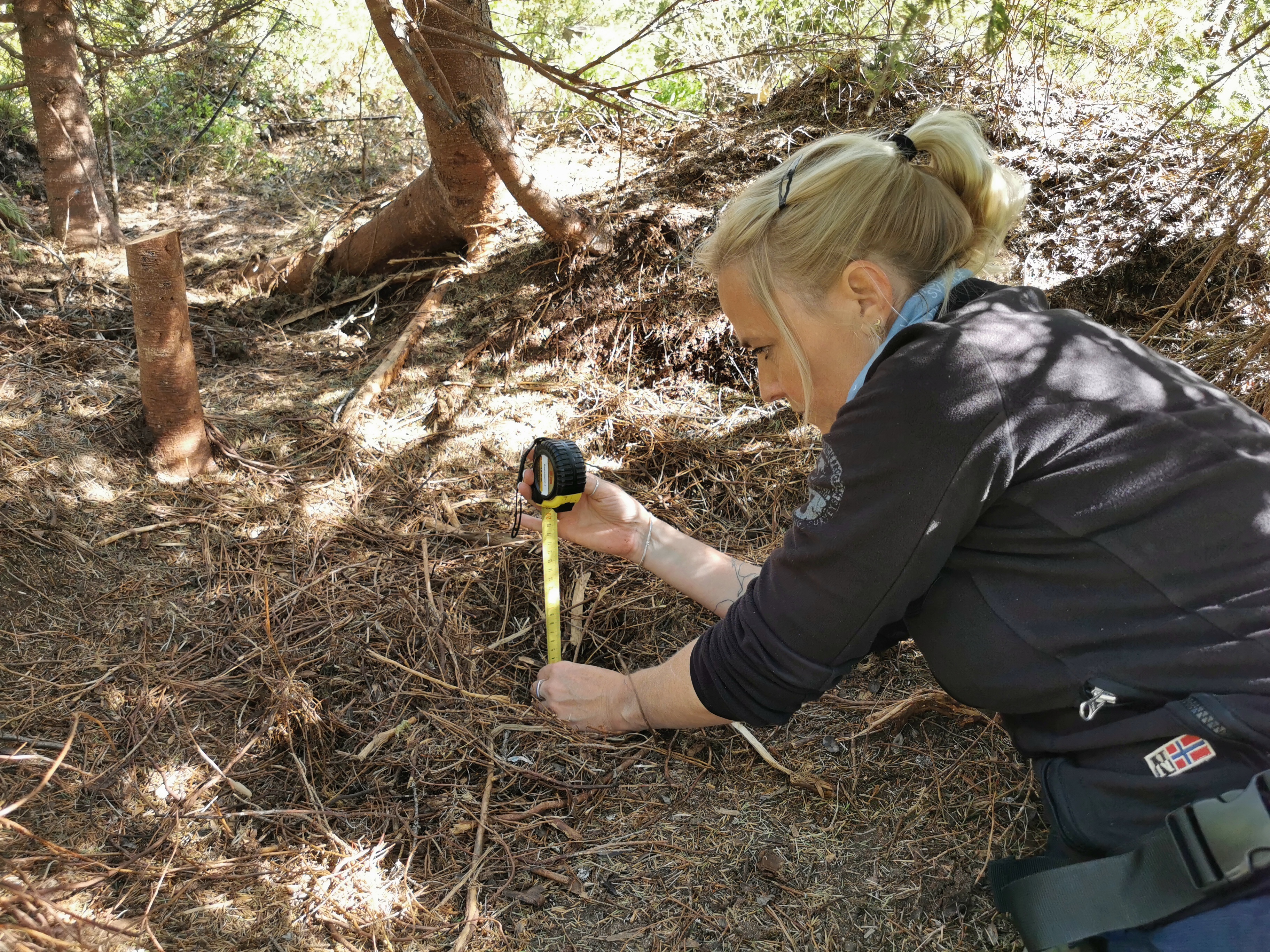
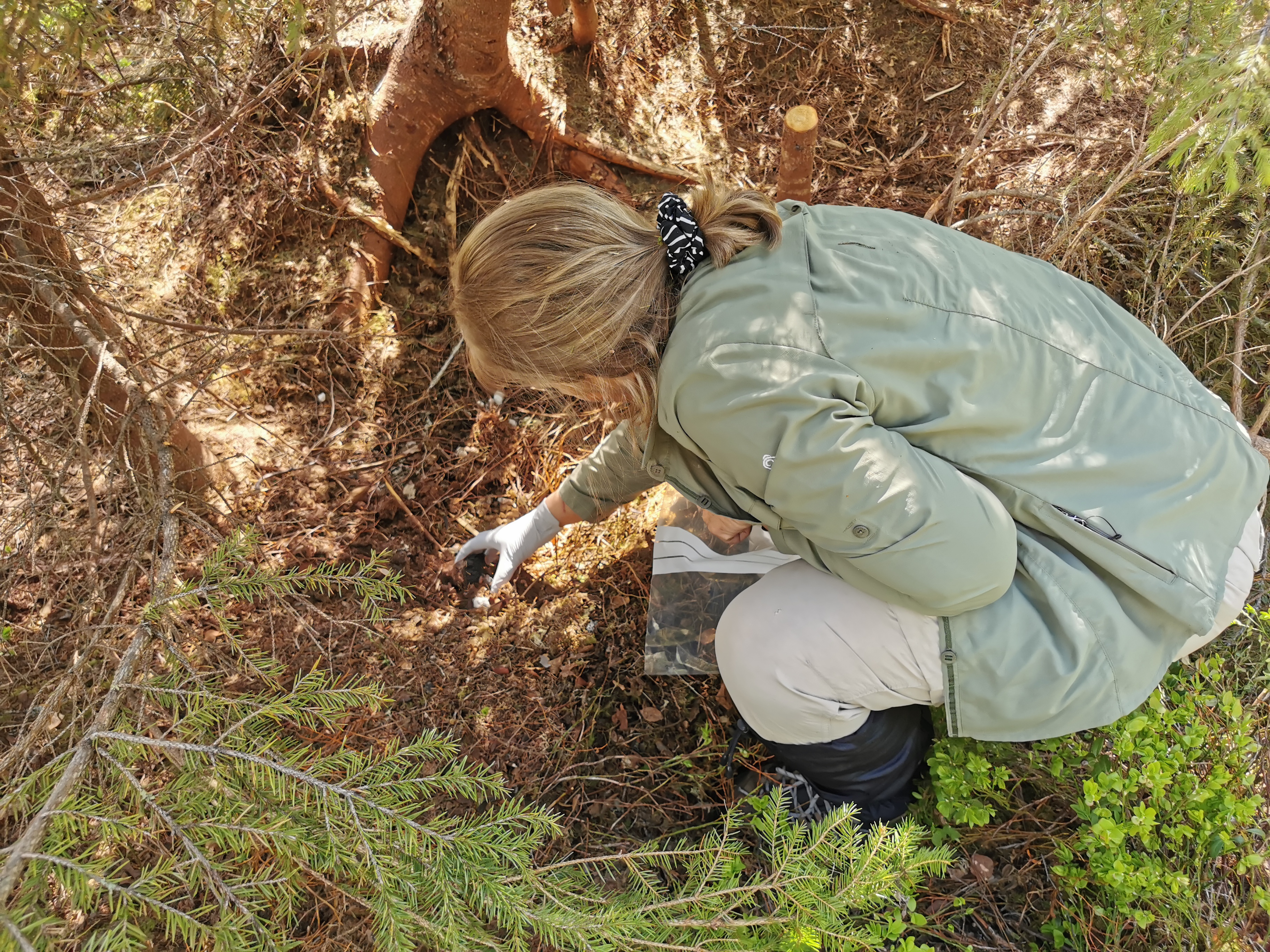
Then the work begins: measuring the den, looking for scats, assessing the vegetation around, how well hidden the den is etc. We have a manual to take us through each step – in case we have forgotten bits of our training – and a datasheet to fill in one field at a time. It takes us about 45 minutes to document everything.
Recording dataMeasuring the nest den bedding depthCollecting scat
Then it’s back to the car and the next site. Another 350 m into the forest. This one’s a cluster site, so we search for clues as to why the bear would have spent time here. We find animal remains. Some bones and moose antlers, chewed down by the bear, probably for its minerals, but nobody is quite sure. A scat that is snowy white and full of bone material. Again we document everything and move on.
Documenting site 2
By the time we get to site 3, the day is already well advanced and we have to hurry. We find scat, bag it quickly for Andrea and get back to the car. An hour’s drive back. A beautiful owl encounter on the way. A quick dip in that lake that beckoned in the morning and we’re back at base, tired but happy. Andrea is happy too, looks at our haul, the datasheets, asks questions and lets us off the hook for a quick shower before the group debrief session, where every group talks the others through their day and results. These are marked on the big map and scored. Ulli and Karin: 8 scats, 9 (!) day beds, 3 carcasses. Pat and Neil: 12 (!) scats and 1 den. Chris & Evelyn: 6 scats, 1 den, 3 chewed antlers and 1 carcass. There are tall tales, much laughter and excellent results. Andrea is happy and that is the point.
The big overview map with results and “scores”
Then off to a delicious dinner of chilly sin carne, lovingly prepared by Roland and Pat, and some well-deserved down-time until we start all over again the next day. It’s not easy being a citizen scientist, but someone’s got to do it 😉
This first diary entry comes earlier than normal, but we wanted to share with you that we now have a new local scientist who will succeed Dr. Volodymy Tytar, who has been there with Biosphere Expeditions since the beginning, leading the science on expeditions to Ukraine, the Altai Republic and most recently the Tien Shan mountains of Kyrgyzstan. Close to retirement, he will sadly not be able to come to his final Tien Shan snow leopard expedition this year as planned, because he wants to stay in Kyiv with his family and people. We salute his and his country’s bravery and thank him for all he has done for Biosphere Expeditions over the past 20 years or so. Thank you Volodya! He will train his successor, Taalai Mambetov, a Kyrgyz scientist, remotely and perhaps return next year for a lap of honour (we hope so anyway).
Outgoing scientist Dr. Volodymyr Tytar
Our incoming scientist is Taalai Mambetov. Taalai holds a Master’s degree from the Faculty of Biology, Kyrgyz National University. He began his scientific career as a junior researcher at the National Academy of Sciences. Since 2017, is as a teacher and field biologist at his alma mater. Taalai has articipated in various projects (ICBA, FFI, Kew Botanical Garden project etc.) mainly related to biodiversity.
He says “I am delighted to be joining the Biosphere Expeditions team to protect the snow leopard and the places where it lives in my beloved Kyrgyzstan. I look forward to learning from Dr. Tytar and to working with the rest of the team, to get up to speed and continue the important work that has already been done. I also look forward to meeting the team of international citizen scientists who have chosen to support conservation, instead of going on a beach holiday somewhere. Thank you for this and for coming to the Tien Shan mountains instead. It will be interesting to talk to all of you about your motivations and to work with you in snow leopard conservation in Kyrgyzstan, my home country.”
Incoming scientist Taalai Mambetov
Together, we will now all crack on to get things ready for you. You won’t hear from us in this diary again until the expedition leaders are on their way as the advance party before the arrival of team 1. May our – and your – preparations and travel go well. See you in Bishkek!
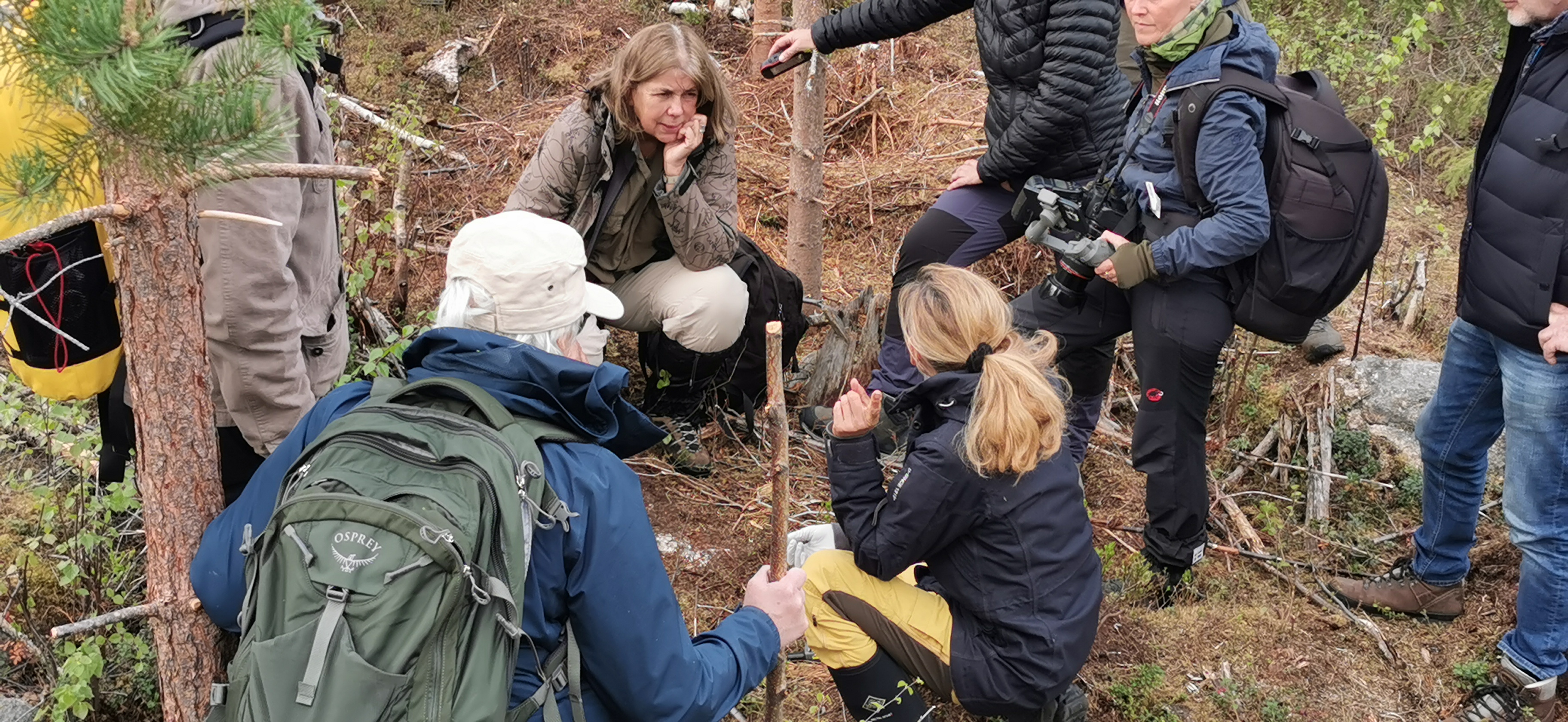
Take a handful of people from all walks of life and from all over Europe (e.g. Germany, UK, Belgium), transfer them from the assembly point to the expedition base (Mora to a fairly remote cottage in the forest), then throw them in at the deep end (background and methodology lectures, new equipment, datasheets, expedition survival and other rules) and – e voilà – as I type this, they are in the forest happily getting drizzled on, using a GPS to find a bear den in the middle of nowhere (first by car and then walking), crawling into it to measure it, collecting little presents the bear has left outside – and then doing it all over again until the day is done and they return to dinner by an open fire.
Well done all of you. Under the guidance of our scientist Andrea and a very capable new (assistant) leader, you have mastered a multitude of new gadgets and techniques in a day and a half and you have earned your new title as citizen scientists. Pat like a gazelle over rough terrain, Neil on his umpteenth expedition overcoming complications, Karin & Ulli finding their keys and feet in English with a gateau on top, Chris geared up to the nines in Swedish plaits, Evelyn dutifully keeping the compass away from the densiometer, Roland mastering the relascope and expedition leading. And they know what these things are, because they are now citizen scientists, helping Andrea with her bear research, her enthusiasm palpable, with a big, grateful smile welcoming the arrival of her new helpers. She is happy in the field, showing us her trade, and so are we.
Tomorrow, after graduation at dinner, they will venture out on their own in twos and threes – no supervision, no mollycoddling – just qualified citizen scientists going about their business in remote corners of the forest, sent there by Andrea with instructions to go find a den, a bear cluster or whatever else Andrea needs us to do.
And Sweden, oh Sweden, does the rest. The endless forests of orange, green and white, the lakes beckoning intrepid swimmers, the bogs lurking behind the trees and rocks, the picture-perfect red cottages with their white window sashes, the moose ambling through the lichen, the silent solitude, the cool wind, the presence of the bear evident all around us – if you know what to look for, the Scandinavian beauty of it all that will stay with us long after we have gone, just like the data we have collected for Andrea will stay with her. A small legacy for the bears, the project, the planet. And that, in a nutshell, is what it’s all about.
Introductory lectureAround the open fireThis is where I need to you go todayStudy site for todayGetting to a bear denAt the bear den
After a lot of driving, a bit of shopping and a night on the road, the advance team for our bear volunteer expedition to Sweden is now on site. The site is and the last 450 km of the drive were as beautiful as ever. However, the weather for our expedition won’t be able to keep up (overcast, chilly). The good news in this kind of weather is that the mosquitoes will by and large be too chilly to go out to make a living.
Driving (bridge that connects Denmark with Sweden)ShoppingRoland and Andrea in discussion whilst setting upRainbow over the study site
Expedition base this morning
Unfortunately one person has tested positive at home and can’t come and another one could not get a visa in time, so we are down to a smaller crew, which will have to work twice as hard to make up 😉 More details about how when you get here.
It is with great pleasure that I am able to tell you that we are setting off on expedition number two since Covid: our bear conservation project in Sweden. I am Matthias, your expedition leader.
Much has happened since we had to postpone Azores 2020 due to Covid. Biosphere Expeditions itself was able to survive due to the generosity of many private donors and help from the governments of Ireland, Germany and the UK. Thank you to all for this.
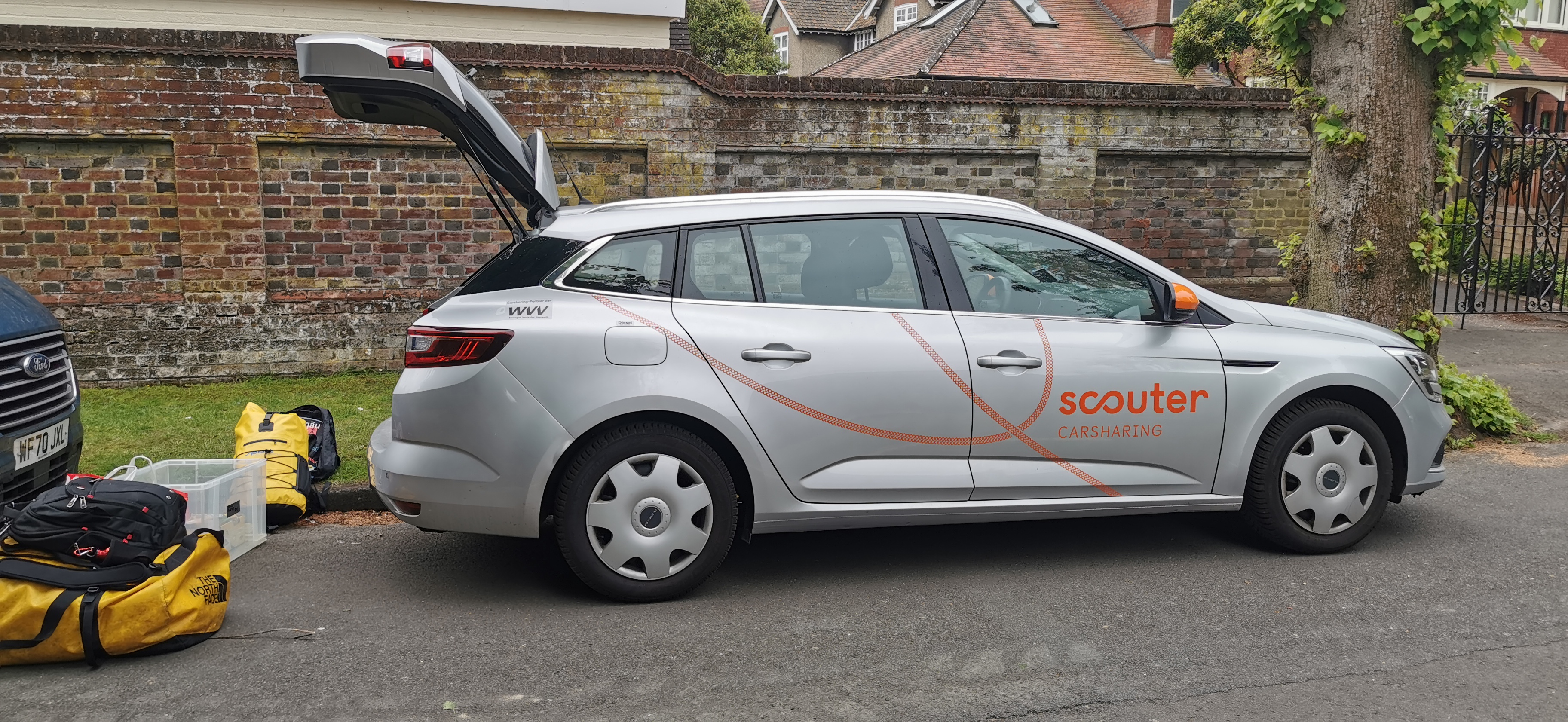
We also used the pandemic to get rid of our fleet of cars and now only use car share, car hire and private vehicles of expeditioners. The first and the last are relevant to this expedition and I would also like to thank those expeditioners who will make their cars available for the expedition.
I am in a car share in the UK at the moment and will collect rookie expedition leader Roland in a few hours in Harwich, before we take the night ferry to the Continent. Roland will assist me on this expedition and learn the ropes. Tomorrow we will drive through the Netherlands and Germany, where we will also do some food shopping. We should make it to our expedition base in Sweden by Tuesday night or Wednesday morning (it’s about 2000 km) and I will be in touch with more news and a weather update then.
Talking about cars and food, the first honourable mention of the expedition goes to Pat, a dear and true expedition addict, who will also be driving to Sweden in a car full of equipment and food for all of us. Thank you for this Pat!
And now for some expedition admin: We will be using Finnish Tracker App on this expedition (with water resistant phones for each group), for navigation, data entry, tracking etc. If you want to have a look at / play with the app, there is a 10 day trial version you can download via https://tracker.fi/en/frontpage/ .
Enough for now. We’re on our way. You will be soon too. Safe travels. We will see you all in Mora and be in touch via this diary before. Thank you for giving up your time and funds to become bear conservation volunteers with us.
It was the first expedition to run after two years of the Covid pandemic. A total of 23 whale and dolphin volunteers from all corners of the world joined Lisa, our scientist, and myself in Horta for whale and dolphin volunteer action. Except for one brave man, it was women power all around on this 16th expedition!
We were reminded of the volcanic nature of the Azores archipelago with a lot of seismic activity on the nearby island of São George, but an eruption never came. After two years of lockdowns, many of us had were keen to explore new horizons, gain news skills and most of all contribute to the conservation of these fascinating animal group of cetaceans.
No citizen scientists tested positive, there were no major issues, great sightings, excellent team spirit, a wealth of data and high degree of satisfaction for those involved. Let me summarise our findings in a nutshell for you:
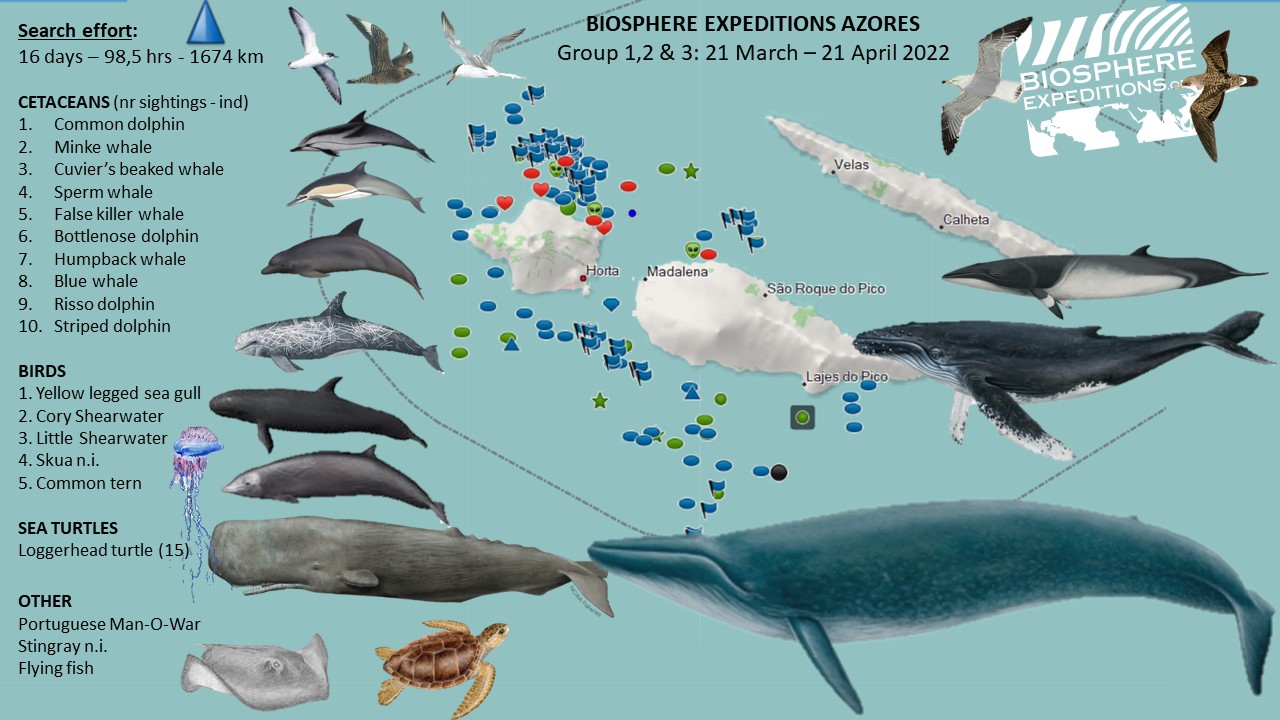
In total three groups of Azores volunteers spent 16 days out at sea, adding up to almost 100 sea-hours while covering 1,674 km around the islands of Faial, Pico and São George. Our search effort resulted in 127 sightings of 10 different cetacean species. Every group was treated to a subset of these and each one had their unique sightings and highlights.
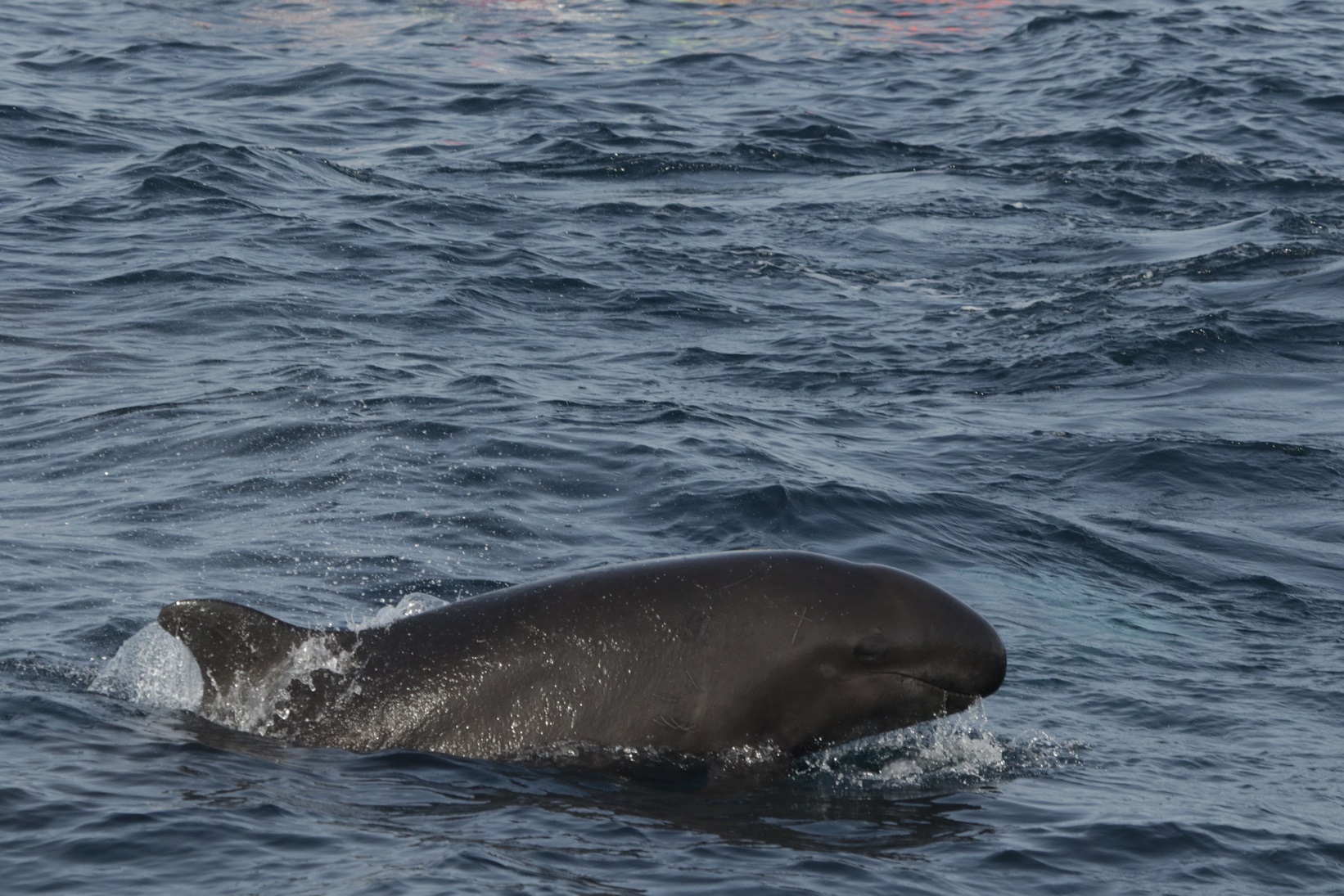
For Group 1 it was very impressive to come across a group of 75 false killer whales feeding on tuna with seabirds all around. Group 2’s most exciting moment was spotting our first blue whale in sea state 6 ‘all hands on deck’ and Group 3 definitely wins the prize of the rarest sighting ever, seeing a leucistic white humpback whale.
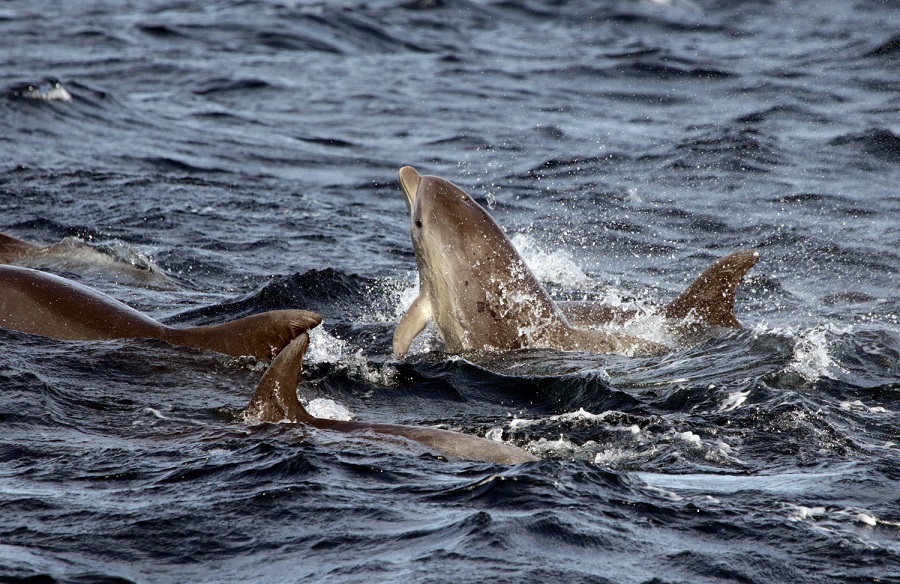
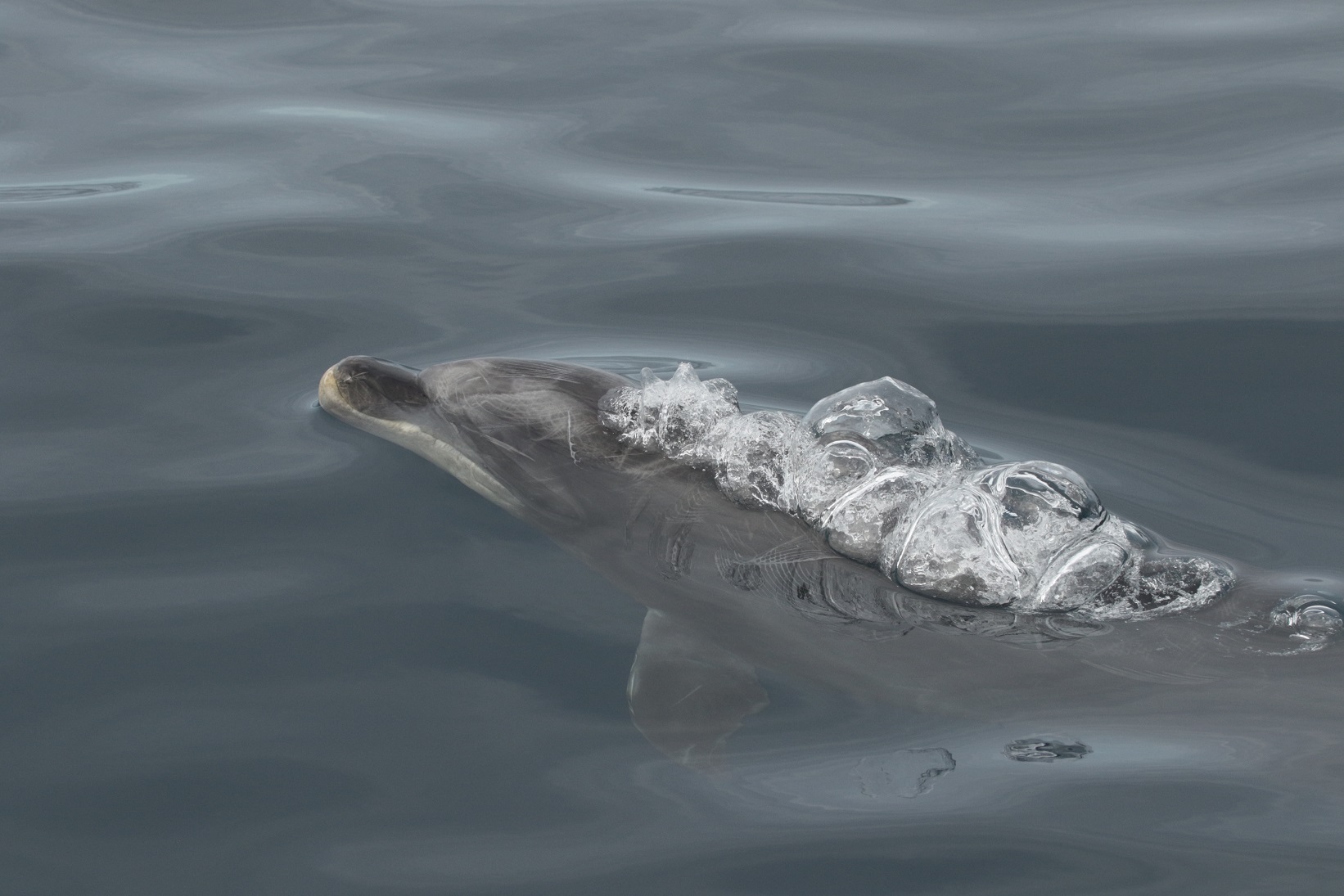
Working our way through the species list, no one will be surprised to hear that common dolphins ome in first in terms of abundance, with 48 sightings and a total of 1,800 individuals. Second comes the iconic sperm whale, Lisa’s main research focus, with 59 sightings. Baleen whales are known to migrate through Azorean waters in spring, hence the timing of our expedition. We were treated to six humpback whales during three different encounters, one minke whale just outside Horta harbour and three majestic blue whales. As for dolphins, most of which are resident, the well-known bottlenose dolphins were spotted five times, we saw mysterious Risso’s dolphins on four occasions and had two encounters with striped dolphins. Last but not least, group 1 also got lucky to see five elusive beaked whales.
But Biosphere Expeditions obviously goes beyond listing species and counting numbers. The main purpose of our expedition is to understand population dynamics, local movements, seasonal migration patterns, as well as group composition and reproduction. Out of the total of 59 sperm whale sightings, we managed to identify 44 individuals of which 18 (40%) are known individuals and 26 (60%) are new individuals of which fluke shots were added to the catalogue. We actually repeated one individual within the expedition, sighted both on 28 March as well as 19 April. Within the known individuals, there are three well-known groups: the one of nr 19 first seen in 1987, the group of 1598 and the group of 2808-2448-3483-6089 with calves of last year. We also spotted a few male sperm whales, one of which is known as Tiktok, that seem to be more resident around the Azores archipelago, often sighted close to São Miguel. This is rather unusual, as most males migrate to the Northern Atlantic for food, while the females are known to stick around.
As for the humpback whales, one of the North Atlantic experts for the species confirmed that one fluke shot we took was matched to an individual seen in October 2014 and in January 2015 in the Tromsø–Andenes region in the north of Norway. Our white humpback whale, called Willow, is rather unique, being the only known white individual in the Northern Atlantic. So based on this feature together with its fluke ID, we were able to confirm that this individual was seen in the breeding grounds of Guadeloupe in 2015, 2019, 2020 as well as in the feeding grounds of Spitzbergen in 2012. A tissue sample had been taken there, indicating Willow is a male. This demonstrates how every fluke photo adds pieces of the puzzle that make up the life history of these long-lived migrating baleen whales.
Regarding the blue whales, the two individuals we spotted travelling together were resightings from the Azores. One was seen there before in 2010 and the other one in 2006, 2010, 2014 and 2018, as confirmed by the expert Richard Sears, showing that at least some individuals use the same migration routes.
Dorsal fin photos were sorted by our whale citizen scientists and sent off to Karen Hartmann, expert of Risso’s dolphins, and to other colleagues working on bottlenose dolphins and false killer whales. These species are considered resident around the islands and we recognised some individuals with distinctive dorsal fins in groups of varying sizes, so as more feedback comes in form the experts, it will also generate increased understanding of these dolphin species.
This year we collaborated closely with the University of the Azores by testing the beta version of the Monicet app, which was released just before the start of the expedition. Our team provided several recommendations, which will be included in an improved version to be released by the end of April. The idea is to roll out the use of the Monicet app to all whale watching vessels in the Azores to further increase data collection and sharing.
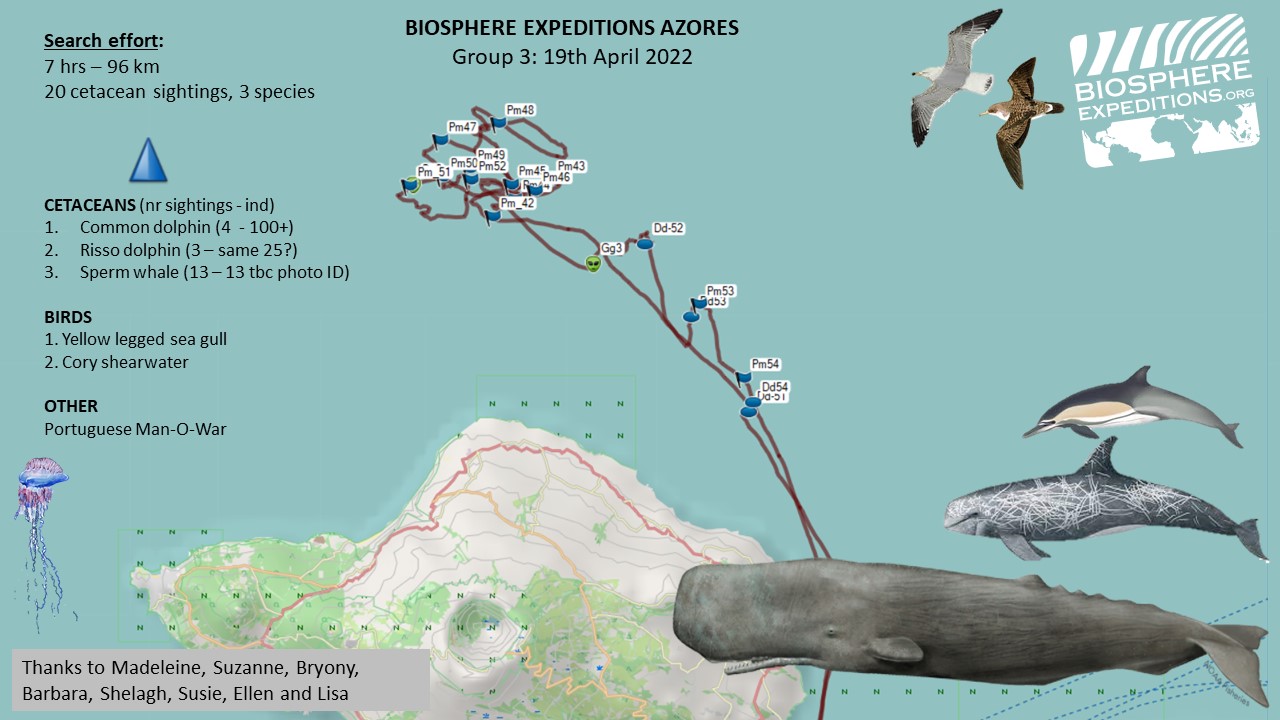
We look forward seeing the first results published and were glad to contribute to these. We also worked with more advanced GPS units, which allowed to record tracks and sightings as you can see from the included maps, which show our sightings during March and April.
Lisa will continue to use this GPS and as more data get uploaded, it will give further insight into movements in space and time of different species, while understanding which are hotspot priority areas for feeding and resting that merit further protection.
Thanks again to Lisa for sharing her expertise with all of us, to captain Siso for sailing us safely through sometimes rough seas, to all lookouts on land for spotting the animals for us and to Jim and Claudia for being excellent hosts. Last but not least, a big thank you to an international team of expeditioners joining us and dedicating their free time, energy, resources and enthusiasm to collecting data and contributing to the conservation of these magnificent creatures of the sea. We hope to welcome more expeditioners in 2023 for expedition nr 17 to continue our long-term monitoring work.
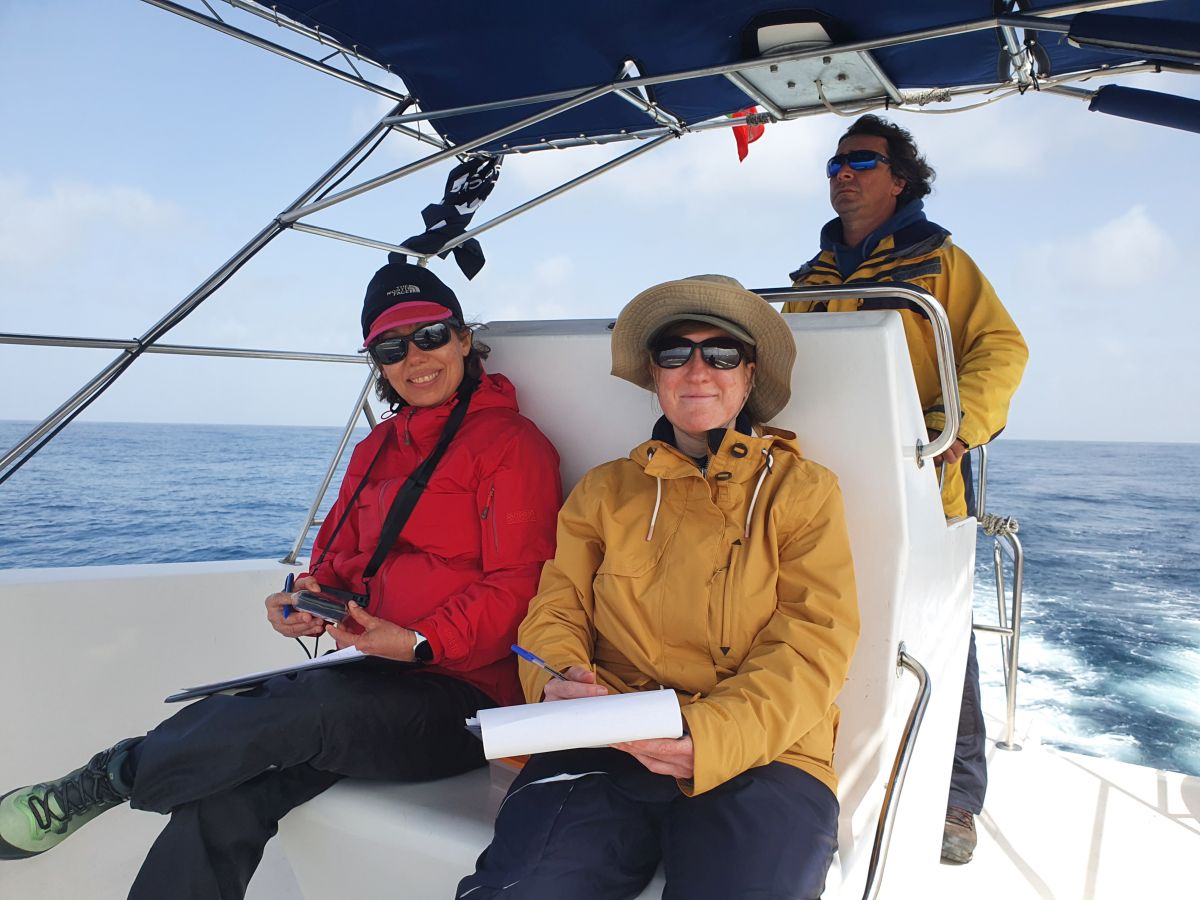
On Tuesday our marine volunteer team headed out to the north of Faial for some great sperm whale encounters. One after the other came up to the surface, making us head into all wind directions trying to get those perfect photo ID shots. While we were hoping for flukes all around, a lot of them did shallow dives and then disappeared making it difficult to identify who we were actually dealing with. Yet we did get what we came for and one male, named ‘Tiktok’ known to hang around São Miguel was one of the ‘usual suspects’. So yes, these creatures can be elusive. But once caught on camera, the detective work starts and completes insight to their walks of life. No more secrets for the whale citizen scientists on board.
Along our track we were also treated to another two sightings of Risso’s dolphins. Karin Hartman, Lisa’s friend and colleague, confirmed that on our previous Risso’s sighting, one female called Albi was seen for the first time with a calf. The group we saw also had calves. And of course our most loyal friends, the common dolphins, joined us for a little while too. A day without them no longer feels complete.
On Thursday – the last day of the expedition – our Azores volunteers headed out eastwards for the channel between Pico and São George where – yes, you guessed it – there were more sperm whales. And on our final day, we were spoiled by smooth sailing, a flat sea surface and limited wind. Sea legs all around and even the photographers on board no longer needed ‘support’ from their fellow citizen scientists to keep standing. Bryony got top marks for scoring a double sperm whale fluke shot. We also saw mothers and suckling calves and sperm whales not finishing their meal. This meant we had parts of octopus floating around on the surface near the area where they were foraging and feeding. Even these bits were photographed and sent off to experts for identification. Lisa confirmed during the debriefing that these were ‘new’ sperm whales not sighted before.
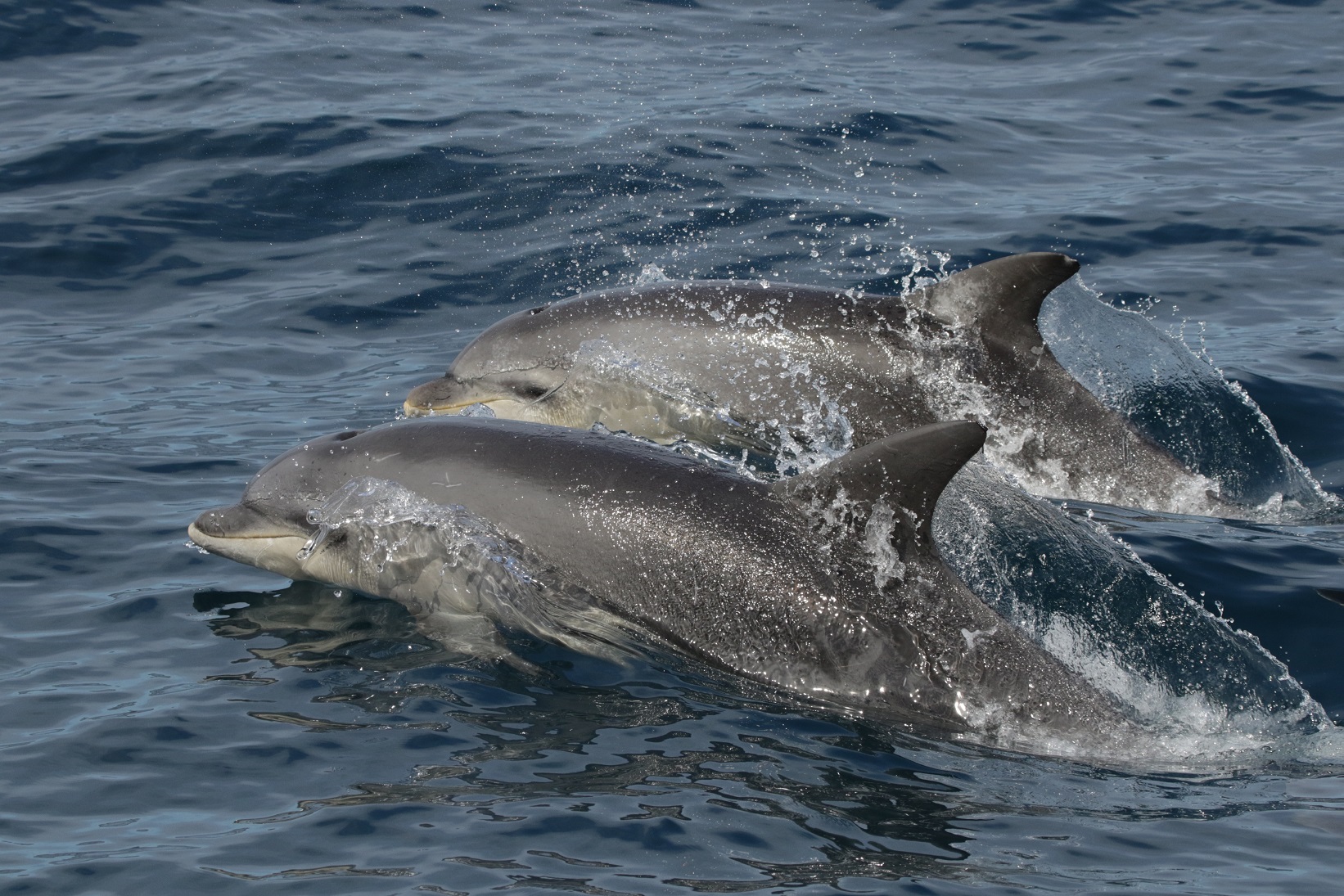
The Risso’s dolphins made another graceful appearance and of course on this last day, the bowriding common dolphins had to be present as well. On our way back, we had our goodbye sighting of this year’s expedition: a large group of bottlenose dolphins jumping on the horizon and then coming closer and displaying all their grandeur near the boat, leaving us with a sunset in the background. It could not have been more perfect.
It was very silent on the catamaran, each and everyone of us absorbing this special moment, leaving us with gratitude for a week well spent, full of magnificent sightings, while each and and every one of us had contributed to data collection sent of to different experts. Another great team effort, contributing to fundamental research that is required to set conservation measures for the great Azorean cetacean diversity. We were all glad to be part of it.
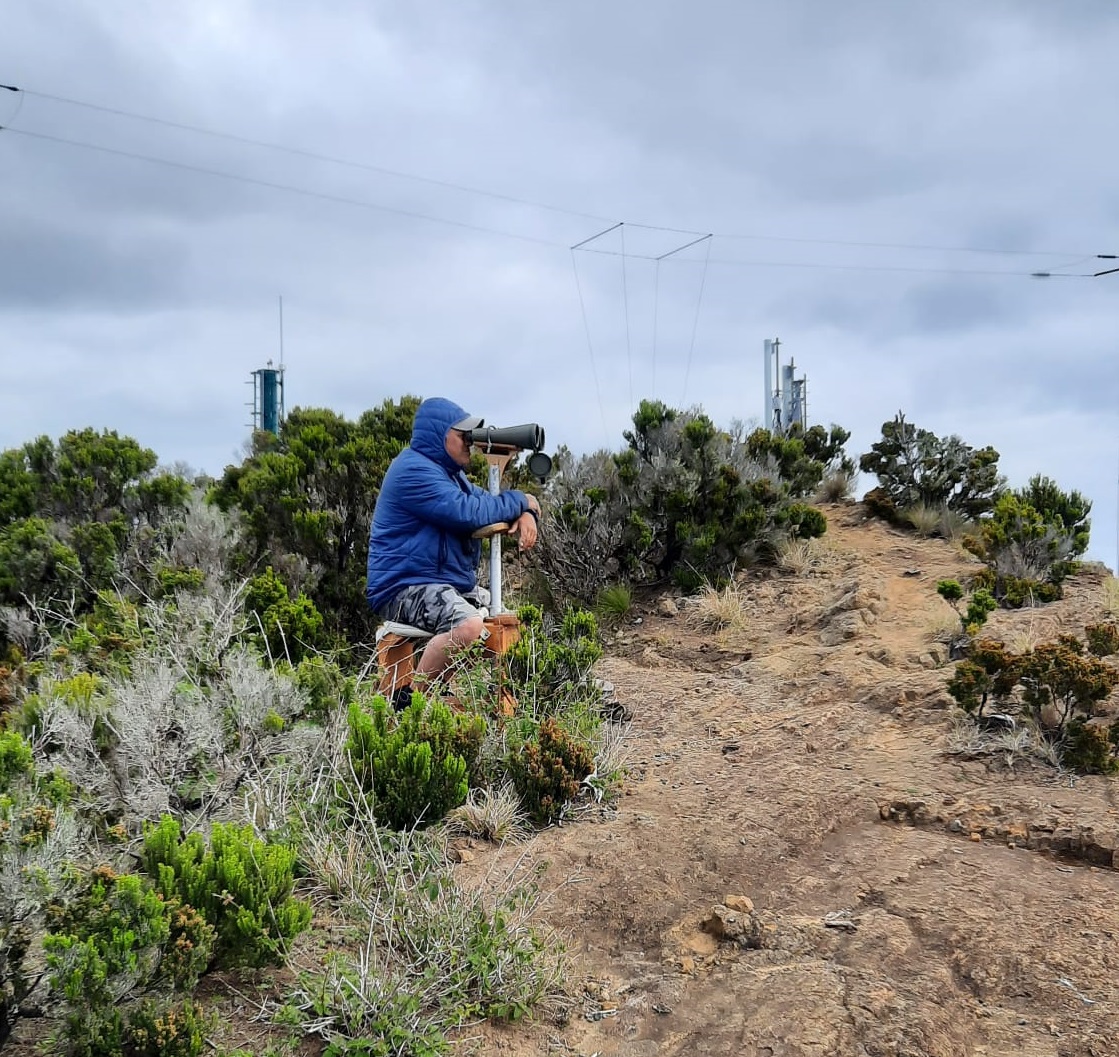
At the end of this season, I would like to say a special thank you to the vigias – lookouts on land. From their viewpoints spread over Faial and Pico, they scan sections of the ocean all day long tell us where to go. Nearly 80% of all our whale sightings are thanks to their work and dedication, with the other 20% a result of listening to the hydrophone or by spotting blows off in the distance by chance. So we owe them big time for the amazing sightings and it was always a lot of fun to hear their contagious enthusiasm on the radio…’uma baleia’ ( a whale). We get the close and personal encounters while they spend their working lives on the cliffs. peering into the distance. Muito obrigada!
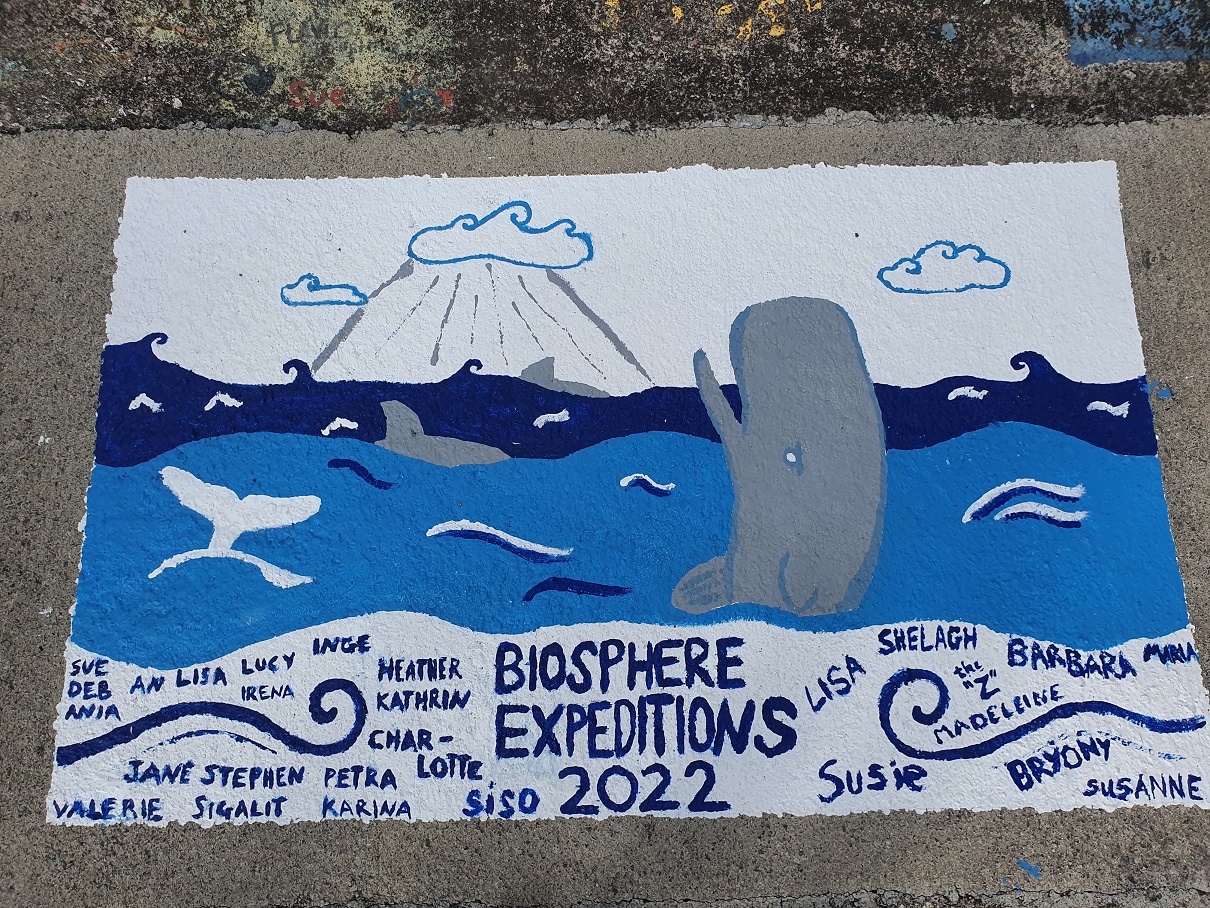
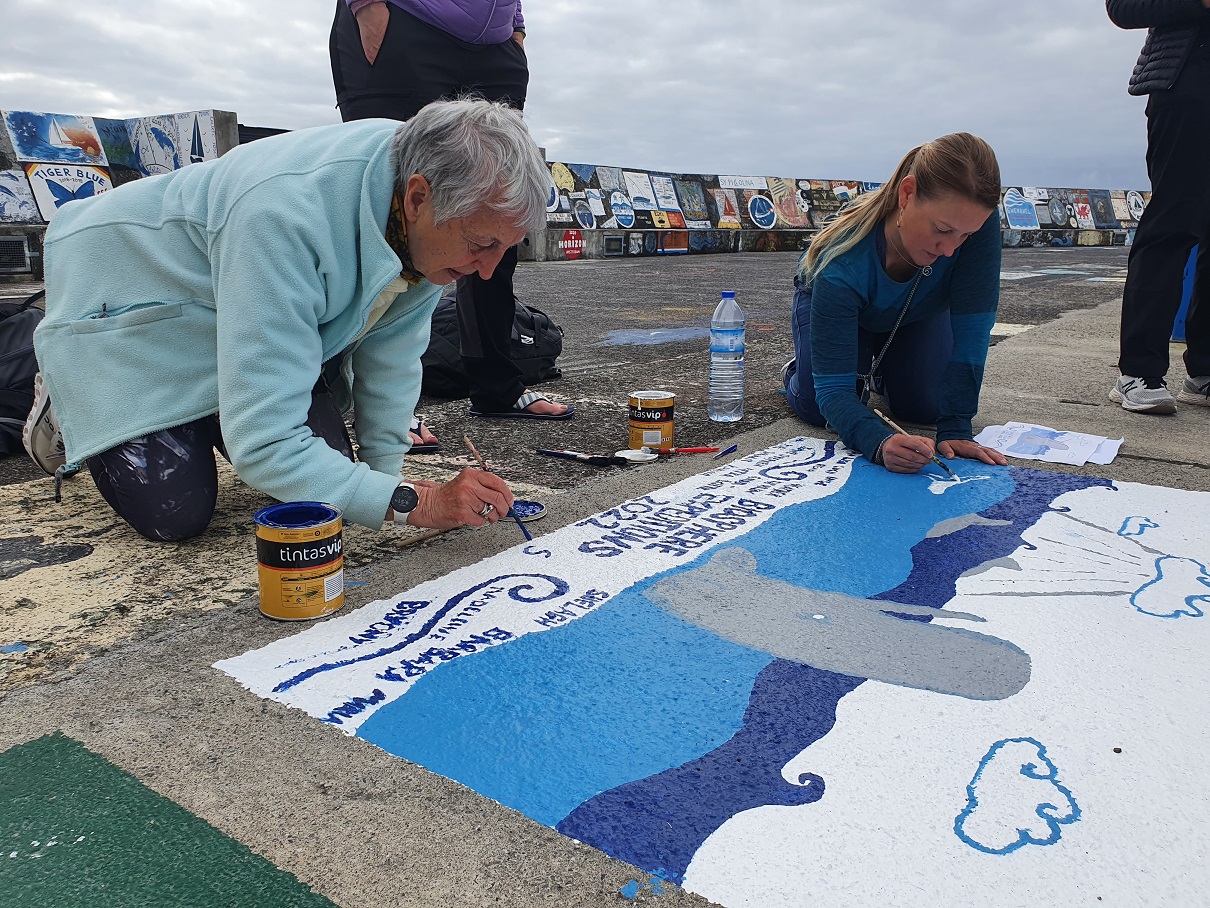
To conclude this last group, let me tall you about a nice tradition in Horta: the paintings in the harbour. These are mostly done by sailors passing through on a trans-Atlantic trip or a tour around the world. It is supposed to bring good luck out at sea. These paintings turn the harbour in a colourful outdoor graffiti exhibition space, telling the many stories of those who passed by here. Of course we join in every year, this time with a design reflecting the cetacean sightings we had. Kathryn from group 1, who is an illustrator, came up with the design and outline of the drawing, Lucy from Group 2 added the names, while Group 3 added our leucistic humpback, more names and a final finishing touch of the waves. Of course I am biased, but I do think that our drawing does stand out in the harbour and deserves its place next to the ones from previous expeditions….. Safe journey back home to all our whale and dolphin volunteers and thanks for making this season a good success ! For an overview of what we achieved, stay tuned for our final blog.
























 Biosphere Expeditions: blogs from the frontline of wildlife conservation and the fight for a more sustainable planet