Award-winning, non-profit and ethical wildlife conservation volunteering. Advancing citizen science and conservation since 1999 – for nature, not profit.
The last few days have been wonderful despite pessimistic weather forecasting. Plenty of harbour porpoise swimming around the inshore waters including a family of them playing around south of Kerrera island yesterday afternoon. We are currently slapping suncream on as we conduct our last survey en route to Tobermory and the harbour porpoise are out again. It is a shame it all has to come to an end, at least for group 3 tomorrow.
Everybody worked extremely hard and have formed a formidable whale spotting team! This is down to excellent training from Olivia and commitment from staff and team members alike. We had fun too! Our only failed objective was to bring James round to liking Marmite. He may still find we slip a pot of it into is bag for the journey back to the States!
Our survey totals are, 411.1 miles covered, 103 sightings,172 animals, 105 harbour porpoise, 6 minke whales, 21 basking sharks, 7 grey seal, 16 common seal, 220 acoustic readings (219 were harbour porpoise), 263 creels and 41 pieces of litter.
We will all be saying our goodbyes tomorrow morning after a send-off meal in Tobermory tonight. I hope the next team have been keeping up to date and know what to expect! I will send a diary update on Monday with details for the next group as it all starts for us again!
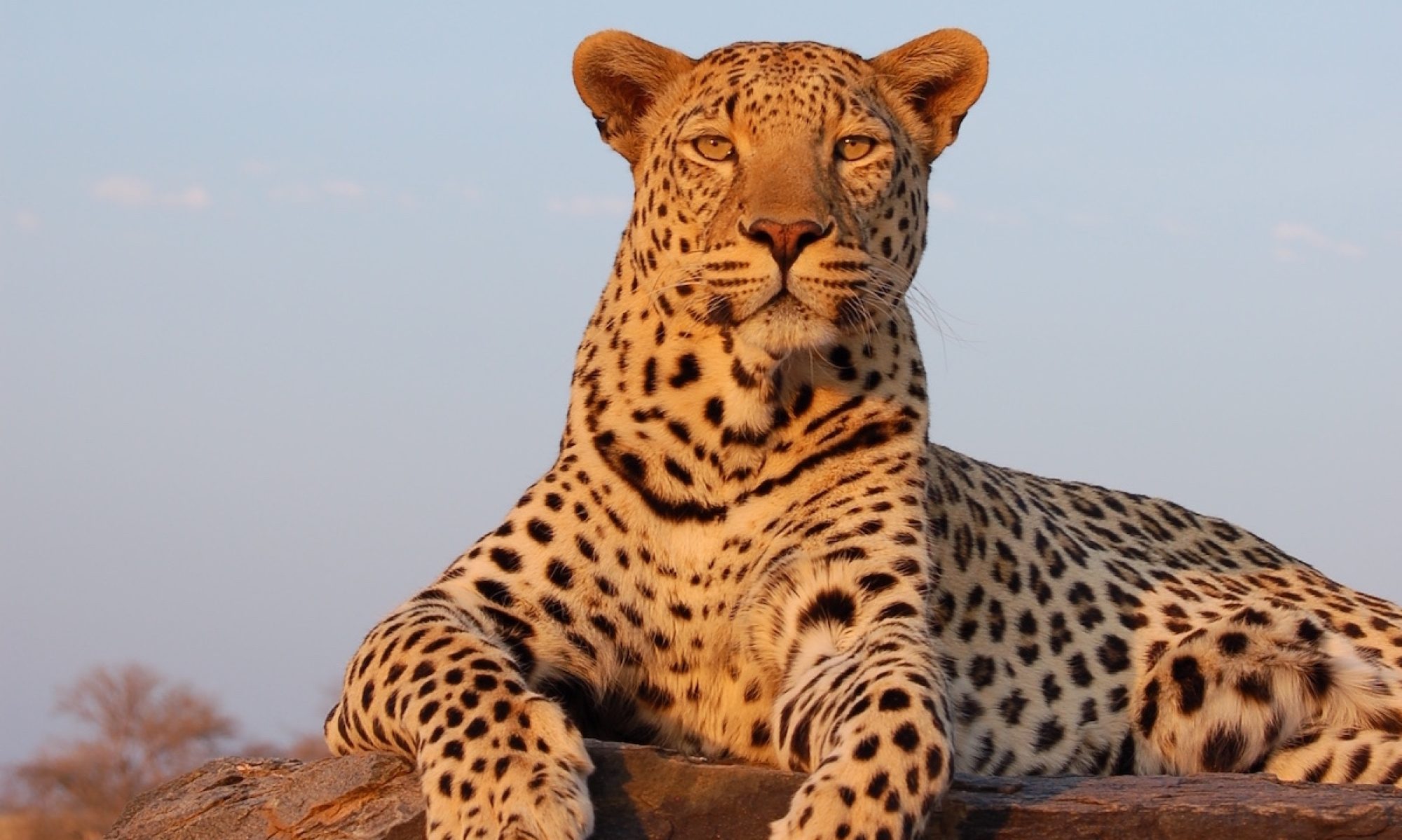
Thursday was our vehicle game drive, and vehicle one came across a fresh place where a leopard had made a kill and we saw the drag marks across the road (good eyes Gary!)
This is a really good example of why the work the volunteers are doing here is so important…without all the extra “eyes” in various places all over the farm, Vera would never have seen the drag marks on her own. Her normal path of travel to base camp is on the other side of the bush, and she would never have seen the fresh kill if not for the volunteers. So a huge thank you to the teams for extending her reach into the study area.
It was really a pleasure to watch how team two communicated via radios and SMS, and through everyone’s efforts – and flexibility – we were able to move and set up two box traps at the kill site that afternoon. The next morning we were rewarded with a HUGE male leopard (69 kg) in the trap. Vera and the IZW team weighed, took DNA samples, and collared him. Recognise Shelagh from team 1?
This slideshow requires JavaScript.
And, this just in from Vera: she has confirmed through ID pictures that the male leopard caught on the camera trap that walked by the hole in the fence but did not come through is, in fact, the very leopard that we have just caught and collared. So, a huge thanks again to team 1 for identifying that hole in the fence and helping to monitor the camera traps there. Way to go teams 1 and 2!
Team Two was greeted the first day with rhinos coming to the water hole at base camp (thanks Claire for the awesome picture!).
Luckily I was done with my briefing for the day, otherwise it would have been stiff competition. The team is now fully briefed and already in action in the field. Monday we did our driver training then checked the box traps. We decided to take the long way home and were rewarded with an extended encounter with a family group of sable antelope. Then just after that we saw not one, but TWO aardvark, and we have determined where they live, which is very exciting.
Tuesday morning the team learned how to change a flat tyre, and were already working well together. Vera brought us all to the box trap at Frankposten, where she gave a demonstration to the group on how the traps work. John volunteered to be the “animal” as long as we promised to release him. Claire did some housekeeping at the trap brushing off the soil so we would be able to see tracks the next day.
After the box trap demo we split up into three teams and went off to our activities: tracks and scats, elephants, and water hole. The elephant team was joined by scientist Joerg Melzheimer and treated to a memorable encounter with the elephants.
Tuesday afternoon the box trap team also found excitement with a female warthog caught in the JM trap. This morning a different box trap team found more excitement with a porcupine in the Frankposten trap. The morning waterhole team was treated to a myriad of animals at Frankposten, including some juvenile giraffes taking a drink. In the afternoon the elephant team had a long encounter with the elephants and was amazed to see the 1 meter branches that the elephants were breaking off the shrubs and eating. The afternoon waterhole team went to Boma, our tree-house hide, and had an interesting afternoon despite Andrew being allergic to the tree they were sitting in. The afternoon camera trap team collected SD cards and looked at pictures and saw heaps of cows but no carnivores in the pictures.
The last few days have been wet and windy making survey efforts very interesting! Usually this sort of weather would hamper our ability to spot our target species. However, the results have been quite positive. A few minke whale sightings have kept us on our toes and harbour porpoise sightings are still frequent. The hydrophone is showing up plenty of results, 33 separate porpoise clicks shown yesterday but only four sightings – this highlights the difficulty of spotting in rough weather.
Wet + windy = rainbow
Delicious neeps, taties and (veggie) haggis were served for dinner last night. The tourist myth of a haggis being a live animal running around the highlands was truly busted after the flawed logic of eating a vegetable-based animal was exposed.
Today we are heading down the Sound of Mull in the light drizzle and the first watch has been set. Everyone is in high spirits, we have formed a truly committed scientific team!
Due to poor internet connection in Iquitos I am writing this year’s final diary entry from my desk in Germany. It was on Friday night when a special thank you & farewell surprise cake from the kitchen was served by Daniel. He kept his secret so let’s guess that many, many camu camu fruits were squeezed to create the impressively pink topping!
The Peru 2013 expedition officially came to an end in Iquitos on Saturday. While Conny & Thomas, Kathy & Stuart went out for a drink (…or two) and Sven relaxed at his posh hotel pool sipping pisco sour, your hard-working expedition leader went through final equipment checks, packing up and storing the boxes… 😉
Again, a big thank you goes to everyone for your contribution, enthusiasm and input in many ways. We’ve walked more than 100 km of transects, canoed up and down river every single day, set up and collected eight camera traps, some of them at pretty remote sites. We collected a great amount of valuable data not only from the camera trap pictures. All of this could not have been achieved without you. The data will be analysed in detail by Alfredo and we’ll let you know as soon as the full report is available. Special thanks also goes to the ARC staff & helpers that supported, guided and fed us so well at base.
I hope you’ve now all arrived back home safely or are enjoying your onward journeys. You’ve been great team members and mates – I hope you’ve enjoyed the time out in the jungle as much as I did.
Take care, stay in touch and I hope to see you again somewhere…
For those of you waiting impatiently for the results of the camera traps, they are now on https://biosphereexpeditions.wordpress.com/ (apologies for only getting this out now, but my internet connection was virtually non-existent until today).
Without much further ado, we found three pictures of a jaguar. The pictures were taken on the trail grid on Saturday morning, only a few hours after the SD card was exchanged. It was on Saturday morning when our friend walked by – I guess he enjoyed the silence while we were on our way downriver to the main lodge. The camera was located at I9 so close to the footprint found a day earlier at G10. Unfortunately the pictures are blury due to a fungus covering the camera’s lense. Thanks to Photoshop, the result is not too bad, don’t you think?
Another thrilling result is a picture of a jaguarundi taken at terra firme. For the first time ever the presence of this speices has now been proved by a picture – you can imagine that Alfredo is very happy about it. His first conclusion is that the elusive cat possibly never comes down to the flooded areas.
A great number of other mammals were also potographed: opossum, red brocket deer, agouti… more agoutis, armadillo, paca and yes – you guessed it – a yellow-crowned brush-tailed rat! Considering that the camera traps have only been out for nine nights our work including long walks beyond the trail grid has already been greatly rewarded.
After the excitement of the first day’s survey, Friday was relatively quiet with a few harbour porpoises sightings. Not that this mattered at all- we were bathed in glorious sunshine for the day and were treated to some fantastic views. Fastidious listening to the shipping forecast by our skipper John provided news of an approaching low pressure system over Saturday. With gales forecast, we hunkered in a sheltered loch out of the wind as the drama in the open sea unfolded. Saturday was not, however, wasted. Talks from Olivia on the birds of the Hebrides would set up even the most unsure ornithologists for the bird surveys that were being introduced today. Manfred and James cooked us up a hearty British feast in the evening called ‘Toad in the Hole’, rather amusing the Germans and Americans among us, but delicious nonetheless (no toads were harmed, only some veggie sausages). As I am writing today (Sunday) it is business as usual. The weather is improving slowly and everyone is enjoying the challenge!
Tuesday our elephant study team had their telemetry skills tested by the elusive elephants. John’s joke of the day was, “how can we ‘lose’ a herd of elephants?” The elephants themselves had not gone missing, but rather we could not follow them into the deep savannah off the vehicle track. We’d located them via telemetry, but could not see them. It was frustrating to know where they were, but not spot them and therefore collect our data.
Tuesday night the team decided to go out for a drive around Okambara at dusk to see what wildlife is around at that time of day. The group that took the western loop was able to watch the night-time ablutions of a male rhinoceros, who took it upon himself to give us a very thorough inspection before moving off into the bush. One the way home the group saw two more enigmatic species, the aardvark (sorry you missed that Joe) and a spring hare. Both were very short encounters, but thrilled the team nonetheless.
Wednesday before dinner Jörg Melzheimer, a very experienced scientist who also works on Okambara, came and gave us a presentation on the ecology of the savannah and the fundamentals of the human-wildlife conflict here in Southern Africa.
After dinner we inspected the camera trap photos that we had collected earlier in the day, and were delighted to see our efforts rewarded.After watching hundreds of cows walk by, we were delighted to see two individual leopards on the camera – two more identification photos to add to her catalog. In addition to the leopards, we also caught a cheetah on a different camera, making Vera extremely grateful to the “Friends of Biosphere Expeditions” who supplied the three new camera traps for her use.
This slideshow requires JavaScript.
Also caught on camera was an oryx which, after making four attempts to do so finally cleared the small hole in the bottom of the fence, only to turn around and go right back through the way he came. Next up was the porcupine that provided us innumerable extremely close-up pictures of his quills. We went off to bed early for the next days’ research.
Thursday morning was our second vehicle game count, and our intrepid teams left at 06:00 to make it to the beginning of their transects at various points on Okambara. Afterwards the teams checked all the box traps (sadly empty) and came back to base for lunch. After lunch everyone pitched in cleaning up the vehicles and equipment, as well as entering data into the computer for Vera’s analyses.
This morning we delivered Team 1 to the gate and said our goodbyes. Thank you Team 1 for a great two weeks and for all the data you collected. You’ve set a nice example of teamwork for the groups that follow. Your legacy is the field work, and thanks to you we were able to identify 3 cheetah, 5 hyaena and 17 leopard tracks. Without Team 1’s surveying efforts, we would not have found the leopards tracks and the hole in the fence that led to your installing a camera trap in that location. And Vera says thanks for the two “snacks”.
Team 1
A PS for following teams from Team 1: another reminder to bring warm clothes (even a windbreaker) as it is quite cold on the early morning vehicle game counts. Also bring a large refillable water bottle (or bladder) as it is quite dry here in the savannah and we all need to stay hydrated. And last, to all my fellow Americans, when Biosphere Expeditions says in the dossier to bring a lunch box, what they really mean is a re-usable plastic box to put your sandwich in, like Tupperware, and NOT a lunch box like you brought to grade school. Ask me how I know this when you get here 😉
And a PPS: if you refer to your pants as pants and not “trousers”, be prepared for the giggles from the Brits. Every time. Ask me how I know this when you get here 😉
Here is the second update from the Scottish Hebrides expedition and I am writing this two hours after sailing northwest out of Tobermory. Yesterday the team settled into our living spaces onboard the Silurian. This morning was busy with some important briefings from Olivia on how the surveying is run on board.
Out of Tobermory
Now we are on our way, if the team wanted time for this all to sink in, they were sorely disappointed! Within half an hour they were put to the test. Two harbour porpoises were spotted off the bow and 15 minutes later, a basking shark. “With whales” was called (stop surveying) so we could go and have a look. It turned out to be a group of eleven basking sharks! As we continued our survey effort, there were more baskers every kilometre or so, the count is now about 21. Apparently this is an unusual area to see them in!
This slideshow requires JavaScript.
I am struggling to finish this diary. I have to keep popping up onto the deck to see these pesky sharks! A few minutes ago a minke whale briefly came up for air 100 m from our starboard side.
The team are making good use of our new optical equipment; a big thank you needs to go to Swarovski Optik for providing this for the expedition. It may not always be as hectic as this on board, we have had a very lucky first few hours. I will let you know in a few days how we are getting on. In the meantime, let’s hope the weather holds.
A day at base. Rain started again falling last night and did not stop, making it impossible to go out and do transect work on the trail grid.
Rain at base
Instead we used the time until lunch for more data entry: Kathy & Stuart volunteered to enter all transect sightings into the computer. Get a first impression of primate and other mammal encounters from the map below.
Sven & Thomas diligently checked the medical kit, sorted out expired items and updated the kit list.
Thomas & Sven
Pictures and videos were exchanged, equipment that won’t be used on the last full day tomorrow was checked and packed up. Details were discussed for picking up the camera traps from various locations. Luckily it cleared up after lunch, so that we were able to run the afternoon activities as usual.


 Biosphere Expeditions: blogs from the frontline of wildlife conservation and the fight for a more sustainable planet