Award-winning, non-profit and ethical wildlife conservation volunteering. Advancing citizen science and conservation since 1999 – for nature, not profit.
Our first days in the field started with car checks before breakfast, so we got up very early to be ready to leave camp at 07.30.
Checking the Land Rovers
Ginny and Susan went for “Tracks & Scats” with Jesaja yesterday and bumped into a group of new-born ostriches. When they spotted the mum close by, they wisely decided to make a detour.
The elephant survey teams on Tuesday had some close encounters with their study objects and on Wednesday we had a hairy moment of hearing a juvenile trumpeting and chasing the Land Rover.
Elephants
All quiet on the trapping front, though, so we thought we’d show you some slides of lots of traffic at one of our traps with one of “our” leopards walking into the trap at the end.
With a couple of weeks to go until our Musandam expedition, I thought I would introduce myself and make you familiar with some changes (remember nothing is as constant as the change of plan on expedition ;).
My name is Matthias and I am the founder & executive director of Biosphere Expeditions and also your expedition leader. There’s a short video of me and why I am your leader (and not Rossella Meloni as per the dossier) below.
Change 1: I am your expedition leader.
Change 2: I will be on UAE mobile number xxx and not the expedition leader mobile advertised in the dossier. Since we have a good crew and have done this expedition for several years now, I will only arrive in Dubai 30 hours before we meet at the Holiday Inn Express Jumeirah. If you are late for assembly or if there is any other urgent matter, please ring me on this phone. Once we get to Oman and onto our liveaboard, I will switch to Oman mobile number xxx for the rest of the expedition.
No change: to the assembly point or time or to the fact that you are joining a research expedition, not a cushy dive holiday 😉 I hope you have all done your swatting up on Reef Check and are ready to help us with our reef research. Here’s an old 2011 survey itinerary. As you can see it’s early mornings and mostly survey dives, but we usually get in a few “lazy dives”, i.e. dives when you don’t have to fill in any datasheets. So please come rested and with your heads clear for all the Reef Check information we’re going to hit you with (and test you on) before you are allowed to collect data.
But enough of the scaremongering! I hope your preparations and packing is taking shape. Remember there is NO dive hire gear in Musandam, so please bring all your own stuff or arrange hire gear in Dubai in advance (see page 19 of your dossier).
I may write once more from Dubai before we all meet at 09:00 at the Holiday Inn Express Jumeirah on 7 October. Safe travels and I look forward to meeting you soon.
Regards
Dr. Matthias Hammer
Executive Director
Biosphere Expeditions
Our all women power team (group 4) has arrived safely on Okambara to join the fray. We’ve been through the training and biefings and Susan now knows that the reason for the big ears of African elephants are not that they can hear better 😉 Kristina was brave and took Sylvia, Allyson and Ginny for driver training even though Sylvia had not driven a manual car for 25 years. All are now well prepared for the upcoming data collection and we made sure they will remember all the GPS, compass and telemetry skills out in the field. The second day ended with Joerg’s presentations and a lovely rainbow over our camp when it started to rain. Weather patterns really are changing!
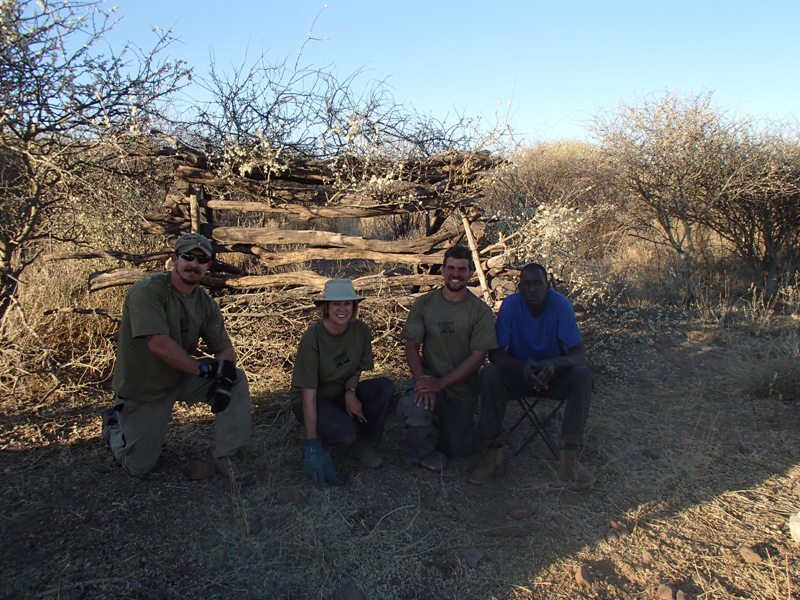
On Monday Andrew, Julia, Terrence and Josh had a tough day working in the heat and built a great new hide at Bergposten so we are now able to observe the animals under the comfort of a sun shade / roof.
Bergposten
Over the last few days we have found the box traps empty, but with their doors down and inside one of them John noticed a big mess. Something must have been in there. When we checked the camera trap pictures yesterday we found we had captured another predator: a honey badger went into the trap at night, but somehow made its way out (probably between the bars) before we could get there in the morning.
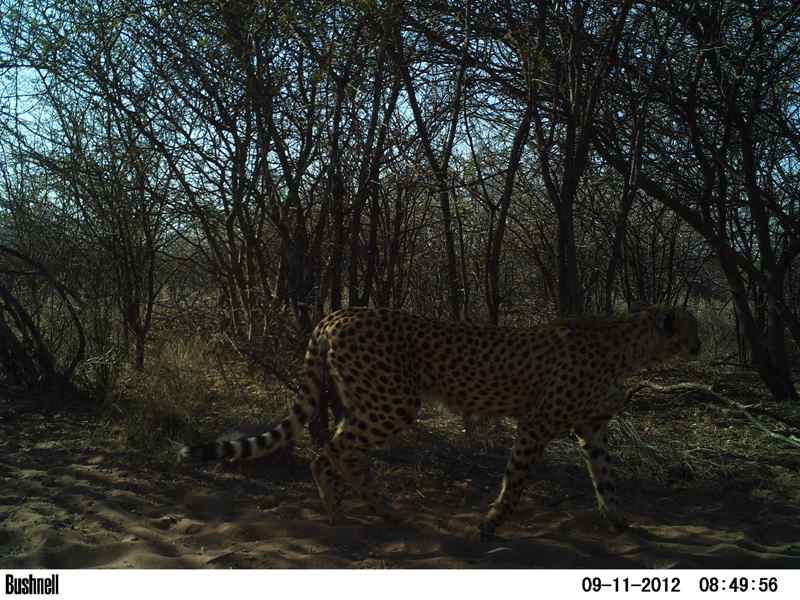
When looking through the other camera trap pictures we had another big surprise: our first cheetah picture!
Cheetah caught in a camera trap
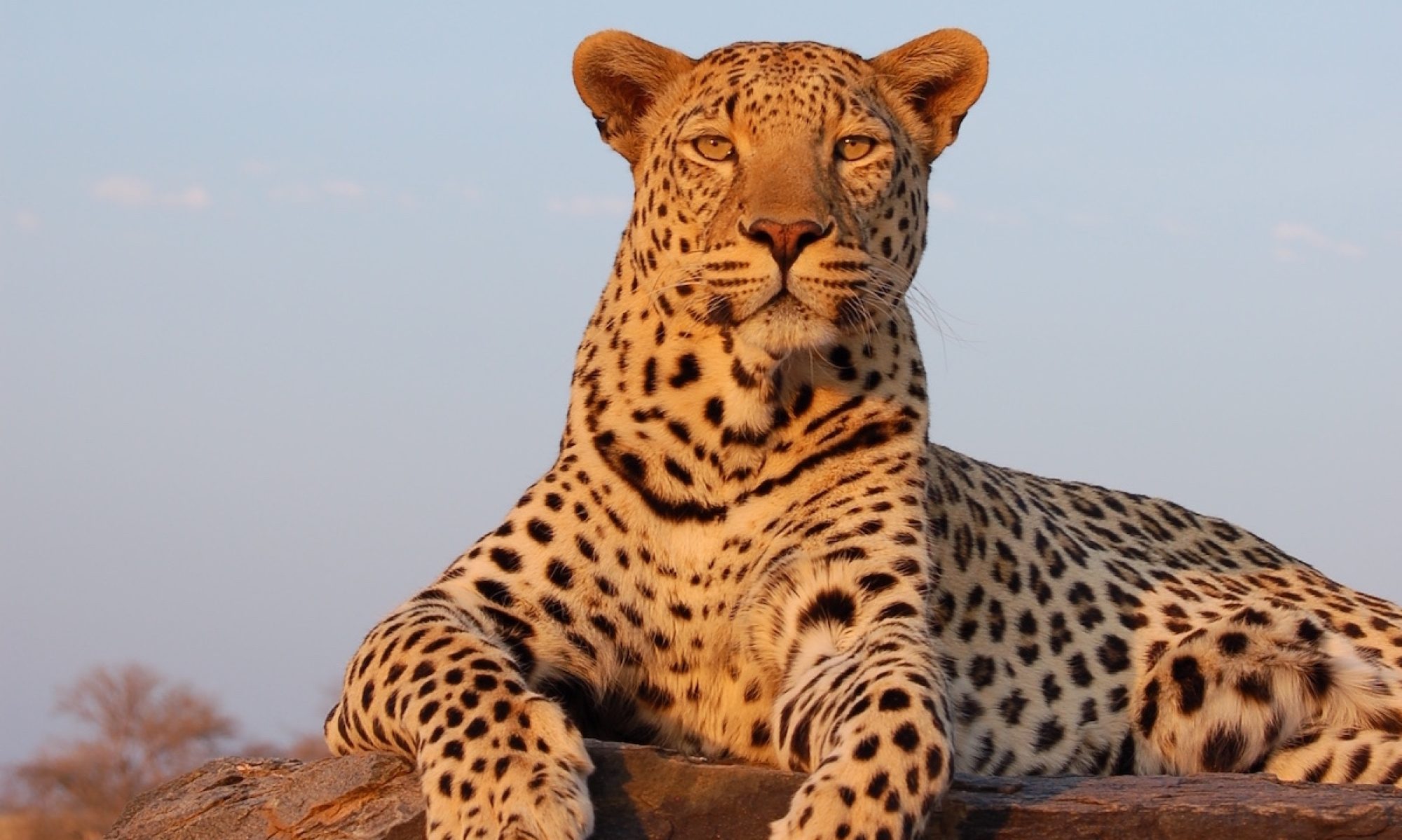
Finally, we decided to call our latest leopard capture “Omusamani” (meaning “old man” in Herero). His collar is working and the data are coming in.
Yesterday we punched the rest of the data for this group into the computer before heading out to watch the African sunset. When you get this this group should all be packed up and ready to go. Thank you everyone. Roll in group 4!
On Friday we had a very early start with everyone still a bit drowsy from the leopard celebrations the night before, but we bravely handled the cold at 06:30 and counted more than 13 different animal species during the vehicle game count. On Saturday morning, we found another (most likeley a leopard) kill (a zebra foal), so we decided to set up a box trap nearby. Kristina and I checked the trap on the day off and found fresh hyaena tracks close by.
The nights are not too cold any longer, so on Saturday night we decided to be brave again and have a couple of beers at the campfire. The Southern hemisphere sky at night was amazing.
Night sky
As I write this, Brian, Derek and Ann are checking the box traps. Let’s see what they come back with.
We checked another reef yesterday, but then the whale sharks obstinately refused to be checked! There was one at noon, just as the bell rang for lunch, but it did not feel like being studied and dived away before we could get into the water. But I think everyone enjoyed the lazy day steaming up and down the surf break, the sunshine, as well as a great farewell sunset and dinner.
It was a late 08:00 breakfast today as we steamed back to Male’, having covered North and South Male’ and Ari atolls on our Reef Check quest (see map in slideshow below). Our scientist Jean-Luc then gave us a presentation on our achievements in reef research/conservation (see http://www.slideshare.net/BiosphereExpeditions/reef-check-results-maldives-2012).
This slideshow requires JavaScript.
As I write this on the Carpe Diem, our time draws to a close here. I would like to thank the crew of the Carpe Diem for looking after us so well, Jean-Luc for being an excellent alpha male scientist, our partners in the Marine Research Centre, Soneva, LaMer, the Live & Learn Foundation, Reef Check and many others for supporting us in our coral reef conservation endeavours, and last but not least the whole expedition team for being such competent and relaxed divers and Reef Checkers. It was a pleasure to have worked with you and I hope I will see you again some day, somewhere on another expedition.
We catch animals quicker than I can write. Yesterday morning started with the release of our hyaena and just an hour later (I was just about to send pictures for the diary), Ann, Derek and Brian called in and with news of a big male leopard in the first box trap they checked. So we quickly changed the schedule for the day again (stay flexible! ;-)) and were lucky that the vet happend to be on the farm and had time to come immediately. Everyone was quickly called in from their activities and we all went straight to witness the big male leopard being collared. It needed six blokes, almost an hour, a lot of discussion and even more laughs to set up a small cover tent, but in the end we managed to sort it all out and were able to put a GPS/GMS collar on the 62 kg male leopard. The collar will now send regular messages with the animal’s location to Kristina. We decided to spend noon and all afternoon at the collaring spot and foregoing lunch were able to release the leopard after some hours. We arrived back at camp in the late afternoon very hungry and tired, but, as you can imagine, very happy!
Sorry for the late final entry, but I was travelling for a long time immediately after the expedition. So here it goes:
1 September
We are back in Iquitos. Early this morning Herbert, Peter Eva, Katherine and I left the ARC after a great & productive time at the Amazon Research Centre. On the way we had lunch at the Tahuayo River lodge and visited El Chino, a small village of 160 residents. We switched to a speed boat in Esperanza village to take us down the Amazon river, on the way we spotted five grey dolphins and watched them for a while.
Over the last two weeks we have surveyed about 48 km on transect routes within the trailgrid.and paddled more than 15 km up and down the Tahuayo river. A couple of hundered different species were spotted including birds, frogs, reptiles, spiders, snakes and bugs. Mammals recorded were squirrel monkeys, saki, titi, brown & white fronted capuchin, saddleback & mustached tamarin monkeys, coati and an anteater. On our camera traps we captured margay, agouti and opossum. On the trails we found tracks of puma, tapir and deer.
This slideshow requires JavaScript.
I would to thank everyone involved in this year’s Peru Amazon expedition. You’ve been a great help and good mates. With your help we have created the basis for long-term wildlife monitoring to help conserve one of the most precious on our planet. I hope you enjoyed the time out in the forest as much as I did and hope to see some of you again someday.
We’ve been very good and checked those reefs, so we treated ourselves to a lazy dive yesterday, at night (after the work was done) and at arguably one of the world’s best night dive sites. Night dive fears were overcome heroically and our reward was a great display of sharks and stingrays hunting, turtles trying to find a place to sleep and a very different reef at night. The daytime reefs haven’t been bad either including one with an unheard of 50% hard coral coverage! Pictures of everything and a short movie of the night dive below.
This slideshow requires JavaScript.
Our scientist Jean-Luc is happy, the sun has come out, the food’s delicious and we’re winning the Reef Check Distinguished Service Medal. What more could we hope for. Whale sharks perhaps? Ah, that’s tomorrow, we hope.
Hello again from Namibia, this is Jenny your expedition leader for the rest of our Namibia expedition. After five successful groups in the Altai mountains, I arrived in Namibia on Saturday just in time to meet and greet group 3 on Sunday morning. Even with the time being changed to daylight savings, all 10 team members (including John, who joins his seventh expedition with us to Namibia!) were on time and keen to start collecting data under the Africa sun. Kristina and I kept everyone awake with presentations and equipment training until 21:00 on our first training day.
On Monday it was driver training as usual and when we returned to base, we heard that the non-driver group had activated two box traps and spotted, besides all the different antelopes, a predator that is really hard to see: a honey badger!
On Tuesday, as we approached the first trap, Kristina noticed that both gates were closed and as we went closer we couldn’t believe that we have already captured a predator: another brown hyaena! This trap seems to be at a very good spot as it has already yielded two brown hyaenas, one leopard and a caracal. What a morning. Everyone is preparing behind me for our afternoon activities and Hendrik, Sandra and John are excited to get the SD cards and look at the pictures of our camera traps.
Stay tuned for more updates and pictures as soon as I can get to an internet connect that will not buckle under a few KB.



 Biosphere Expeditions: blogs from the frontline of wildlife conservation and the fight for a more sustainable planet