Award-winning, non-profit and ethical wildlife conservation volunteering. Advancing citizen science and conservation since 1999 – for nature, not profit.
Today’s “catch” was 17 harbour porpoises and two seals. We’ve had some rough conditions, but nobody was sick. We’ve also had some excellent brownies for “second breakfast” and a great Thai dinner. We’ve come into Craobh Haven for the night to shelter from the strong winds. Tomorrow we’re heading south towards the island of Islay and will see what the weather brings. Videos below
Team 1 has arrived safely and we have had our first 24 hours on the research vessel. Yesterday we had introducations and some safety briefings before going for a last shop and turning into our bunks pretty late, although still light at almost 23:00.
Today we’ve had our science training in the morning and our first survey run. It’s been dry, but overcast, but some bad weather is moving in, so for now we are staying in some sheltered lochs.
Our first sighting today was a harbour porpoise and everyone has been busy switching stations: observer, data relayer, data recorder, listener, etc. We’ve also had our first lunch out of cups on the run/survey.
No more videos for now as we snatch the odd patch of GSM coverage to get this to you. So here are a few pictures from our first 24 hours as we are sailing by Duart Castle.
Yesterday we arrived at Tobermory on Mull and we have brought the rain with us! Stuart the skipper tells us it has been glorious weather for the last week, but it will now be unsettled for a few days. Saturday is forecast to be the worst with high winds, so Stuart has planned a route that will take us into a sheltered loch to hide from the worst of it; better weather is forecast after the weekend..
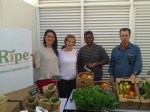
Preparation: The research yacht is all fuelled up and the crew have been busy loading on all our food for the expedition – as you can see below
18 deg C, overcast during the day, positively beautiful in the evening, no rain! Forecast not so good – see http://www.bbc.co.uk/weather/2635754. Looks like we’ll be feeding the fish with lots of wind an wave action. And the midges are flying high.
Preparation:
The boat is coming in from a research outing as we speak. This year’s first basking sharks sighted.
As you can tell, Kate’s not too comfortable in front of the camera, so we have also added a video of someone who is VERY comfortable, in fact could probably not survive for longer than 48 seconds without a camera lens being pointed at them, to the blog.
You must watch this extremely interesting video of utter relevance to the future of our planet until the end and expect to be tested during the expedition. Or you could watch http://youtu.be/pGifZhozLVA and really learn something.
I’m back in Germany as I send this and wanted to give you a quick summary of our achievements.
During last week’s field work a total of 42 quadrants were surveyed, covering 200 of the DDCR’s 227 sq km. Three teams surveyed an area of 56 sq lm each by foot; set, checked and collected 12 live and 11 camera traps in total. Provisional results of species encounters are sightings of nine different species (excl. reptiles) such as Arabian gazelle, sand gazelle, desert eagle owl, lappet -faced vulture, Maqueen’s bustard, red fox and sand fox. The central group’s four camera traps took 56 pictures of the species above (and oryx, of course), seven more SD cards still need to be checked for results. The presence of Gordon’s wildcat within the reserve was proven so far by tracks only; we’ll keep you updated on the results of the remaining camera traps.
As to the oryx survey, data of 24 oryx herds were recorded all over the DDCR, eighteen herds were sighted in the north, two in the central area and four in the south. Within a range between 0 to 5, the average condition scoring of individuals is 2, corroborating the DDCR scientists’ hunch that the majority of animals are malnourished. Steve is not surprised by this, because the whole desert ecosystem has been suffering from a drought over the last two years, but emphasises how useful it is to have so many oryx surveyed by us volunteers in a short, concerted survey effort.
We would therefore all like to thank everyone involved in the project – first of all all the team members that have put in a lot of sweat and hard work in the field, but also our partners, sponsors and supporters. This conservation project wouldn’t be possible without you! We are looking forward to continue working in desert conservation and hope you’ll all stay involved. A comprehensive report will be published in due course.
Expedition team 2013
I’ve thouroughly enjoyed our time in the desert and hope to see some of you again some time!
Today is the last day of our one week in the field… already! As I write this, the North, Central and South groups are collecting live and camera traps and later on will survey two last 2 x 2 km quadrants within their areas. By this afternoon every team will have surveyed 56 sq km of varied habitats within the Dubai Desert Conservation Reserve (DDCR): sand dunes, vegetated sand dunes and gravel plains. This one week tour de force by our survey teams is an important annual survey benchmark for the DDCR that can only be produced through your hard work and dedication. Thank you everyone and long may it continue!
During this year’s live capture week, no animals went into the live traps. More: not a single one of our twelve live traps was triggered druing their six nights out in the field. Was it bad placement, bad luck or, more worryingly a decline in species. Our camera traps will have to shed more light on the presence of nocturnal species such as Gordon’s wildcat, foxes, hares, etc.. Watch this space for more news and of course the full expedition report in due course.
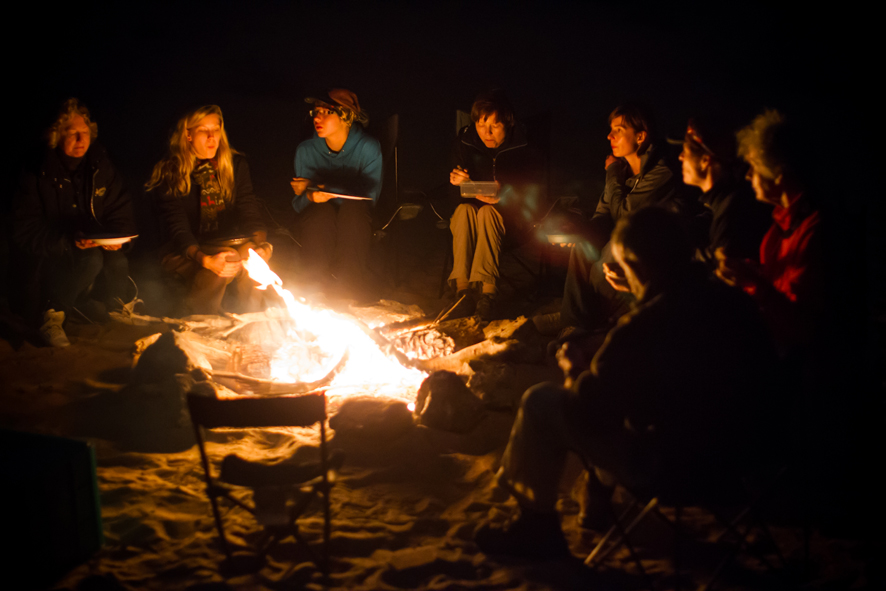
To bring things to a close today, Steve gave us all a review of the work done before we had our last dinner around the camp fire. We’ll end this year’s desert expedition by having a drink at the Al Maha Resort later tonight….
Thanks again for all your help. I’ll send through any interesting camera pictures we get, as well as more pictures of the expedition soon.
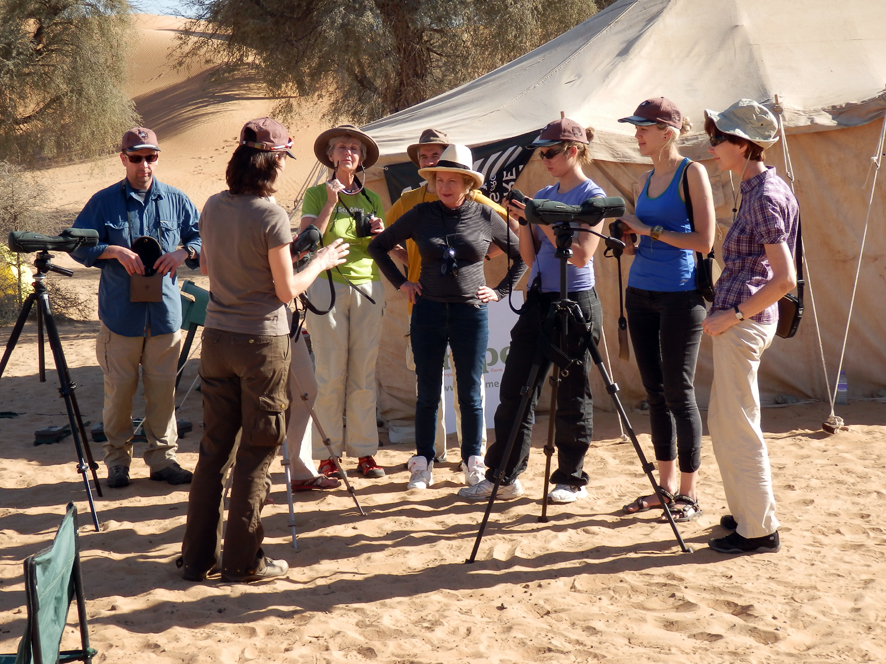
After assembly on Sunday, Monday saw the team being trained up on the use of research equipment, live and camera traps, datasheets, animal identification and oryx scoring (health status of individuals) as well as on GPS navigation… intensively ;).
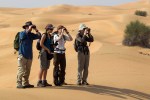
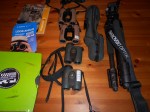
Training how to use the Swarovski Optik binoculars, spotting scopes and laser distance measurers to assess Arabian oryx health in the desert.
Ben, Lizzy, Liz and Hildegard went on their 4×4 desert driving course, whilst everyone else prepared and set up the camera traps supervised with Greg, the expedition’s chief scientist. Three groups went out to set a total number of 12 live and 12 camera traps in the field, each within their assigned survey area for the week (North, Central and South). From Tuesday onwards, the teams have checked the live traps every morning but unfortunately no capture… yet.
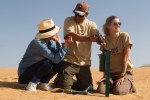
Setting up a camera trap
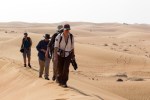
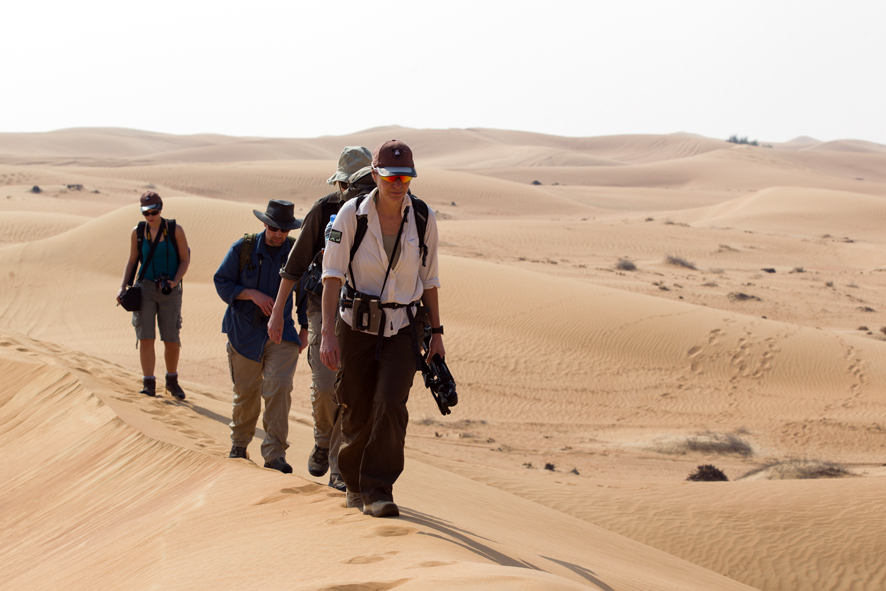
After the trap checking, we go on desert survey walks up and down the sand dunes. Three quadrants of 2 x 2 km are surveyed per day per team. This may not sound much, but is actually hard work and we suffer for science here 😉 The South group (Bernhad, Hildegard and Liz) encountered gazelles and a few oryx and were lucky to spot an eagle owl. More oryx herds were found in the Northern parts of the reserve, with Lizzy and Sokolov assessing the health status of a lot of oryx individuals and also spotting a ringed Maqueens bustard. Alex, Irmtraut and Ben and I (Central group) did not spot a single oryx within our quadrant despite scouring the beautiful landscape for hours. We did, however, come across mountain and sand gazelles on our trek through the desert.
Desert survey trek
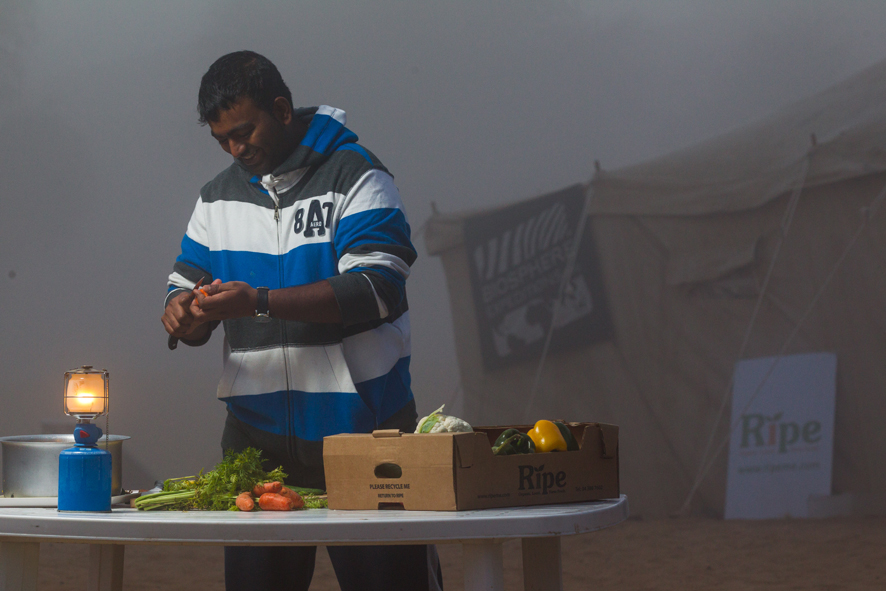
We’ve hit the groove and research routine now: breakfast at 6:00, followed by route planning and packing up, leaving base at 7:00 – just after sunrise. The early morning desert scenery is amazing, as is the sunset. It’s pitch dark by the time we have dinner at 19:00, so we all sit around the fireplace reviewing the day and chatting about each group’s adventures. And only a short while after having another great meal prepared by our chef Thaya, it suddenly gets really quiet at camp. I wonder why 😉







 Biosphere Expeditions: blogs from the frontline of wildlife conservation and the fight for a more sustainable planet