Award-winning, non-profit and ethical wildlife conservation volunteering. Advancing citizen science and conservation since 1999 – for nature, not profit.
On Friday morning we had an early start to count prey animals just after sunset. Soon group 1 (Jesaja, Linda, Allyson and I) came across a very fresh leopard track close to where we caught our male two weeks ago. Then, just after we had finished our vehicle game count, Allyson and Linda spotted a freshly killed impala next to the road. We decided to set up a camera trap on the spot straight away. On our way back to camp after setting the trap, we found more fresh tracks: cheetah this time.
The new camera trap yielded great pictures straight away (see below) with two different leopards feeding on the carcass at different times. A female leopard was there first and a few hours later our recently collared leopard male “Omusamani” took over. It seems the kill is the perfect new spot for live trapping. As I write this one trap is already set up. The second one is being set up as I type by our research team, who decided to give up their free day. Thank you.
Our first days in the field started with car checks before breakfast, so we got up very early to be ready to leave camp at 07.30.
Checking the Land Rovers
Ginny and Susan went for “Tracks & Scats” with Jesaja yesterday and bumped into a group of new-born ostriches. When they spotted the mum close by, they wisely decided to make a detour.
The elephant survey teams on Tuesday had some close encounters with their study objects and on Wednesday we had a hairy moment of hearing a juvenile trumpeting and chasing the Land Rover.
Elephants
All quiet on the trapping front, though, so we thought we’d show you some slides of lots of traffic at one of our traps with one of “our” leopards walking into the trap at the end.
Our all women power team (group 4) has arrived safely on Okambara to join the fray. We’ve been through the training and biefings and Susan now knows that the reason for the big ears of African elephants are not that they can hear better 😉 Kristina was brave and took Sylvia, Allyson and Ginny for driver training even though Sylvia had not driven a manual car for 25 years. All are now well prepared for the upcoming data collection and we made sure they will remember all the GPS, compass and telemetry skills out in the field. The second day ended with Joerg’s presentations and a lovely rainbow over our camp when it started to rain. Weather patterns really are changing!
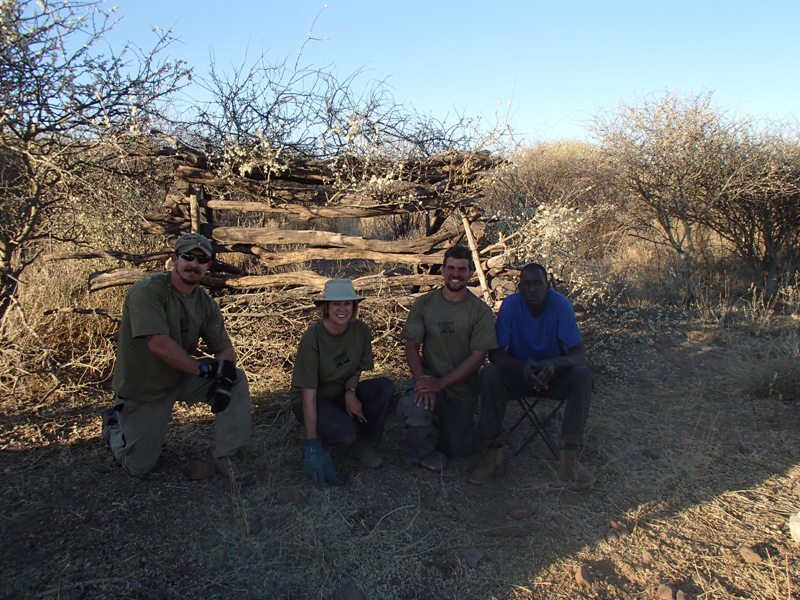
On Monday Andrew, Julia, Terrence and Josh had a tough day working in the heat and built a great new hide at Bergposten so we are now able to observe the animals under the comfort of a sun shade / roof.
Bergposten
Over the last few days we have found the box traps empty, but with their doors down and inside one of them John noticed a big mess. Something must have been in there. When we checked the camera trap pictures yesterday we found we had captured another predator: a honey badger went into the trap at night, but somehow made its way out (probably between the bars) before we could get there in the morning.
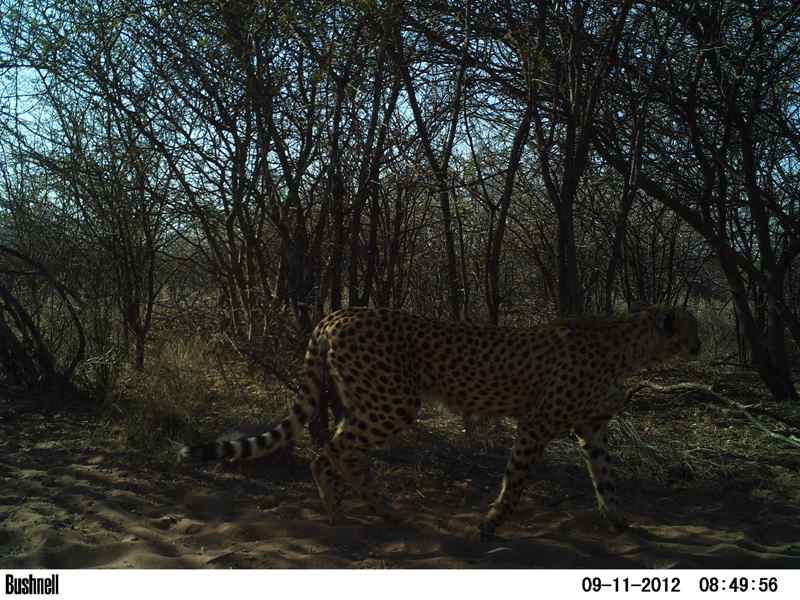
When looking through the other camera trap pictures we had another big surprise: our first cheetah picture!
Cheetah caught in a camera trap
Finally, we decided to call our latest leopard capture “Omusamani” (meaning “old man” in Herero). His collar is working and the data are coming in.
Yesterday we punched the rest of the data for this group into the computer before heading out to watch the African sunset. When you get this this group should all be packed up and ready to go. Thank you everyone. Roll in group 4!
On Friday we had a very early start with everyone still a bit drowsy from the leopard celebrations the night before, but we bravely handled the cold at 06:30 and counted more than 13 different animal species during the vehicle game count. On Saturday morning, we found another (most likeley a leopard) kill (a zebra foal), so we decided to set up a box trap nearby. Kristina and I checked the trap on the day off and found fresh hyaena tracks close by.
The nights are not too cold any longer, so on Saturday night we decided to be brave again and have a couple of beers at the campfire. The Southern hemisphere sky at night was amazing.
Night sky
As I write this, Brian, Derek and Ann are checking the box traps. Let’s see what they come back with.
We catch animals quicker than I can write. Yesterday morning started with the release of our hyaena and just an hour later (I was just about to send pictures for the diary), Ann, Derek and Brian called in and with news of a big male leopard in the first box trap they checked. So we quickly changed the schedule for the day again (stay flexible! ;-)) and were lucky that the vet happend to be on the farm and had time to come immediately. Everyone was quickly called in from their activities and we all went straight to witness the big male leopard being collared. It needed six blokes, almost an hour, a lot of discussion and even more laughs to set up a small cover tent, but in the end we managed to sort it all out and were able to put a GPS/GMS collar on the 62 kg male leopard. The collar will now send regular messages with the animal’s location to Kristina. We decided to spend noon and all afternoon at the collaring spot and foregoing lunch were able to release the leopard after some hours. We arrived back at camp in the late afternoon very hungry and tired, but, as you can imagine, very happy!
Hello again from Namibia, this is Jenny your expedition leader for the rest of our Namibia expedition. After five successful groups in the Altai mountains, I arrived in Namibia on Saturday just in time to meet and greet group 3 on Sunday morning. Even with the time being changed to daylight savings, all 10 team members (including John, who joins his seventh expedition with us to Namibia!) were on time and keen to start collecting data under the Africa sun. Kristina and I kept everyone awake with presentations and equipment training until 21:00 on our first training day.
On Monday it was driver training as usual and when we returned to base, we heard that the non-driver group had activated two box traps and spotted, besides all the different antelopes, a predator that is really hard to see: a honey badger!
On Tuesday, as we approached the first trap, Kristina noticed that both gates were closed and as we went closer we couldn’t believe that we have already captured a predator: another brown hyaena! This trap seems to be at a very good spot as it has already yielded two brown hyaenas, one leopard and a caracal. What a morning. Everyone is preparing behind me for our afternoon activities and Hendrik, Sandra and John are excited to get the SD cards and look at the pictures of our camera traps.
Stay tuned for more updates and pictures as soon as I can get to an internet connect that will not buckle under a few KB.
For our last few days the rhinos have been appearing for most of the groups, standing very close to one of the routes to a main waterhole. They are very calm and a joy to observe as we head out to our respective jobs. The elephants have also moved closer to camp and continue to entertain us with their disappearing acts. They have been observed eating and trying to knock down trees and have often been seen travelling on the tracks for some distance before walking into the bushes and vanishing.
Rhinos
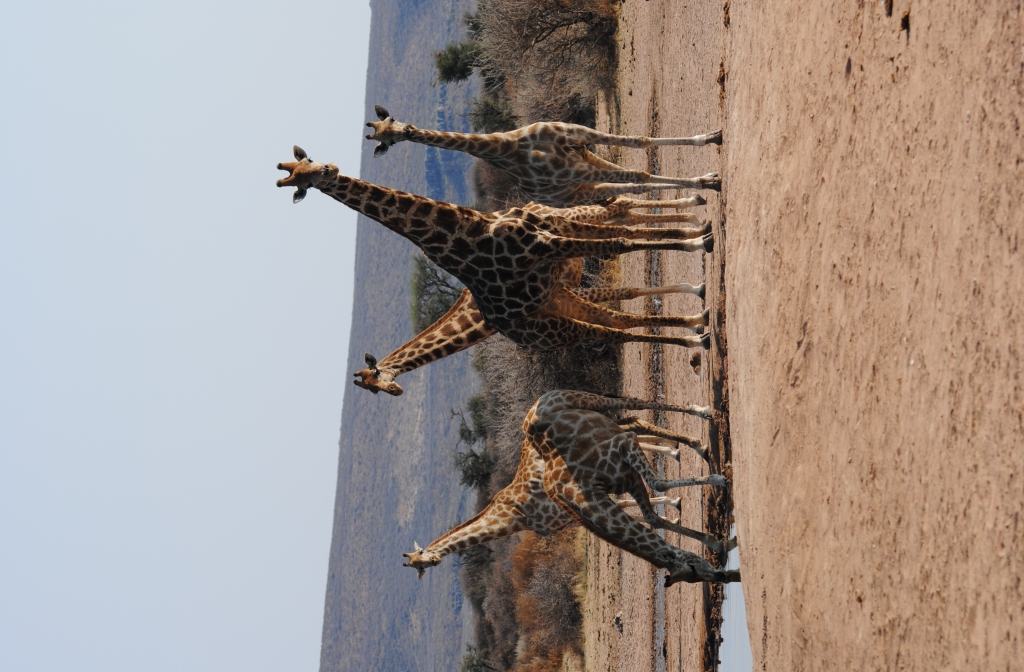
We have seen quite a few juveniles of several species during this last week, the new-borns arriving with the spring here. There is a four-day old giraffe, several baby oryx that look like little fluffy cows (although I’m told that their distinctive long straight horns grow very quickly) and we came across a very calm sable antelope with three young on Wednesday. The acacia bushes are coming more into bloom and with the warm weather the spring smells are wafting over the savannah now. Flipflops around camp are becoming fashionable with a growing feeling that the cold has really gone for this year.
As the end of this slot approached a bottle of whisky appeared from John’s bag and the last three nights have produced an increasing number of tasters each time. We even managed to stay up past 22:00 on Wednesday night, pretty much unheard of due to the early mornings, fresh air and early darkness (06:00) in these parts. For our last evening we all headed out to find the ancient rock art that is marked on our maps as a little way NE of base. We had a wonderful drive as the sun was beginning to set and spent a relaxed half hour with the rhinos before heading up the slope to the East. We stopped in what we thought was the right spot, but only found a rare example of ancient Namibian invisible art. After some serious searching we gave up and had a sun-downer whilst Kristina gave us a summary of the work that has been done here. We all got back in the Land Rovers and headed back only to be stopped after a few minutes by Kristina declaring that we were at the right spot – after a very short search we found a fabulous drawing of an oryx and some hunters, well worth it. A shooting star lit our way home and the evening finished with Joerg giving us a great summary of the elephant research that had been done.
Many thanks to all in slot 2. It was a very memorable 2 weeks with some great work and lots of expedition spirit! I am heading home too so all the best to Jenny (Kraushaar) who will be taking over as expedition leader for the remainder of the expedition, and I hope that Kristina, Joerg, and the next teams have a wonderful and productive time.
With the freezing overnight temperatures continuing we decided to deactivate the box traps for a couple of nights. This was to prevent the capture of smaller animals that cannot cope with such low temperatures at times when they are usually in their dens. Thankfully this spell of weather has passed and the nights have warmed up again, so all the traps are fully operative. However, nothing to report in terms of captures. We have tracks of predators walking near the traps, but nothing has gone in as yet…
The elephant teams have been continuing their observations morning and afternoon and getting quite close to the animals now, something that we were unable to do in the first slot. This has meant some interesting feeding observations and also some reversing to maintain our 50 metre distance rule (we should not get closer than this for safety reasons) as the elephants are wandering towards us and have, on occasion, appeared out of the bushes at a closer distance, but always calm and relaxed. It’s amazing that such large animals can be invisible in acacia bushes.
Our waterhole counts have been interesting too – there are a lot of different species here, with everything from giraffe, to cavorting wildebeest and shy oryx, not to mention the donkeys who were a surprise to me. Due to the destructive nature of the elephants here, it is not sensible to build the sort of hides that you can find in Europe – nice wooden boxes for people to sit in with a window slit to look out of. Unfortunately these don’t last long as the elephants can be very inquisitive and when they want to find out about something they investigate with their trunks and objects often don’t survive very long. So we use adapted bushes with enough foliage to keep people covered and just enough room for three people sitting on folding stools. These have worked very well in fooling one species – the elephant team spent 20 minutes in front of the newest hide doing their radio telemetry work and noting cheetah tracks before one of them followed some tracks right to the door of the hide and three laughing people. It has been more difficult to hide from the other species, most animals seem to know that we are there, often staring straight at the hide before drinking and going about their business. This month is known as the month of changing winds and we more than suspect that the animals can smell us (some team members even claimed to have had showers the same day so they don’t understand it). Our evening camp fire discussions over the last couple of nights have included a lot of debate on hide design – a portable, collapsible design seems to be the most favoured at the moment, but I think we will have a proper design competition before the end of the slot.
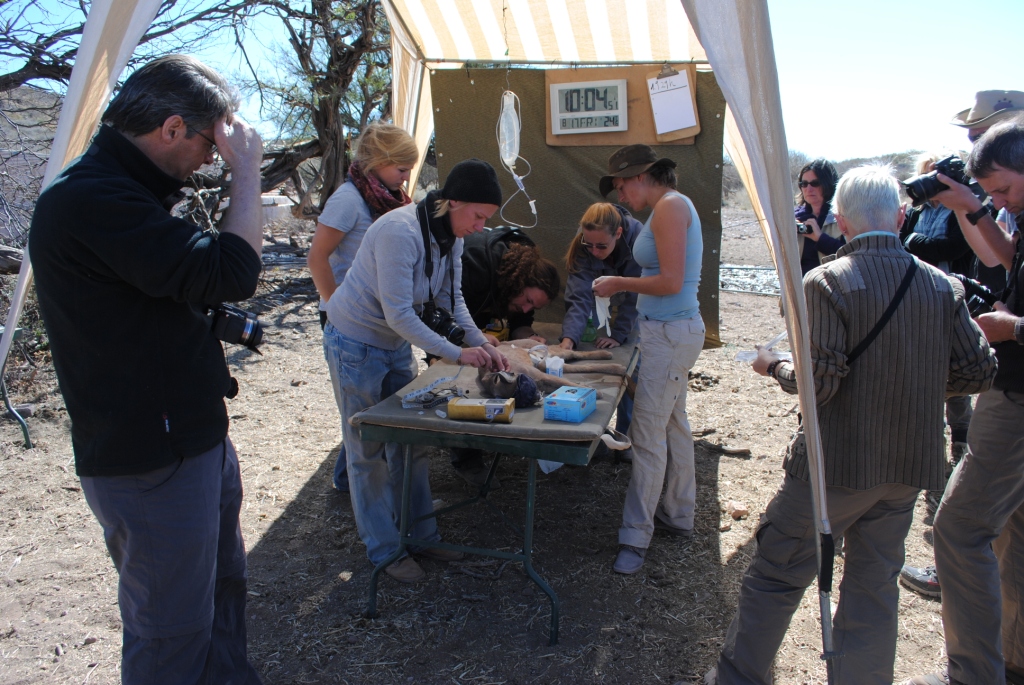
The temperature has dropped again over the last few nights with ice on the waterholes early in the morning and our water pipes freezing, so there is no water first thing in the morning. The Land Rovers have also refused to move before they have warmed up, but teams have still managed to leave camp by 08:00. On Thursday morning a caracal was found in box trap number 1 (a quick congratulations to the team from the last slot who set this trap up before they left – their third capture, truly box trap setting gods:)). The wildlife vet came to sedate the animal so that samples could be taken, and the usual efficient and professional organisation came with her. She arrives on scene with helpers (some also qualified vets) and a tent is set up with a table for the animal to be taken to once it is sedated. A clock sits over the proceedings and everyone works quickly to ensure that the animal is sedated for the minimum amount of time. Our team members likened it to everything from the set up used by Medicine sans Frontier in the field, to the arrival of a CSI (Crime Scene Investigation) team.
CSI field lab
Caracals are known to bruise their faces when they are in box traps, something that they quickly recover from, but our animal had damaged its lower teeth, a very rare happening, so a decision was taken to remove it to a large enclosure where it could be watched for some days before release.
One team was very fortunate in finding some big drag marks crossing their path, and on following them into the bush they found the remains of an impala that had been killed by a leopard. It was a very fresh kill, which means that the leopard will be back to eat more. A decision was quickly made to move one of the box traps to this location and set up a kraal around the kill so that if the leopard wanted to get to the meat, then it would have to go through the box trap and hopefully be captured. The team worked hard with the very spikey acacia bushes to create a kraal that the leopard could not get through. This morning we found the tracks of the leopard coming back to have a look for its kill but it hadn’t tried to reach it – we are very hopeful that it will ‘take the bait’ within the next few nights…




 Biosphere Expeditions: blogs from the frontline of wildlife conservation and the fight for a more sustainable planet