Award-winning, non-profit and ethical wildlife conservation volunteering. Advancing citizen science and conservation since 1999 – for nature, not profit.
Picture an office in the middle of the jungle: meshing instead of windows, solar panels quietly providing electricity to run the inevitable computers. Green is the colour you see all around, sounds from the rainforest is all you hear. All of a sudden the quiet solitude is broken by the roar of at thunderstorm.
A brief lesson on rainforest seasons: As per Alfredo, our local scientist born in the Amazon, there is no dry season in the rainforest. More appropriately, seasons should be described as heavy rain season and light rain season. When preparing for the boat ride, please bear this in mind and make sure you have your rain gear or poncho handy. It’ll be a good idea to pack your mobiles, cameras and other such items into a waterproof (plastic) bag. There will be no shelter on the small boats taking us from the Tahuayo Lodge to the Research Centre (about one and a half hours).
Yesterday Alfredo and I created a detailed work plan for the first week, especially the first expedition day when we are aiming to bring out and set up all the camera and track traps, some of them a day’s walk away from base.
Alfredo and I will spend the time before you arrive with preparing base, setting up the computer for you entering data and uploading the finished maps the GPSs.
It is partly cloudy & warm in Iquitos – the dry season is just about to start. The water levels in the Amazon are still pretty high, so the boat ride up to our research centre should be interesting. Writing this I am sitting in the lobby of A&E Tours waiting for my boat to depart. I have just been told that my boat will wait for two more people whose flights from Lima were cancelled, so I have another three hour to wait.
After having been delayed myself by lovely Iberia Airlines, over the last one and a half days I’ve retrieved our research equipment from storage, checked it all through and made it ready for use. The printer and laminator (!) – one of the most important pieces of equipment – are working well again. I’ve put more hours into THE MAP, which you will help me to add more detail to by exploring the jungle around the research centre. THE FINAL MAP will be uploaded to the brand new GPSs I have brought with me.
Alisa, your expedition leader, here and I am writing to you from the ground in Namibia.
Kathy and I arrived yesterday and have joined Vera at base camp in Okambara. Last night we were treated to several wildebeests drinking from the water hole outside the lapa and later a jackal. This morning the giraffes joined us for our morning tea, all while we were busy preparing base camp for the expeditions and looking forward to your arrival.
A reminder that our meeting point is Casa Piccolo in Windhoek at 8:30. Team 1 will need to be there on Sunday, 4 August. Please arrive on time, and Casa Piccolo requests that you check in with reception when you arrive. What then happens is that Casa Piccolo staff will put you on a transfer bus that we hire from Omahuka Transfers. This bus will take you to our study site, a drive of about 2 hours. Vera, Kathy and I will then meet you in our 4x4s upon your arrival at Okambara’s Josephine Gate.
Just a quick update on the expedition preparations while I am still in Europe. Have a look below for the map we’ve created for us trailblazers and be prepared for intensive GPS & mapping training.
The map is still quite blank for us to fill with lots of waypoints and tracks of trails on land and on water. We will be talking a lot about quadrants and how to access remote parts of the study area to place camera and track traps and to conduct our visual encounter surveys. I am looking forward to entering the jaguar’s realm, encounting & recording primates and other wildlife species together with you.
I am off later today and will be in touch again from Iquitos with the latest on-the-ground information.
Mutiny already and we have not even started! We’ve received replies containing the s/h/v-words in open defiance of the ban. Smartphones will doubtless have to be confiscated. Do you know why they are called smartphones by the way? Well before the NSA (hello, by the way – we hope you are also enjoying reading this), there was a secret agency based somewhere in Washington with a secret agent called Smart who had a portable phone way before anyone else had….
And while you ponder this, we leave you with some girl power pictures so that you all know who to hand your phones into…
Two weeks to go until the start of our Amazon biodiversity expedition to Peru. Next week, Malika Fettak, your expedition leader will be off a few days ahead of you to set things up.
Malika Fettak
The weather in Iquitos at the moment is damp and hovering around the twenties (Centigrade). High twenties during the day, low twenties at night. Your scientist Alfredo Dosantos is at base already, preparing the research and maps for you.
Alfredo Dosantos
Where we will work is shown below.
Group 1’s task will be opening and exploring more trails so that we can increase our sampling area and cover as many of the big squares (quadrats) around base as possible with camera and track traps, and visual encounter surveys on foot in the jungle and in wobbly canoes along the waterways, recording species as we come across them and hoping to catch the very illusive ones in our low-tech track traps and our high-tech camera versions. All in an effort to show with hard data how biodiverse this place is, and therefore worth protecting.
But beware! Monkeys and jaguars will not be falling into your lap, despite what TV may want you to believe (and what took months to film). The forest is full of life, true, but it is also full of leaves that swallow almost everything a few paces away and reduce encounters to fleeting glimpses of monkeys in the canopy and black shadows streaking across dark green canvas. You’ll hear things before you see them – if you see them – and there will be a cacophony of unfamiliar sounds, and smells and sights, dulled by the constant assault of green on your eyes.
If you come with the expectation of entering into a zoo full of animals on silver plates, you will be disappointed. If you come to soak up the wonders you will hear yet not see and to just be amongst life in one of the most biodiverse spots in this green sea of our blue planet, you won’t be. Come with all your senses open (and perhaps even leave your cameras at base unless you are a lens hunter of the small wonders the jungle has to offer). And come in the spirit of David Henry Thoreau who said “I went to the woods because I wished to live deliberately, to front only the essential facts of life, and see if I could not learn what it had to teach, and not, when I came to die, discover that I had not lived.”
Malika and Alfredo will be in touch from base a few days before the off. The forest of hidden wonders awaits!
Not long to go now. With Vera already in Namibia, Kathy will join her from the UK via Germany next week and Alisa will from the US, also via Germany. Girl power indeed.
Meanwhile a male particpant is clearly struggling with the Buff that you will all receive when you get there (he won his in a competition).
And usually it’s only male cheetahs that get caught in a box trap repeatedly. Females, once trapped once, will by and large never be caught out again. Draw your own conclusions 😉
The weather in central Namibia is sunny with temperatures during the day in the twenties (Centigrade) and dropping to single figures at night. Getting up in the morning will feel decidedly cold – there is no culture of heating in Namibia anywhere, so bring warm clothes group 1. The good news is that as soon as the sun comes up over the horizon, you will quickly be able to shed those layers.
The girl power team will be in touch from Namibia once they have settled in and awoken the expedition gear from its Sleeping Beauty lull in a shed near the expedition base.
Alisa will send her mobile number for emergencies a few days before we start and update us all on final preparations.
We hope yours are going well too. We have attached the plan so far as well as some datasheets for you to swot up on – and dispel any last myths there may persist of anyone joining some kind of safari holiday 😉
Two weeks to go for trailblazing group 1…
P.S. In case you were wondering what the heck a Buff is, have a look at
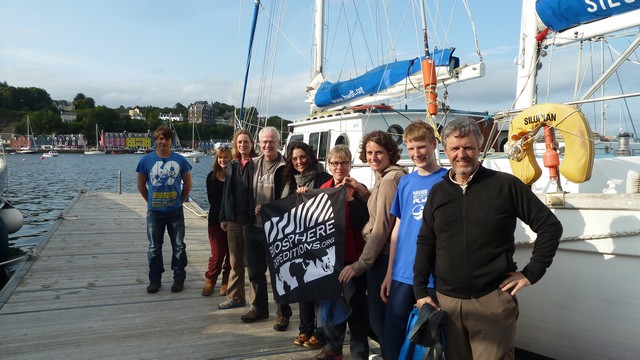
So after 10 days out at sea covering 404 miles around the Inner and Outer Hebrides we came back into Tobermory yesterday for our final meal together before saying our goodbyes to each other, the crew and our trusty yacht ‘Silurian’.
Although the weather throughout was pretty grey, damp and windy and we were stormbound for one whole day, the wildlife was abundant – we had 56 separate sightings with 91 animals in total. This included 46 harbour porpoises, 1 basking sharks, 6 minke whales and 16 common dolphins.
There were some really positive signs such as witnessing 4 minke whales “lunge feeding” for the first time in couple of years, which indicates that their habitat and food source has been restored, and seeing so many harbour porpoises (some with very young calves) which will support the current application for a Special Area of Conservation for that species.
So a huge thank you to the expedition team for their contribution to this valuable work – Brian, Steve, Elke, Lena, Celine and Alex, the crew – Stuart and Tom for their professional handling of the boat, and our scientist Olivia for her education, guidance and teatime treats!
We now go for a 5-week break and I hand over the reins to Adam as expedition leader, who will be in touch in due course. Enjoy the summer!
Well, we’ve thoroughly checked those reefs! We put two more surveys under our belts on Thursday, arriving in the south of Ari atoll as the sun was setting over Mamigilli. One survey was along the wall of a sea mount (thilla) with dense growths of coral, ascidians, echinoderms, sponges and encrusting algae painting the wall in all colours of the rainbow. Large groupers and sweetlips lurked in the overhangs, jacks traversed the blue and sharks patrolled the sea fan gardens below.
Once at Mamigilli as night fell, most then opted for a last twilight dive to round off the day.
Today brought storms, which blew out our whale shark survey efforts and made for an interesting crossing of the channel back over to North Male’ atoll. The excellent crew of the Carpe Vita steered us through this too with total assurance, as they have done all week. Thank you again for looking after us so well!
As I type this, night has fallen over Male’ and Hulamale’ harbour. The bright lights of the city can be seen not far away, but for one more night we hang onto the relative solitude of our live-aboard home. The week has gone far too quickly and all that remains is to pack up and say our good-byes tomorrow.
Thank you to the whole team for making it pass so quickly. You could have gone to a resort and read a book on the beach for a week; you could have gone anywhere. But you chose to put your time and money into reef conservation. My respect and gratitude for this and I hope to meet you again sometime, somewhere on this blue planet of ours.
Matthias
Thank you Shidha for sharing this beautiful selection of your photos





 Biosphere Expeditions: blogs from the frontline of wildlife conservation and the fight for a more sustainable planet