Award-winning, non-profit and ethical wildlife conservation volunteering. Advancing citizen science and conservation since 1999 – for nature, not profit.
We’re back in Dubai, Tessa’s and my pictures below have been uploaded to the Pictureshare site, lots of new fish videos are now on the indicator playlist, and there will be a press release about the expedition’s results tomorrow.
It has been a great week with an AWESOME team. You could have gone to Dubai just to shop, or on a lazy diving holiday or whatever, but instead you decided to put your time, energy and money into helping coral reef conservation. Thank you so much for this. And thank you to Jean-Luc, the crew of the MS Sindbad and everyone else who helps to make this expedition a success. We could not do this without you.
Safe travels home and I hope to see you again, some day, somewhere on this beautiful blue planet of ours.
We’re back in Khasab harbour and we’ve basically checked the hell out of the Musandam reefs over the past few days. We were hold hands from France and Oman, as well as new Reef Checkers from Canada, Germany, Oman, the UK and USA. After a five-hour drive from Dubai to Khasab we went straight into our two intense days of training. All passed – even Rolf who was down with the lergy in his cabin, where he swotted away assisted by Angela. When he did surface, he still passed the tests with flying colours. Well done everyone!
Then it was into three days of checking the Musandam reefs all over the place – seven surveys in total! In the end we worked like a well-oiled machine. So much so that we could even cope with all whimp staff dropping out: Tessa with a cold from sitting in the air-condition blast too much, Matthias with a tooth ache and, most honourably, Jean-Luc, who was attacked by a needlefish during a night dive. It punctured his wetsuit and lower leg. Nothing too bad, but an impressive bandage anyway. Serves him right for waving his light around at the surface where they are out to hunt at night!
But all jumped into the fray. Patrick as half-naked SMBer par excellence, Patti as substrate queen, Elaine as diction champion, Lori & Jon as awesome! Reef Checkers, Ali & Waleed as the very interesting local connection, along with remarkable Jenan & Tanya, and unmistakably Mancunian Andy….
But what am I talking about: See for yourself below and read from our soon to be published press release:
Dr. Jean-Luc Solandt, a coral reef expert from the Marine Conservation Society and the expedition’s chief scientist, summarises the expedition: “Our surveys have taken place during a particularly rich plankton bloom, so visibility in water has been quite low. Many sites hosted large numbers of snapper, way in excess of 1000 per kilometer square, which is encouraging. But the average size of the snapper is quite low, which indicates overfishing. Also, the large numbers of Diadema urchins continue to be a threat to the corals, because they are overgrazing the bedrock and base of some corals. Grouper (hammour) numbers are reasonable, but size ranges continue to be small due to overfishing, which is a worry, since only larger groupers can breed and produce more fish.”
Dr. Matthias Hammer, the founder and executive director of Biosphere Expeditions, this year led the expedition himself, “because we are now at a crucial stage of development in Musandam. The discussions we had with fishermen are encouraging. They have been told about and are respecting the Khor Hablain ‘closed area’, declared in 2013, where only line fishing is now permitted. We commend the government of Oman for its foresight in closing such a large area of the Musandam for all but line fishing. This is far-sighted and will surely help with the conservation of fish stocks and coral reef health around Musandam. However, Kumzari fishermen are concerned over illegal fishing from Iranian waters and believe this has resulted in significant catch declines in the past decade. We therefore encourage the Oman government to heed the fishermen’s concern and also continue its marine conservation efforts by putting marine conservation high on the agenda. After all, conservation management is essentially good overall management.”
Indeed, successful marine conservation efforts will always include the local fishermen. History has shown that the most successful marine conservation areas are those that are created bottom-up, with the help and acceptance from local fishermen and communities, rather than top-down governmental decisions that are not understood or accepted on the ground, and therefore often ignored. “With a bottom-up approach, the chance of everyone winning is so much higher than with top-down, where often everyone loses”, conclude Drs. Solandt and Hammer.
In another development, three more Omanis (Jenan Alasfoor from Muscat, as well as Ali Saleh Ibrahim and Waleed Alkaabi, both from Sohar) were trained on the expedition in reef survey techniques as part of Biosphere Expeditions’ on-going placement and local empowerment programme. All three qualified as Reef Check EcoDivers during the expedition and can now conduct reef surveys anywhere in the Indo-Pacific, including in Oman. This brings the total number of Omanis trained over the years up to seven – including divers from the Ministry of Environment and Climate Affairs, and the Environment Society of Oman – in what Biosphere Expeditions hopes to be the start of an all-Omani community-based survey effort. Dr Hammer said that “Biosphere Expeditions has been very successful in setting up such a community-based programme in the Maldives (see more information on this here and here) and we are very hopeful that Oman will now follow suit”. Ali Saleh Ibrahim adds that “the knowledge I have gained participating in this expedition will help me to go further with my interest of protecting the underwater environment. Now I am ready to start my first independent Reef Check together with other Biosphere Expeditions placement graduates and I plan to do this in the coming months. I really appreciate Biosphere Expeditions’ efforts to save coral reefs in my country and thank them for giving me the opportunity of a placement on the Musandam expedition, and putting Oman on their world map of conservation expeditions.”
Dr Solandt concluded the expedition this year by saying that “coral health of the sites we have visited this year appears good, though we have seen a few more incidents of disease than in previous years. We have been encouraged by the large number of snapper and we believe that more small no-take zones will help local fishermen and their communities into the future. We encourage the government to discuss further measures with them in order to recover fish stocks and achieve a bright future for all – local people and the environment we all depend on.”
So here we are, on our last night. More after we are all back in Dubai tomorrow. For now we are out to town in Khasab…
If you have ever wondered what an expedition looks like before you get there, below is your answer 😉
All well in Dubai. Sunny skies, 30 degrees C, all ready for you. I hope you are well rested and prepared. It’s going to be intense.
Some of us are meeting in the lobby of the Holiday Inn Express at 18:00 to go out for dinner. Join us if you can. If not, I will see you tomorrow at 08:00 in the same place.
I am in London now for meetings, one of which was about the Omani government’s plans for Musandam and marine protected areas there, and how we can help in their establishment and designation. Things are moving and we are delighted to be involved.
Meanwhile a good, informative article has appeared in Muscat Daily, summarising the work of our 2015 expedition and the threats the Musandam reefs are facing, and what can be done to safeguard the reefs. Keeping Musandam on the public agenda in Oman is part of our strategy and one of the reasons why we publish press releases about our work.
Tomorrow I will board a flight to Dubai to set up the expedition, a couple of days ahead of you. I have not heard from anyone who cannot make the earlier 08:00 assembly, so I will see you all in the lobby at that time. Those of you meeting us in Khasab, please also be there an hour earlier, so 11:00 instead of 12:00 noon.
I will write again from Dubai with a quick confirmation of my local phone number.
Hello and welcome to the first diary entry of the 2016 Musandam expedition. I am Matthias Hammer, the founder & executive director of Biosphere Expeditions, and also your expedition leader this year. I will work alongside our chief scientist Dr. Jean-Luc Solandt.
Matthias Hammer
Jean-Luc Solandt
This year is an exciting year to take part in the expedition. Things are happening in terms of strategic thinking, including protected areas and national parks, in Musandam and Biosphere Expeditions and the data we have collected over the years is very much part of this process. A lot of the information is still confidential, so not for this forum, but suffice it to say that we at Biosphere Expeditions are excited about what is happening and proud to be part of the processes. And so should you as what you have done and are about to do is very relevant. More on this on the ground when we all meet.
But before this, some admin things: First of all, I would like to make the assembly time on 23 October to 08:00 (instead of 09:00 as per the dossier) to give us more time on that day. Please e-mail me on info@biosphere-expeditions.org if you have a problem with this. If I do not hear from you, I will assume an 08:00 start is fine with everyone and I will confirm this in another diary entry closer to the time. Secondly, I will also confirm my local phone number closer to the time, when I have arrived in Dubai to set things up, which should be a couple of days ahead of you.
Other than that, we are getting ready here at Biosphere Expeditions and all flights and transfers are booked, equipment is purchased, etc. I hope your preparations are going well too. Please do not forget to swot up on Reef Check (see your dossier for details)! The more you can do now, the easier the first two days, which are crammed with lectures and tests before we allow you to collect data, will be for you, so time invested beforehand is time well spent.
I’ll be back in touch from Dubai, if not before, with other updates.
Leatherback turtles frequent much of the Caribbean coast of Costa Rica during the months of February and July to lay their eggs. One egg has a market value of $2 and one turtle can lay a clutch of up to 100 eggs. For poachers this is a significant income and poaching is rife on the Caribbean coast of Costa Rica. But without eggs hatching, the species will disappear. This is where Biosphere Expeditions and its partnership with LAST (Latin American Sea Turtles) comes in.
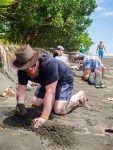
Our joint mission is to patrol the beach on a nightly basis and relocate as many clutches of eggs to a guarded hatchery as possible, thus preventing the poachers from taking all the eggs. For this a whole host of trained “foot soldiers” (Biosphere Expeditions team members) is need to monitor the beach, catch a turtle before she lays, wait as she digs her nest, then catch the falling eggs in a large plastic bag and whip them out from beneath her before she starts to fill in the nest and camouflage her tracks. Biometric data are also taken, and the nest re-dug by hand by the team member on duty in the hatchery. The nest, now safely in the hatchery, is guarded 24 hours a day for the next 60-70 days until the hatchlings emerge.
Magali Marion MSc is the lead scientist at Pacuare Research Centre. For the past three years she has worked tirelessly training volunteers, delivering lectures, leading night patrols, working with the local community and generally acting as the perfect role model for a successful conservation programme. “The key problem,” she says, “is that this is a public beach, so we have no control over who comes onto it.” The weekends are the worst with a noticeable increase of poachers lurking in the undergrowth. “Foot soldiers are really important,” says Magali, “as their number determines the amount of patrols we can run.”
“I’m amazed at myself and the energy this project unleashed in me!” says Janet Hoffberg a 76 year-old passionate animal advocate from Florida. The reward? To spot a turtle before the poachers and safely deposit the eggs in the hatchery. But, as Theresa Bowman, aged 43 from Germany, points out, “it’s not all black and white – we are used to the poachers being the ‘evil ones’, but there is more to it.”
This is a complicated issue and Magali has put herself right in the middle of it, working with the local association (La Asociacion para el Ambiente de Nuevo Pacuare) to offer poachers the chance to become guides for the project. There are ground rules – no alcohol or drug consumption, no more poaching, a willingness to learn and work with volunteers from around the globe. Some pass the test, some fail, but the beauty of Magali’s strategy is that whichever camp you fall into, there must be no confrontation between poachers and patrols. “Our mission is long-term. We will not eradicate poaching from Pacuare in the next year, but we believe that by providing alternative livelihoods to the community and involving children, we will change their mindset so they understand that natural resources must be exploited in a sustainable way. It involves long hours of talking and exchanging with different people without judging them. When we get to understand what is the social reason that pushes people to poach, then we can get to the root of the problem, which in Pacuare is geographical isolation, low education and poor job opportunity.”
As rainy season sets in a second threat to the turtle population is revealed – erosion. With constant storms raging out at sea, the high tides flood the beach, reducing the availability of viable leatherback nesting sites. Cyclical erosion has always occurred on this coastline, but with the added pressure of climate change, this erosion is becoming more extreme. “Nesting grounds are degraded by erosion”, says Magali, and this year’s El Nino event has been very intense, which is now leading to an equally intense rainy season. We have reinforced the hatchery, so that it will not be eroded by the waves, but if the water table gets too high, the nests can be flooded from below.”
So what does the expedition mean in conservation terms? 15 clutches of eggs safely relocated to the hatchery; clutches, which if left in their natural condition would have either been poached or washed out to sea. This amounts to over 1000 potential hatchlings, and based on statistical probability, that is one adult who against all the odds will return in 15 years to lay her own clutch. This may not sound like much, but for a dwindling population of fewer than 4,000 leatherback turtles on the Caribbean coast, every single one counts.
This week it has become increasingly obvious that beach erosion is also a big problem in Pacuare. As a result of global warming more extreme weather events have been observed in the area in recent years, and due to current storms in the Caribbean we have seen very high tides and strong wave action eating away the beach from under our feet. This has also impacted the number of nesting turtles we have encountered. There have been fewer females coming out to nest at night, as there is little to no beach above the high tide line to nest on.
We did, however, encounter a turtle camouflaging her nest, that sadly had been poached, on Tuesday night. Fortunately we managed to recorded her tag numbers and get her measurements. She was an interesting turtle as her carapace was deformed and not very streamlined, and her back left flipper was missing, probably as a result of a shark attack. Only the previous day when we released a clutch of hatchlings, where a few had deformed carapaces, did we wonder if these juveniles would ever make it to adulthood. It turns out they do!
Wednesday, our last night on patrol saw more rain and therefore little turtle activity. Brad joked that, “it is like being on Survivor and preparing for a marathon each night!” But morale was still high. “Camaraderie doesn’t happen unless you’re doing something challenging”, said Janet from the UK. It certainly has been a challenging, but also a very rewarding time for the team, and turtles alike, but as the expedition draws to a close another nest emerges – 34 writhing hatchlings ready to begin their adventures at sea.
So with a joyous farewell dinner, with cake from Magali, candelabras by Theresa, and Scottish folk songs from Gordon, it is time to leave our rustic abode, and return to whence we came. We will not forget our experiences here in Pacuare and it has been an fruitful inaugural expedition for Biosphere Expeditions, with a total of 15 nests recovered and relocated in the hatchery. That’s over 1000 potential hatchlings! Thank you team for all your hard work in making this a reality. Many thanks also to our project partners LAST and especially to Magali for her knowledge, skills and dedication in the field – it was a pleasure working with you. A big thanks also to all the staff on site, to Silvia our cook, to the research assistants, to Pablo and especially the local guides, Mauricio, Carlos, Nene, Hernan and Steven who led us to the turtles each night. The poaching issue, although far from being resolved, is under the watchful eye of LAST and the Environmental Association of Nuevo Pacuare, and we look forward to continuing our relationship next year on another expedition.
Longest-known sperm whale match recorded during the Biosphere Expeditions Azores project. Male sperm whale returns to the “scene of the crime”
Biosphere Expeditions, now in its 13th year of collaboration with marine biologist Lisa Steiner, observed a sperm whale 29 years after she was first seen swimming in the Azores. Nº19, as she is known, was first observed as an adult in 1987. This is the longest recorded re-sighting of a sperm whale anywhere on the planet. Nº19 was observed ten times (three times during an expedition) over at least half of her life, since sperm whales live for 60-70 years.
The expedition also had an unbelievable sighting, a real “Ripley’s Believe It or Not” moment. A male sperm whale seen on 20 April 2016 was re-sighted in almost exactly the same position and at the same time as it was on 20 April 2009, seven years to the day and hour previously.
Also sighted during the 2016 expedition were a couple of blue whales that had been seen previously, one in 2006 & 2013 and the other from 2010.
This long-term research is showing that these ocean giants utilise the same migration corridor year after year. Three different humpback whales recorded during the expedition have also been observed on the breeding grounds in the Cape Verde Islands. The Azores is a “snack stop” on their way back to the Norwegian or Icelandic feeding grounds.
All of these data are collected using citizen scientists that come from all walks of life who may have never seen a whale before. Without them, this valuable information would not be collected.
Lisa Steiner says that “Photo-ID projects take time to bear fruit and it’s great that Biosphere Expeditions is in for the long haul. We are starting to generate some amazing results from our efforts. Inter-annual matches of these migrating giants shows that they tend to migrate along the same corridors year after year. Matching some of these animals to breeding grounds or feeding grounds gives us clues as to how whales are split into separate stocks. And the icing on the cake, for me, is identifying a sperm whale 10 times over the last 29 years; that is absolutely incredible.”
Photo archive of the 2016 expedition:
False killer whale (c) Craig Turner
False killer whales and Pico (c) Criaig Turner
Risso’s dolphin with calf (c) Craig Turner
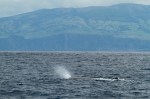
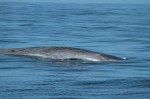
Fin whale (c) Craig Turner
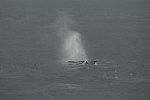
Sperm whale (c) Craig Turner
Breaching false killer whale (c) Craig Turner
Deploying the hydrophone
Laura recording data
Lynn listening to the hydrophone
Fin whale (taken by Craig Turner)
Sperm whale (taken by Craig Turner)
Sperm whale fluke (taken by Craig Turner)
Sperm whale fluke for ID (taken by Craig Turner)
Multiple sperm whales (taken by Craig Turner)
Following sperm whales (taken by Craig Turner)
Celine recording data (taken by Craig Turner)
Southern coast of Faial (taken by Craig Turner)
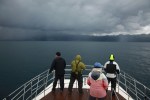
Some of the team on lookout (taken by Craig Turner)
Fin whale with calf
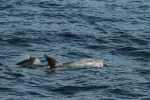
Bottlenose dolphins
Sperm whale fluke
Fin whale (taken by Craig Turner)
Fin whale (taken by Craig Turner)
Sperm whale fluke (taken by Craig Turner)
Sperm whale fluke for ID (taken by Craig Turner)
Cory’s shearwaters (taken by Craig Turner)
Sperm whale with Cory’s shearwaters (taken by Craig Turner)
Tracking a Fin whale (taken by Craig Turner)
Recording sperm whale data (taken by Craig Turner)
Recording sperm whale data (taken by Craig Turner)
Data sheet (taken by Craig Turner)
Sperm whale recorded last week and also recorded in 2014 (Craig Turner)
Team on the boat (Craig Turner)
Team on the boat (Craig Turner)
Risso’s dolphin (Craig Turner)
The reality of cetacean research (Craig Turner)
Waves in the harbour – never good news (Craig Turner)
Brief sighting of a fin whale (Craig Turner)
Following a sperm whale
Male sperm whale fluke, but not for ID
A better sperm whale fluke ID image, but not perfect
How many sperms whales do you see?
Pico smoking
Camila on aft lookout duty
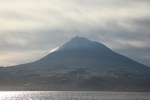
Sunshine over Pico
Carol and Camila recording blow rates of sperm whales
A busy day of data for Scott
The sun does not always shine
Working in the shadow of Pico
Bottlenose dolphins
Bottlenose dolphin
The ideal dorsal fin ID shot
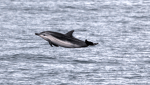
Dorsal fins of Risso’s dolphins
Risso’s dolphin with calf
Male sperm whale seen on the same day in 2009 and 2016
Fin whale blow
Fin whale with characteristic white jaw
Sperm whale off the north coast of Faial
Sailing south of Faial island
Western point of Faial island
Stuart and Camila recording data
The team (by Lisa Steiner)
Fin whale and calf (by Julie Bork)
Rolling fin whale (by Uwe Burkhardt)
Fin whale with characteristic white jaw
Blue whale with fin whale
Risso’s dolphin
Fin whale fin
Characteristic mottling of a blue whale
Team on alert
The fly deck team on alert
Julie on aft lookout
David on hydrophone
Capturing the action
Carol on ‘POPA’
Sailing past Pico
Returning to Horta
Blue whale blow
Common dolphin (Craig Turner)
Harbour-side briefing from Lisa (Craig Turner)
Boat orientation (Craig Turner)
Close encounter of a blue (whale) kind (Craig Turner)
Blue whale south of Pico (Craig Turner)
Silvio hard at work recording data (Craig Turner)
The characteristic mottling and colouration of the blue whale (Craig Turner)
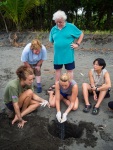
Our second expedition team have arrived, been trained in patrol and hatchery methodology, with Janet digging the “perfect leatherback nest.” In the hope of washing off the post nest-digging sand, most of us dived straight into the ocean. The ocean had other ideas, however, and tumbled us around in the surf, spitting us out with more sand in our clothes than before we had entered!
The first night proved a fruitful patrol for Magali’s team – as they encountered a smallish (141 cm carapace length), young turtle, bearing no tags. She took a very long time to drop her first eggs and then only laid 59, which is quite a small clutch for a leatherback. Holly from the UK who was given the task of collecting the eggs, said afterwards, “Being a new mum myself, I could relate to her not really knowing what she’s doing!”
Sunday night, the new moon, which had so delighted us with its light, enabling us to finally see where we were going, suddenly became obscured by dark, black clouds, which duly opened upon us. Then a nesting turtle suddenly appeared for Catherine, Carol, Terry and Janet, and it was action stations! The turtle was already laying and we peeped into the nest to see a clutch of glistening eggs. Oscar, our guide, quickly tried to excavate as many eggs as possible, but she was nearing the end, so he deftly inserted one end of a long measuring tape into the nest and waited until she had finished covering up and moving off, before unearthing the eggs – there’s no way a human can compete with the power of a leatherback’s flippers, so this was the best option. After rescuing Terry’s glasses from a near burial, we took the data and brought the eggs to the hatchery, which fortunately for us, was only two minutes away.
Other patrols witnessed two poaching events, and it seems that our thief (from last week) is still at large, as whilst taking a pee in the bushes, one of the poacher’s own egg bags was swiped! “Now that’s Karma!”, said Ida.
On Monday loud knocks woke us up at 21:30. There were initial grumbles at being woken up during our pre-midnight patrol nap. But as the word “hatchlings” were uttered we all got out of bed, bushy-tailed and bright-eyed. There was a clutch of twenty-five baby leatherback turtles ready to head for the ocean. We all observed them being measured and weighed before finally making their last mad dash for the sea. During the night a few more emerged and by the morning Theresa, who was on early morning hatchery shift, released the last lost little wanderer on to the beach.
Tuesday afternoon Magali excavated the nest and another nine turtles were dug out from the bottom of the nest. Everyone released a turtle, cheering them on as they crossed the beach. Dustin was up for hatchery duty next and just as we were all about to leave, he noted a few little heads starting to poke out of one of the nests. “I had just started my shift,” exclaimed Dustin. A couple of hours later as Theresa and Janet were about to take over hatchery duty, fifty-nine hatchlings had emerged and they measureed, weighed, and then finally released the little ones. What a night!
As we enter the darkest phase of the moon, the turtle activity seems to have declined slightly. However, due to our recent reporting of the poacher’s breach of agreement and subsequent egg theft, the presence of coast guards on the beach at night has risen from zero to four. As if to justify their presence even further, they were the ones to discover the only two nests that have been taken to the hatchery in the past couple of days! Hopefully this will inspire them to stick around, as their dedication is greatly needed.
For expedition team 1, the week in Pacuare is drawing to a close and instead of our usual afternoon beach duties, clearing the plethora of plastic from this remote coastline, and removing the logs which not only trip us up in the dark, but more importantly, may deter a cautious turtle from nesting, we opted for a locally-run wildlife tour instead. Our guide, Freddy, had an extremely keen eye, and alerted us to troupes of spider monkeys performing their aerial acrobatics in the high branches, miniscule bats lined up on a dead log asleep, lazy sloths and crimson poison dart frogs. A wonderful way to end an extremely experience-rich week.
Thank you team 1 for all your very hard work, day and night, for your diligence, your enthusiasm and all your wonderful feedback. During this expedition, we witnessed 24 false crawls, (this is when a turtle emerges from the sea, but does not dig a nest or lay any eggs), took 10 clutches of leatherback eggs to the hatchery for their protection, (a total of 760 eggs) and released 90 hatchlings into the sea. This is an excellent achievement. Unfortunately the poachers took a further 13 clutches of eggs despite our relentless patrolling, which brings the reality of the situation home. This is an area where only hands-on conservation work can make a difference – thank you for all your efforts, and we look forward to welcoming the second team in a few days time to continue what you have started.







































 Biosphere Expeditions: blogs from the frontline of wildlife conservation and the fight for a more sustainable planet