Update from our volunteer vacation / conservation holiday protecting whales, dolphins and turtles around the Azores archipelago (www.biosphere-expeditions.org/azores)

If our first day at sea was about diversity (with blue, sperm and humpback whales; not to mention the common and bottlenose dolphins), our second day was all about intensity.

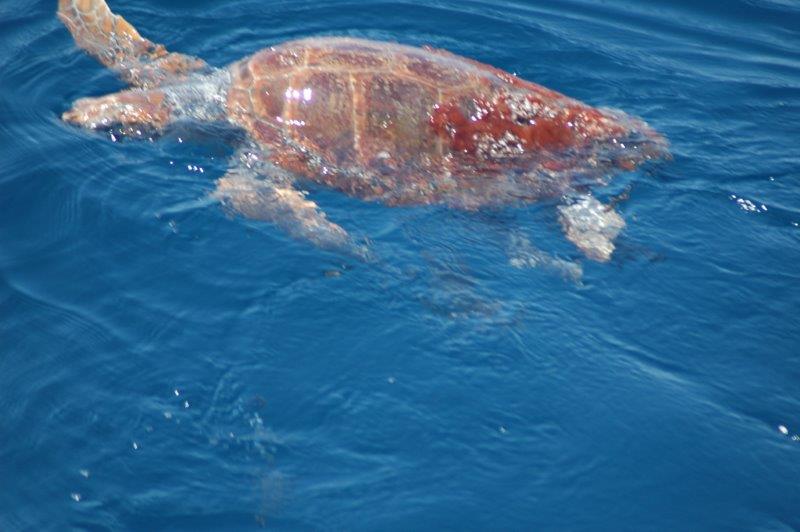
After the obligatory turtle sighting from Carlos (winning the prize for the first spot of the day), common dolphins were again added to the sightings list, but this time with calves. Our lookouts (Anthony and Simon) then proved their worth with a dolphin shout that turned out to be Risso’s, again with calves. With hieroglyphic scratches covering their bodies, this not only makes them distinctive, but also gives a window on their history.

Risso’s dolphin sighted off Pico Island – the scratch marks on the dorsal fin aids identification. Picture courtesy of Craig Turner.

Body art was also a theme for the part of the day, as we observed the ‘chevron patterns’ of several fin whales – these markings behind the head are partly used to identify individuals.

IMG_8791
Trying to identify a fin whale from its chevron markings. Picture courtesy of Craig Turner.

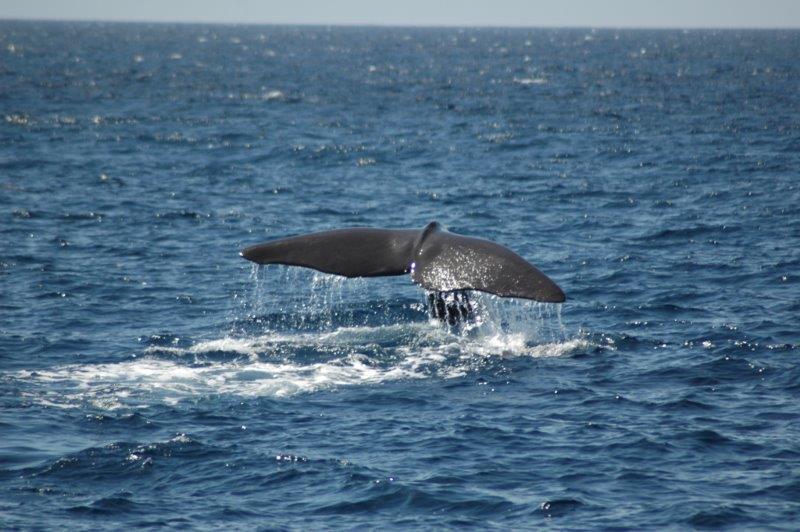
The afternoon was reserved for sperm whales by the dozen. Keeping the team busy recording blow rates and fluke photographs for identification of individuals. Several of the females observed were also with calves. There must be something in the water!

Until tomorrow.

Craig


Update from our volunteer vacation / conservation holiday protecting whales, dolphins and turtles around the Azores archipelago

Update from our volunteer vacation / conservation holiday protecting whales, dolphins and turtles around the Azores archipelago (www.biosphere-expeditions.org/azores)

This is Anthony, Craig’s assistant expedition leader, reporting on our first day out at sea.

Datasheets at the ready, we set sail this morning. Within moments of leaving the dock, we spied our first pod of common dolphins. In the rush to get the corresponding paperwork to document this event, a turtle was spotted by Annabel. Now hurriedly looking for the turtle sheet we were now in the bay and into the blue.

common dolphin (1)
Common dolphins
turtle 2010 (1)
Turtle

With the early records documented, we saw our first blow in the distance. It belonged to a humpback whale. Before we could get there, it had dived. Luckily, however, the radio, operated by our spotters on land, reported sightings of a baleen whale, so we powered in that direction.

humpback whale (1)
Humpback whale


When we arrived we discovered it was the mother of all baleens, the mighty blue whale. We patiently watched it as it swam gently on its way before diving and giving us five minutes or so of Meerkat-style peering around in all directions to see where the next blow came from.

blue whale (1)
Blue whale


Eventually we headed off and happened upon our humpback again, waving at us with his enormous pectoral flipper.

The day was rounded off with a group sperm whales until we had to make our way back to the harbour and call it a day.

Sperm whale
Sperm whale

All in all we could not have hoped for a better first day. What will tomorrow bring…?


Update from our volunteer vacation / conservation holiday protecting whales, dolphins and turtles around the Azores archipelago

Update from our volunteer vacation / conservation holiday protecting whales, dolphins and turtles around the Azores archipelago (www.biosphere-expeditions.org/azores)

After an early start for the final pieces of preparation, we can at last say a big Azorean welcome to our expeditioners.

The team all arrived safely, from the north, east and west; via a mix of routes and modes of transport. The good news is they are all present and correct and very excited. So the first slot of 2015 officially begins.

With initial introductions, risks assessments and briefings completed, we stretched our legs with a whistle–stop orientation around Horta. Whilst important for us to impart the initial project knowledge, it has been great to learn about our new team. The day was rounded off with our first dinner, created in-house by the team – a tasty vegetarian pasta it was too!

Rested and recuperated from the travel and briefing exertions of yesterday, the science training began today. Familiarisation with equipment was followed by data records training, and rounded off with a boat orientation – though the latter was slightly delayed, as our vessel went (without us) to the aid of another boat stranded engineless in the harbour – always be prepared for the unexpected!

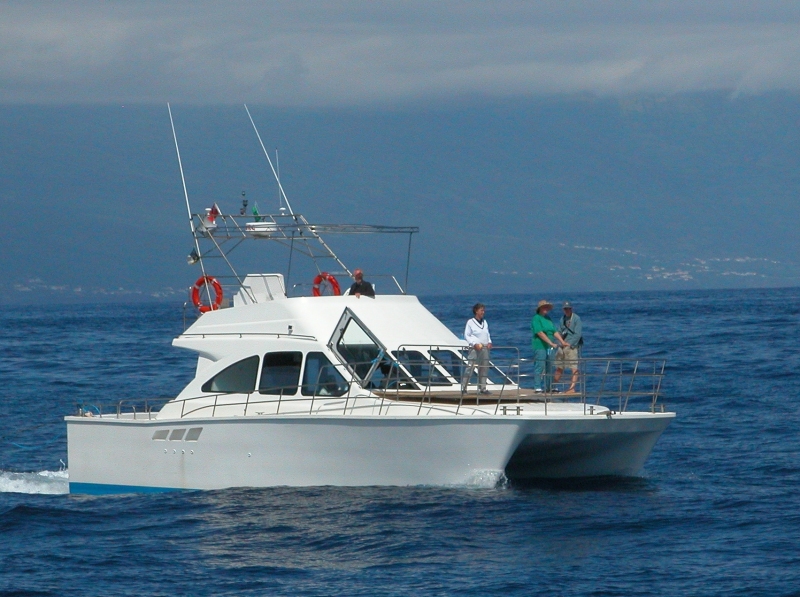
boat (1)
The research vessel


Slightly less than unexpected was the small ‘weather spanner’ thrown into the workings of the expedition, as our training session at sea was postponed by high winds. Tomorrow looks more favourable, so it will be all systems go as our team put their new-found knowledge into practice. The whales won’t have to wait for us much longer 😉

The weather delay meant Lisa (our scientist) could give a background talk on cetaceans, and the team could acquaint themselves with the data entry and the fluke matching process – how we identify and track individual whales.

The day was rounded off learning key identification features of species we will hopefully encounter, the team are now poised and ready for action. All we need now is a good night’s rest and the right weather for whales…


Update from our volunteer vacation / conservation holiday protecting whales, dolphins and turtles around the Azores archipelago

Update from our volunteer vacation / conservation holiday protecting whales, dolphins and turtles around the Azores archipelago (www.biosphere-expeditions.org/azores)

Our migration to the Azores is complete. After a great flight from Ponta Delgada, staring at the sea below whilst passing the towering volcanic peak of Pico island, Anthony and I are now in Horta. Yesterday and today we have been preparing for your imminent arrival.

It has been great to re-orientate ourselves around town, meet up with our hosts (Jim, Claudia and Tiago) and catch up with Lisa (our scientist) to hear about all the recent sightings. We can share more detail on that once you’ve arrived (or you can have a look at Lisa’s Facebook pag at https://www.facebook.com/pages/Whale-Watch-Azores/113978598781878?fref=ts). We now just hope that the weather and whale gods are on our side and we can look forward to some great fieldwork (and data collection) over the next few days.

Easter Sunday has greeted us with liquid sunshine, but it won’t dampen the preparations or enthusiasm for the first group of the expedition. So safe travels to those of you still en route, and we look forward to meeting you all on Monday.

Peter's Cafe (Sport)
Peter’s Cafe (Sport) in Horta

Update from our volunteer vacation / conservation holiday protecting whales, dolphins and turtles around the Azores archipelago (www.biosphere-expeditions.org/azores)

Hello everyone

It’s time for the initial introductions. I am Craig Turner and I’ll be your expedition leader in the Azores this year. It is great to be going back after my first stint last year.

I am already on route, having packed my gear and left the snowy hills of north Scotland yesterday. Today is the Lake District to Lisbon leg, and tomorrow Horta. It will be great to meet up with friends and colleagues from last year, not least our scientist Lisa Steiner. If you want to find cetaceans in the Azores, then she is the person to find them. Last year, my baptism was blue – a great way to kick off our data collection. Who knows what it will be this year, with an early and rare rumour of orcas in the wider area.

I arrive a couple of days before you in order to set up the expedition headquarters. We’ll have Anthony and Chris as expedition-leaders-in-training along with us on each slot, which will be a great addition to the team. I’ll send around another message once I get on the ground in Horta and confirm my local telephone number.

This reminds to mention communications on the island. There’s mobile phone reception on Faial in addition to internet here and there, but there’s also a golden rule of no cell phones while we’re at sea. Hopefully you can resist the need for frequent international comms, and why not go off the grid for the expedition, and soak up the expedition experience.

I know you’ve all been eagerly reading your expedition materials and know to bring many layers of clothing. The weather can be a bit like four seasons in one day, so prepare for warm, cold, wet and dry. Like the weather in Scotland! Don’t forget your waterproof trousers – you’ll thank me when you are stationed on the bow as a lookout and the weather is choppy.

So with the local team in place, whale sightings already logged by Lisa, all we are missing is you. This Monday morning is hopefully one we are all looking forward to….. It will be great to meet you all and I’ll send along another update very soon.

Safe travels…

Craig


Update from our volunteer vacation / conservation holiday protecting whales, dolphins and turtles around the Azores archipelago

Update from our volunteer vacation / conservation holiday protecting whales, dolphins and turtles around the Azores archipelago (www.biosphere-expeditions.org/azores)

Addendum of pictures of the 2014 expedition

This slideshow requires JavaScript.

Continue reading “Update from our volunteer vacation / conservation holiday protecting whales, dolphins and turtles around the Azores archipelago (www.biosphere-expeditions.org/azores)”
Update from our volunteer vacation / conservation holiday protecting whales, dolphins and turtles around the Azores archipelago (www.biosphere-expeditions.org/azores)

Thursday we had four encounters with blue whales, one of them a breathtaking experience. The joke on board the Physeter was, “Now we know what blue whales play with—us!” because our first blue whale of the day circled the boat three times before heading off on a deep dive—directly under us! A couple of fin whales, one humpback, and encounters with common dolphins as the first and last encounters rounded out the day.

Friday the team had another remarkable day. First, the team reported a random sighting of the sun 🙂

Our first cetacean encounter was with two blue whales and a fin feeding together. It was another action-packed day with plenty of whales spotted by the vigias, as well as several random sightings of animals we spotted on our own. “Eyes to the back of the boat” was the motto of the day, and sure enough, many of the cetaceans chose to sneak up behind us today. We spotted an uncooperative humpback, which only fluked once. Luckily our photographer for the day, Simon, caught it right as its tail disappeared into a wave.

Humpback whales are unusual here in the Azores, and while there were reports of a few sightings of humpbacks before team 3, only team 3 actually saw them. Counting today’s last humpback encounter, Lisa was downright giddy that this was our fifth individual seen this season.

Another unusual occurrences war the “norm” for team 3; Lisa had just pointed out a few petrels – a species of bird that is generally not present this time of year – and had commented on how she had never before seen so many. There were around 150 birds and then we saw the reason why; they were feeding on a dead whale.

We estimated that the whale carcass was about 3-4 months old. Indeed, it was far gone (luckily our skipper kept us upwind). The species was unidentifiable, but the enormous amount of floating blubber did not leave any doubt as to what it was. In general the team agreed that it was a privilege to see the dead whale, an honour to bear witness to the cycle of life having also seen young whale calves during our time here. We also were privileged to see several blue whales, pilot fish, and the now-positively identified Wilson’s storm petrels.

A big thank-you to all team 3 members for your hard work. Your efforts catalogued:

Bottlenose dolphins – 0 encounters (much to Martina’s dismay…)

Common Dolphins – 18 encounters totalling 522 animals

Risso’s dolphins – 4 encounter totalling 36 animals

Fin whales – 11 encounters totalling 19 animals

Sei whales – 9 encounters totalling 11 animals

Blue whales – 16 encounters totalling 21 animals

Humpback whales – 5 encounters with 5 individuals

Sperm whales – 22 encounters with 15 identified individuals

and

Loggerhead turtles – 4 encounters with 4 individuals (with 1 tagged)

Saturday was the last day of the expedition and we obviously did our training job well in the Azores because after we said good-bye to team 3, I received a phone call from Martina at the airport…Diana had spotted a fluke! The two confirmed a humpback whale right off the coast of the island. Good work team!

Indeed good work everyone this year! A sincere thanks to all our hard working participants who came out with us this year. Your contributions in effort and time really made a difference in our research here – we simply would not have been out on the sea at this incredible time without you making this expedition happen. Thanks for braving bad weather, choppy seas, seasickness and POPA paperwork.

Overall stats for all three slots combined:

Bottlenose dolphins – 8 encounters totalling 60 animals

Common dolphins – 62 encounters totalling 1429 animals

Risso’s dolphins – 8 encounter totalling 82 animals

Fin whales – 20 encounters totalling 36 animals

Sei whales – 21 encounters totalling 37 animals

Blue whales – 19 encounters totalling 25 animals

Humpback whales – 5 encounters with 5 individuals

Sperm whales – 91 encounters totalling 276 animals

and

Loggerhead turtles – 11 encounters with 11 individuals

Leatherback turtles – 1 encounter with 1 individual

It was great to meet all of you and a privilege for Lisa and I to work alongside you. I hope to see you on another expedition. Can someone give me a water temperature please?

Alisa

This slideshow requires JavaScript.

Continue reading “Update from our volunteer vacation / conservation holiday protecting whales, dolphins and turtles around the Azores archipelago (www.biosphere-expeditions.org/azores)”

Update from our volunteer vacation / conservation holiday protecting whales, dolphins and turtles around the Azores archipelago (www.biosphere-expeditions.org/azores)

Tuesday we came close to breaking the Biosphere Expeditions record for the highest number of individual sperm whales catalogued in one day…we sighted 15 individual animals! We did, however, break the number of sperm whale breaches, with an astounding SIX breaches. Plus we saw another two sperm whale tail lobs. A tail lob is when a large whale positions themselves downwards vertically and then slaps the water surface with the stock of their tail.

On the way back to base we also saw two pods of Risso’s dolphins and a small group of striped dolphins.

Wednesday Ana Besugo, a researcher with the Departamento de Oceanografia e Pescas, Universidade dos Açores, came on board with us. Thanks to her we caught and tagged our first loggerhead turtle of Team 3. Volunteers saw Ana in action taking samples from the loggerhead, including barnacle scrapings and the turtle crabs. Most loggerheads have one or two crabs that live underneath the shell of the turtle close to the anus in a symbiotic relationship. The crabs clean, and the turtles provide protection.

The team did a terrific job again with big rolling waves and choppy seas today. We were treated to 20 common dolphins only a half hour from the harbour, then spent the rest of the day bouncing in between fin whales (6 in all), blue whales (2), and a humpback whale. The humpback was not bothered by the boat at all; matter of fact, he was downright photogenic. He fluked very close straight towards the boat, and then fluked very close going away from the boat, giving us some excellent ID pictures. (Thanks Ann for letting me post your pictures!)

This slideshow requires JavaScript.

Continue reading “Update from our volunteer vacation / conservation holiday protecting whales, dolphins and turtles around the Azores archipelago (www.biosphere-expeditions.org/azores)”

Update from our volunteer vacation / conservation holiday protecting whales, dolphins and turtles around the Azores archipelago (www.biosphere-expeditions.org/azores)

Due to bad weather at sea, Sunday was a shore day for the group. Seven of us – Manuel, Flávio, Mónica, Diana, Sue, Lisa and I – spent our morning alongside the locals in Almoxarife participating in Faial’s Beach Clean.

Organised every year, teams of volunteers meet at the island’s beaches to pick up debris that’s either been washed up from the Atlantic or left behind by locals. At the end of the two-hour clean, all the trash is piled up in the centre of town as a monument to the volunteers’ efforts. It’s amazing what a big difference a few volunteers can make. And I admit, it was really an honour to work alongside the Faialenses and be able to give back to this beautiful island community where we are privileged to work.

Yesterday, Monday, well, I just have to say well done Team Three! It was a difficult day at sea with a rocking boat and challenging sea conditions. We had two long encounters with two blue whales, totalling four animals to add to the catalogue. En route to a group of sperm whales we saw a small group of Risso’s dolphins.

Before we arrived at the sperm whales, a report of a humpback whale came in. When this changed to TWO humpbacks, we changed our course and went down to photograph them. They were actually at the mouth of the harbour – at one point only about 100 meters off of Monte da Guia. They were magnificent to watch, with their 5 meter long flippers that we could see under water.

This slideshow requires JavaScript.

Continue reading “Update from our volunteer vacation / conservation holiday protecting whales, dolphins and turtles around the Azores archipelago (www.biosphere-expeditions.org/azores)”

Update from our volunteer vacation / conservation holiday protecting whales, dolphins and turtles around the Azores archipelago (www.biosphere-expeditions.org/azores)

Team three arrived Thursday, and wasn’t able to go out to sea on our first scheduled day because of high winds (Team 2 knows what I am talking about!) Today, Saturday, was our first day out and we made up for lost time.

What a day! Our group saw seven blue whales. We also saw eleven sei whales, nine badly behaved sperm whales who chose not to fluke, two fin whales, one turtle and about 80 common dolphins. The second to last blue whale did fluke for us; it’s very rare that they do, but we’ve got pictures and a video to prove it

Martina was our super spotter today, with our first sighting of the day. With only eight team members, and three of them feeding the fish at the back of the boat, yours truly was “water girl” (most of the time). Kudos to all team members for filling in for others as they dropped down to the back deck one by one. And special thanks to Ann, who wrote up the POPA transects and a staggering amount of random cetacean sightings by herself on the first day!

Marília was our photographer today, and she did a great job. There were lots of Portuguese man-of-war in the water, and she captured this really nice one for the team. Actually, all of these pictures are hers.

This slideshow requires JavaScript.

We have four “placements” with us on this group, Masters Students from the University that have joined the expedition as part of our capacity-building efforts. On all projects Biosphere Expeditions tries to give back to the community by using local services, guides, resources and food, as well as educating and empowering locals. Marília, Mónica, Manuel and Flávio are a great addition to our team.


Continue reading “Update from our volunteer vacation / conservation holiday protecting whales, dolphins and turtles around the Azores archipelago (www.biosphere-expeditions.org/azores)”