Award-winning, non-profit and ethical wildlife conservation volunteering. Advancing citizen science and conservation since 1999 – for nature, not profit.
‘I wanted to have an impact on protecting nature,’ says Angelika Krimmel from Germany, reflecting on what drew her to her first expedition with Biosphere Expeditions.
That first experience was in 2016, studying whales and dolphins in the Azores. It wasn’t long before Angelika found herself coming back again and again – to Slovakia in 2017 to monitor lynx, bear and wolf; to Kyrgyzstan in 2019 and 2024 for snow leopard research; and to Kenya in 2023 for African biodiversity conservation.
Whales, paw prints and camera traps
Each project offered something unforgettable. “After a week with the whales, you think nothing can top the first sight of one. But then a curious sperm whale swam alongside our boat, jumped three times and looked straight into our eyes. That look went directly to my heart.”
Angelika (yellow circle) with her 2016 Azores expedition team
Peter Pilbeam from the UK is a long-time supporter of Biosphere Expeditions. He took part in every single expedition to the Altai mountains that Biosphere Expeditions ran from 2003 to 2012. ‘And then it just snowballed’, he remembers. Here’s his story.
‘Initially I was intrigued by the slogan ‘Where on earth is the Altai?’ and my interest in snow leopards’, Peter recalls ,‘and I liked my first expedition so much that I just kept coming back’.
Peter (yellow circle) and his Altai expedition team in 2011.
‘In the years after the Altai expeditions, I went to Kyrgyzstan to continue with snow leopard expeditions, then to Slovakia and Germany to study wolves, Sumatra to work on tigers, and Scotland and the Azores for cetaceans.’ All in all Peter has been on 17 expeditions since Biosphere Expeditions started in 1999, which makes him one of the most experienced expeditioners of the NGO.
‘All these expeditions have taught me how to travel independently, how to camp in the wild, and a good dose of self-reliance’, reflects Peter, ‘and once on the expeditions, I really appreciated all the great and varied experiences, some very hot and humid like Sumatra, some cold and snowy like the Altai and Kyrgyzstan, some wet and with rough seas, such as Scotland and the Azores.’
Altai 2011
Scotland 2013
Slovakia 2017
‘And I always take lots of memories home with me’, says Peter, ‘some of the most abiding ones are trekking over mountains through snow and across scree slopes in the Altai, tracking wolves in snow and mud in Slovakia, and watching and recording whales – those beautiful creatures of the sea – around the Azores archipelago’.
Back home in the UK, Peter has now given lots of talks on snow leopard. He is also active as a mammal surveyor and teaches small mammal ID courses regularly. He has also become a reserve warden in his home-county of Cambridgeshire.
‘I expected to learn something on the expeditions, but I never expected it to have such a profound impact on me!’ says Peter. ‘ To anyone out there thinking about going on an expedition, I would say do it! Choose with care, but just do it!’, he adds with a laugh.
Pascal Tchengang, from Paris, France, loves travelling and being in touch with nature. In fact, this is how he discovered Biosphere Expeditions way back in 2002 and then went on an expedition to study big cats in Namibia in 2003, returning there in 2005 as staff. Today Pascal helps out part-time in Biosphere Expeditions’ French office near Paris.
Pascal’s first engagement with Biosphere Expeditions was in 2002, when he was researching options for holidays with a purpose in nature. ‘My favourite thing -then and now – when I travel is being in touch with nature’, Pascal reminisces, ‘there are certain places you can discover and visit on your own or with your family, but there are others where you really need to be accompanied by specialists’. This is how he came across Biosphere Expeditions all those years ago and has ‘never looked back’, he says with a broad smile.
Pascal on expedition in 2005.
‘You see, I love animals and wildlife in general. Back then I had a burning desire to go to Africa and see wildlife up close. Of course, there are national parks that you can visit on your own or with your family by renting a vehicle, but what I wanted was to get as close as possible to the large mammals. So, while searching the web, I discovered Biosphere Expeditions. Browsing through their website, I was fascinated by the programmes offered on each expedition. So I signed up and took part in my first expedition to Namibia in 2003’, Pascal recalls. ‘It was incredible, a real revelation. It was the first time I had ever come into close contact with large mammals. In Namibia, I had the chance to get up close to cheetahs and leopards, because we were accompanied by a scientist who was studying them there. In fact, during that first expedition, I enjoyed both the opportunity to encounter the animals and being part of a group that was genuinely curious and eager to learn’.
On the expedition Pascal met some senior Biosphere Expeditions staff and asked whether he could help out with the office in France. He could – and started assisting with enquiries and attending events, becoming a spokesperson for Biosphere Expeditions.
Two years later, Pascal was back in Namibia as staff, this time with Peggy, ‘the person I share my life with today’, Pascal says with his eyes lighting up, ‘this trip was her first of its kind, a real revelation’.
Peggy & Pascal
‘So, yes, if you are looking for a trip where you won’t encounter trivialities, and especially if you want to make yourself useful, then I really recommend Biosphere Expeditions’ Pascal says, adding with a laugh ‘and I don’t just say this because I am biased, but because I genuinely believe it’. For advice, over 20 years after his first expedition, Pascal is the representative in France, so please feel free to reach out. ‘I will be happy to provide you with as much information as I can’.
Sven Strohschein from Hamburg, Germany, has made some great memories with Biosphere Expeditions, going with them twice to research whales and dolphins around the Azores archipelago, to study Amazon biodiversity in Peru, African wildlife in Namibia and the Arabian leopard in Oman. After these expeditions, he also joined the ‘Friends of Biosphere.’ ‘It was and is a great experience to be part of Biosphere Expeditions’, he sums up.
Sven on expedition in 2007
For Sven, who has been in the shipping industry since 1981, going on an expedition was something completely new for him: ‘I found Biosphere Expeditions through an article in a magazine. I was curious to get more experience and knowledge about wildlife conservation and looking after our natural environment.’ So Sven took the plunge into what was to become a formative experience.
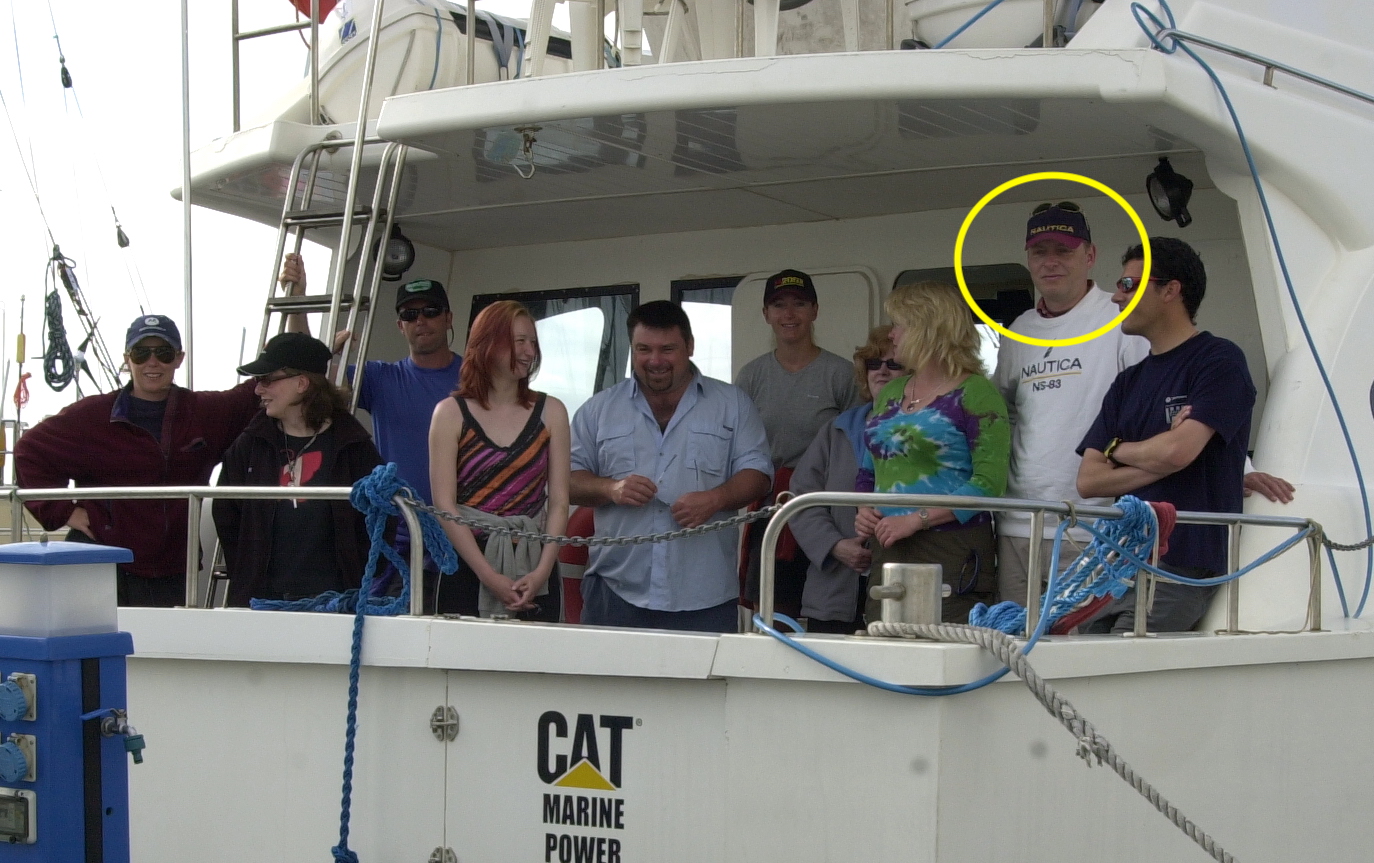
Sven (circle) and his Azores expedition team
‘I can still remember sitting at the campfire under the stars during the Namibia expedition and hearing the lions roar. I also remember jumping into the Atlantic Ocean, trying to catch a glimpse of the whales after they went under the waves, and watching the sunrise at our research station on the Amazon.’ Perhaps his most abiding memories were ‘being woken up by elephants browsing trees just a metre away from where I was sleeping, witnessing a lion hunt in the middle of the night and talking to local people face-to-face’.
When asked about what he’s learnt, Sven thinks that a lot more needs to be done to help the natural world recover and also that everyone can help, not only scientists.
Sven (left) tracking a lion in Namibia
Looking back, Sven reminisces that “Each time I joined a Biosphere Expeditions team in the field, it was definitely a unique experience. I am happy and proud to also support Biosphere Expeditions through the Friends and by helping with media enquiries in Germany and talking to those who are thinking of coming on an expedition.’
Peter Thoem, a retiree from Canada, has participated in six expeditions so far. ‘I have time in my life, the health and the resources – so why not’ is his go-getter attitude in all this. This is why he started with expeditions and what he experienced on them.
‘Back in the day, when I was thinking about joining my first expedition to the Tien Shan mountains to study snow leopards, it was the opportunity to get into a really wild area. I could see that few westerners would ever get to see or experience the Tien Shan mountains and that the expedition might yield exciting results’, recounts Peter, ‘it was simply too good an opportunity to miss.’
And since then? ‘Tien Shan was just so thrilling’, says Peter, ‘and then the year after – in 2019 – there was the chance to do something equally useful in places as fascinating as the Dubai Desert Conservation Reserve and Kenya’s Masai Mara. It deeply interested me’. So off he went to the Dubai Desert Conservation Reserve first and then a few months later to Africa for back-to-back expeditions in 2019 and 2020, just before the Covid pandemic brought everything to a standstill for a couple of years.
Peter with local rangers on the Kenya Masai Mara expedition
His most recent expedition was to the Azores archipelago, studying whales & dolphins from a catamaran.
When asked about lessons learnt on expedition, Peter’s answers are swift and precise, showing his enthusiasm. He believes that with good planning, an open mind, health and resources, you can do it, because ‘it’s a fascinating world out there’. And further that even if ‘our western comforts make us think that everywhere else is scary, it’s not. Yes, some places can be risky, even dangerous, but not everywhere else.’
When asked to summarise his experiences, Peter takes some time to think, smiling to himself and then says: ‘Sometimes it’s rigorous – we have work to do and protocols to follow, we have to understand what’s expected. We have to coalesce as a team and appreciate each other’s strengths and not-so-strengths. Then we have to find ways to work with the less committed – some are day-dreamers, others are bloggers who don’t always contribute much.’ But it always works out in the end: ‘We come from all corners of the world, some of us have even met before, because we’re committed to the Biosphere Expeditions ethic. And when I return, I always feel richer and profoundly privileged for having been to places and done things that I used to believe only existed in an Attenborough world.’
Peter’s most abiding memories include standing on the slope of a remote valley in Kyrgyzstan with a clear blue sky. ‘It’s just warm enough to unzip my jacket. I’m surrounded by yellow expanses of spring flowers, there’s rushing meltwater cascading off snow-draped mountains around me and I had to pinch myself. Is THIS really me? Am I really here?’
Or there is the time when Peter was on his middle-of-the-night-shift keeping watch over a waterhole in Kenya’s Masai Mara. There are elephants around and hippos lie in the waterhole, but it’s quiet except for the odd grunt, splash or snuffle. Then from across the valley comes a strange upside-down bark, like indrawn breath ‘EEeeeeYiP’. What’s that, Peter asks the ranger. ‘Hyaena’, the ranger replies and Peter’s spine tingles.
And most recently, in 2024, on the expedition boat off Faial, one of the islands of the Azores archipelago: ‘The sea is lively and we have to hold on white-knuckle tight’, remembers Peter, ‘we’re all doing our tasks as assigned when a blue whale is sighted. We slow down and carefully approach – again everyone does as instructed – gathering data: time, water temperature, sea-state; taking photos, watching, counting and more. And then we’re spell-bound. There in front of us, all but immersed, visible yet almost invisible is the world’s largest mammal. It blows a couple of times, then dives to depths that take it out of the realm of human comprehension.’
A blue whale: a spell-binding animal for Peter
With all those experiences, what impact have the expeditions had on Peter’s daily life, away from expeditions? Again, Peter does not hesitate: ‘I’m seen and known for having just come back from another exotic place. Where are you going next, people ask. I have a greater understanding and appreciation of the value of citizen science’. An appreciation that has contributed to a structured long-term project on bird populations close to Peter’s home (now in its 10th year).
And what about Peter’s connection to nature? Has this changed through the expedition experiences he’s made? ‘My connection with nature has always been strong’, Peter responds, ‘and I feel that I have a reasonable understanding of how the balance of nature all weaves together. The expeditions give me the chance to see some of those interactions and inter-relationships’. And Peter adds an example of this: ‘With Alan, our expedition scientist in Kenya, we watched a small group of impala ingesting mineral-rich soils. Alan was ecstatic, it was, he said, the first known-to-science example of geophagy (animals eating soil, usually for its mineral content) by impalas. My photos made it a publishable observation‘.
Impala geophagy at the Memusi mineral (salt) lick, photo courtesy of Peter Thoem.
The interview ends with the question of what Peter would tell others who are thinking about joining their first expedition. Peter laughs and just says: ‘If it appeals to you, then set aside your fears and just go do it’.
Find an overview of all upcoming expeditions here.
Also see Peter’s birding blog entries for Kenya and Arabia
In his fifties, Neil Goodall felt the familiar urge to get away from it all and out into nature. Yet when he took the leap into expeditions, Neil discovered more than a new world – he found a new path, and a new lease of life.
Neil on expedition in 2018
Neil Goodall never expected to find himself in an acacia bush.
‘We were tracking leopards in Namibia, and had to set traps,’ Neil explains. ‘So I volunteered to crawl into the bush, and put the smelly carcass in the trap – and I thought, I’m an accountant!’
Setting a trap for leopards in Namibia
Since his first expedition in Namibia, Neil never looked back. Thailand, Malawi, Tien Shan: Neil traversed swamps, crossed deserts, and returned with a different perspective on life. ‘The contrast between this and working at my desk all day was just amazing. My colleagues couldn’t believe it. Gradually I became known as the Scat Hunter!’
Yet he wasn’t always an adventurer. Like many people, Neil found himself isolated from the natural world.
‘I always liked nature but never found the time for it,’ he says. ‘I was in my early 50s. Busy life. Two kids, family, and a very busy job – as a finance director for a public organisation.’
To get closer to wildlife, Neil followed what seemed to be the only option – safari, spending five days in the Serengeti.
‘Afterwards, I thought, I loved that, but a couple of things nagged me: you’re a tourist, you’re stuck in a vehicle, you can’t interact, and when you do see wildlife, they’re surrounded by tourist vehicles…it all felt a bit contrived.’
Signing up to be a citizen scientist with Biosphere Expeditions gave Neil the immersion in the natural world that he couldn’t reach in his everyday life – and then some.
‘It was everything that I’d hoped for: structured, but with a sense of liberation. We could go out into the wild, and as long as we did our tasks, we were free to do as we pleased. Wildebeest, giraffe, springbok – all close enough to smell them.’
Yet there was a crucial distinction. Neil wasn’t just close to the wildlife; his participation in the expedition enabled him to contribute to their conservation, shoulder to shoulder with dedicated scientists out in remote wilderness. On his first expedition, in Namibia, part of the project’s purpose was to change the narrative.
‘The farmers blamed the leopards for killing their livestock. Our work was helping to protect the cats. Collecting data, but properly in the wild – it’s such a purposeful interaction with wildlife.’
Part of what makes the expeditions so meaningful is because they’re not a holiday – they’re challenging, as Neil attests.
Neil (right) entering data with a fellow expeditioner in Malawi
‘It’s hard work,’ he agrees. ‘You’re up early, active from the off, but when you look back at the end of the day, shattered, you think – but what have I done? All day in nature, encounters with wildlife, collecting data with a team of people who were strangers a few days before. It’s hard, but it’s also one of the best things to experience because it connects with a lot of deep drivers that are rare to find in everyday life. But Biosphere Expeditions gives you confidence: you’re well briefed, well fed, and you know what you’re doing: solid foundations to go out of your comfort zone!’
And, like many expeditioners, Neil found himself not just out of his comfort zone, but far beyond it. His experiences across the world have been so out of the ordinary that they’ve changed how people see Neil as a person.
‘On my third expedition, I went to Peru – the first person in my family ever to go to South America. I found myself taking the boat from Iquitos down the Amazon, and I remember pinching myself – literally pinching myself – going, I’m on the Amazon. How!?’ Neil says, laughing. ‘People at work see me as the accountant. But it changes people’s perspective of you. They react ‘Wow, you did What!?’’
Neil (middle) with fellow expeditioners in Amazonia
Judging by his stories, this amazement is justified.
‘One night, in a remote region of Malawi,’ Neil begins, eyes lighting up in recollection, ‘We were observing a goat carcass to see if it attracted predators in the dark. We set a camera trap 10 miles from camp, but on the way back, we got stuck in the rutted road. Imagine: three of us, in the pitch black dark, somewhere in the middle of Malawi…and we had no choice but to get out of the car and push it out of the ruts. And you feel the danger,’ Neil admits. ‘We could radio for help, we knew we were safe, but it’s so far beyond everyday life. You come back and think: Wow!’
Ultimately, though, Neil’s experiences on expedition have given him more than just memories. They’ve given him new skills, opened new opportunities, and have made him an active protester for change. Inspired to put his new skills to use, he attend his first protest march – Restore Nature Now – in London in the summer, alongside 60,000 other nature lovers. Neil says, ‘I thank Biosphere Expeditions for giving me the confidence and the compulsion to protest for what I believe is a just cause, something I had not done before in my 68 years. And I will do the same again if the march is repeated.’
‘It changed my idea of what’s possible,’ Neil reflects. ‘I’ve always had it latent within me – but when are you going to get the chance, sitting in the office?’
Sixteen expeditions later, Neil the office accountant, has been transformed – and it hasn’t gone unnoticed. So who has Neil’s new sense of purpose influenced most? Neil bursts out laughing.
‘My sons – who see me as a boring old dad – they can’t believe what I’ve done!’
As biologists, Gary and Sandra Hogben have always been fascinated by the natural world. But when seeking a way to get stuck into some fieldwork, they began going on expeditions together. From tiptoeing past sleeping elephants to learning how to use the village water pump, it’s been an even richer journey than they’d imagined.
Sandra (left) and Gary Hogben (right) on their elephant expedition to Thailand in 2023.
Gary and Sandra never imagined they’d end up stranded on a dirt road in Malawi, miles from anywhere, bus broken down, no immediate way of moving. But that’s exactly where they found themselves. Rather than the struggle, however, they remember the laughter and camaraderie that came from taking responsibility for their own fate. ‘You’re really pushing yourself,’ Sandra says. ‘You learn your limits.’
Their story starts back in 2013, when the couple undertook their first expedition to Namibia. It proved a turning point in how they saw themselves—and their holidays. Both are biologists by training, but as Sandra notes, ‘It’s microbiology, not macro, so we wanted a broader perspective. Something that let us get back to what we used to do: proper fieldwork.’ A classic game drive wasn’t enough; they wanted hands-on involvement, real interaction with wildlife, and a sense they were contributing to something bigger.
So they signed up for a Biosphere Expeditions project in Namibia, discovering that expedition life is intense in ways they never anticipated. ‘I felt anxious about what I’d signed up for,’ Gary admits, recalling the dossier’s instructions on braving remote desert roads and uncertain conditions. But from the start, that same uncertainty became an addictive challenge. ‘I love to travel, but because of the climate crisis, I felt guilty,’ he says. ‘This wasn’t just a holiday though — it had a purpose, a way to give something back.’
Over time, they ventured further: Malawi, Arabia, Costa Rica, Thailand — each place tested them physically and emotionally. They’ve dodged tsetse flies, tiptoed past elephants at night, and faced torrential storms checking on hatcheries every fifteen minutes. Yet for all the trials & tribulations, both speak with a sense of wonder. ‘You come back feeling that you’ve overcome a challenge,’ Sandra says. ‘And very glad to have done so.’
Gary & Sandra (from right) and their 2018 Costa Rica sea turtle expedition team.
Sandra digging an incubation nest for leatherback turtle hatchlings
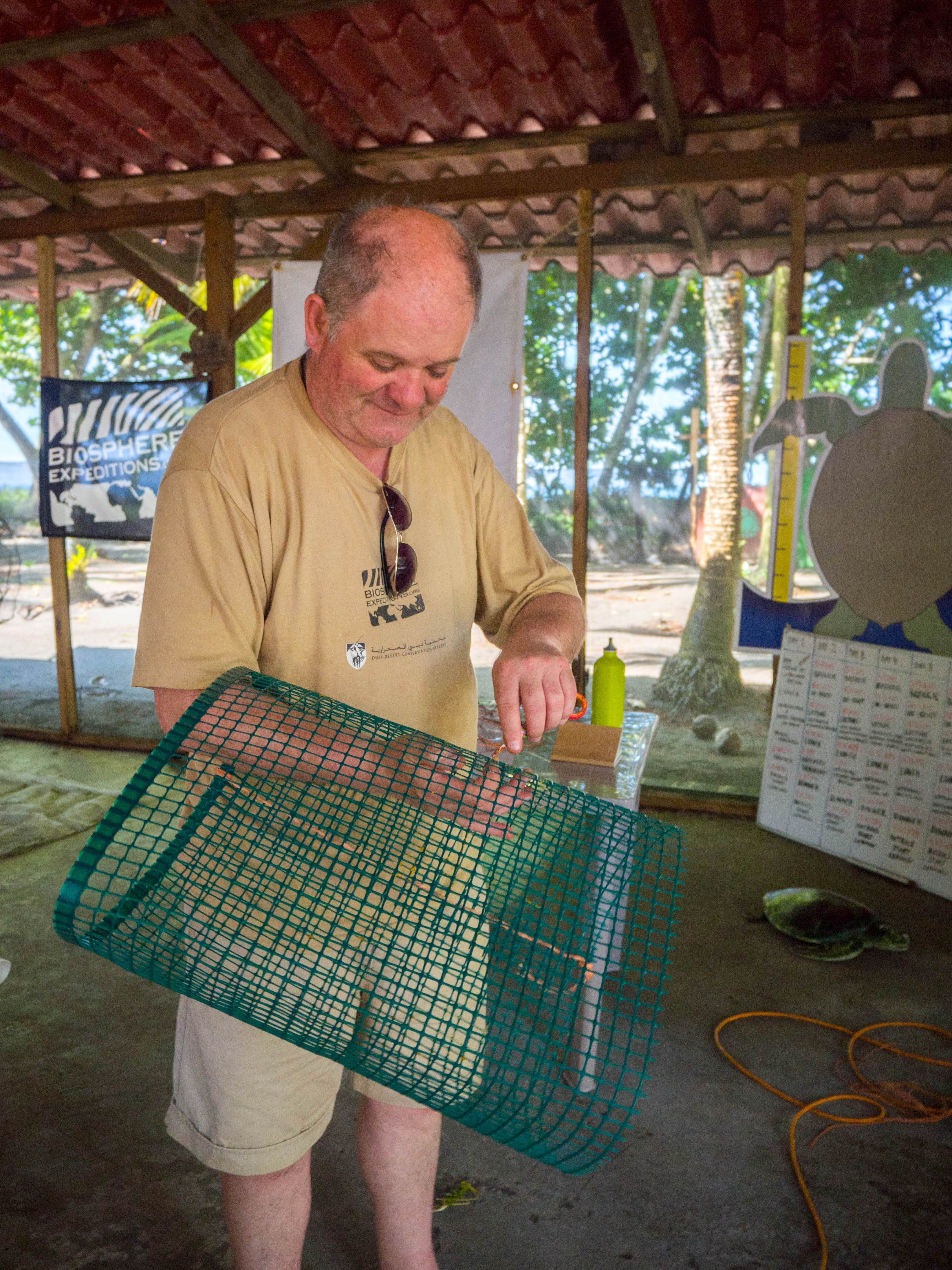
Gary constructing a protective basked for leatherback turtle hatchlings
Gary & Sandra on their 2018 Costa Rica experience
Meeting local communities helped them see their own routines in a new light. In Malawi, they learned to pump water from a village source, twenty liters at a time, or no shower. Back home, they realised their perspective had changed. ‘You see it a bit differently,’ Sandra reflects. ‘It shows you what’s possible.’ Gary now chairs a clean-water advisory group, inspired by the stark realities he encountered. ‘You’re right on the frontlines of conservation,’ he explains, ‘seeing the difference you’re making.’
Gary on his 2019 Malawi experience
Perhaps the biggest surprise has been the friendships they’ve forged. ‘We’ve stayed in touch with people from our first expedition,’ Sandra says. ‘Helen from Australia visited us in the UK, and Georg from Germany — like-minded folks who keep coming back for more.’
‘If someone asks whether they should do it, I always say: ‘Go for it. You won’t regret it,’’ Gary says. ‘I used to think being stuck between hippos and elephants was something you’d watch on TV. Now it’s part of our reality.’ And for both Gary and Sandra, that reality is far more compelling — and life-changing — than any other kind of holiday could ever be.
The Thailand 2024 expedition has now ended and all citizen scientist have left base with a little sadness, but also a spring in their step and plans to join future expeditions. It’s suddenly gone very quiet here without them. Just the sounds of cicadas, children, chickens, dogs, a passing buffalo and the calming gurgle of the river.
The last few days saw us continuing to observe the elephants and record their behaviour, adding to the impressive dataset. The final day in the field was hot, but fortunately for us the elephants headed for the shade of the forest and the cool of the streams for most of the time and we all had a wonderful few hours watching elephants forage, explore, dust bathe, drink and interact: simply living the natural elephant life.
Over the course of the expedition, we collected 142 hours of records of elephant activity, calf development, types of plants eaten and association between individual elephants. We also completed two biodiversity transect surveys near to base. Scientist Laura is really happy with what we have achieved and in due course she will write up the results and conclusions from our data in the expedition report.
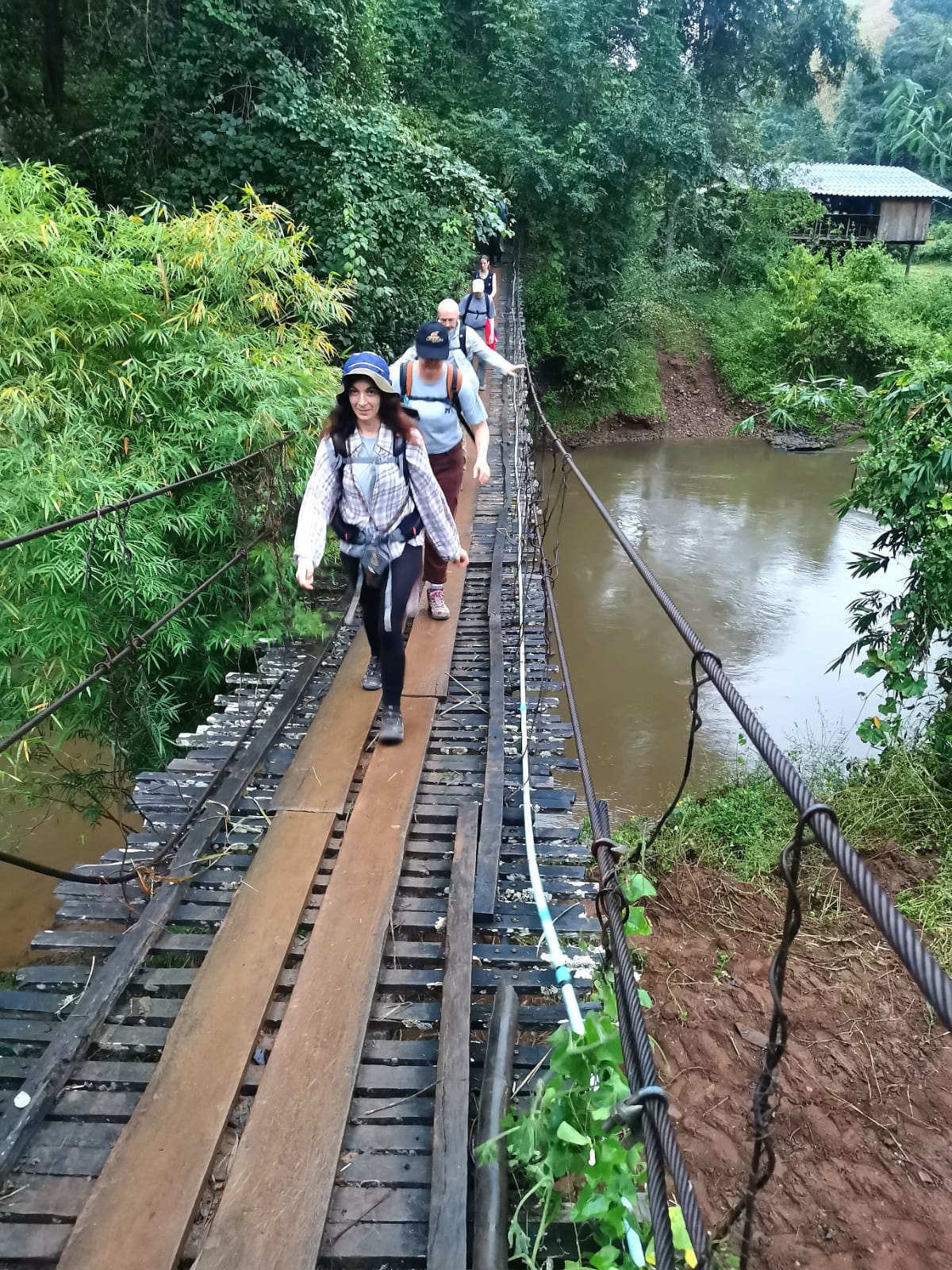
Our final hike back from the forest was great. We passed and greeted the locals sharing the same trail, by foot and motorbike, to get to the rice fields. We enjoyed the sight of butterflies, lizards and praying mantises.
I would like to thank the excellent team at KSES – Kerri, Laura and Cris – who hosted us, oversaw the science and gave us an insight into the world of captive Asian elephants released into their natural habitat. Thank you to Kanda, our young local guide who kept us safe and was always so warm and smiley. Thanks too to the villagers of Ban Naklang who fed and accommodated us in their home stays: Baw Eh, Tawahmoh, Nee, Jadee, Lujet and Seeva. And a big thank you to Neele, Anette, Stephen, Brandon, Jim, Rachel and Ed, the expedition citizen scientists who made this conservation research expedition such a success. You were a great team: hard-working, punctual, cooperative, appreciative of the value of the work we do here and altogether had a great attitude to the expedition. I hope to see you again on a future expedition.
We have settled into a good routine now. A one hour hike to the forest, setting off sometime between 06:00 and 10:00, depending on which period scientist Laura needs data for that day, followed by two or three hours of data collection with the elephants.
Once we find the elephants, we split into teams – generally one citizen scientist per elephant plus a team of two who will record where each visible elephant is in relation to the rest. If the elephants drift away from each other, we have to decide whether our teams should follow them or if it is more useful for us to watch from a distant vantage point. We need to be adaptable. On two days we have had to spend our time fighting through the jungle, following the elephants as they trample their way through thick vegetation. There is a real art to choosing where to go and when, in order to get a good view of your target elephant so you can record its behaviour, while keeping our distance for safety reasons (and to avoid annoying the elephant). It keeps you on your toes (or sometimes off your toes when you trip over terrain that the elephants find effortless to traverse).
Laura, the scientist is happy with the data we have collected so far and the team are operating well, whatever the time of day, weather and conditions.
The rain has stopped now and we are being reminded how hot it gets here when the sun is fully out and the air still. A good day for drying out. Tomorrow is our last day of data gathering – likely to be in the forest as the elephants will probably retreat from the open grass field when it gets too hot. But in the meantime, we have another bio-hike to do this afternoon: a transect survey of a path near our base, recording the numbers and diversity of insect life. After that – large helpings of good Thai food for supper, with perhaps a cold beer to celebrate another successful day completed on this expedition.
Our first two days of research have sped by. The core activity involves hiking out to where the six elephants that we are studying live and observing them for a few hours. Working on different methodologies, we record each animal’s behaviour, how the elephants associate with each other and what plants they eat.
On both our research days, the elephants have been foraging in a large sloping field of tall grass, rather than in the nearby forest. Our best vantage point to watch them is on the opposite side of the small valley. This has the added benefit of a large shelter we can stand under when it rains. It rained incessantly all day today, but with that shelter, use of umbrellas and the upbeat attitude of our small team of citizen scientists, our spirits were high.
We happily watched and recorded the elephants as they foraged, explored, dust-bathed and interacted with each other. The two younger females tend to hang out together along with the 18-month old calf. The two adult bulls usually stay apart although one of them (father to the calf) does readily join the trio. The old matriarch tends to keep herself to herself.
With some spare time this afternoon, we carried out an extra research task. The appealingly named ‘Biohike’ is a transect survey of insects contributing to a long-term study of biodiversity in the area near our base, including habitats affected by elephants, which have a significant and long-term ecological impact as they trample, break up and uproot the vegetation as they pass through.
This evening we will be eating dinner with our homestay hosts and tomorrow it’s back to watching and recording the elephants. The expedition team is doing well.











 Biosphere Expeditions: blogs from the frontline of wildlife conservation and the fight for a more sustainable planet