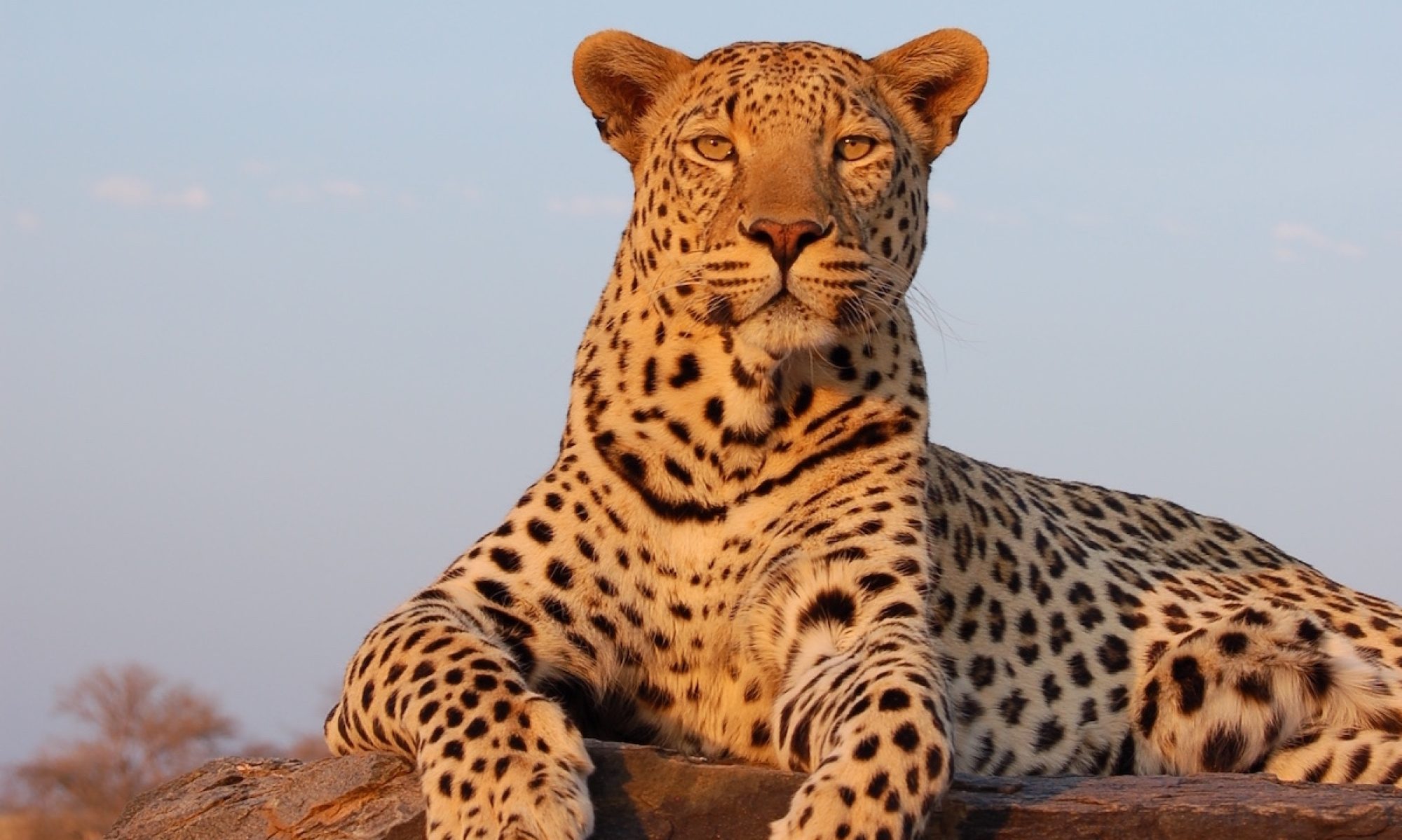
From our working holiday volunteering with leopards, caracals and Cape biodiversity in South Africa (www.biosphere-expeditions.org/southafrica)

The first volunteers of the inaugural ‘Carnivores of the Cape Floral Kingdom’ expedition all arrived on Sunday with only a minor glitch of getting one vehicle stuck just a couple of miles from the expedition base. Welcome to expedition life!

With initial introductions, risks assessments and briefings completed by Sunday afternoon, we stretched our legs with a brief orientation walk around Blue Hill Nature Reserve – our base for the next 12 days. We passed by (and checked) the leopard trap, which will form a key part of the survey work, and enjoyed some of the local wildlife whilst on route. Sightings included klipspringer, jackal buzzards and an ancient relative of the elephant – the dassie or rock hyrax. This was followed by another orientation walk up a ridge behind our base. The climb rewards you not only with a great view over the fynbos landscape, but also with a mobile phone signal. I have a feeling the path will be well–trodden by some!

Rested and recuperated from Sunday’s travel and briefing exertions, the science training than began in earnest on Monday, with camera trapping analysis and mammal ID work. Practical session came in the form of off-road 4WD training. Our three transport options on the project are either by foot, by 4WD or by mountain bike. All vehicles and drivers returned to base in one piece. So far there have been no riders.

With equipment briefings completed and after-dinner lectures from our project scientist (Dr. Alan Lee) digested, we put things into action on Tuesday. The sunrise activity of trap checking yielded a klipspringer in the trap, which was promptly released. Unfortunately it broke a horn in the box trap, something that happens very rarely, but did this time. Alan was worried, but the klipspringer seems to have been fine. Later in the morning we practised setting 50 small mammal traps in a big group. It took us about three hours, so a couple of people should manage in an afternoon, especially because we have already marked and recorded the fifty locations now, covering a big rectangle of 250 x 1000 m. In the afternoon we conducted our first ‘flush survey’ in a group of seven walking all abreast and 2 m apart, recording vegetation and any animals that are disturbed and ‘flushed’ out of the undergrowth. Christine, who had twisted her ankle just before the expedition, and her husband Prasadu stayed back to go through camera trap pictures collected by Alan in the past. This will be another key activity where we can help Alan do things that he would not be able to do without willing volunteers, in this case because he simply lacks the time to go through 3000-odd camera trap photographs. But split over two weeks amongst seven volunteers working in shifting pairs this task become manageable and the end result, Alan hopes, will be a peer-reviewed scientific publication on “temporal patterns of abundance of medium to large-size mammals from camera trap records” (that already sounds very scientific, doesn’t it ;).

This slideshow requires JavaScript.


From our working holiday volunteering with leopards, caracals and Cape biodiversity in South Africa.

From our working holiday volunteering with leopards, caracals and Cape biodiversity in South Africa (www.biosphere-expeditions.org/southafrica)

Hello and welcome to the South Africa expedition diary. I am Craig Turner your expedition leader and I am writing this on board the flight to Johannesburg. I am due to land in an hour or so and will then meet up with Matthias Hammer, Biosphere Expeditons’ executive director (who will be joining us for the first few days), to fly onto George and eventually Blue Hill by car. We should be there tonight and once we have settled in, I will be in touch again with details of our plans for the expedition, weather updates, emergency conctact details, etc.

I hope your preparations are going well. Safe travels and I look forward to meeting you in due course.

Craig Turner
Expedition leader


From our working holiday volunteering with leopards, caracals and Cape biodiversity in South Africa.

From our scuba diving conservation holiday with whale sharks and coral reefs of the Maldives (http://www.biosphere-expeditions.org/maldives)

No bleaching and lots of teaching on Biosphere Expeditions’ Maldives reef expedition 2015

If you have ever visited the Maldives, you will have seen fleets of luxury liveaboards motoring around the atolls taking their guests to well-known dive sites to experience the underwater beauty that the Maldives is famous for. This September, one of those liveaboards, the MV Carpe Diem, housed a rather different clientele – the honeymooners and adventure divers were replaced with studious environmentalists embarking on a training course to learn the monitoring techniques necessary to collect reef health data – Reef Check.

From five different countries, 10 participants, two of whom were Maldivian, came together to learn the Reef Check methodology on an annual research expedition organised by nonprofit conservation organisation Biosphere Expeditions. Biosphere Expeditions recognizes the importance of training local Maldivians, alongside citizen scientsts from around the world. Once the expedition is over, and most participants have returned to their temperate homes, the Maldivians have continued access to their reef and with their newly acquired knowledge, can support Biosphere Expeditions’ work with additional Reef Checks, amongst them the first such all-Maldivian survey in 2014.

So, with the lounge of the Carpe Diem transformed into a classroom and its dhoni (dive boat) now a research vessel, the ten newly qualified Reef Check team set out on a survey route previously visited in 2011 and 2013. “We revisit the same sites to get a clearer idea of what’s going on,” says Catherine Edsell, expedition leader and Reef Check trainer, “much can be gleaned from repetitive datasets – they helps us to see what is changing, especially when it comes to the issue of bleaching.”

With a global El Niño event and documented sea surface temperatures rising, the team were on high alert for signs of coral bleaching. leaching occurs when corals are stressed resulting in expulsion of the symbiotic algae (zooxanthellae), which not only give them their colour, but provide them with food via photosynthesis. Without their zooxanthellae corals appear bright white or luminous yellow and it was this sign that the team was on the look-out for.

Initial training dives around Baros Resort’s house reef revealed no such incidence, but Mariyam Shidha Afzal, this year’s expedition scientist and a previous Maldivian recipient of Biosphere Expeditions’ training programme said, “Bleaching can be quite localised, so we may find when we travel south that things are different.” Fortunately this was not the case and there was minimal bleaching at all survey sites. Storm damage, on the other hand, was quite severe, especially at Bathalaa Maaga and Holiday Thilla, and it was easy to see why, as throughout the expedition, monsoon storms battered the more exposed atolls, causing one of the surveys to be aborted.

“Understanding the factors that are affecting the health of the Maldives’ reefs is the ambition of the programme”, says Dr Jean-Luc Solandt of the Marine Conservation Society and Reef Check co-ordinator for the Maldives. “It is never a simple story – when we put our heads underwater at each site, we have a basic understanding of what‘s likely to be affecting the reef, but Reef Check allows us to nail this down further with data on a wide variety of factors. At the same time we are able to train Maldivians and conservationists from other countries to do the same, so we are delighted with the long-term results of the trainings and collaborations we are forging in the Maldives.”

Biosphere Expeditions’ placements this year, kindly supported by the Rufford Foundation, were Mohammed Ryan Thoyyib, currently working for LaMer (Land and Marine Environmental Resource group – a local environmental consultancy), and Irthisham Hassan Zareer from the Maldives Whale Shark Research Programme. Both organisations have an ongoing relationship with Biosphere Expeditions and offer up their most promising candidates to become Reef Checkers. “I feel extremely lucky to be part of such an expedition that brings people together from different corners of the world for the same goals, to try and conserve the beautiful reefs that we are blessed with,” says Irthrisham, “I am hoping to get in contact with some of the other Reef Check trainers from the Maldives and with the help of some more dedicated divers, carry out more surveys at the end of the year.”

2015 expedition slideshow:

This slideshow requires JavaScript.

Continue reading “From our scuba diving conservation holiday with whale sharks and coral reefs of the Maldives (http://www.biosphere-expeditions.org/maldives)”

From our scuba diving conservation holiday with whale sharks and coral reefs of the Maldives (http://www.biosphere-expeditions.org/maldives)

So, sadly all good things must come to an end. It has been an excellent expedition, with a hardworking, diligent, enthusiastic team. The fact that everyone passed their Reef Check tests first time was testament to the effort put into studies. And despite being a diverse group from many different countries, with an age difference of over 30 years, the team gelled really well and we all had a lot of fun together. Thanks also to Shidha, our scientist, who stepped in at the last minute and did a great job.

I must mention the fantastic crew of the Carpe Diem who supported us both on board and under water – without them, some of our transects would not have been laid, due to the extreme weather and currents we encountered, so they really were integral to the success of the expedition and the collection of valuable data. Thank you!

In addition to all our Reef Check data, (which will be published in the 2015 Maldives Report), we also collected ID shots of manta rays, which I will submit to Manta Matcher www.mantamatcher.org. This a conservation group that endeavours to learn more about the habits of Manta rays worldwide, with a view to their protection. Of course our whale shark encounters that were also mapped and logged will also be submitted to the Maldives Whale Shark Research Programme http://maldiveswhalesharkresearch.org. Using IS3, a programme initially designed by NASA to identify constellations, we were able to identify two of the sharks we saw by matching ID photographs of their markings to those already on the MWSRP’s database. Our sharks were called Adam and Kokko, two juvenile males taking refuge in the warm sheltered waters of Ari Atoll.

So thank you all for your energy, your laughter, for joining me on the sun deck for yoga at dawn, for revising late into the night, for supporting and helping each other throughout the week – you really made a fantastic team, and I hope to meet you all on another expedition someday.

This slideshow requires JavaScript.

Continue reading “From our scuba diving conservation holiday with whale sharks and coral reefs of the Maldives (http://www.biosphere-expeditions.org/maldives)”

From our scuba diving conservation holiday with whale sharks and coral reefs of the Maldives (http://www.biosphere-expeditions.org/maldives)


Our final Reef Check survey at Holiday Thilla went exceptionally smoothly. We recorded a lot of storm damage, but fortunately there was no actual storm during our data collection.

Next on the agenda was our whale shark survey, but the whale sharks beat us to it, interrupting our data entry! We grabbed our masks and snorkels and hopped back onto the dhoni (our dive boat) and set off down the transect to catch up with the shark. All in all we had five encounters with three individuals, the last unfortunately disturbed by a dive boat and jumping divers who scared it away. Iru, our placement from the Maldives Whale Shark Research Programme (MWSRP), and the dive guides were outraged by the behaviour of the dive boat and rightly told them so! Encounter protocols are so rarely followed and although we were in an MPA (marine protected area), there is no enforcement and no limit on the amount of boats (and people) that can safely enter an area where a whale shark is present. It is very common for the sharks to bear scars as testament to this unregulated behaviour.

After a couple of hours of surveying, we headed back to the Carpe Diem and listened to Iru’s excellent presentation about the whale shark and the work that the MWSRP are doing, and later visited their headquarters on Dighura atoll – it was great to see such inspiring work taking place.

This slideshow requires JavaScript.


Continue reading “From our scuba diving conservation holiday with whale sharks and coral reefs of the Maldives (http://www.biosphere-expeditions.org/maldives)”

From our scuba diving conservation holiday with whale sharks and coral reefs of the Maldives (http://www.biosphere-expeditions.org/maldives)

Our third Reef Check survey at Kudafalu went well and we arrived at Digga Thilla with high hopes and great expectations. Digga Thilla is a submerged pinnacle, rather than island and does not break the surface of the ocean. Its exposed position means that it is at the mercy of unpredictable wave action and current – and due to the recent storms we have been subjected to, Wednesday was one of those days! After fighting the current and surge for a while, we had to abort, leaving our survey unfinished. Well done though to Lori and Shidha for battling through and actually finishing their part of the transect!

Saddened by the fact that we had failed in our data collection, we came up with the idea that perhaps in the coming months a team of Maldivian Reef Checkers (trained by Biosphere Expeditions in previous years), could return to Digga Thilla and survey the reef in our place!  Iru and Ryan, our current Maldivian trainees thought that was a great idea  – we look forward to hearing their results!

buddies safety stop

Continue reading “From our scuba diving conservation holiday with whale sharks and coral reefs of the Maldives (http://www.biosphere-expeditions.org/maldives)”

From our scuba diving conservation holiday with whale sharks and coral reefs of the Maldives (http://www.biosphere-expeditions.org/maldives)


Our first transit across open ocean from one atoll to another greeted us with storms – and these continued into the night. With the Carpe Diem rocking wildly in the wind and waves, it was quite a rough night’s sleep, for everyone except Yannick and Desiree who slept through the whole affair!

It’s been an exciting couple of days for the Maldives team – we’ve dived with reef sharks, eagle rays and enormous humphead wrasse during a dawn dive before work, and snorkled with Manta rays after dinner! Everyone passed all their tests first time round so no re-tests were necessary. Congratulations to you all!  This also meant that we could all focus our attention on the survey work.   We’ve now completed two full Reef Check surveys in Rasdhoo Atoll and Bathalaa Maagaa, and so far the news is good – no significant bleaching.

The stormy weather is still with us, but let’s hope it will be a calmer night tonight, with clear skies for tomorrow’s survey in Kudafalu.

This slideshow requires JavaScript.

Continue reading “From our scuba diving conservation holiday with whale sharks and coral reefs of the Maldives (http://www.biosphere-expeditions.org/maldives)”

Update from our volunteer vacation / conservation holiday protecting whales, dolphins and turtles around the Azores archipelago (www.biosphere-expeditions.org/azores)

Decade of data from citizen science confirms cetacean hotspot

Information on cetacean sightings collected by Biosphere Expeditions’ citizen science volunteers in the Azores are confirming the importance of this region for a variety of species, amongst them humpback, sperm and blue whales – the largest species ever to exist on our planet.

Recent data have highlighted the importance of ‘site fidelity’ (the same individuals returning to the same location again and again) for species such as sperm whales. Indeed some individuals have been recorded multiple times since 2004, when Biosphere Expeditions first collaborated with Whale Watch Azores on this long-term project.

Cetacean specialist Lisa Steiner, the expedition’s scientist, says that “the collaboration with Biosphere Expeditions has led to repeat sightings of blue whales in different years, as well as matching humpback whales seen in the Azores to the Cape Verde Islands. We often encounter sperm whales that have been observed more in the early or late part of the year, and such information will help determine if there are ‘winter’ and ‘summer’ whales.”

But the decade-long data collection has not only revealed patterns of the lives of whales and dolphins around the Azores. Fluke identifications have been matched with individuals recorded further afield, such as in Norway. The project supports initiatives with both the University of the Azores and University of Florida, resulting in multiple novel scientific publications on the marine life of this unique archipelago.

“The volunteer data collection effort is vital”, says Dr. Craig Turner, the 2015 expedition leader, “as it helps unravel the detail in the lives of not just one ocean giant, but also resident species such a Risso’s dolphins and migratory species such as loggerhead turtles. The project is developing an insight not just into which species are here, but what these species are doing, where and when. This knowledge is vital for any conservation efforts, if they are to be effective.”

Dr. Matthias Hammer, Biosphere Expeditions executive director, adds: “The Azores is one of our longest-running projects and our collaboration with Lisa Steiner has given hundreds of people a unique insight into cetacean research and conservation over the years. It has also yielded a vast amount of data. We may not have headline-grabbing news every year, but it’s the steady chipping away at the block that makes the difference here, because the data collected by our citizen scientist volunteers are the bedrock on which effective conservation sits. The project as a whole is also a showcase of how volunteer-led commitments can go well beyond the support of a few years that are usually offered by grant-giving bodies. Lisa has shown an outstanding dedication to marine life that now spans several decades, so this long-term support is what is needed. We are proud to be helping Lisa in her efforts and look forward to many more years of working with her.”

2015 expedition slideshow:

This slideshow requires JavaScript.

Continue reading “Update from our volunteer vacation / conservation holiday protecting whales, dolphins and turtles around the Azores archipelago (www.biosphere-expeditions.org/azores)”

From our snow leopard volunteering expedition in the Tien Shan mountains of Kyrgyzstan (http://www.biosphere-expeditions.org/tienshan)

Snow leopard ground data and computer modelling

The two months long 2015 snow leopard expedition to the Tien Shan mountains of Kyrgyzstan ended on 8 August, with the last of three teams breaking camp. Biosphere Expeditions in collaboration with the local office of German NGO NABU (Naturschutzbund = Nature & Biodiversity Conservation Union) runs the snow leopard expedition annually with the aim of providing valuable scientific data to empower local authorities to make informed conservation decisions and take action based on hard data.

One of the highlights of this year’s results is the confirmation of snow leopard presence (in the form of tracks and scat) in the Kyrgyz Alatoo range. Three individual instances were recorded over the course of two months.

While this is exciting, especially for volunteer citizen scientists doing the ground work in the field, the project does not focus solely on the search of snow leopard sign, but also collects information on prey species. For example, mammals and birds that can reveal information on the biodiversity and health of the habitat as well as disturbances.

“It all adds to statistics and you also take into account the zeros”, explains field scientist Dr. Volodya Tytar. “If you check the camera trap and say – oh there is nothing – it is something! Because if it is a zero, which has been obtained, that also adds to the statistical database.”

When talking about how the data are used, Dr. Tytar mentions a new approach called ‘ecological niche modelling’ or ‘species distribution modelling’. This consists of the combination of readily available environmental digital information (for example temperature, moisture, vegetation, etc.) with ground data collected by volunteers. Computer software then combines the two to arrive at some sophisticated forecasting of wildlife distribution. It also identifies new areas that have not been surveyed yet, but that could be promising snow leopard habitat. “With modern computing methods a lot can be done”, Dr. Tytar adds, “but the bottleneck turns out to be that there are often very little ground data. So the data collected by our expeditioners in the field adds a fundamental missing piece of information to an existing digital information puzzle, enabling predictive analysis of species distribution even across non-surveyed areas – an exercise which would otherwise not be possible.”

Talking about the results of this year’s expedition, Dr. Tytar says that together with NABU, Biosphere Expeditions will be able to generate specific conclusions and recommendations about candidate areas for conservation status: “There are areas where we found fresh tracks of ibex in combination with minimum disturbances. Many of these areas are in very confined mountain locations with only one entrance, so they would be quite easy to protect by just having, say, a ranger station or a signboard and people patrolling the area. I think all this together in the future will work out in a network of protected areas, maybe including some kind of corridors as well. What we have been doing here significantly contributes to that kind of work”, concludes Dr. Tytar.

Listed as “Endangered” on the IUCN Red List, the snow leopard is threatened by poaching, retaliatory killings and habitat loss. It is estimated that fewer than 7,500 snow leopards remain in the wild. One goal formulated by an international snow leopard conference in Bishkek in 2014 was the 20/20 pledge – to protect 20 snow leopard landscapes that have over 100 breeding adults by 2020, and to promote sustainable development in areas where the species lives.
 

 Slideshow of the 2015 expedition:

This slideshow requires JavaScript.

Continue reading “From our snow leopard volunteering expedition in the Tien Shan mountains of Kyrgyzstan (http://www.biosphere-expeditions.org/tienshan)”

From our Sumatran tiger conservation volunteering holiday in Indonesia (http://www.biosphere-expeditions.org/sumatra)

The Sumatran tiger’s fight for survival

The Sumatran tiger’s habitat is threatened by illegal plantations and logging, forest fires, poaching, human encroachment and corruption. Listed as Critically Endangered on the IUCN Red List, and with as few as 400 estimated individuals left alive in the wild, it is facing a fight for its very existence.

Biosphere Expeditions has just finished its first year helping in the conservation of the Sumatran tiger in Rimbang Baling Wildlife Sanctuary. For twelve weeks, six separate teams of volunteers from across the globe covered 136 square kilometres to collect data for WWF scientist Febri Anggriawan Widodo, who has been managing a tiger research and monitoring team within the WWF Indonesia for the last three years.

Febri says that “the expedition’s research has provided a host of data critical for both the conservation of tigers and landscape management of Rimbang Baling Wildlife Sanctuary. With the help of our citizen science volunteers, we have collected information about mapping and the population distribution of tigers, co-predators and their prey, as well as some behavioural data. The expedition has also helped me to better understand the local community’s perspective on tigers, poaching and human-tiger conflict. We deployed camera traps and, during a total of 265 trap nights, captured hundreds of animal pictures including clouded leopard, leopard cat, Malayan sun bear, binturong, yellow-throated marten, pig-tailed macaque, long-tailed macaque, barking deer and wild pig. The Sunda clouded leopard (Neofelis diardi) is a co-predator of tigers that indicates Rimbang Baling is still home to five wild cat species based on previous surveys by WWF Indonesia. Also, we have camera-trapped potential prey of tigers such as wild pig (Sus scrofa), indicating that there is plenty of prey for tigers. Although no tiger pictures were captured, we have obtained tiger information via community interviews. There is good evidence that tigers still occupy the area with local people telling us about recent tiger signs around their plantation or in the deeper forest. None of this would have been possible without the help of my volunteer expedition team and I am very grateful for the assistance.”

With means of income few and far between and only three rangers available to cover a large area, blatant illegal activities such as logging, poaching and unlicensed plantations are evident throughout the more populated areas of the wildlife sanctuary, even if there are large swathes of remote forest – more than 70% – away from people left in the sanctuary. Nevertheless, a sea change is necessary in the populated areas and many villagers during interviews said they would welcome with alacrity alternative and legal means of generating income, for example through ecotourism. The consensus amongst the community was also that this would be highly beneficial for the next generation, who are the future of the area.

One such initiative has started already. The Batu Dinding Community Group was a crucial part of the expedition. It provided critical services such as boat and vehicle transport, food, cooks and local guides and other logistical support. Batu Dinding Community Group is an initiative set up by the WWF two and a half years ago to empower local people and provide alternative incomes through eco-tourism.

In addition to conducting surveys in the wildlife sanctuary, the expedition has also been active in local schools, delivering presentations to students and teachers about the tiger and its habitat, and what changes are needed if both are to survive. Febri adds that “it has been great to see our citizen science volunteers lead sessions and games with the students, expressing their joint passion for the rainforest across all language divides. A large factor in saving the tiger’s habitat is local education. With the head teachers backing us and the students themselves all keen for us build on this aspect of the project, we have had a very positive effect. We look forward to building on this next year.”

When asked at the end of the expedition “why just save the tiger?”, Febri responded “the tiger is like an umbrella. To save the tiger is to save its habitat. If you save the tiger all the other species survive too. If you save the tiger, you save the forest”.

Picture slideshow of the expedition:

This slideshow requires JavaScript.


From our Sumatran tiger conservation volunteering holiday with tigers in Sumatra, Indonesia