Our expedition scientist, Dr Volodya Tytar, on citizien science and snow leopard conservation

Award-winning, non-profit and ethical wildlife conservation volunteering. Advancing citizen science and conservation since 1999 – for nature, not profit.
Our expedition scientist, Dr Volodya Tytar, on citizien science and snow leopard conservation
Team 2 arrived on Saturday, and already, in only one day, we have completed so much. This is the first ever Biosphere Expeditions Reef Check expedition to take previously trained Reef Check EcoDivers only and dedicate the whole expedition to gathering data. With the training process removed, it has allowed us to plan a new itinerary that will re-visit historic Reef Check sites that have not been surveyed in many years due to their distance from Male’ and also for the fact that in one week, to collect repetitive data sets, there just isn’t the time!
Some of the sites we will be surveying have had no data collected since 1997, prior to the last big bleaching event. Most of this week’s team trained with Biosphere Expeditions in other locations such as Musandam (Oman) or in Malaysia during the last couple of years, although Graham and Janet, from New Zealand, have had a seven year break! Adam from the USA gained his Reef Check qualification in the Phillipines and is new to Biosphere Expeditions.
So after a quick refresher in methodology and an intensive reminder of indicator species, we set off to Bandos to perform our first ‘mock’ Reef Check survey. It went well and everyone was comforted by their ability to ‘slip back into it’. The fish survey was given a great opportunity to tell the difference between snapper and emperor fish when a huge mixed shoal swam through both transects.
Happy with the lessons learnt, we re-surveyed the site ‘for real’ and are looking forward to our first survey tomorrow on Vaavu Atoll – our first uninhabited reef!
First off, I’d like to say a big thank you to all the members of group 2: Yryskeldi, Andy, Carol, Brian Martin, Franzesca, Christof, Christina, Christore, Amy (from the UK), Amy (from the US), Maria and Sven. You made the last two weeks very enjoyable and successful by working well as a team!
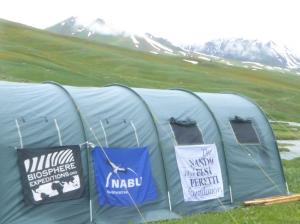
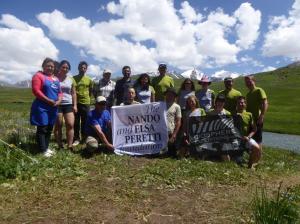
Our first day of training held perfect weather, but just like in group 1, our first day out in the field had stormy skies in store. But unlike group 1, the weather would continue to be wet for another few days. On Thursday we decided to try and dig the snow off the high mountain pass between the East and West Karakol river valleys and make an attempt to reach Dong Alysh, the first village along the road. An hour of snow digging later (and a few blisters here and there) and we had opened the road! In Dong Alysh we met with some local partners who will be continuing our camera trapping efforts throughout the rest of the year (thank you to the Nando Peretti Foundation for supporting this). We also got the chance to visit the natural history museum in the local school. In the end, the bad weather allowed us a great opportunity to open the pass, meet our local partners and visit the museum.
Now that the pass was open, it was time to get busy on the other side…as long as the weather held out. Fortunately, the rain had passed and we were left with clear beautiful skies. Splitting into three groups each day, we were able to make up for lost time at the beginning and saw more than 30 ibex, an army of marmots, and lots of wonderful birds, butterflies, and petroglyphs. The snow leopard kept away, but we are hopeful that the camera traps we’ve been setting will catch one! More on this during later groups.
On the last day of the expedition, we decided to take a trip to the NABU rehabilitation centre, where injured snow leopards and other wildlife are nursed back to health. Seeing the work NABU is doing to take care of wild animals rescued from poachers was inspiring for all of us and made us realise that we are part of something bigger in snow leopard and wildlife conservation.
Group 2 was full of amazing people, experiences and memories. Thank you again. Looking forward to group 3 starting 31 July!
Our final Reef Check survey at Holiday Thilla was completed on 20 July, and again we were witness to near complete degradation of live coral caused by last year’s bleaching event. Coral recruits are visible throughout the substrate, but they are still very small. The survey itself ran like clockwork, and indeed all the surveys have been executed extremely well – you know it is a great survey team when the only complaint is that the transect tape has twisted so as to not instantly be able to read the cm side!
After the survey, we de-camped to the dhoni (our dive boat), and took our positions for the whale shark survey transect, and after about an hour scanning the shallow waters the dark shape of a whale shark, was spotted. The team jumped in and snorkelled behind it, it initially dived, but then resurfaced giving half the team a great view of the gill area, important for ID purposes, and Charlotte managed to get some excellent footage.
Unfortunately, for the rest of us, a group of divers then jumped directly in front of the shark, (against all protocols), and the shark dived, but we had collected the data! A storm blew through, causing us to abandon our survey, but we took the data to the Maldives Whale Shark Research Programme HQ on Dhigurah, and analysed it using I3S software – a program initially used by NASA to identify constellations. We discovered that the shark we had spotted was called ‘Adam’, the same shark we identified in 2015. He must have known we were in the area!
So as the expedition draws to a close we have to say goodbye and a massive thank you to Charlotte, Hani, Christina, Ida and the majority of the Maldivian contingent. Fathimath ‘Farah’ Amjad will be staying with us, representing Reef Check Maldives, and assisting with next week’s survey. Michele, Ian and Richard will also be staying on board, and we look forward to welcoming the new team tomorrow.
It has been an absolute pleasure working with Hussein Zahir, whose expertise and sharp wit have been immensely valuable and entertaining. Ibrahim Shameel’s dedication to Reef Check data collection and whale shark research was duly noted, and Hassan Ahmed is an inspiration to us all – his positivity and passion for reef conservation amongst the next generation makes him an excellent ambassador for Reef Check here in the Maldives. Thanks also to Nizam Ibrahim and Adam Saaneez – it has been an excellent week. We will miss you all!
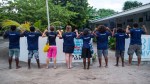
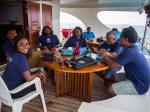
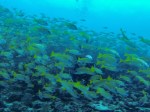
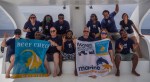
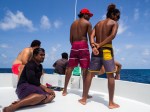
It has been a very interesting couple of days with excellent survey work by the team, coupled with interesting lectures from Hussein Zahir and Ibrahim Shameel, from La Mer, and The Maldives Whale Shark Research Programme respectively. Unfortunately the condition of some of the reefs we have surveyed show significant loss of coral cover due to the 2016 bleaching event, and there has, as yet, been little recovery. There is some hope though, as the substrate is not yet covered in algae, so coral recruits do have a place to settle and grow.
We learned from Hussein Zahir, that it took almost 12 years for the reefs to recover from the previous massive bleaching event in 1997, but by 2009 there was significant coral cover once again. As we had just had to witness an almost completely dead reef in Kudafalu, these statistics did give us some comfort. The problem is that due to climate change, pollution and other human impacts, events threatening/killing reefs/corals now come around so frequently that there is little time for reefs to recover from one impact until they are pummelled by the next. There is no denying it: the reefs of the Maldives, and elsewhere, are in serious trouble.
Before work, on Tuesday, we managed to squeeze in an educational dawn dive, with most of our indicator fish species presenting themselves in all their glory, including the magnificent humphead wrasse. Apart from that it has been systematic survey work followed by the all important data entry. Spirits are high, and we look forward to our whale shark survey tomorrow.


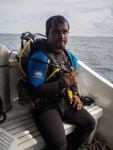


The team is working hard and the last couple of days have seen us studying from dawn until dusk, taking tests in and out of water, and learning all the methods and identification skills needed to successfully complete a Reef Check survey.
It is important to practice everything, from completing the relevant forms prior to the start of the survey, gathering all the information we can about the local area, to the laying of the transect tape, and of course practicing collecting all the data underwater. As we have such a wealth of experience in our Maldivian partners, each expeditioner from abroad can be teamed with one of them for the first survey. This will help improve everyone’s confidence and hone the skills needed to be a great Reef Checker – after all, that’s why we’re all here!
So, on Monday 17th July we conducted our first mock survey at Rasdhoo Madivar. It is the healthiest reef we have seen so far, as sadly much of the reef at Baros, our inner reef training site did not recover from last year’s extensive bleaching. Rasdhoo, on the other hand, being an outer reef with stronger currents and increased water flow has, from first glance, recovered completely. The survey itself was hampered by a swarm of jellyfish and some strong currents towards the end, but was none the less a great learning experience.
So with all tests completed, and all team members successfully obtaining Reef Check Eco Diver status (congratulations), the data collection begins!
Greetings from Male’! I have arrived to a beautifully sunny day, but sadly Dr. Jean-Luc Solandt is not with me. Due to unforeseen circumstances, he has had to withdraw from this expedition at the 11th hour, and will no longer be on board the MV Carpe Diem with us. He will, however, be working with us remotely and will support and advise throughout. On expedition we are always reminded to, ‘expect the unexpected’, and this is a true example of that maxim!
Dr Jean-Luc has asked me to pass on this message to you:
“Unfortunately – for critical personal reasons – I cannot make the expedition this year. For that, I’m very sorry. However, you are all in excellent hands with an exceptional expedition leader (with excellent coral reef teaching skills), and two Maldivians who are competent in Reef Check methodology, and who are developing the new in-country NGO ReefCheck Maldives. I hope you have a truly successful and brilliant time, and thank you for your endeavours to help save Maldives reefs.”
As Dr Jean-Luc has alluded to, we are fortunate to have a wealth of experience and expertise on board, with a passionate and pioneering Maldivian presence and a number of marine biologists as part of the team, and it is now all of our responsibility to work hard and collect the data as planned.
I now have a local mobile number +960 789 2930 which should only be used for emergency purposes (such as missing assembly).
I hope your travels are going well and I look forward to meeting you tomorrow, Saturday, at 11:00 at the Coffee Club in Male Airport.
Best wishes,
Catherine Edsell
Expedition Leader
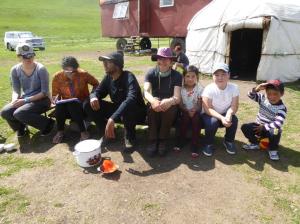
Can one have too much of pretty wildflowers, awesome mountain vistas and amazing sunshine? Perhaps, but who cares. Get your fill from group 1 here!







Hello, my name is Catherine and I’m going to be your expedition leader for this year’s Maldives expedition. I led this expedition in 2014 and 2015, and am looking forward to investigating, with your help, the recovery from last year’s bleaching event (do read the 2016 report in preparation).

I’ll be travelling out in advance with Dr. Jean-Luc Solandt, our scientist, to ensure that everything is ready for your arrival, and will be in touch with updates and my local mobile number from Male’.

On this expedition we will be training and passing knowledge to our new Maldivian partner NGO Reef Check Maldives, which was formed recently as a direct result of our local placement and capacity-building programme.
During the first slot, we will visit our permanent monitoring sites and re-test our theory that those sites in more exposed waters are faring better than the more sheltered sites. In the second slot, we have the chance to complete an extensive set of surveys in more isolated locations, well away from most tourist islands. This will provide very interesting data comparison, and give us more information on the impact of last year’s bleaching event. We will also be recording sightings of rare and spectacular species such as whale sharks and mantas, with a brand new survey site for whale sharks, south of Vaavu reef.
I hope all your preparations are going well, and that you’ve had a chance to study all the Reef Check material and whale shark info available on www.biosphere-expeditions.org/methods as this will not only save you revision time on board, but stand you in good stead for a fruitful expedition. For those of you who are already Reef Check qualified, this is also a great resource to refresh your memory!
I look forward to meeting the first team at the assembly point, Coffee Club at Male Airport on 15 July at 11:00.
Best wishes
Catherine Edsell
Expedition Leader
Group 1 is safely back in Bishkek, after an excellent fortnight in the mountains with a great group. Thank you all!
We found 1.5 snow leopard signs, saw plenty of ibex and other wildlife, amazing wildflowers and landscapes, and were so lucky with the weather too.
But I will let the videos below speak for themselves. These were done by Matthias, so from now on it will be text and pictures only every fortnight when we change over in Bishkek, but I think the videos will last all of us for the expedition’s duration.
Thank you again to group 1 of Adnan, Cate, Gina, Jannis, Lisa, Matthias, Nadia, Neil, Nitin, Shruti, Uli, Urmas, the Grupa Bars members Aman and Shailo, our scientist Volodya and our amazing cook Gulia, as well as Biosphere Expeditions staff Tessa, Amadeus & Matthias.
See you on Monday, group 2! You have big boots to fill 😉
…and here is an updated version of…
 Biosphere Expeditions: blogs from the frontline of wildlife conservation and the fight for a more sustainable planet