Update from our volunteer vacation / conservation holiday protecting whales, dolphins and turtles around the Azores archipelago (www.biosphere-expeditions.org/azores)

After an early start for the final pieces of preparation, we can at last say a big Azorean welcome to our expeditioners.

The team all arrived safely, from the north, east and west; via a mix of routes and modes of transport. The good news is they are all present and correct and very excited. So the first slot of 2015 officially begins.

With initial introductions, risks assessments and briefings completed, we stretched our legs with a whistle–stop orientation around Horta. Whilst important for us to impart the initial project knowledge, it has been great to learn about our new team. The day was rounded off with our first dinner, created in-house by the team – a tasty vegetarian pasta it was too!

Rested and recuperated from the travel and briefing exertions of yesterday, the science training began today. Familiarisation with equipment was followed by data records training, and rounded off with a boat orientation – though the latter was slightly delayed, as our vessel went (without us) to the aid of another boat stranded engineless in the harbour – always be prepared for the unexpected!
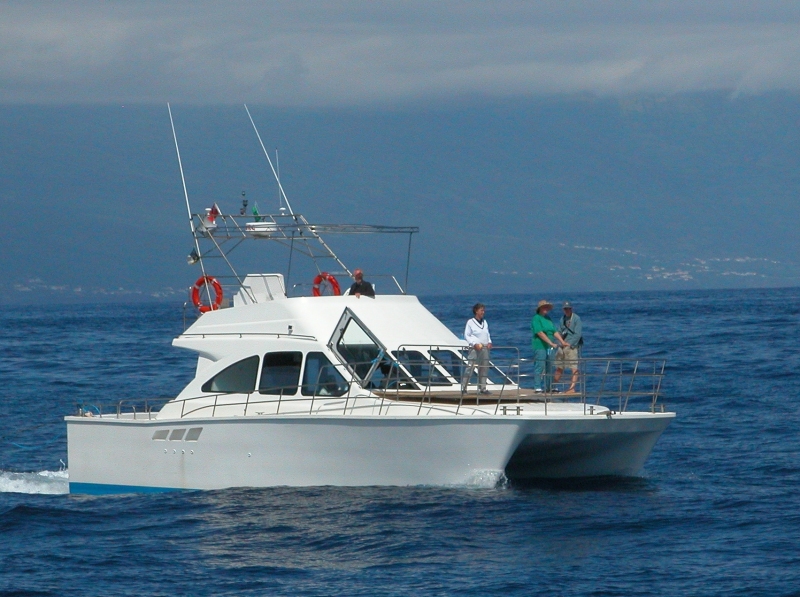
boat (1)
The research vessel


Slightly less than unexpected was the small ‘weather spanner’ thrown into the workings of the expedition, as our training session at sea was postponed by high winds. Tomorrow looks more favourable, so it will be all systems go as our team put their new-found knowledge into practice. The whales won’t have to wait for us much longer 😉

The weather delay meant Lisa (our scientist) could give a background talk on cetaceans, and the team could acquaint themselves with the data entry and the fluke matching process – how we identify and track individual whales.

The day was rounded off learning key identification features of species we will hopefully encounter, the team are now poised and ready for action. All we need now is a good night’s rest and the right weather for whales…


Update from our volunteer vacation / conservation holiday protecting whales, dolphins and turtles around the Azores archipelago

Update from our volunteer vacation / conservation holiday protecting whales, dolphins and turtles around the Azores archipelago (www.biosphere-expeditions.org/azores)
Hello everyone

It’s time for the initial introductions. I am Craig Turner and I’ll be your expedition leader in the Azores this year. It is great to be going back after my first stint last year.

I am already on route, having packed my gear and left the snowy hills of north Scotland yesterday. Today is the Lake District to Lisbon leg, and tomorrow Horta. It will be great to meet up with friends and colleagues from last year, not least our scientist Lisa Steiner. If you want to find cetaceans in the Azores, then she is the person to find them. Last year, my baptism was blue – a great way to kick off our data collection. Who knows what it will be this year, with an early and rare rumour of orcas in the wider area.

I arrive a couple of days before you in order to set up the expedition headquarters. We’ll have Anthony and Chris as expedition-leaders-in-training along with us on each slot, which will be a great addition to the team. I’ll send around another message once I get on the ground in Horta and confirm my local telephone number.

This reminds to mention communications on the island. There’s mobile phone reception on Faial in addition to internet here and there, but there’s also a golden rule of no cell phones while we’re at sea. Hopefully you can resist the need for frequent international comms, and why not go off the grid for the expedition, and soak up the expedition experience.

I know you’ve all been eagerly reading your expedition materials and know to bring many layers of clothing. The weather can be a bit like four seasons in one day, so prepare for warm, cold, wet and dry. Like the weather in Scotland! Don’t forget your waterproof trousers – you’ll thank me when you are stationed on the bow as a lookout and the weather is choppy.

So with the local team in place, whale sightings already logged by Lisa, all we are missing is you. This Monday morning is hopefully one we are all looking forward to….. It will be great to meet you all and I’ll send along another update very soon.

Safe travels…

Craig


Update from our volunteer vacation / conservation holiday protecting whales, dolphins and turtles around the Azores archipelago

From our desert expedition volunteering with oryx and wildcats in Arabia (http://www.biosphere-expeditions.org/arabia)

Well that’s another Arabia expedition over and a lot of valuable data collected, which will be thoroughly analysed over the next few weeks and months to go into this year’s expedition report. The team finished surveying their quadrants yesterday and gathered up all the live traps (aimed at sand foxes and Gordon’s wildcats), rodent traps and camera traps from throughout the reserve on one final drive-around.

Unfortunately there were no more captures in the live traps, but there was a lot of evidence of fox activity around the traps and one team did see cat tracks on Thursday.

There were more captures of Cheesman’s gerbils in the rodent traps, which suggests that their population is at a good level, which is important as they are a major food source of the Gordon’s wildcat and eagle owls. We were certainly made aware of the eagle owls’ presence during the last two nights with incessant hooting in the nearby ghaf trees!

The camera traps photographed a lot of oryx and two Arabian red foxes, but no Gordon’s wildcat. This does not mean that there are no wildcats, but it reinforces the estimate of just how rare they are.

The initial summary of the sightings in the quadrant surveys indicates that the populations of Arabian gazelles and sand gazelles are good and the health of the oryx herd is really good, based on the fact that they are now breeding, which they have not really done over recent years. Each herd recorded had several calves and one herd had eight.

On Thursday afternoon (the hottest day of the week at 36°C), we were joined by the reserve’s botanist, Tamir, and Head of Conservation, Greg, to be shown the new drone. A flight was planned covering the area around our camp, which is being surveyed by air to assess the vegetation cover and type. We were all able to watch the drone being launched and fly transects backwards and forwards looking like a big bird and sounding like a very distant mosquito.The DDCR scientists are very excited about this new development in the technology that can be used to help them do their jobs with minimal impact on the habitat and wildlife.

So we said our thanks and farewells to the team this morning and hope to see them again on future expeditions. Many thanks also to the DDCR and the scientists for another great expedition and we look forward to 2016 by which time a few Arabian wolves will hopefully have been introduced into the reserve and we’ll have even more work to do…

Thanks to all our participants. Your work has become an integral part of conservation efforts in Dubai. You could have shopped, shopped, shopped, but instead you spent a week in the desert surverying, surveying and surveying. Well done and thank you so much.

Kate

This slideshow requires JavaScript.

Continue reading “From our desert expedition volunteering with oryx and wildcats in Arabia (http://www.biosphere-expeditions.org/arabia)”

From our desert expedition volunteering with oryx and wildcats in Arabia (http://www.biosphere-expeditions.org/arabia)

The team have now settled into the daily routine, which is firstly checking the cat/fox traps and rodent traps that they set up on Sunday followed by surveying three 2 x 2 km quadrants of the reserve on foot with the help of binoculars, spotting scopes and range finders. In the evening the teams enter their data onto the acientist’s computer to be analysed at the end of the expedition.

After two full days of surveying we have sighted most of the study animals – oryx, Arabian gazelles, sand gazelles, Arabian red fox, Mcqueen’s bustard and lappet-faced vulture. The biggest difference we have noted, compared to last year’s expedition, is the presence of lots of oryx calves, some only a couple of weeks old, which is an indicator that the oryx population is thriving. The photo is of one herd’s young on top of a sand dune near one of the tracks we drive on to get around the reserve.

The northern team (Kate, Melanie, Neil and Andre) had a live capture yesterday morning of a black and white ferral cat (see picture). These are the biggest threat to the endangered Gordon’s wildcat due to interbreeding and competition, so this cat has now been taken outside the reserve.

Almost all of the team members have now had a rodent capture in the smaller traps. We are assessing the rodent population, because it is the food source of the Gordon’s wildcat and Pharoah’s eagle owl, but is also being hunted by the Arabian red foxes. In the pictures Jörg is about to handle a Cheesman’s gerbil (yes, that is it’s name) to discover its sex and body measurement and mark it before re-releasing. Well, this was the plan but the gerbil had a different idea and ran up Jörg’s arm and out of the trap before he could get a proper grip!

There are two and a half more days left to complete the survey of the reserve before we retrieve the live and camera traps and get an overview of the data we have collected. In the meantime we are enjoying our long sandy survey walks in the warm sunny weather and it seems too soon to be thinking about the end!

This slideshow requires JavaScript.

Continue reading “From our desert expedition volunteering with oryx and wildcats in Arabia (http://www.biosphere-expeditions.org/arabia)”

From our desert expedition volunteering with oryx and wildcats in Arabia (http://www.biosphere-expeditions.org/arabia)

Just a quick note to update a few things relating to the expedition. We now have confirmation from the local vet that he will come out on Sunday to assist our three groups to dart and radio collar three individual oryx.

This slideshow requires JavaScript.

There will be a local photographer here while we are working (a friend of the scientist) who is going to make a short film of the expedition to put to music. He will use a GoPro camera and a drone to take action shots of us driving around the reserve and walking in the dunes in addition to filming the study animals in their natural habitat. He has offered to do this purely to support the conservation activities, so the film will be made available for Biosphere Expeditions to use.

Looking forward to meeting the team at 09:00 tomorrow morning for the start of the expedition!

Continue reading “From our desert expedition volunteering with oryx and wildcats in Arabia (http://www.biosphere-expeditions.org/arabia)”

From our desert expedition volunteering with oryx and wildcats in Arabia (http://www.biosphere-expeditions.org/arabia)

Last night Malika and I spent our first night sleeping under the stars at our base camp in the Dubai Desert Conservation Reserve (DDCR). We planned an early night and a lie-in after our long journeys and were woken by the loud dawn chorus at 6.30 – during the expedition this won’t happen because the expedition team will be the early birds!

Sunset

Early morning is the best time to start our research work as we are more likely to see the study animals and we will need to free any animals that may be caught in our live traps as soon as possible to minimise any (heat) stress to them.

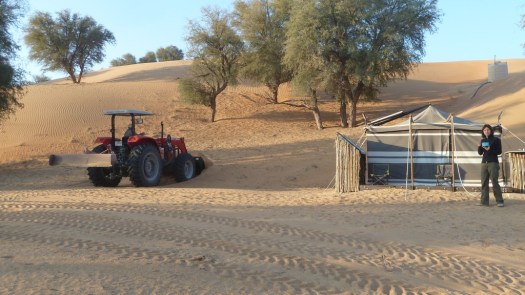
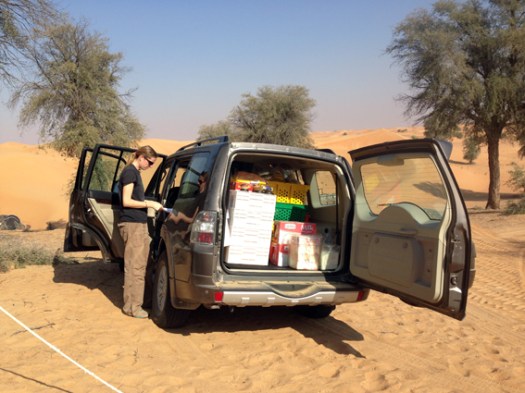
This morning the workers of the DDCR came to prepare an area for our Bedu and then they erected it in record time while we were away from camp collecting all the food for the expedition.

P1070571 (2)

The car was so full of food I think we, like the oryx, will be well fed while we are in the reserve.

food car

This year there will be no body condition scoring of the oryx because the last survey carried out a few months ago by the local scientists showed that they are now all in good condition. Still, we will have plenty to do with the new tasks I mentioned in the last diary entry and if we get time during the expedition, we may even get a chance to fly a drone – the latest piece of equipment to arrive at the DDCR for use in their research work.

The rest of this week we will be busy preparing our equipment and datasheets and setting up camp ready for the arrival of the team on Saturday – no more lie-ins for us!

Continue reading “From our desert expedition volunteering with oryx and wildcats in Arabia (http://www.biosphere-expeditions.org/arabia)”

From our desert expedition volunteering with oryx and wildcats in Arabia (http://www.biosphere-expeditions.org/arabia)

Hello everyone, happy new year and welcome to the first diary entry for Biosphere Expeditions’ fourth Arabia expedition taking place in January 2015. My name is Kate Fox and I will be your expedition leader for this project along with Malika Fettak. We were both in Arabia almost a year ago and are very much looking forward to returning to continue with this valuable research work.

At the moment I am in West Wales (cold and windy), preparing paperwork and equipment, but next Monday I will be flying to Dubai to meet up with Malika for more preparation work in the Dubai Desert Conservation Reserve (currently 27°C and sunny).

On this expedition we will continue to survey and monitor the endangered Arabian oryx and other species in the reserve including sand fox and extremely elusive Gordon’s wildcat. Our survey techniques include setting live traps and camera traps and using GPS to navigate around the reserve by car and on foot – a good chance to burn off all those excess calories after Christmas, tramping up and down sand dunes for several hours a day! Live traps will be set up not only targeting sand foxes, but also a variety of smaller rodents since not much is known about their presence/absence in the DDCR and the behaviour of some of them. We will record everything we see, whether it is the study animals themselves or their tracks in the sand. For the first time during this expedition, we will also be darting Arabian oryx and attaching radio collars to monitor their movements. Three collars are waiting to do their job. The data delivered from the collars will help to build up a picture of their movements and behaviour, how far each herd ranges and what their preferred feeding places are.

Keep an eye out for our next diary entry from Arabia next week and in the meantime Happy New Year!

Kate

Continue reading “From our desert expedition volunteering with oryx and wildcats in Arabia (http://www.biosphere-expeditions.org/arabia)”

From our snow leopard volunteering expedition in the Tien Shan mountains of Kyrgyzstan (http://www.biosphere-expeditions.org/tienshan)

The final group of the 2014 Tien Shan snow leopard expedition to Kyrgyzstan has just made the long journey to Bishkek from the Tien Shan mountains, which ends the first Biosphere Expedition foray into this amazing country.

Whilst we did not directly see the aptly named “mountain ghost”, we have fairly convincingly determined its presence in these hills through multiple reports of livestock loss amongst the local herders including a survivor whose scars are very suggestive of big cat. The distinct cough-like call of a cat was heard by myself as well, and the fact of there being good amounts of leopard food, such as ibex and argali, in this valley system speaks strongly of a habitat, which could be expected to support the animal.

As many of us observed, many lower areas are heavily overgrazed and this is driving wildlife into the rugged upper reaches of the range. This pressure is only growing, so the time is now to start working to improve the relationship between the landscape’s managers and the wildlife, which makes this delicate biota tick.

This expedition was by definition a reconnaissance operation. We were here to assess the status of the landscape through the lens of its capacity to support apex predators such as the snow leopard, a fundamental measure of an ecosystems health. We found a good number of predators including wolves and the above mentioned evidence of our cat. The next step is to attempt to identify the numbers and distribution of these predators and how their population relates to their wider known distribution. These questions will yield the answers needed to plan adequately for the sustainable coexistence of all of the players in this dramatic, but fragile place.

Thanks to all of the teams, without whom this sort of research would be impossible. Each participant brought their own invaluable perspective to the effort. The data you collected may seem vague and even trivial… Oh look, more pooh!… but taken together, all that shit and all those footprints paint a detailed picture of a complex puzzle, which Volodya will now begin to interpret, as he has with great skill and to great effect for many years in other places, for other creatures.

Thanks especially to Volodya for sharing his expertise with this effort and to Emma for keeping this army marching on its stomach. Thanks also to the guys from NABU, Amman and Shilo, Kurmanbek and Joeldosh, and Tolkunbek. These local experts made this possible and will continue to work hard for Kyrgyzstan’s faunal emblem in our absence. A special thanks to the local volunteers Aliaskar and Ulan, whose assistance was hugely valuable in many ways beginning with translation and turning into a list that would run off the page. Very importantly, thanks again and again to Almaz, who provided the vehicles and the ground support and much logistical management from his base in Bishkek. There are many others too; you know who you are.

That’s it from me. It was a pleasure working with you all. Keep this up and we might just make a difference.

Paul

P.S. We’ve updated our albums on https://biosphereexpeditions.wordpress.com/ and www.facebook.com/biosphere.expeditions1 with our photos and a “best of” the ones submitted to the Picture Share site.

Continue reading “From our snow leopard volunteering expedition in the Tien Shan mountains of Kyrgyzstan (http://www.biosphere-expeditions.org/tienshan)”

From our snow leopard volunteering expedition in the Tien Shan mountains of Kyrgyzstan (http://www.biosphere-expeditions.org/tienshan)

Well, the last traps are in and as of this year in Tien Shan, Kyrgyzstan, despite three reliable and recent instances of horses being attacked and the clear sound of a leopard’s cough, we have not managed to bag a photograph. The last traps were from the Kashka Tor valley in which two horses had run-ins with our big cat. The first, you may remember from a few weeks ago, was killed, leading to an overnighter in that valley a few days after the camera traps were placed. The second, very recent attack was on a foal whose mother apparently drove off the leopard leading to a survivor with fresh and quite dramatic wounds, which we have photographed. The feeling amongst those with a perspective to speak from are that the most likely cause of such damage is in fact a snow leopard.
Today is the last day on the ground here and it was spent by some on an interview run into the East Karakol valley system. This time the team sought to focus on the relationship between the women of the Kyrgyz herder culture and the leopard, because in the small glimpses of such that we had obtained thus far, it appears that they have a more ambivalent attitude to the animal than the men, who speak in very patriotic terms about the Kyrgyzstan national symbol. It will be interesting to hear what the interviews yield.

The rest of us went about preparing the base camp for tomorrow’s hectic pack-down. We have quite a lot of stuff to load into the trucks in the morning, but the work we did today will make it much easier.

This afternoon, Volodia will sum up the expedition science achievements and discuss the likely evolution of the project. I understand that there is some interest in a night of vodka on the part of some team members who have been sitting on a stash for this occasion. I better pack my stuff up now then…

Continue reading “From our snow leopard volunteering expedition in the Tien Shan mountains of Kyrgyzstan (http://www.biosphere-expeditions.org/tienshan)”

From our snow leopard volunteering expedition in the Tien Shan mountains of Kyrgyzstan (http://www.biosphere-expeditions.org/tienshan)

As I signed off on the last diary entry, I could see the first lot of team members cresting the ridge that separates us from their target valley for that day. As I packed up the satellite coms, they were close enough for me to see that there was a spring in their step. Although it was really just a training run with Volodya, they found quite a lot, amongst which was clear footprints of a Palas’ cat or manul. The next day was also productive, with the first real survey yielding access into Issyk Attar’s upper reaches where a fantastic high traffic pass was discovered. Tracks and scats of all kinds and so fresh that the urine patches of many argali were still clearly visible amongst the still wet droppings. There are two platforms below the pass and each has a wide mud flat, which has captured the comings and goings of herds of beasts as they negotiate the pass into the valley systems to the north. This will surely be a big focus of next year’s explorations.

This morning the heat of yesterday’s excitement was significantly cooled off by the fact that we all awoke in igloos. As our tents bowed in under the weight of a good layer of snow, we were woken by the freezing sides of the inner tent settling on our heads. The drumming of tent walls being pounded from within to dislodge the heavy snow blanket woke those not already up, and when we opened the zips and stepped outside, we were in another land from that which had seen us off to bed the previous night.The entire valley was covered in snow.

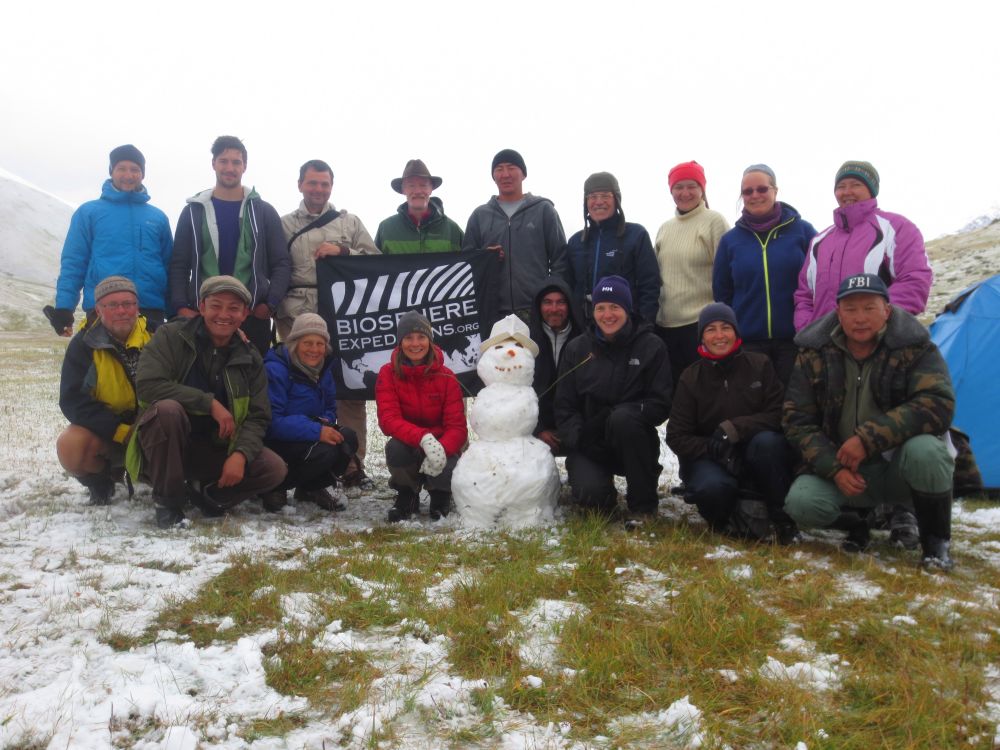
The day’s plans now out of the window, we fixed a couple of tents before the first snowball hit its mark. Thomas and Robert started it, but Katie and then Susanna quickly returned fire, and pretty soon it was on for young and old. When Shiloh emerged from his tent, he was imediately pelted, but, as an ex riot cop, he just stood there and only moved a little when the trajectory of a snowball included him. No-one hit him despite the flurry of projectiles he was simultaneously monitoring.

The newest member of the team, named Matthias by his creator Gary, can be found front and centre of the team photo below.

The snowman

An addendum. It is now a few days since I prepared the above. Some technical issues have prevented me from sending the August 15 diary and we have more news. The cold weather is intensifying and snow is now a feature of our days and nights. The cold has caused havoc with some of our equipment and is making sending diaries difficult. The traditional Sunday off saw most of the team pay a visit to our neighbours down the road who live in a very beautiful yurt and display fantastic traditional Kyrgyz hospitality. On their way back to base camp, our people stopped at another yurt and learned that only three days previously a horse was attacked by what the herders say was a leopard in a valley close to base refered to as No Name Valley. This has led to a revision of our plans for the day and a team has been sent to the herder to find out the precise details. The urgency is warrented by the fact that the horse survived the attack and is sporting the wounds which, if leopard, will be highly characteristic of such and need to be photographed as soon as possible. We have a vet on the team as well, who may be pressed into action if we find the horse’s condition requires her attention. Stay tuned.

Continue reading “From our snow leopard volunteering expedition in the Tien Shan mountains of Kyrgyzstan (http://www.biosphere-expeditions.org/tienshan)”