Award-winning, non-profit and ethical wildlife conservation volunteering. Advancing citizen science and conservation since 1999 – for nature, not profit.
We’ve arrived and we’re unpacking, shopping, setting things up. The food that Al Maha kindly provide for us is great. The sun is shining, it’s warm during the day and not too cold during the night to sleep under the stars (but there are plenty of tents too).
Today we are working with Greg on the research side (I hope you’ve read the 2016 expedition report to set the scene for you) and tomorrow we are tying up loose ends. And then we’ll see you at the right place and time on Saturday morning. Safe travels to get you there.
In another piece of excellent news, we’re a finalist for the 2017 Tourism for Tomorrow Awards! That in itself is another great feather in our cap. Now wish us luck for the final round, which entails an assessor joining our team for the week, who will take part in the expedition as normal, as will a journalist from National Geographic, and they will both want to talk to the rest of the team, so be nice to them please 😉
Hello and welcome to the first expedition diary entry of 2017, for our Arabia expedition to the Dubai Desert Conservation Reserve (DDCR). I am Matthias Hammer, founder and executive director of Biosphere Expeditions, and also your expedition leader for this expedition. Other key people are Greg Simkins, head of the DDCR and also our expedition scientists, as well as expedition leaders in training Tessa Merrie and Amadeus DeKastle.
This slideshow requires JavaScript.
And then of course there’s you, the expedition team. There will be a full complement of 12 of you from the UAE, UK, USA, Germany, Belgium and Switzerland, as well as a journalist for National Geographic Traveller and an assessor from a major travel award, which I can’t tell you about yet, since there’s a news embargo until the shortlists are officially announced on 16 Jan. But suffice it to say that it’s great just to make it onto the shortlist, which in itself is a major feather in our awards cap.
But enough of this for now. Let’s focus on you all getting there and the work ahead.
I hope your preparations are going well and you are starting to get excited. Tessa and I will fly from Norwich in the UK via Amsterdam to Dubai on Tuesday and set things up with Greg, Tessa & Amadeus. Amadeus will be coming from Bishkek, the capital of Kyrgyzstan, and you will all be coming from Europe, the USA and the Middle East.
Once we are all together, we will follow the recommendations of the 2016 expedition report, which was published at the end of December. Do have a look at this to be prepared. The methodology we will use and the skills you will need are explained in the report and there is also a YouTube playlist with it. We will follow the cell methodology, use camera traps and GPSs, as well as binoculars and spotting scopes. You might also want to watch some sand driving technique videos on YouTube; there’s plenty of them and this is a good skill to have too.
I’ll be in touch again from Dubai (then also with my contact number there). Good preparations and safe travels. I look forward to meeting you all.
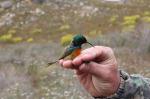
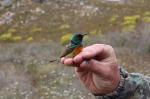
An international team of citizen scientists, working on a conservation project in South Africa recently completed a world first – capturing a Hottentot buttonquail (Turnix hottentottus). This is remarkable, because this species, considered to be endemic to the fynbos biome of South Africa, has never been caught before.
It is also a species of some mystery, with limited and variable knowledge regarding its ecology and conservation status. The Hottentot buttonquail is one of 18 species of Turnicidae; a group of cryptic, small, terrestrial birds probably best known for their polyandrous breeding systems.
There has been little consensus over the last 30 years as to the conservation status and taxonomy of the animal. Taxonomically the species was considered conspecific with the black-rumped Buttonquail, while now they are considered a separate species. From the conservation perspective, the species has variously been described as: ‘on the brink of extinction’; ‘possibly extinct’; ‘possibly critically endangered’, while at the same time it was classified as ‘Least Concern’ globally; and as of 2014 ‘Endangered’ both globally and nationally.
Clearly there is still much to learn about this species. Project scientist, Dr. Alan Lee is on a quest to advance the knowledge of this species. In addition to undertaking a range-wide population assessment of the species, Dr. Lee has been keen to mist-net and capture an individual so basic biometric information can be taken. This will permit telemetry collars to be fitted to this species so we can better understand their biology, ecology and inform conservation action.
On capturing the first individual at Blue Hill Nature Reserve, in the Western Cape, Dr. Lee said ‘I am delighted. I have been mist-netting and ringing birds since 2011, with over 7000 birds caught, and this was the first Hottentot buttonquail, not just caught by me, but by anyone. Clearly it wouldn’t have been possible without the collective efforts of the Biosphere Expeditions team’.
Biosphere Expeditions leader, Dr. Craig Turner stated ‘what a highlight for any expedition. Our volunteer teams want to contribute to worthwhile conservation science, but perhaps never imagined they could achieve a world first’.
Dr. Lee is soon to publish a range-wide study assessing the population and distribution of the Hottentot buttonquail, and then will pursue to use of telemetry collars to better understand this over-looked species.
Here are now also the highlights of the photos and videos you all shared (thank you).
This October saw the eighth expedition of Biosphere Expeditions’ annual coral reef survey of the Musandam Peninsula. Fifteen divers from all over the world (Canada, France, Germany, Oman, the UK and USA) spent a week of their holiday time to assist with reef conservation in Oman. Diving two or three times a day, they conducted surveys all over northern Musandam.
Dr. Jean-Luc Solandt, a coral reef expert from the Marine Conservation Society and the expedition’s chief scientist, summarises the expedition: “Our surveys have taken place during a particularly rich plankton bloom, so visibility in water has been quite low. Many sites hosted large numbers of snapper, way in excess of 1000 per kilometer square, which is encouraging. But the average size of the snapper is quite low, which indicates overfishing. Also, the large numbers of Diadema urchins continue to be a threat to the corals, because they are overgrazing the bedrock and base of some corals. Grouper (hammour) numbers are reasonable, but size ranges continue to be small due to overfishing, which is a worry, since only larger groupers can breed and produce more fish.”
Dr. Matthias Hammer, the founder and executive director of Biosphere Expeditions, this year led the expedition himself, “because we are now at a crucial stage of development in Musandam. The discussions we had with fishermen are encouraging. They have been told about and are respecting the Khor Hablain ‘closed area’, declared in 2013, where only line fishing is now permitted. We commend the government of Oman for its foresight in closing such a large area of the Musandam for all but line fishing. This is far-sighted and will surely help with the conservation of fish stocks and coral reef health around Musandam. However, Kumzari fishermen are concerned over illegal fishing from Iranian waters and believe this has resulted in significant catch declines in the past decade. We therefore encourage the Oman government to heed the fishermen’s concern and also continue its marine conservation efforts by putting marine conservation high on the agenda. After all, conservation management is essentially good overall management.”
Indeed, successful marine conservation efforts will always include the local fishermen. History has shown that the most successful marine conservation areas are those that are created bottom-up, with the help and acceptance from local fishermen and communities, rather than top-down governmental decisions that are not understood or accepted on the ground, and therefore often ignored. “With a bottom-up approach, the chance of everyone winning is so much higher than with top-down, where often everyone loses”, conclude Drs. Solandt and Hammer.
In another development, three more Omanis (Jenan Alasfoor from Muscat, as well as Ali Saleh Ibrahim and Waleed Alkaabi, both from Sohar) were trained on the expedition in reef survey techniques as part of Biosphere Expeditions’ on-going placement and local empowerment programme. All three qualified as Reef Check EcoDivers during the expedition and can now conduct reef surveys anywhere in the Indo-Pacific, including in Oman. This brings the total number of Omanis trained over the years up to seven – including divers from the Ministry of Environment and Climate Affairs, and the Environment Society of Oman – in what Biosphere Expeditions hopes to be the start of an all-Omani community-based survey effort. Dr Hammer said that “Biosphere Expeditions has been very successful in setting up such a community-based programme in the Maldives (see more information on this here and here) and we are very hopeful that Oman will now follow suit”. Ali Saleh Ibrahim adds that “the knowledge I have gained participating in this expedition will help me to go further with my interest of protecting the underwater environment. Now I am ready to start my first independent Reef Check together with other Biosphere Expeditions placement graduates and I plan to do this in the coming months. I really appreciate Biosphere Expeditions’ efforts to save coral reefs in my country and thank them for giving me the opportunity of a placement on the Musandam expedition, and putting Oman on their world map of conservation expeditions.”
Dr Solandt concluded the expedition this year by saying that “coral health of the sites we have visited this year appears good, though we have seen a few more incidents of disease than in previous years. We have been encouraged by the large number of snapper and we believe that more small no-take zones will help local fishermen and their communities into the future. We encourage the government to discuss further measures with them in order to recover fish stocks and achieve a bright future for all – local people and the environment we all depend on.”
Below is a selection of expedition pictures, as well as a video.
I have just finished the Thailand reconnaissance visit and we are now very close to confirming the expedition. The dates have changed a little (new dates are 23 – 31 October | 3 – 11 November 2017) and we still need some final quotes for services and to iron out a few final details, including the expedition contribution, but we are almost there.
The expedition page and briefing are ready save for the expedition contribution, which we want to have by the end of November at the latest. We will then tell everyone on the wait list first, so that they can be the first sign up on the expedition, before we launch it to the public a week or so later. If you are not on the wait list already, you can join it below, simply by submitting your e-mail (the form will do the rest).
Below are also a few videos and pictures from the site to give you a better idea of the expedition. These and links to more, as well as the briefing, are also on the expedition page.
I hope you are all getting excited. We certainly are and we look forward to updating you soon.
We’re back in Dubai, Tessa’s and my pictures below have been uploaded to the Pictureshare site, lots of new fish videos are now on the indicator playlist, and there will be a press release about the expedition’s results tomorrow.
It has been a great week with an AWESOME team. You could have gone to Dubai just to shop, or on a lazy diving holiday or whatever, but instead you decided to put your time, energy and money into helping coral reef conservation. Thank you so much for this. And thank you to Jean-Luc, the crew of the MS Sindbad and everyone else who helps to make this expedition a success. We could not do this without you.
Safe travels home and I hope to see you again, some day, somewhere on this beautiful blue planet of ours.
We’re back in Khasab harbour and we’ve basically checked the hell out of the Musandam reefs over the past few days. We were hold hands from France and Oman, as well as new Reef Checkers from Canada, Germany, Oman, the UK and USA. After a five-hour drive from Dubai to Khasab we went straight into our two intense days of training. All passed – even Rolf who was down with the lergy in his cabin, where he swotted away assisted by Angela. When he did surface, he still passed the tests with flying colours. Well done everyone!
Then it was into three days of checking the Musandam reefs all over the place – seven surveys in total! In the end we worked like a well-oiled machine. So much so that we could even cope with all whimp staff dropping out: Tessa with a cold from sitting in the air-condition blast too much, Matthias with a tooth ache and, most honourably, Jean-Luc, who was attacked by a needlefish during a night dive. It punctured his wetsuit and lower leg. Nothing too bad, but an impressive bandage anyway. Serves him right for waving his light around at the surface where they are out to hunt at night!
But all jumped into the fray. Patrick as half-naked SMBer par excellence, Patti as substrate queen, Elaine as diction champion, Lori & Jon as awesome! Reef Checkers, Ali & Waleed as the very interesting local connection, along with remarkable Jenan & Tanya, and unmistakably Mancunian Andy….
But what am I talking about: See for yourself below and read from our soon to be published press release:
Dr. Jean-Luc Solandt, a coral reef expert from the Marine Conservation Society and the expedition’s chief scientist, summarises the expedition: “Our surveys have taken place during a particularly rich plankton bloom, so visibility in water has been quite low. Many sites hosted large numbers of snapper, way in excess of 1000 per kilometer square, which is encouraging. But the average size of the snapper is quite low, which indicates overfishing. Also, the large numbers of Diadema urchins continue to be a threat to the corals, because they are overgrazing the bedrock and base of some corals. Grouper (hammour) numbers are reasonable, but size ranges continue to be small due to overfishing, which is a worry, since only larger groupers can breed and produce more fish.”
Dr. Matthias Hammer, the founder and executive director of Biosphere Expeditions, this year led the expedition himself, “because we are now at a crucial stage of development in Musandam. The discussions we had with fishermen are encouraging. They have been told about and are respecting the Khor Hablain ‘closed area’, declared in 2013, where only line fishing is now permitted. We commend the government of Oman for its foresight in closing such a large area of the Musandam for all but line fishing. This is far-sighted and will surely help with the conservation of fish stocks and coral reef health around Musandam. However, Kumzari fishermen are concerned over illegal fishing from Iranian waters and believe this has resulted in significant catch declines in the past decade. We therefore encourage the Oman government to heed the fishermen’s concern and also continue its marine conservation efforts by putting marine conservation high on the agenda. After all, conservation management is essentially good overall management.”
Indeed, successful marine conservation efforts will always include the local fishermen. History has shown that the most successful marine conservation areas are those that are created bottom-up, with the help and acceptance from local fishermen and communities, rather than top-down governmental decisions that are not understood or accepted on the ground, and therefore often ignored. “With a bottom-up approach, the chance of everyone winning is so much higher than with top-down, where often everyone loses”, conclude Drs. Solandt and Hammer.
In another development, three more Omanis (Jenan Alasfoor from Muscat, as well as Ali Saleh Ibrahim and Waleed Alkaabi, both from Sohar) were trained on the expedition in reef survey techniques as part of Biosphere Expeditions’ on-going placement and local empowerment programme. All three qualified as Reef Check EcoDivers during the expedition and can now conduct reef surveys anywhere in the Indo-Pacific, including in Oman. This brings the total number of Omanis trained over the years up to seven – including divers from the Ministry of Environment and Climate Affairs, and the Environment Society of Oman – in what Biosphere Expeditions hopes to be the start of an all-Omani community-based survey effort. Dr Hammer said that “Biosphere Expeditions has been very successful in setting up such a community-based programme in the Maldives (see more information on this here and here) and we are very hopeful that Oman will now follow suit”. Ali Saleh Ibrahim adds that “the knowledge I have gained participating in this expedition will help me to go further with my interest of protecting the underwater environment. Now I am ready to start my first independent Reef Check together with other Biosphere Expeditions placement graduates and I plan to do this in the coming months. I really appreciate Biosphere Expeditions’ efforts to save coral reefs in my country and thank them for giving me the opportunity of a placement on the Musandam expedition, and putting Oman on their world map of conservation expeditions.”
Dr Solandt concluded the expedition this year by saying that “coral health of the sites we have visited this year appears good, though we have seen a few more incidents of disease than in previous years. We have been encouraged by the large number of snapper and we believe that more small no-take zones will help local fishermen and their communities into the future. We encourage the government to discuss further measures with them in order to recover fish stocks and achieve a bright future for all – local people and the environment we all depend on.”
So here we are, on our last night. More after we are all back in Dubai tomorrow. For now we are out to town in Khasab…
If you have ever wondered what an expedition looks like before you get there, below is your answer 😉
All well in Dubai. Sunny skies, 30 degrees C, all ready for you. I hope you are well rested and prepared. It’s going to be intense.
Some of us are meeting in the lobby of the Holiday Inn Express at 18:00 to go out for dinner. Join us if you can. If not, I will see you tomorrow at 08:00 in the same place.
I am in London now for meetings, one of which was about the Omani government’s plans for Musandam and marine protected areas there, and how we can help in their establishment and designation. Things are moving and we are delighted to be involved.
Meanwhile a good, informative article has appeared in Muscat Daily, summarising the work of our 2015 expedition and the threats the Musandam reefs are facing, and what can be done to safeguard the reefs. Keeping Musandam on the public agenda in Oman is part of our strategy and one of the reasons why we publish press releases about our work.
Tomorrow I will board a flight to Dubai to set up the expedition, a couple of days ahead of you. I have not heard from anyone who cannot make the earlier 08:00 assembly, so I will see you all in the lobby at that time. Those of you meeting us in Khasab, please also be there an hour earlier, so 11:00 instead of 12:00 noon.
I will write again from Dubai with a quick confirmation of my local phone number.
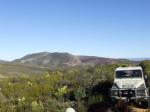
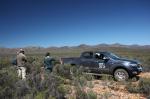
That’s all folks. Our time on expedition has come to an end. Our volunteers have departed, the kit is packed and now Alan and I must head our separate ways. First we must convoy south to return our Ford Rangers (thank you again Ford South Africa!). I then have to make the migration north to Scotland, and Alan to Senegal to present some of his research. The science never stops!
I can hardly believe our second expedition in South Africa is already over. Let me start by thanking our team. First off, our volunteers; the joy of expeditions is working with a bunch of liked-minded people towards a common goal – we’ve had a fantastic group and you’ve all made a great contribution (which I’ll expand on in a moment). But firstly we owe a huge thank you to Melda and Gurli, for the continual provision of culinary delights, and their botanical wisdom! We would also like to thank the extended Lee family (Anja, Elli, Charlie, Chris & Elaine) for their boundless hospitality. And finally, our enormous collective thanks go to Alan, our leader in all things scientific. It has again been a fantastic privilege to share in your world and work with such a passionate scientist.
So what about that contribution I mentioned? Well, the stats are staggering, over 50 litres of wine drunk, in excess 130 chocolate bars eaten, and numerous cups of tea and coffee consumed, and we still managed to complete all the fieldwork. Of course data still need to be crunched from the various field surveys and just think of all those new camera traps still clicking and collecting data….long beyond our departure.
But in case you have forgotten, here are just some of our highlights:
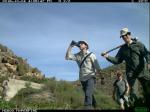
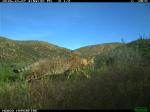
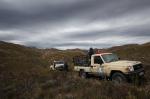
Several new camera traps have been deployed across the Blue Hill area (and many others serviced) to monitor leopard, caracal and other mammal activity and movement patterns.
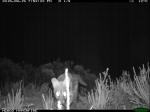
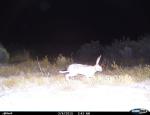
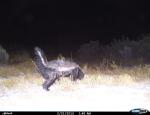
Nearly 3000 camera images from Blue Hill have be analysed, identified and catalogued, revealing activity of leopards, caracals and African wildcats across a number of locations.
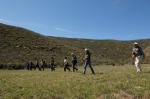
Over 20 kms of flush transects surveys have been completed across the Blue Hill area.
Several mist netting surveys have been completed providing more data on several endemic and range-restricted bird species.
We completed yet another round of small mammal trapping surveys.
We identified the location of more Cape rockjumper nests (a bird endemic to the Fynbos).
We have identified at least another two new species of bat in the research area (bringing the total to seve) and additional cave roosts of the Cape horseshoe bat have been identified.
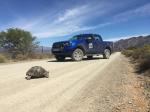
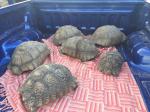
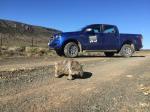
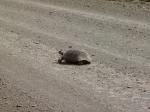
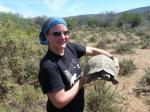
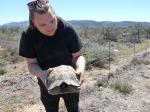
The team have contributed to pioneering and ongoing research of Matt Macray into the impact of electric fences on tortoise species. This is going to be a ground-breaking study highlighting the devastating impacts on a species, which poses no threat to any other animal.
And finally, the Hottentot buttonquail……
Alan has been catching and ringing birds at Blue Hill since 2011, and in that time he has caught over 7,000 birds but not a single Hottentot buttonquail. But neither has anyone else caught one, ever, anywhere. Biosphere Expeditions volunteers have been instrumental in changing that, and helping to influence our understanding of this endangered, range-restricted fynbos endemic bird.
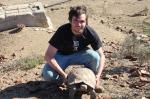
Andrew to the tortoise rescue
Another day in the office
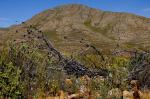
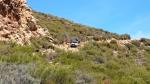
Another survey location
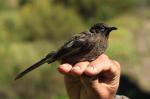
Cape weaver
Checking the nets
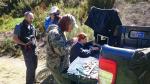
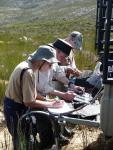
Data entry
Deploying a bat detector
Fieldwork is hardwork
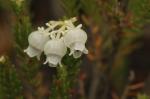
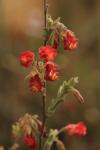
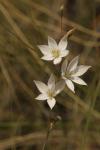
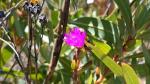
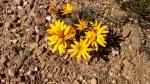
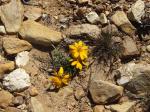
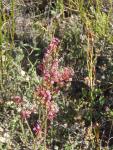
Floral kingdom
Floral kingdom
Floral kingdom
Hottentot buttonquail
Jim taking in the view
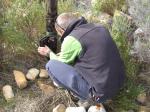
Setting a camera trap
The lucky ones
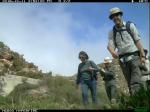
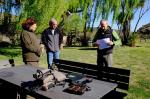
The expedition team
The unlucky ones
No matter whether you are a volunteer, scientist or expedition leader, we all go on expeditions with a varying mix of nerves, hope and expectation. We never know what we will achieve and I certainly don’t expect a ‘world first’, but in the diminutive shape of the Hottentot buttonquail, that is exactly what this team has achieved. Who would have thought that was possible when you are just going away for a couple of weeks?
Be pleased, be proud and I look forward to being back next year.













































































 Biosphere Expeditions: blogs from the frontline of wildlife conservation and the fight for a more sustainable planet