From our snow leopard volunteering expedition in the Tien Shan mountains of Kyrgyzstan (http://www.biosphere-expeditions.org/tienshan)


With our team in the field off for a week, a two-page feature about the expedition has just appeared in NABU’s member magazine in Germany (see http://issuu.com/biosphere-expeditions/docs/ts-naturschutzheute15b). Thank you to NABU for the great coverage.

Continue reading “From our snow leopard volunteering expedition in the Tien Shan mountains of Kyrgyzstan (http://www.biosphere-expeditions.org/tienshan)”
From our snow leopard volunteering expedition in the Tien Shan mountains of Kyrgyzstan (http://www.biosphere-expeditions.org/tienshan)


Here, at last, is the diary for slot 1 of our Tien Shan expedition. We could not get it to you because there is a big mountain range blocking the sat phone signal in the south. Calls can get through, but data can’t. Since this mountain range is unlikely to move over the next couple of months, please assume that field updates will only come every two weeks, as we switch teams and go back to Bishkek. Unless we haul the sat phone up the mountain with us on one of our surveys. You never know 😉

12 June (Friday)

A collective sigh of relief could be heard last Monday, when the team left Bishkek. The city heat – temperatures beyond 30 degrees – were happily left behind as was dust and heavy traffic. Snacks were picked up in a supermarket on the way and the convoy of three cars stopped for lunch when the tunnel was passed at 3200 m altitude. Overall it took us about 7 hours to get to base camp, so teams 2 – 4 please be prepared for a long journey.

08:00 o’clock. It’s a fresh and clear morning. The warming rays of sunlight haven’t yet made it over the eastern ridge sheltering base camp, nestled in a small side valley of the Karakol river. We’ve seen all four seasons since team 1 arrived four days ago. Rain made us seek shelter in the mess tent for the first expedition day’s training sessions, while the surrounding peaks were covered with a fresh layer of snow. Carolyn, Susan, Theresa, Charlie, Robert and Thorsten learned how to use GPSs, maps, compasses and radios, went through safety briefings and off-road driving lessons. After a practice survey walk with the whole team including Volodya, the scientist on this expedition, as well as Shailoo and Aman from NABU’s snow leopard patrol, and Kathy, one of Biosphere Expeditions’ senior staff joining the first slot, they have now all left camp in smaller teams for today’s surveys.

So far eleven cells have been surveyed in two days in Choloktor and Chon Chikan valleys. I will be talking a lot about cells – a grid of 2 x 2 km laid over the study area map in the Tien Shan mountains divides the terrain into these cells, which will be surveyed systematically.

No camera traps have been set yet. Snow is still covering the most promising spots. Over the next few days we’ll continue to explore the area hoping for a lot of sun to melt the snow away. Findings so far were wolf scat (a lot) and an ibex skull and horns, a red fox and marmot were sighted as well as quite a few golden eagles, just to mention a few.

P.S. Please remember to bring insect repellent, there are some mosquitoes around 😉

15 June (Monday)

We’ve continued exploring the valleys around base camp. On the third survey day, Susan, Robert & Theresa went together with Aman to the other side of the main valley and up the mountains we look at from base. The day’s motto was “slowly, slowly” since everyone was feeling a bit worn out after three days of going up and down lots of hills. Not so Aman, who was briefed intensively the night before about what “slow” means to us. 😉 The second group consisting of Volodya, Carolyn, Charlie and myself walked up what the locals call the “boar stream” pretty close to camp. We’ve crossed alpine meadows, scree fields and climbed up rocks before reaching the ridge at 3792 m altitude. Most animals signs such as ibex scat, argali footprints and snow cock scat, feathers and dust holes were found within the rocky habitat well above 3400 m. Further down, abundant marmot holes were spotted, a big colony of them must once have lived there.

This slideshow requires JavaScript.

The weather changed overnight from sun to rain and wind. Leaving Carolyn & Charlie, Susan & Robert behind, two cars left camp in the morning for a shopping trip to Suusamyr. Not a quick one since the town at the entry of the Karakol valley is about a 2½ hour drive away. The tasks on our list were: 1) buy bread, 2) buy milk and 3) buy a chimney for the yurt stove. Doesn’t sound complicated at all, but we failed with two out of three. Instead of milk we could have bought a great variety of vodka (even from the smallest shop) and for the chimney a local herder suggested to go back all the way to Kara Balta close to Bishkek on the other side of the Kyrgyz Alatoo mountain range. But bread we got! And also a taste of yoghurt cakes, a local specialty recommended by Emma, our cook. But to be honest, this was probably the most disgusting flavour Kathy, Torsten and I have ever tried. I guess you can also tell that from Torsten’s face on the picture. ϑ

At breakfast this morning our hopes for better weather seemed to be nothing but wishful thinking. But just when we decided to stay half a day at camp, the sun came out and everyone was ready, dressed and packed up in record time for another survey walk. This year’s first interview was held with a very friendly herder offering Kathy a ride on his horse, which was thankfully accepted 😉 Being a cattle herder he didn’t have any problems with snow leopards in the past, not even wolves because the cattle can defend themselves. A woolly ball was brought back to camp and analysed during the review session after dinner. We learned that these remains are produced by birds of prey regurgitating bones, feathers and other parts of their meal that can’t be digested.

16 June (Tuesday)

The sun laughs at us again! It’s been a clear night, the water drops on my tent were frozen this morning. Everyone is excited to finally go out for an overnighter. Camp is as busy as an ant’s nest. Emma is preparing food boxes, Aman and Shailoo are preparing cooking gear and packing up cars, everyone else is gathering equipment and packing their sleeping gear. Kathy and I wave them goodbye as they leave. We will go through some re-org in the next couple of days.

18 June (Thursday)

SNOW LEOPARD TRACKS! The overnighter team is back, exhausted, but thrilled about two exceptional survey days and a “night out”. The camping spot was chosen close to the mountain pass connecting the Eastern and Western Karakol at an altitude of 3500 m. Still partly covered in patches of snow and therefore not crossable for herders and their livestock from the Eastern side, this area would be worth a check before the cattle, sheep and horses will move in for the summer. Well done, everyone! The snow leopard tracks found were not fresh, but still clear enough for identification without any doubt. Two camera traps were placed, now everyone is hoping for some good results.

20 June (Saturday)

Slot one is ready to leave base camp. We did a reccee walk yesterday researching more overnighter possibilities in order to reach more promising rocky mountain areas at the far end of some of the valleys. Aman has suggested we follow an old track leading uphill over grassy hills not knowing where it would lead us to. So we drove as far as the cars would take us and continued on foot split up in two teams. An old herder’s place was found – an optional overnight camping spot close to a mountain stream. A badger was spotted as well as ibex far away on the rocky peaks of the mountain range. It was early in the afternoon when we returned to camp leaving us some time for final checks on the cars, the tents, the equipment and a detailed review of the results of what the team has achieved over the last two weeks. 26 cells have been surveyed – an impressive number considering the small number of citizen scientist on the first slot. We’ve spotted or found tracks of all snow leopard prey species such as ibex, argali and marmot. Tracks and scats of wolf, fox, badger and snow cock were also found and quite an impressive number of different bird species is already on the bird list, which will be continued until we leave in August. But most excitingly the presence of snow leopard was proven by tracks. This success was celebrated after Volodya’s review and another delicious dinner with quite a few toasts and some local vodka.

21 June (Sunday)

The first two weeks of this year’s Tien Shan expedition went in a flash. While Carolyn and Charlie will stay for two more weeks, I had to say good-bye to Kathy, Theresa, Sue, Robert and Torsten after a final dinner in Bishkek. Thank you everyone – you’ve been a special and a great team! Thanks for putting your time, sweat, mountaineering expertise and excitement into this project. Safe travels back home. I hope we meet again some day in the future!

Continue reading “From our snow leopard volunteering expedition in the Tien Shan mountains of Kyrgyzstan (http://www.biosphere-expeditions.org/tienshan)”

From our snow leopard volunteering expedition in the Tien Shan mountains of Kyrgyzstan (http://www.biosphere-expeditions.org/tienshan)

We’ve had a call from base camp. They are having trouble with the satellite connection. They can phone us, but the data connection for diaries and photos is not working, so this is just a short message to say that everyone is safe and doing well. We’ll send a diary entry as soon as we can, but it may only be at the changeover 20 – 22 June.

Continue reading “From our snow leopard volunteering expedition in the Tien Shan mountains of Kyrgyzstan (http://www.biosphere-expeditions.org/tienshan)”

From our snow leopard volunteering expedition in the Tien Shan mountains of Kyrgyzstan (http://www.biosphere-expeditions.org/tienshan)


You will be glad to know that our visit to the mountains has resulted in a site for camp 1. You can see the location of base camp on this map, as well as the grid lines we will be using during the survey (more below also).

You will also be glad to know that the weather was great and the mountains as beautiful as ever. And that the bread tastes the same, as does the fermented horse milk 😉 The ominous tunnel we have to take through the mountains is also there with much-needed repairs being done to it and delays. We’ll have to see how this pans out when you all arrive, but be prepared for a long break on the way to base camp.

This slideshow requires JavaScript.

You will also have seen the publication of last year’s report with our commitment to further research and local involvement, which is just what you are about to do. Remember that science is not safari and that results can take a long time. The great thing about your involvement is that we have a long-term source of help in the field as well as funding. And long-term commitment is what is needed. Thank you to all of you for this!

So, after a brief stint in Bishkek for last minute shopping and to collect Kathy, another member of the Biosphere Expeditions staff, we’re now off again to set up base camp.

So as we prepare at this end, please can you do some more preparation too. In addition to studying the dossier, have a look at the “Methods & equipment” playlist. The bits that are relevant to the expedition are first and foremost our cell survey methodology, followed by GPS, compass & map, Garmin etrex 20, PBLs, camera trapping and binoculars. Enjoy!

Continue reading “From our snow leopard volunteering expedition in the Tien Shan mountains of Kyrgyzstan (http://www.biosphere-expeditions.org/tienshan)”

From our snow leopard volunteering expedition in the Tien Shan mountains of Kyrgyzstan (http://www.biosphere-expeditions.org/tienshan)

It’s 06:00 in the morning. Writing this, everyone else is still fast asleep, but very soon it will get busy at the NABU offices. Volodya, the expedition scientist arrived two days ago and preparations are now in full swing. Soon we will be heading out for a reconnaissance drive to the southern side of the Kyrgyz Alatoo range, investigating this year’s conditions on the ground and finding a good spot to set up base camp for slot 1. From what we’ve heard, it has been extraordinarily wet in the mountains over the last few months, most probably there will be snow cover higher up.

A couple of days ago we collected the base camp equipment from storage – a garage outside the city of Bishkek. It’s a good thing we have the truck, kindly supplied by our local partner NABU. Since then every single item has been unpacked and checked. Emma, the expedition cook, joined us on Tuesday, just back from a trip to Russia. We’ve started working through our shopping list at one of Bishkek’s biggest markets. Besides many other kitchen items, we bought a new cooker, but not before Emma gave it a thorough check. After more shopping at innumerable hardware stores and supermarkets, we went to a private supplier to check a yurt we are planning to buy.

This slideshow requires JavaScript.

The placement interviews went well. So far four local people will join the expedition slots – one Kyrgyz student in the first slot, two more in the second and one in the third slot. We continue to receive applications and more interviews will be held in the remaining days before our departure from Bishkek.

I’ll be back in touch once we return from our mountain reconnaissance drive.

Continue reading “From our snow leopard volunteering expedition in the Tien Shan mountains of Kyrgyzstan (http://www.biosphere-expeditions.org/tienshan)”

From our snow leopard volunteering expedition in the Tien Shan mountains of Kyrgyzstan (http://www.biosphere-expeditions.org/tienshan)

It is sunny and warm in Bishkek. I arrived two days ago on a clear morning just after sunrise. From the plane approaching Bishkek airport from the north, I was had fantastic views over vast flat steppe stretching out all the way to the bottom of the snow-covered Kyrgyz Alatoo mountain range, rising south of the city. For now, having temperatures climbing up to 31 degrees mid-day, I’ve almost forgotten about down jackets and long-johns stashed away in my bag.

Kyrgyz Alatoo range rising just behind Bishkek

I’ve settled in at the NABU Kyrgyzstan office close to Bishkek centre, warmly welcomed by our partners on the ground. Over the last two days we’ve all been busy with gathering the expedition equipment, which has been stored in various locations. I’m still busy with updating inventories and writing shopping lists. NABU’s snow leopard patrol (Grupa Bars), a group of four staff I will introduce you to later in detail, has returned from a camera collection trip to the Ala Archa National Park on the northern side of the mountain range. 21 camera traps will now all be prepared to be set up again within our study area. The SD cards will be checked for results over the next couple of days.

Sign to NABU offices

I met with the Director of the local mountain rescue services yesterday to discuss emergency procedures and communication lines – all part of Biosphere Expeditions’ safety procedures. Quite a few local placement applicants have been invited for an interview, most of them to be held tomorrow. Offering placement opportunities for local students is part of Biosphere Expeditions’ capacity-building programme (see www.biosphere-expeditions.org/placements). Depending on how the interviews go, one or two local people will join the expedition teams in addition to the team list that has been sent out to everyone.

Continue reading “From our snow leopard volunteering expedition in the Tien Shan mountains of Kyrgyzstan (http://www.biosphere-expeditions.org/tienshan)”

From our snow leopard volunteering expedition in the Tien Shan mountains of Kyrgyzstan (http://www.biosphere-expeditions.org/tienshan)

Hello everyone, this is the first diary entry for this year’s snow leopard conservation expedition to the Tien Shan mountains of Kyrgyzstan. My name ist Malika and I will be the leader for the first three groups starting on 8 June.

Over the last few days I’ve been busy with preparing paperwork, data sheets, equipment and finally making it all fit into three huge bags now making their way to Bishkek. I’m at Frankfurt airport as I write this, about to board a plane heading east towards Instanbul before catching a connecting flight to Bishkek.

Our partners on the ground at the Bishkek NABU office are ready to help me set the scene once I arrive. Quite some more shopping and preparation needs to be done before the first group of citizen scientists arrives and we are all looking forward to it. We will be working out a day-to-day plan within the next few days (which will be attached to one of the next diary entries for your preparation, along with my local phone number once I have verified the SIM still works). Dr. Volodya Tytar, the scientist on this expedition will be joining us on the weekend. Together with him and the NABU Grupa Bars (snow leopard patrol), I will be looking for this year’s base camp sites

That’s it for now. I’ll be in touch again from Bishkek with more details soon.

Malika Fettak

Expedition leader

Continue reading “From our snow leopard volunteering expedition in the Tien Shan mountains of Kyrgyzstan (http://www.biosphere-expeditions.org/tienshan)”

From our snow leopard volunteering expedition in the Tien Shan mountains of Kyrgyzstan (http://www.biosphere-expeditions.org/tienshan)

The final group of the 2014 Tien Shan snow leopard expedition to Kyrgyzstan has just made the long journey to Bishkek from the Tien Shan mountains, which ends the first Biosphere Expedition foray into this amazing country.

Whilst we did not directly see the aptly named “mountain ghost”, we have fairly convincingly determined its presence in these hills through multiple reports of livestock loss amongst the local herders including a survivor whose scars are very suggestive of big cat. The distinct cough-like call of a cat was heard by myself as well, and the fact of there being good amounts of leopard food, such as ibex and argali, in this valley system speaks strongly of a habitat, which could be expected to support the animal.

As many of us observed, many lower areas are heavily overgrazed and this is driving wildlife into the rugged upper reaches of the range. This pressure is only growing, so the time is now to start working to improve the relationship between the landscape’s managers and the wildlife, which makes this delicate biota tick.

This expedition was by definition a reconnaissance operation. We were here to assess the status of the landscape through the lens of its capacity to support apex predators such as the snow leopard, a fundamental measure of an ecosystems health. We found a good number of predators including wolves and the above mentioned evidence of our cat. The next step is to attempt to identify the numbers and distribution of these predators and how their population relates to their wider known distribution. These questions will yield the answers needed to plan adequately for the sustainable coexistence of all of the players in this dramatic, but fragile place.

Thanks to all of the teams, without whom this sort of research would be impossible. Each participant brought their own invaluable perspective to the effort. The data you collected may seem vague and even trivial… Oh look, more pooh!… but taken together, all that shit and all those footprints paint a detailed picture of a complex puzzle, which Volodya will now begin to interpret, as he has with great skill and to great effect for many years in other places, for other creatures.

Thanks especially to Volodya for sharing his expertise with this effort and to Emma for keeping this army marching on its stomach. Thanks also to the guys from NABU, Amman and Shilo, Kurmanbek and Joeldosh, and Tolkunbek. These local experts made this possible and will continue to work hard for Kyrgyzstan’s faunal emblem in our absence. A special thanks to the local volunteers Aliaskar and Ulan, whose assistance was hugely valuable in many ways beginning with translation and turning into a list that would run off the page. Very importantly, thanks again and again to Almaz, who provided the vehicles and the ground support and much logistical management from his base in Bishkek. There are many others too; you know who you are.

That’s it from me. It was a pleasure working with you all. Keep this up and we might just make a difference.

Paul

P.S. We’ve updated our albums on https://biosphereexpeditions.wordpress.com/ and www.facebook.com/biosphere.expeditions1 with our photos and a “best of” the ones submitted to the Picture Share site.

Continue reading “From our snow leopard volunteering expedition in the Tien Shan mountains of Kyrgyzstan (http://www.biosphere-expeditions.org/tienshan)”
From our snow leopard volunteering expedition in the Tien Shan mountains of Kyrgyzstan (http://www.biosphere-expeditions.org/tienshan)

Well, the last traps are in and as of this year in Tien Shan, Kyrgyzstan, despite three reliable and recent instances of horses being attacked and the clear sound of a leopard’s cough, we have not managed to bag a photograph. The last traps were from the Kashka Tor valley in which two horses had run-ins with our big cat. The first, you may remember from a few weeks ago, was killed, leading to an overnighter in that valley a few days after the camera traps were placed. The second, very recent attack was on a foal whose mother apparently drove off the leopard leading to a survivor with fresh and quite dramatic wounds, which we have photographed. The feeling amongst those with a perspective to speak from are that the most likely cause of such damage is in fact a snow leopard.
Today is the last day on the ground here and it was spent by some on an interview run into the East Karakol valley system. This time the team sought to focus on the relationship between the women of the Kyrgyz herder culture and the leopard, because in the small glimpses of such that we had obtained thus far, it appears that they have a more ambivalent attitude to the animal than the men, who speak in very patriotic terms about the Kyrgyzstan national symbol. It will be interesting to hear what the interviews yield.

The rest of us went about preparing the base camp for tomorrow’s hectic pack-down. We have quite a lot of stuff to load into the trucks in the morning, but the work we did today will make it much easier.

This afternoon, Volodia will sum up the expedition science achievements and discuss the likely evolution of the project. I understand that there is some interest in a night of vodka on the part of some team members who have been sitting on a stash for this occasion. I better pack my stuff up now then…

Continue reading “From our snow leopard volunteering expedition in the Tien Shan mountains of Kyrgyzstan (http://www.biosphere-expeditions.org/tienshan)”

From our snow leopard volunteering expedition in the Tien Shan mountains of Kyrgyzstan (http://www.biosphere-expeditions.org/tienshan)

As I signed off on the last diary entry, I could see the first lot of team members cresting the ridge that separates us from their target valley for that day. As I packed up the satellite coms, they were close enough for me to see that there was a spring in their step. Although it was really just a training run with Volodya, they found quite a lot, amongst which was clear footprints of a Palas’ cat or manul. The next day was also productive, with the first real survey yielding access into Issyk Attar’s upper reaches where a fantastic high traffic pass was discovered. Tracks and scats of all kinds and so fresh that the urine patches of many argali were still clearly visible amongst the still wet droppings. There are two platforms below the pass and each has a wide mud flat, which has captured the comings and goings of herds of beasts as they negotiate the pass into the valley systems to the north. This will surely be a big focus of next year’s explorations.

This morning the heat of yesterday’s excitement was significantly cooled off by the fact that we all awoke in igloos. As our tents bowed in under the weight of a good layer of snow, we were woken by the freezing sides of the inner tent settling on our heads. The drumming of tent walls being pounded from within to dislodge the heavy snow blanket woke those not already up, and when we opened the zips and stepped outside, we were in another land from that which had seen us off to bed the previous night.The entire valley was covered in snow.

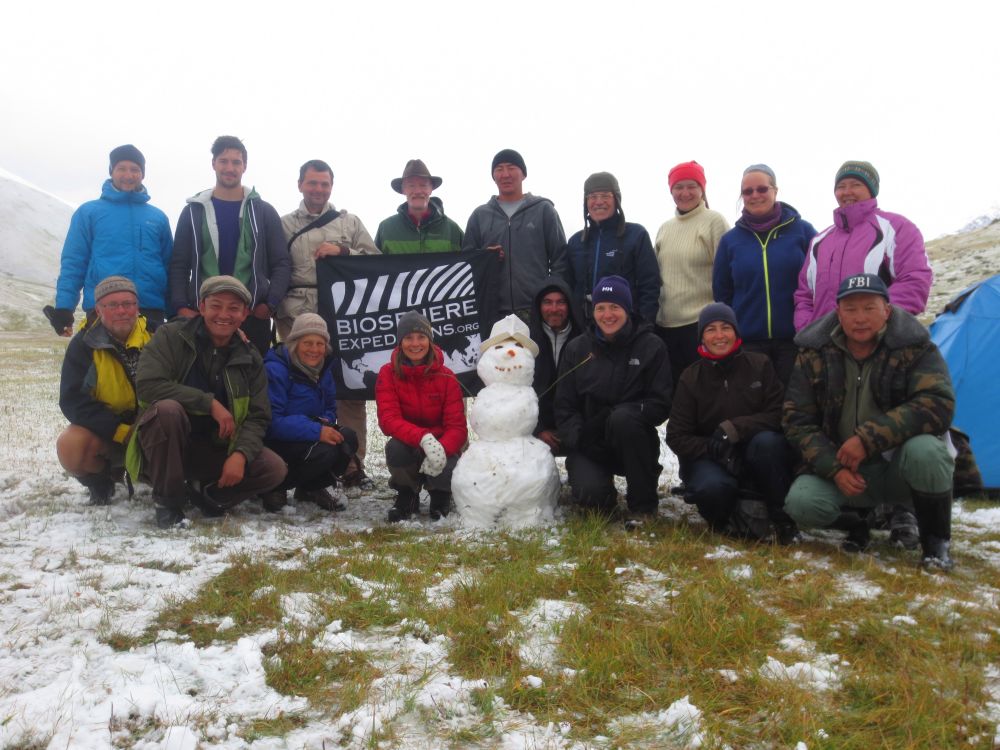
The day’s plans now out of the window, we fixed a couple of tents before the first snowball hit its mark. Thomas and Robert started it, but Katie and then Susanna quickly returned fire, and pretty soon it was on for young and old. When Shiloh emerged from his tent, he was imediately pelted, but, as an ex riot cop, he just stood there and only moved a little when the trajectory of a snowball included him. No-one hit him despite the flurry of projectiles he was simultaneously monitoring.

The newest member of the team, named Matthias by his creator Gary, can be found front and centre of the team photo below.

The snowman

An addendum. It is now a few days since I prepared the above. Some technical issues have prevented me from sending the August 15 diary and we have more news. The cold weather is intensifying and snow is now a feature of our days and nights. The cold has caused havoc with some of our equipment and is making sending diaries difficult. The traditional Sunday off saw most of the team pay a visit to our neighbours down the road who live in a very beautiful yurt and display fantastic traditional Kyrgyz hospitality. On their way back to base camp, our people stopped at another yurt and learned that only three days previously a horse was attacked by what the herders say was a leopard in a valley close to base refered to as No Name Valley. This has led to a revision of our plans for the day and a team has been sent to the herder to find out the precise details. The urgency is warrented by the fact that the horse survived the attack and is sporting the wounds which, if leopard, will be highly characteristic of such and need to be photographed as soon as possible. We have a vet on the team as well, who may be pressed into action if we find the horse’s condition requires her attention. Stay tuned.

Continue reading “From our snow leopard volunteering expedition in the Tien Shan mountains of Kyrgyzstan (http://www.biosphere-expeditions.org/tienshan)”