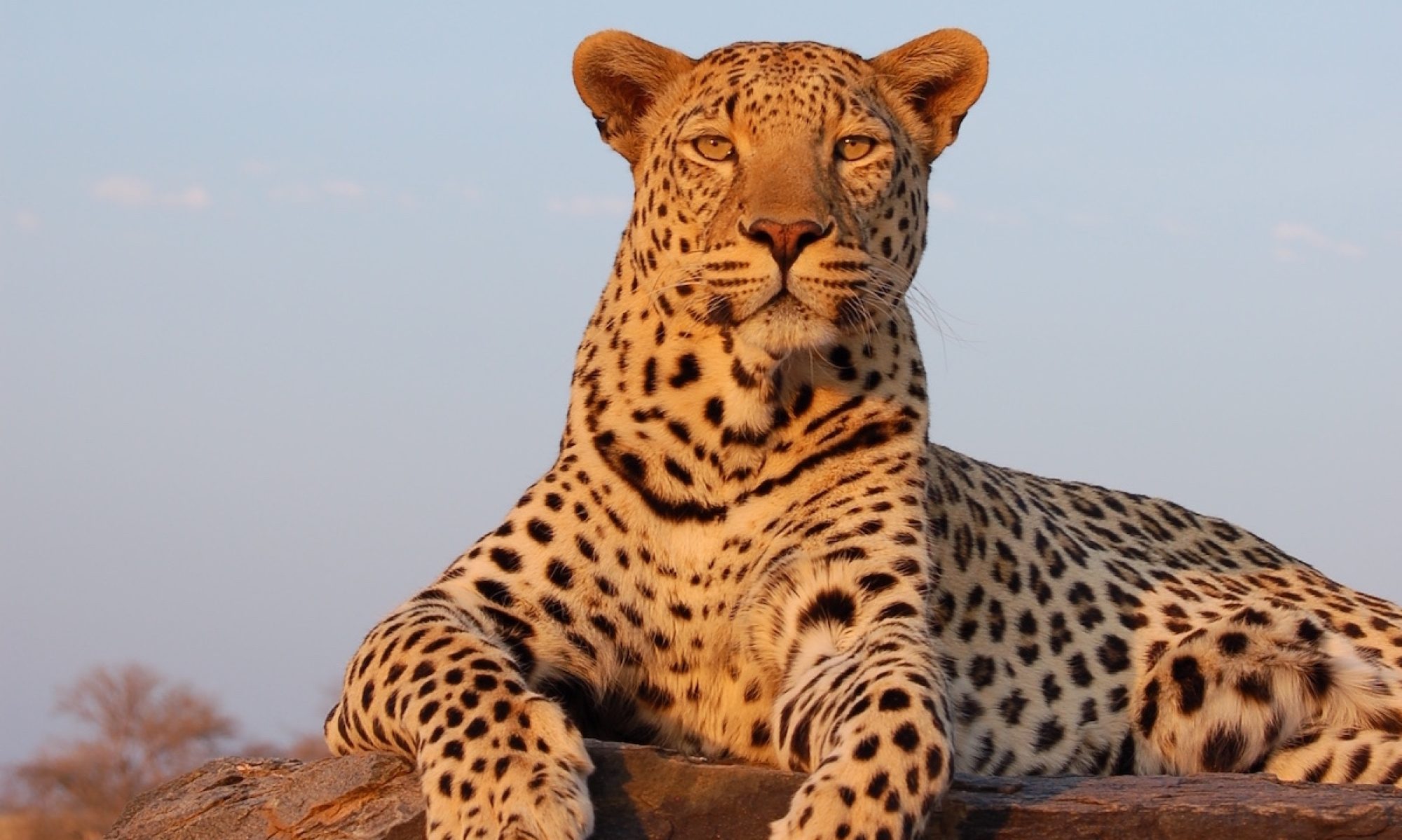
From our working holiday volunteering with leopards, elephants and cheetahs in Namibia, Africa (http://www.biosphere-expeditions.org/namibia)

Thursday was our weekly vehicle game count. What a difference a week can make. Last week we were frozen solid on the backs of the trucks and counting game like crazy, and this week the weather was much warmer and the animal counts much less. The mountain team consisting of Mark, Helen, Uli and Ashley didn’t see much game on the game count, but they did see a lot of tracks. In fact, one track they followed led them straight to out box trap! There the leopard put on paw in the trap, then proving how very clever they are decided it was a bad idea and stepped out again without activating the trap. We can’t wait to see what leopard it was when we view the camera trap pictures!

Elephant observation teams were extremely unlucky after the first encounter. We scoured the farm for four days never finding them, getting random beeps but never seeing them. Finally on day 5 we went out and found followed their signal (and them) to the Sandposten waterhole. We had a lovely encounter for more than an hour, unfortunately never observing any feeding behaviour because they were so absorbed in the water. What was very interesting to all of us was how they chased off the cows: they blow water at them!

elephants

Vera’s game count team of Mara, Paul, Emma and Bruce didn’t see much game at all according to Helen and Uli doing data entry to my right, but they reported seeing the rhinos on the way back home. My team of Louize, Di, Vibeke and John on the east side of the farm didn’t see the bat eared foxes this week, but we did see a plentiful amount of the beautiful and delicate Steenbok. (Our data sheets were so full we didn’t want to brag that we also saw the rhino family group plus the big male.) We also counted among our animals a sable antelope.

evening light

The rest of the week’s activities hummed along swimmingly well. The teams worked hard even though it has been quite hot these past two weeks. We’ve changed around the activities a bit so that we’re doing the more sedentary activities in the afternoons, but for some activities like box traps and changing the bait meat in the traps, it’s just a hot, sweaty, smelly business no matter what time of day you do it.

team 5

A hearty thanks goes out to all the Team 5 volunteers. We wish you safe travels home.

Team 6? See you at the Josephine Gate on Sunday!

Continue reading “From our working holiday volunteering with leopards, elephants and cheetahs in Namibia, Africa (http://www.biosphere-expeditions.org/namibia)”

From our working holiday volunteering with leopards, elephants and cheetahs in Namibia, Africa (http://www.biosphere-expeditions.org/namibia)

Last Friday Team 5 set up a new box trap at the south fence. Last year’s volunteers reading this diary might know its location on the ridge on the fence south of JM House where we set the camera trap. I don’t think I’ve shared the attached camera trap picture yet. While it’s not the target species of this project, it is an awfully cute picture.

IMG_0254

With the help of IZW scientists, Team 5 also set up a new box trap in the mountain area of Okambara this past week. We’ve stepped up our trapping efforts as you can tell and have borrowed two traps from the IZW in order to catch as many leopards as possible. There are still several females we are targeting to get collared, and we wouldn’t mind re-capturing the leopards we caught last year in order to refresh their collars.

So Team 5 now is lucky enough to have a total of six traps check. Traps are far enough apart that we’re spending considerable time driving all over Okambara both mornings and evenings, and sometimes we split up the box trap duties and combine them with other activities in order to make sure we’re operating at maximum efficiency.

Team 5 has been super helpful not just on science-related tasks and I have to commend them for their fantastic “dig in and do it” attitudes. For example; three nights ago Emil the male rhino came along and thought the fence surrounding our lapa was a pretty good place to get a good scratch. Unfortunately, the fence toppled inwards and left a lovely hole for every animal coming to the waterhole to crawl through, so Bruce, Ashley, John, Paul and Mark put their heads together, put their backs into it and got it fixed. Bruce, Ashley, John and Paul then went out with Ligeus to gather firewood too.

_G8Q8260 IMG_6104

Continue reading “From our working holiday volunteering with leopards, elephants and cheetahs in Namibia, Africa (http://www.biosphere-expeditions.org/namibia)”

From our working holiday volunteering with leopards, elephants and cheetahs in Namibia, Africa (http://www.biosphere-expeditions.org/namibia)

Team 5 arrived on Okambara and was treated to three wonderful animal encounters during their first (half) day in the field. It wasn’t too difficult to identify the five rhinos. What made it an interesting encounter was that it was the first time we’d seen so many of them together, including the baby rhino. At dinner the same group of rhinos waltzed right through camp and took a long drink at the water hole. For dessert the elephants came to visit us.

elephan 2012 (2) rhino 2012 (1)

Box trap training went well and on the first day out solo this morning’s box trap team had to release a honey badger. Vibeke and Paul must have nerves of steel – talk about a tough first animal to release from a trap! Now this afternoon’s box trap team will have their work cut out for them re-setting the trap…

honey badger

Wednesday’s elephant team was led on a merry chase trying to locate them and it turns out they’d headed up to the mountains, where they almost never go. Meat was changed in all the box traps Wednesday afternoon by John, Helen, Dianne, Louize and yours truly. Despite our hanging some really juicy meat in them, there were no animals in the traps the next morning. Along the way Dianne and I learned the value of wearing gloves while retrieving abandoned ostrich eggs from the field – we stank all the way home.

Thursday was our vehicle game count day. The weather turned quite cold overnight and everyone was frozen by the time they reached their start points. Mark, Helen, Uli and Ashley reported not seeing many animals in the mountains, although they did solve the mystery of where the elephants have been hiding: they followed the tracks of the entire herd all the way down from the Lodge. Emma, Mark, Bruce and Paul were with Vera on Route 2, and they reported a still morning. Route 3 with me, well, we started the day off with a rare sighting of a pair of normally nocturnal bat-eared foxes. That wonderful sighting led us into counting almost every giraffe on the farm, plus seeing both rhino mommas and their babies. So John, Di, Louize, Vibeke and I felt quite pleased with our morning.

etosha 2004 (16) kudu (2) springbock (1) zebra (2)

Continue reading “From our working holiday volunteering with leopards, elephants and cheetahs in Namibia, Africa (http://www.biosphere-expeditions.org/namibia)”

From our working holiday volunteering with leopards, elephants and cheetahs in Namibia, Africa (http://www.biosphere-expeditions.org/namibia)

Our second week was business as usual on Okambara. We played hide and seek with the elephants, picked up bagfuls of carnivore scats and changed more flat tyres than we could count. The team had several encounters with the baby rhinos and newborn giraffe, and the last morning Emil the male rhino came and serenaded Jan and Sonja with his rumbling grunts right outside their room.

Nerys and Keryn did hour upon hour of data entry and went through thousands of photos for us. It was gratifying to see L075, the male leopard we have just collared, on the camera trap acting normally. It was also interesting to see the other collared male (L052) come to the same water hole one hour and three minutes later!

Wednesday Vera took Nerys, Keryn, Jan and Rebekka into the field for a new activity collecting data and leftovers at kill sites. Vera had received satellite data from L074, the female leopard we collared in group 2, and the group spent the entire day in the field tracking down bits to collect. We were told at briefing that the team spent at least half their time hacking new trails for the truck and eventually just went up and down the mountains on foot.

Our last evening was a “briefing in the round” (with all fourteen of us sitting inside the fire pit) with Jan, our intrepid and inspirational 74-year-old Australian-Canadian reading the poem she’d written that afternoon.

Safe travels home team 4. Team 5? See you on 12 October…

This slideshow requires JavaScript.

Continue reading “From our working holiday volunteering with leopards, elephants and cheetahs in Namibia, Africa (http://www.biosphere-expeditions.org/namibia)”

From our working holiday volunteering with leopards, elephants and cheetahs in Namibia, Africa (http://www.biosphere-expeditions.org/namibia)

Thursday was our vehicle game count, and while the days are now quite hot, it was still freezing cold when we set out on the backs of the trucks pre-dawn. At briefing Thursday night, Ligeus and I learned of our nicknames: Ligeus= “eagle eye” because of his uncanny ability to spot scats from 300 metres away, and me (Alisa)= “egg eye” because, well, I keep spotting random ostrich eggs in the field. We now have six of them on the shelves at the bush camp waiting to be turned over to Christian.

Friday I honestly don’t remember, because of yesterday’s events. Saturday is usually our “day off”. Yet it was anything but, because the box trap team called in with a “tiny” leopard in the Bergposten “1” box trap (this is the first box trap that was set up at Bergposten this year, on the north side of the water hole). Imagine Nerys, Jeff and Volker’s surprise when they walked up to the trap expecting one of the usual by-catch species and they got growled at! Smart team, because they verified with binoculars that it was a leopard and then left the animal alone. They then called us. Being Saturday, Walter, the veterinarian had to finish a couple of appointments in Windhoek before driving out to Okambara.

We all arrived at Bergposten as the sun set, and the team helped the scientists set up the field hospital. Work was done in the dim glow of the truck lights, with every volunteer huddled around the scientists holding their torch/flashlight/headlamp on the animal and equipment so they could see to do their jobs. I only wish I could have had an aerial photo of that! Thanks Team 4 for being so helpful and flexible and being willing to stay out in the field until the immobilisation/collaring was complete, and for patiently waiting to eat your dinner at 22:00!

By the way, our “tiny” leopard was male, and he weighed in at 63 kg. Teams 1, 2 and 3, you may remember the leopard we kept seeing on the camera traps at Bergposten with the strange “poof” on the end of his tail…we caught him! It will be very interesting to see what this fellow is doing roaming around in the middle of another male leopard’s territory (that would be L052 from last year). Thanks to all of the teams so far now we are one step closer to finding out.

L075, welcome to the project!

This slideshow requires JavaScript.

Continue reading “From our working holiday volunteering with leopards, elephants and cheetahs in Namibia, Africa (http://www.biosphere-expeditions.org/namibia)”

From our working holiday volunteering with leopards, elephants and cheetahs in Namibia, Africa (http://www.biosphere-expeditions.org/namibia)

Team 4 is on the ground and all trained up. They are the first team I ever recall gathering SIX scats on the training day. So we’re off to a great start.

Tuesday was our first full day in the field, and it was, well, a very full day. We’ve borrowed a box trap from the IZW scientists (thanks to Christian, too, for letting us use it since it was on loan to him) and set up a second trap at Bergposten, where we keep seeing an uncollared male on the camera traps. Last year we caught and collared a male (L055) at Bergposten, so if we catch this other guy it might be very interesting to see why and where he is in between two other males’ territories.

Vera did the box trap training in the field as we set up the Bergposten Trap, now very creatively called Bergposten #2. So, for those of you who have been here before, Bergposten #1 is in the same spot it’s been for all teams this year (north of the water hole and not under the tree like last year).

Bergposten Trap #2 is behind where last year’s trap was, West of the waterhole and more deeply hidden in the bushes. We placed it along a trail where we’ve seen lots of leopard tracks on their way up from the water hole. We also found a fresh leopard scat there, so now all we have to do is wait to see whether the leopard we’ve seen on the camera traps can be convinced to go into our nicely set up box trap.

This slideshow requires JavaScript.

Today, Wednesday, was a more “normal” day in the field. We had the usual box traps teams (they were all open and nothing was in the traps, and in the afternoon the team changed the bait meat in the CS House trap). Tracks and Scats #5 was where we walked this morning (5 scats and 2 cheetah tracks), and in the afternoon we observed the elephants (found them and saw six of them just after they’d left the Frankposten water hole.

Sue, Volker, Renate and Jan volunteered to be the “all day” team, who went out into the mountains for a mixed activity day of checking the Frankposten box trap in the morning, then checking the mountain camera traps, changing the SD cards and installing fresh batteries. After a lunch break in the field, they did a waterhole observation at the lodge, then replaced the meat in the lodge box trap. Then they managed to get not one, but TWO flat tyres, which they changed in record time we were told. They walked into the lapa with big smiles on their faces, so it was a hugely successful day to get so much done and have a great time too. Well done!

Continue reading “From our working holiday volunteering with leopards, elephants and cheetahs in Namibia, Africa (http://www.biosphere-expeditions.org/namibia)”

From our working holiday volunteering with leopards, elephants and cheetahs in Namibia, Africa (http://www.biosphere-expeditions.org/namibia)

Sunday and Monday was business as usual on Okambara. Our small group finally caught up with all the “everyday” field work and we were able to turn to some of the less physical tasks such as waterhole observation and data entry.

Monday our Tracks & Scats team had a very nice walk up at the lodge and along the northern fence line we found two holes in the fence that we reported to Christian, the farm owner. Not usually something very notable unless the large ungulates can get through them (we did report one of those), what was unusual was that we found two snares imbedded into the holes. These wire snares would be difficult to see in the normal surveys of the fence lines, but on foot and with Ligeus’ keen eye, our team found and disabled them.

IMG_5631 IMG_5635 IMG_5643

Barbara, William and I went out to observe the elephants yesterday and were rewarded with watching them at the Boma waterhole. We followed them on their grazing journey for almost a kilometer and then nearly bumped into two of them demolishing a tree when we rounded a corner. It never ceases to amaze me how stealthily these large animals move through the bush. The cow and her offspring didn’t seem to mind us, and we were able to observe them from quite close.

_G8Q7139

Monika and Rebekka volunteered for an all-day-out-in-the-field on Tuesday and looked happy and very tired upon their return. They checked all the camera traps in the mountains (#s 11, 13, 1, 3 and 6), then in the afternoon checked the Frankposten box trap and sat at the waterhole there.

While previous groups this year reported very few animals, this group has definitely seen more animals. Monika and Rebekka reported seeing an entire herd of impala at Frankposten, along with 13 waterbuck, heaps of kudu, several giraffes. Two rock monitor lizards even came for a drink. So much for the empty waterholes of August!

_G8Q7093

Vera and I want to say a hearty THANK YOU to Team 4 for your hard work and get-it-done-without-complaint attitude. It was really great to work alongside of you and we were sad to drive you to the gate this morning. Lucky for us, Rebekka will be with us again on the next group. We’re looking forward to seeing all of you on Team 4 on Sunday!

Continue reading “From our working holiday volunteering with leopards, elephants and cheetahs in Namibia, Africa (http://www.biosphere-expeditions.org/namibia)”

From our working holiday volunteering with leopards, elephants and cheetahs in Namibia, Africa (http://www.biosphere-expeditions.org/namibia)

William, our new guide, arrived in camp Wednesday night straight from fighting a large brush fire on a neighbouring farm. I have to commend Team 3 on their teamwork and bush relay communication skills, because Barbara and Diane had spotted the fire when they were in the mountains near Kuduposten. There’s no cell phone coverage up there, so they took the initiative to drive back to the lodge and tell Christian about the fire.

Fires are an extreme hazard here in the dry season, and can spread quite quickly. Normally everyone drops what they are doing to extinguish them because they gain speed rapidly. We volunteered ourselves and our team to help, but we were not needed. The fire was on a neighbour’s farm and many people from several other neighbouring farms went to help. Thanks Team 3 for being willing to do whatever is required out here!

bushfire1

Thursday Team 3 got up early and drove out to our respective start points for the vehicle game count. On Route 1 there was much excitement: the entire team heard a leopard in the distance and Ligeus saw it through the binoculars before the animal disappeared into the rocky hillside. Route 2 members saw the baby rhino near CS house. Route 3 members, well, we found an ostrich egg. Fun stuff for every team.

Friday everything hummed along as usual. It’s really getting hot here during the days, and the team suggested we start earlier. Good thinking! We’re now starting our morning activities an hour earlier in order to beat the heat. Those of you at home who have yet to pack don’t need that extra sleeping bag I mentioned at the beginning of the diaries, but still be sure to pack lots of layers because some nights here are still quite cool. The best thing you can bring now is a sun hat and long, light sleeves to protect you from the burning rays of the sun.

Saturday was our “day off”. The team volunteered to check box traps in shifts and then drove to see the rock art. Nothing exciting to report except for a reluctant porcupine that decided it was quite cozy inside our box trap. Monday was a stellar day for tracks and scats—seven cheetah and three leopard scats were waiting for Vera when she came to evening briefing. We’re seeing leopard tracks all over the farm, including some quite nearby our box traps, so it seems only a matter of time….

This slideshow requires JavaScript.

Continue reading “From our working holiday volunteering with leopards, elephants and cheetahs in Namibia, Africa (http://www.biosphere-expeditions.org/namibia)”

From our working holiday volunteering with leopards, elephants and cheetahs in Namibia, Africa (http://www.biosphere-expeditions.org/namibia)

Group 3 arrived on Sunday, and we’re a notable group because we’re all women. (Our male staff are having a blast I’m sure!) Training went very quickly and smoothly, and group three stunned us with their ease at adapting to our tasks. It’s always great to see how adaptable, eager and open the volunteers are to trying new things. We’re having a blast AND getting the science done. Go girlpower!!!

The first night Monika and I got a nickname: Team Gecko, because we shepherded a small gecko out of the lapa using our bare hands as corrals. We finally herded him out and onto the steps outside where we hope he’ll grow large and hearty.

Group 3 is the smallest team of volunteers Vera and I have worked with, so we’ve had to adapt some of the activities in order to get all the tasks done. It’s only this team’s second day out in the field and they make me so proud with their flexibility and willingness to dig right in.

Yesterday, Tuesday, their first task was to collect the repaired box trap (the one that caught the female leopard last week) and install it up at Bergposten. In the afternoon the entire team piled into the back of a truck to learn telemetry and observe the elephants, and was rewarded with a viewing of the entire elephant herd at the Sandposten waterhole for their first elephant encounter.

We got to watch the elephants drinking, then bathing and cavorting around in the water, and then witnessed their sand bath while one clever little one went back to the waterhole and drank from the source instead of the nasty elephant-bath-and-poop water. Team 3 is still in for their bush surprise when they learn how well camouflaged an elephant is and how easily they slip away from our sight. Right now team 3 thinks elephant observation is easy…the elephants will set them straight… J

Both teams stayed out in the field all day today getting a lot done. Our box trap/scats & tracks 3/camera trap/elephants team of Rebekka, Monika and Ligeus came back first and popped three cold ones to beat the heat. Diane and Barbara looked like they, too, needed a cold beer when they came back from the mountains…turns out they’d reset two box traps in addition to changing a flat tire as well as their bit of box traps and camera trap.

If you look closely in the one picture of Rebekka and Monika processing and labelling the scats, well, I can assure you that I’ll be having my dinner on the opposite end of the table.

It should be a very interesting briefing tonight…

This slideshow requires JavaScript.

Continue reading “From our working holiday volunteering with leopards, elephants and cheetahs in Namibia, Africa (http://www.biosphere-expeditions.org/namibia)”

From our working holiday volunteering with leopards, elephants and cheetahs in Namibia, Africa (http://www.biosphere-expeditions.org/namibia)

We’d given the traps at the lodge a “night off” (really an opportunity for the mother and cub leopard not to be bothered if they were still in the area recovering), and Sunday morning Team 2 reset the lodge box trap. John, Valerie, Lesley and Jesaja had quite some work because of the leopard caputre, and we’d actually split into two box trap teams for the task. The trap that caught the mother leopard was brought to Vera’s base for repairs, and we collected the release box out of the field as well. That leaves us three box traps still set (Frankposten, behind the farm owner’s house and the one at the lodge).

John and Lesley set out to (not) find the elephants, frustrating because once again the team knew where they were, but there was no track close enough to view them. Lynne and Valerie checked box traps in the afternoon (empty), while Glenn stayed at base to do data entry.

Thursday’s “Black Mamba” vehicle game count team re-encountered a monitor lizard on their route (thanks Valerie for several nice pictures added to this diary). Lynne had a “magical” encounter with the elephants at Boma, when she single-handedly recorded elephant behaviour. Other pictures are of Team 2 working in the field.

We’re having some maddening problems with the Bushnell cameras. One, the display stopped working. Another, it seems to like to spit out the batteries right after the volunteers set it, so we don’t get any pictures. Super frustrating since these cameras were installed in the mountainous area of Okambara, so that means furtherst away from base camp.

The good camera news is that our Tracks and Scats team found a leopard “marking” place (it’s a place with a lot of defecation, so marking is not the proper term but that’s what we’ve nicknamed it). We set a camera trap up there and once we get the cameras working properly, then we’ll see who’s coming around.

This slideshow requires JavaScript.

Other good news is that our partner scientists have flown over the study site, collecting data from the collars of several animals, and our female leopard L074 from Monday was on the download. We were able to see her movements after her immobilisation, and as predicted she laid low until her immobilisation drugs wore off, then climbed the ridge behind and walked off down the ridge.

Team 2 leaves today and it’s hard to believe it’s already been two weeks. It’s been a very productive and interesting two weeks. Thanks for your flexibility and eagerness to get out into the field and do whatever is necessary, including Valerie and Lesley taking a bag of intestines up into the mountains and dragging them towards a trap in order to entice a leopard. Not all of our work is pretty or “nice”, but thanks to all of you for tucking in and getting it done. My favorite Vera quote this week: “Is it my imagination or is everyone getting out into the field freakishly early?”

Team 3? See you on 7 September after the week’s break. We have a box trap that’s ready to be placed back into the field, lots of animals to be counted and elephants whose feeding behaviour we need to record, so pack your sunscreens, water bottles and get ready to roll up your sleeves and get down to the business of catching more leopards!

Continue reading “From our working holiday volunteering with leopards, elephants and cheetahs in Namibia, Africa (http://www.biosphere-expeditions.org/namibia)”