From our conservation holiday volunteering with jaguars, pumas, ocelots, primates and other species in the Amazon rainforest in Peru, South America (http://www.biosphere-expeditions.org/peru)

We waved goodbye to Brigitte, Tom and Frankie on Friday when our first slot here in the Amazon came to its end. We all went downriver to the Tahuayo Lodge for a final lunch together before the boat to Iquitos departed. Thank you all three of you for putting your money, time and sweat into this project. I wish you a few more enjoyable days at the Lodge and in Iquitos and safe travels back home.

While David, Neil, Alfredo and myself stayed one night at the Tahuayo Lodge to wait for the next team to arrive on Sunday, Anh continued with the research at the ARC having Segundo as her ‘personal’ assistant. 😉 We’re now all back at the ARC indluding Julian, David, Andrew, Shelly and their three boys Jayden, Keiran and Ashley. Today will be a training day for the newcomers, everyone else is already out in the field continuing survey walks.

AM team 2 boat 27-7-14

Continue reading “From our conservation holiday volunteering with jaguars, pumas, ocelots, primates and other species in the Amazon rainforest in Peru, South America (http://www.biosphere-expeditions.org/peru)”

From our snow leopard volunteering expedition in the Tien Shan mountains of Kyrgyzstan (http://www.biosphere-expeditions.org/tienshan)

Once more a team stayed out in the field for a night. This time Aman, Ulan, Volodya, Liss, Martin H. and James made it further to the east to explore a big valley. Our maps indicated an accession via a pass to a remote area higher up. They found a huge barren area, which Liss described as ‘Mars’-like. Despite this there was good evidence of ibex and even argali. The next slot has to work out where to place camera traps as there is an old pass that leads into another big valley further north. We don’t know yet if this pass is still being used to move livestock between the two valleys.

Furthermore we installed two more camera traps way up in a valley next to our base camp. All in all there are now 14 cameras placed in the field. It will be a challenge for the next slots to go back to these places to check each of them. But it will be also an exiting task.

Now, this is my last entry as I am handing over to Paul who will lead slots 4 and 5. I would like to thank everybody who supported our common idea of wildlife conservation and helped me personally in many ways to make it fly. It’s you who made my eight weeks in the field a memorable time indeed. Thank you.

I wish Paul and the next two slots a successful (snowy is still the only visible snow leopard in the area) and enjoyable time.

Ronald


This slideshow requires JavaScript.

Continue reading “From our snow leopard volunteering expedition in the Tien Shan mountains of Kyrgyzstan (http://www.biosphere-expeditions.org/tienshan)”

From our conservation holiday volunteering with jaguars, pumas, ocelots, primates and other species in the Amazon rainforest in Peru, South America (http://www.biosphere-expeditions.org/peru)

At 05:30, shortly before sunrise the Amazonia Research Center wakes up.The chattering sound of people wandering up and down the wooden gangway and in and out their rooms mixes with the sounds of the jungle. At 06:0 it’s breakfast time. Half an hour later, when we leave for another day in the office, the sun has risen.
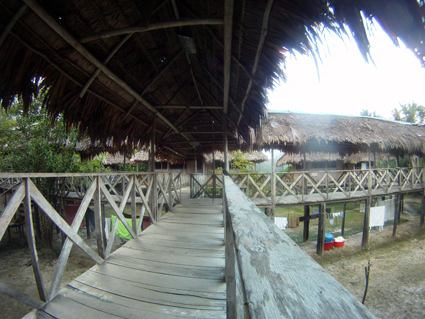
DCIM100GOPRO

After a training day on Monday we set up all camera traps, each now surveying a spot within differents cells of 2×2 km in our study area. Thanks to Brigitte and David providing their personal camera traps, nine cameras in total are out in the field to do their job. Furthest away from base are three cameras set up in the terra firme forest. This is “solid earth” forest that never gets flooded. Frankie and David joined Alfredo for a full day hike about six kilometres away from base. That gives you an idea how slow progress in the jungle can be.

camera

Our study area includes different vegetation zones from flooded to seasonally flooded to never flooded areas, palm swamps and islands, so-called ‘restingas’ that stay dry even during the high water season. Different types of animal frequent the various habitats and we are trying, trying, trying to camera trap some of them. Brigitte, Tom and David set up four cameras within the trail grid behind the ARC while Neil went to a trail we’ve recorded last year further up the river. Anh and I set up two cameras on a new trail leading to a lake nearby.
DCIM100GOPRO

On that first day all teams found jaguar tracks and even a puma track not far behind base! The weather conditions have been pleasant since we’ve started our work. I has not rained for almost three days and the waters in the river have already dropped by a couple of metres.
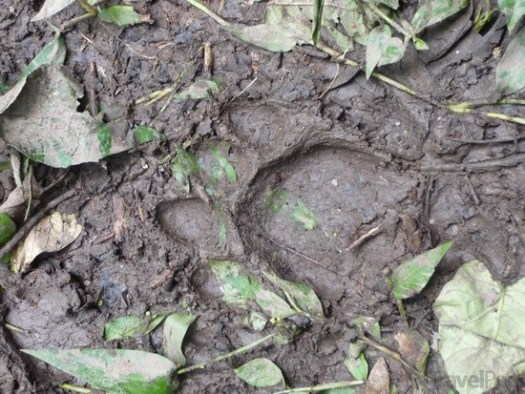
jaguar-track-thankfully-1-day-old-coca

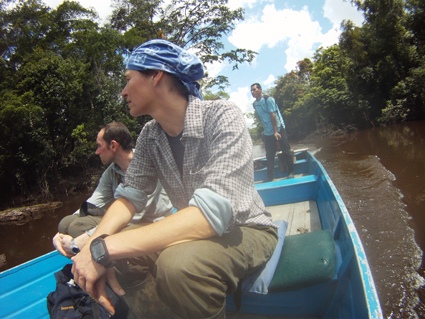
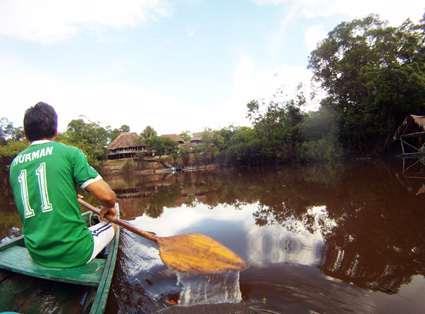
Survey ‘transect’ walks and canoe surveys up and down the Tahuayo river were our daily routine from Tuesday onwards. Apart from our scientst Alfredo we have Alain, Segundo and Oskar with us. While Alain has been working as an English-speaking jungle guide for nine years at the Tahuayo Lodge, Segundo and Oskar live in El Chino, one of five villages within the Tamshiacu Tahuayo Community Regional Conservation Area (TTCRCA). With their help we were able to spot and identify many, many species and tracks while walking the dense rainforest trails. Their amazing skills include hearing, seeing and smelling animals – there is a lot we can learn from each other.

Sightings of study species so far are saddleback and moustached tamarins, saki monkey, titi monkey, squirrel monkey, brown capuchin monkey. Tracks of jaguar, puma, margay, tayra, porcupine, paca, red brocket deer and white-lipped peccaries have been recorded only to mention a few.
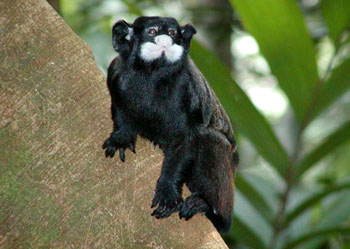
white-mustached-tamarin

As regards our trailblazing project, we’ve recorded quite a few new trails. Thanks to Segundo who knows the area inside out, we were able to include another cell in our surveys. Starting from the other side of the Tahuayo river just opposite from the trail leading to the lake we’ve explored the forest by having Segundo cutting a way through the forest followed by us carrying all the research equipment for recording the trail and, of course, animal encounters. Although we offered him a GPS to navigate back to the boat, he preferred to rely on his very own sense of direction, which works just as well.

Rotating through the afternoon activities two teams are surveying the river edges from canoes (one going up and one going down the river) while two more teams have been setting up track traps for the last couple of days. By now we have a total of eight track traps set up within the trail grid behind base to be monitored on a daily basis from today onwards.
DCIM100GOPRO

Continue reading “From our conservation holiday volunteering with jaguars, pumas, ocelots, primates and other species in the Amazon rainforest in Peru, South America (http://www.biosphere-expeditions.org/peru)”
From our snow leopard volunteering expedition in the Tien Shan mountains of Kyrgyzstan (http://www.biosphere-expeditions.org/tienshan)

Following teams 1 and 2, team 3 also spent their (Sun)day off with a herder. The afternoon was entertaining for everybody, including the family of the herder 😉

At the beginning of this week we resurveyed valleys that we could not reach the end of previously, because of snow. A very promising valley (we named it ‘You Youkon’) attracted our attention from the very first visit. This week Ulf, Ilka, Sheilo and Paul finally made it up to a pass that might give us the chance of advancing further north into what we hope will be undisturbed higher ground. Their findings confirmed our plan to go back there again for an overnighter: many ibex and argali tracks as well as wolf scat.

The Ysik Ata valley can now also be walked up to the very end, up to the ridge where the glacier begins. There we installed two camera traps in promising places (and have now added camera trap pictures to the previous entry on https://biosphereexpeditions.wordpress.com/).

Throughout this slot we have found petroglyphs in many places. We are actually not counting them anymore. Thomas has meanwhile compiled a comprehensive collection of photos of them. Thanks’ for that.

This slideshow requires JavaScript.

We have also extended our surveys to the east, checking out a new valley. Again there seems to be a pass leading north into the unknown and hopefully undisturbed parts of the range. Besides the perpetually exciting sightings of several ibex, the local herder told us that last year he saw a snow leopard feeding on a sheep in that area. Well, you can’t take everything for granted, but we will definitely be back. And it feels like we’re getting closer to our quarry…

Continue reading “From our snow leopard volunteering expedition in the Tien Shan mountains of Kyrgyzstan (http://www.biosphere-expeditions.org/tienshan)”

From our conservation holiday volunteering with jaguars, pumas, ocelots, primates and other species in the Amazon rainforest in Peru, South America (http://www.biosphere-expeditions.org/peru)

We’re all set. Writing this, I am sitting in the Tahuayo Lodge’s lab room waiting for the team members to arrive. Alfredo has taken a canoe to go to the village of El Chino just around the corner from here. We’re after another local worker to guide and help us finding forest trails but it’s quite a task to find a person that knows the area around the ARC AND is willing to work at this time. Soccer championships are running in Esperanza village further up the Blanco river and that’s where a lot of the local people now prefer to spend their time. Anyway, we’ll have three helpers, getting a fourth guide would increase the efficiency of our work.

Brigitte & Tom from Belgium are already here and are as keen as Alfredo and I to get started. Today and tomorrow are going to be training days on the equipment, the research, study species, data sheets, etc., which will also include a training forest walk to practice the skills learned. I’ll be in touch again when everyone has gained their first research experience.

This slideshow requires JavaScript.

Continue reading “From our conservation holiday volunteering with jaguars, pumas, ocelots, primates and other species in the Amazon rainforest in Peru, South America (http://www.biosphere-expeditions.org/peru)”

From our snow leopard volunteering expedition in the Tien Shan mountains of Kyrgyzstan (http://www.biosphere-expeditions.org/tienshan)

For the past few days it’s been getting colder every night up to the point where we have to defrost our hand wash basins in the morning.

Despite the icy temperatures and days with all four seasons of the year rolled into one, research activities continue as normal. One of the first tasks for this group was to check whether the Karakol Pass was still blocked by snow. Good news: we were able to find a way around and finally made it to the eastern side. And, Pei Hao, a participant from Singapore, for the first time in his life touched real snow ! The big valley east of the pass is crowded by herders but several deep, long northern side valleys seem to be promising as survey areas.

Another day saw Martin, Liss, James , Pei Hao and Aman survey the first of these valleys. It was a long and strenuous day full of beautiful landscapes, waterfalls and sightings of badgers, marmots and several ibex. We will definitely be back for an overnighter.

This slideshow requires JavaScript.

Volodya, Martin, Guenter and Gordon combed the southern valleys. To do this, an early morning icy river crossing is compulsory, but was taken sportingly and in good spirits. Before they reached the terminal moraine of one of the glaciers, they found a long, perfectly clear wolf track, some wolf scat and hundreds of amazing old petroglyphs (showing deer, camels, donkeys, birds and hunting scenes). A remarkable find! But they also found evidence of hunting.

Ulf, Ilka and Agnes in the meantime pushed the survey altitude up to far above 3700 meters.

Our overnighter team of this week was Liss, Martin, Ulan, James and Aman who visited our old “home valley” of Base Camp 1. On their way they stopped at the herder of that valley, where they were served a second breakfast. As the water level of the rivers has dropped noticeably, they managed for the first time to get a car across a ford and penetrate deep into the valley beyond. First, and supported by fantastic weather conditions, they checked the camera traps we installed two weeks ago. Fresh ibex scat all over had everybody looking forward to having a look at the camera trap pictures. And indeed several good shots were taken of ibex, badger, fox and argali. But none of the mountain ghost. On one picture it appears as if the mountain sheep is chasing away the fox!

This slideshow requires JavaScript.

On the second day of their overnighter, they installed four more cameras high up on the other side of the valley. Perhaps the ghost will grace those. We live in hope. The stunning landscape, the team spirit, the weather, visiting the herder made it all together an unforgettable experience and they returned to base in high spirits. Well done everyone!

Continue reading “From our snow leopard volunteering expedition in the Tien Shan mountains of Kyrgyzstan (http://www.biosphere-expeditions.org/tienshan)”

From our conservation holiday volunteering with jaguars, pumas, ocelots, primates and other species in the Amazon rainforest in Peru, South America (http://www.biosphere-expeditions.org/peru)

Iquitos. It’s busy, noisy and hot. I’ve been running around doing what’s always top on the expedition leader’s in-country to do list: shopping 😉

AM diary IQT

Apart from office stuff, batteries and insect repellent, three machetes have been added to our expedition equipment. Due to a jetlag of -7 hours I’ve spent some time in the early hours of this morning with setting up a few brand new GPSs I brought over. They are now ready for being taken out in the jungle: waypoints, tracks and the research grid have been uploaded. I was rewarded with seeing a wonderful sunrise from my hotel room (see picture: Mainai river that connects to the Amazon).

AM diary sunrise IQT

A note on insect repellent: Strong repellent (30% DEET or more) is not sold in Iquitos, but is a good thing to have when working in the forest. I’ve used 40% DEET before and it works well.

Alfredo, our scientist, and I just met at the A&E Office and we’re about to leave the city. The boat will take us to the main lodge today, tomorrow morning we’ll proceed to the Amazonian Research Centre, our base in the jungle. You will hear from me once we’ve arrived there. From now there won’t be any mobile phone coverage. If you need to contact me (for emergency reasons only, i.e. being late for assembly), please send an e-mail AND contact the A&E office in Iquitos.

Safe travels

Malika

Continue reading “From our conservation holiday volunteering with jaguars, pumas, ocelots, primates and other species in the Amazon rainforest in Peru, South America (http://www.biosphere-expeditions.org/peru)”
From our snow leopard volunteering expedition in the Tien Shan mountains of Kyrgyzstan (http://www.biosphere-expeditions.org/tienshan)

The start of our 3rd slot has been very exciting for all team members due to fantastic weather on Monday that accompanied us all the way to base camp.  Additionally, the various team members whose interest includes birds are being well served by a great abundance and variety. Marlies in particular was especially thrilled to encounter birds that she was academically familiar with, but had never seen before.

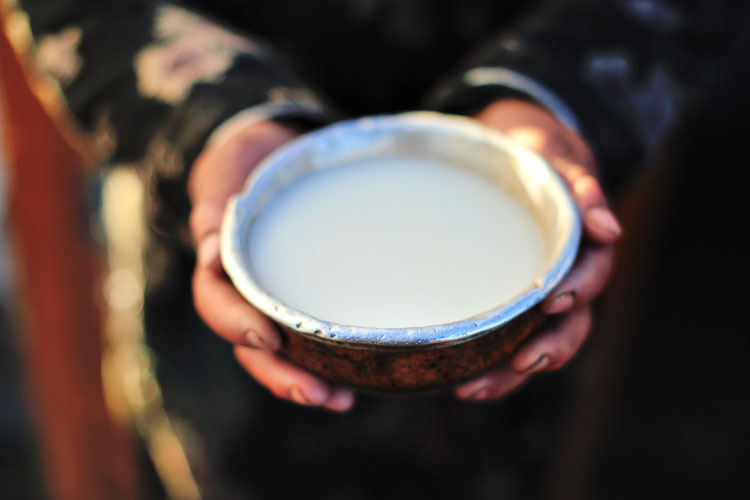
Prior to arrival at base camp we stopped at a herders yurt who treated us to a taste of fermented horse milk. Whilst generous, this treat was not to everybody’s taste 😉

horse milk

As it did for us during set up, the breathtaking panorama – glaciers beetling from rocky peaks over rolling green glades – grabbed everybody’s attention. Despite the beauty of this first evening, that first night’s temperature dropped to near freezing and reminded everybody of the challenges we will face in this mountain expedition.

alatoo

Meanwhile, everybody has passed training with flying colours and have just finished their first day in the field. Spirits are high, even Gordon’s freezing voluntary dip in our glacial stream couldn’t quell his enthusiasm.

Continue reading “From our snow leopard volunteering expedition in the Tien Shan mountains of Kyrgyzstan (http://www.biosphere-expeditions.org/tienshan)”

From our conservation holiday volunteering with jaguars, pumas, ocelots, primates and other species in the Amazon rainforest in Peru, South America (http://www.biosphere-expeditions.org/peru)

Welcome to the first entry of our 2014 Amazonia expedition. My name is Malika Fettak and I am your expedition leader this year. Alfredo Dosantos, our Peruvian field scientist, and I have been busy getting this expedition ready for you. I will make my way to Iquitos on Monday to set things up for you together with Alfredo.

We’ve done this expedition for a few years now, but please still expect the unexpected and be prepared for things to go wrong and all of us helping each other out whilst having a laugh. In return you get the bragging rights of having been on a real jungle expedition, not some cushy wildlife tour in an air-conditioned hotel. Talking about the jungle, yes, it’s full of life, but it’s all very hard to spot and identify. Those of you who have been to the jungle before will know this. Those of you who have not, please don’t come with expectations of animals jumping around all over the place for you to see and photograph. Life is there, everywhere, like a green blanket covering everything and playing havoc with your senses, but it is also a veil that can only be drawn back by those with patience and the right attitude. Science is not safari!

Onto the research. We’ve put some resources of maps, datasheets, field guides, a methodology manual, etc. on https://app.box.com/s/zv38to9cffca5ybqwzjz for you. A map of our study site including the cells we’ll be working in/through is in the folder too.

map

“Cells” I hear you ask? By way of explanation we’ve put a video of our methodology below for you as well.

It would be great if you could watch the video and use the resources provided to do some studying before you arrive. We’ll hit you with lots of information in the first couple of days and the more you’ve swotted up on things beforehand, the more you will remember, and the more useful you will be in the field. The datasheets and methodology may be confusing to start with, but if you read up now, we can explain things in the field more easily if you come with some background knowledge already.

Once you’ve seen all the materials, including the 2013 work plan that we will use as a guideline again this year, all your last hopes of a relaxing holiday in the jungle with monkeys and jaguars posing for bragging shots should evaporate like the downpoars that will hit the roof of our base, turning into steamy tufts of white, making the forest the humid, green paradise it is…. only to be replaced by the knowledge that soon you will be part of something important and useful in biodiversity conservation in the Amazon jungle. And what, I ask, has more value? You could have opted for a beach holiday. Instead you are going to spend your time and money helping Alfredo out in the field. Thank you – I take my hat off to you for that.

That’s it for now. I’ll be back in touch once I have arrived in Peru.

Best wishes

Malika

Continue reading “From our conservation holiday volunteering with jaguars, pumas, ocelots, primates and other species in the Amazon rainforest in Peru, South America (http://www.biosphere-expeditions.org/peru)”

From our snow leopard volunteering expedition in the Tien Shan mountains of Kyrgyzstan (http://www.biosphere-expeditions.org/tienshan)

Well, time flies and group 2 has ended. With everyone’s help, we packed the entire camp into our truck as we are going to move it further east. So group 3, be prepared for being trailblazers once more. Group 2, meanwhile, has returned to Bishkek and we now have a week off to reorg and regroup.

Unfortunately the weather changed earlier in the week and prevented a second ‘overnighter’. Nevertheless we are happy to announce another remarkable finding: on Thursday a large team decided to explore a hitherto unresearched area – the long and deep Ala Archa valley (west of our “home” valley). As it is not accessible by car, we had to spend hours walking to the higher parts of the valley at its end. At a confluence of two streams, the team split up into two. At the end of the day group one reported sightings of ibex, group two of argali! This is even more remarkable because we have been told consistently by herders that there are no argali left in this area.

argali1

The landscape was something else too and Ala Archa valley has been officially declared the most beautiful valley we’ve seen so far. So there are a multitude of reasons to come back: wildlife, landscape and finding places for camera traps.

Ala_archa

All in all we have covered about 35 cells now. Highlights so far are sightings of argali, Himalayan snow cock, several groups of ibex and clear tracks of a Pallas’s cat.

Thank you everyone on group 2 for your efforts. Yes, we are still at the very beginning of a new project. There is much more to learn about the area, but you have helped enormously to add more pieces to the puzzle.

Finally, a piece of advice for everyone yet to come: if your luggage does not arrive with you, please try, with the help of your hotel, to obtain it before (!) we meet at the assembly point.

Looking forward to meeting group 3 in a week.

Continue reading “From our snow leopard volunteering expedition in the Tien Shan mountains of Kyrgyzstan (http://www.biosphere-expeditions.org/tienshan)”