Award-winning, non-profit and ethical wildlife conservation volunteering. Advancing citizen science and conservation since 1999 – for nature, not profit.
Peter Pilbeam from the UK is a long-time supporter of Biosphere Expeditions. He took part in every single expedition to the Altai mountains that Biosphere Expeditions ran from 2003 to 2012. ‘And then it just snowballed’, he remembers. Here’s his story.
‘Initially I was intrigued by the slogan ‘Where on earth is the Altai?’ and my interest in snow leopards’, Peter recalls ,‘and I liked my first expedition so much that I just kept coming back’.
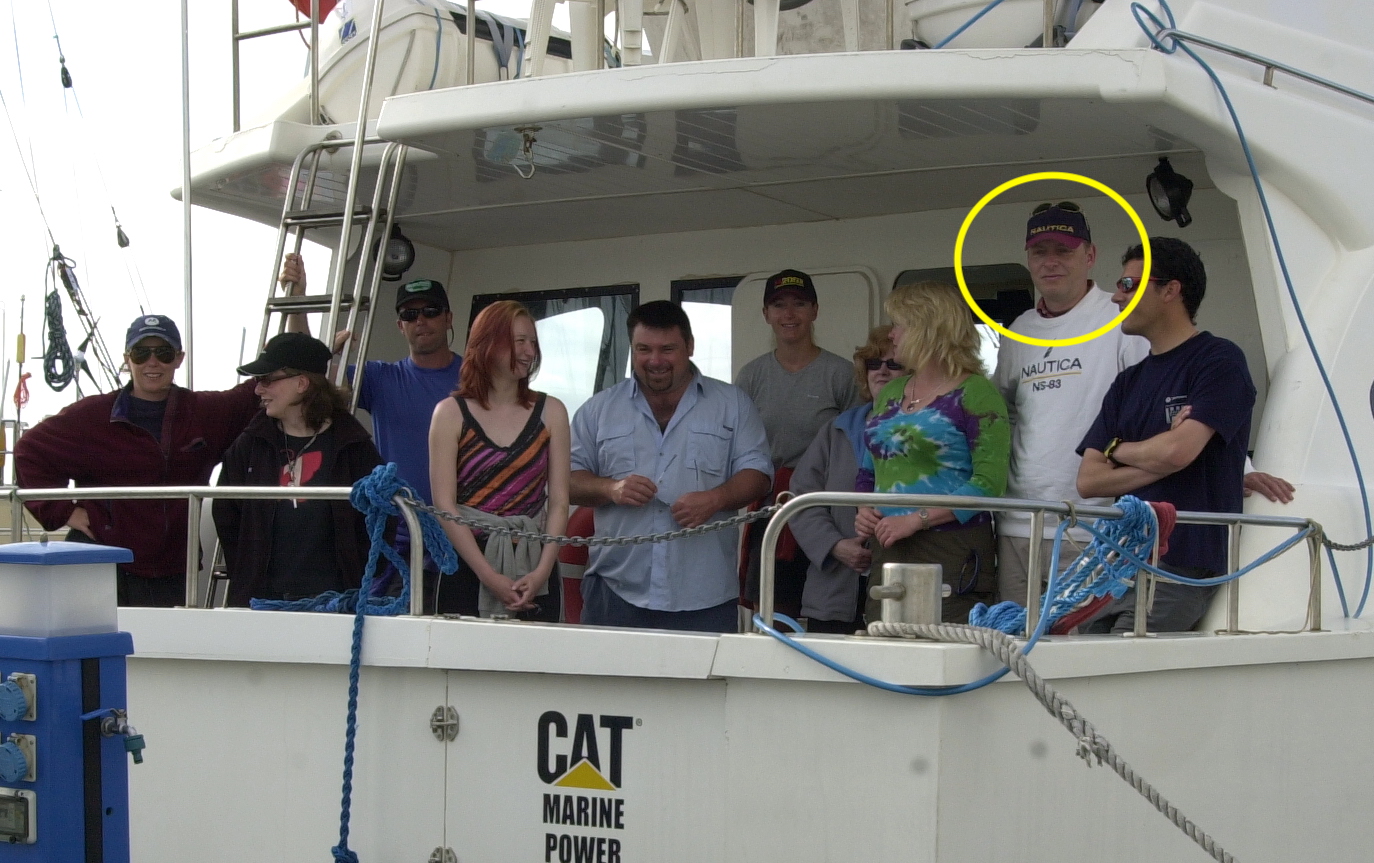
Peter (yellow circle) and his Altai expedition team in 2011.
‘In the years after the Altai expeditions, I went to Kyrgyzstan to continue with snow leopard expeditions, then to Slovakia and Germany to study wolves, Sumatra to work on tigers, and Scotland and the Azores for cetaceans.’ All in all Peter has been on 17 expeditions since Biosphere Expeditions started in 1999, which makes him one of the most experienced expeditioners of the NGO.
‘All these expeditions have taught me how to travel independently, how to camp in the wild, and a good dose of self-reliance’, reflects Peter, ‘and once on the expeditions, I really appreciated all the great and varied experiences, some very hot and humid like Sumatra, some cold and snowy like the Altai and Kyrgyzstan, some wet and with rough seas, such as Scotland and the Azores.’
Altai 2011
Scotland 2013
Slovakia 2017
‘And I always take lots of memories home with me’, says Peter, ‘some of the most abiding ones are trekking over mountains through snow and across scree slopes in the Altai, tracking wolves in snow and mud in Slovakia, and watching and recording whales – those beautiful creatures of the sea – around the Azores archipelago’.
Back home in the UK, Peter has now given lots of talks on snow leopard. He is also active as a mammal surveyor and teaches small mammal ID courses regularly. He has also become a reserve warden in his home-county of Cambridgeshire.
‘I expected to learn something on the expeditions, but I never expected it to have such a profound impact on me!’ says Peter. ‘ To anyone out there thinking about going on an expedition, I would say do it! Choose with care, but just do it!’, he adds with a laugh.
Pascal Tchengang, from Paris, France, loves travelling and being in touch with nature. In fact, this is how he discovered Biosphere Expeditions way back in 2002 and then went on an expedition to study big cats in Namibia in 2003, returning there in 2005 as staff. Today Pascal helps out part-time in Biosphere Expeditions’ French office near Paris.
Pascal’s first engagement with Biosphere Expeditions was in 2002, when he was researching options for holidays with a purpose in nature. ‘My favourite thing -then and now – when I travel is being in touch with nature’, Pascal reminisces, ‘there are certain places you can discover and visit on your own or with your family, but there are others where you really need to be accompanied by specialists’. This is how he came across Biosphere Expeditions all those years ago and has ‘never looked back’, he says with a broad smile.
Pascal on expedition in 2005.
‘You see, I love animals and wildlife in general. Back then I had a burning desire to go to Africa and see wildlife up close. Of course, there are national parks that you can visit on your own or with your family by renting a vehicle, but what I wanted was to get as close as possible to the large mammals. So, while searching the web, I discovered Biosphere Expeditions. Browsing through their website, I was fascinated by the programmes offered on each expedition. So I signed up and took part in my first expedition to Namibia in 2003’, Pascal recalls. ‘It was incredible, a real revelation. It was the first time I had ever come into close contact with large mammals. In Namibia, I had the chance to get up close to cheetahs and leopards, because we were accompanied by a scientist who was studying them there. In fact, during that first expedition, I enjoyed both the opportunity to encounter the animals and being part of a group that was genuinely curious and eager to learn’.
On the expedition Pascal met some senior Biosphere Expeditions staff and asked whether he could help out with the office in France. He could – and started assisting with enquiries and attending events, becoming a spokesperson for Biosphere Expeditions.
Two years later, Pascal was back in Namibia as staff, this time with Peggy, ‘the person I share my life with today’, Pascal says with his eyes lighting up, ‘this trip was her first of its kind, a real revelation’.
Peggy & Pascal
‘So, yes, if you are looking for a trip where you won’t encounter trivialities, and especially if you want to make yourself useful, then I really recommend Biosphere Expeditions’ Pascal says, adding with a laugh ‘and I don’t just say this because I am biased, but because I genuinely believe it’. For advice, over 20 years after his first expedition, Pascal is the representative in France, so please feel free to reach out. ‘I will be happy to provide you with as much information as I can’.
Sven Strohschein from Hamburg, Germany, has made some great memories with Biosphere Expeditions, going with them twice to research whales and dolphins around the Azores archipelago, to study Amazon biodiversity in Peru, African wildlife in Namibia and the Arabian leopard in Oman. After these expeditions, he also joined the ‘Friends of Biosphere.’ ‘It was and is a great experience to be part of Biosphere Expeditions’, he sums up.
Sven on expedition in 2007
For Sven, who has been in the shipping industry since 1981, going on an expedition was something completely new for him: ‘I found Biosphere Expeditions through an article in a magazine. I was curious to get more experience and knowledge about wildlife conservation and looking after our natural environment.’ So Sven took the plunge into what was to become a formative experience.
Sven (circle) and his Azores expedition team
‘I can still remember sitting at the campfire under the stars during the Namibia expedition and hearing the lions roar. I also remember jumping into the Atlantic Ocean, trying to catch a glimpse of the whales after they went under the waves, and watching the sunrise at our research station on the Amazon.’ Perhaps his most abiding memories were ‘being woken up by elephants browsing trees just a metre away from where I was sleeping, witnessing a lion hunt in the middle of the night and talking to local people face-to-face’.
When asked about what he’s learnt, Sven thinks that a lot more needs to be done to help the natural world recover and also that everyone can help, not only scientists.
Sven (left) tracking a lion in Namibia
Looking back, Sven reminisces that “Each time I joined a Biosphere Expeditions team in the field, it was definitely a unique experience. I am happy and proud to also support Biosphere Expeditions through the Friends and by helping with media enquiries in Germany and talking to those who are thinking of coming on an expedition.’
Peter Thoem, a retiree from Canada, has participated in six expeditions so far. ‘I have time in my life, the health and the resources – so why not’ is his go-getter attitude in all this. This is why he started with expeditions and what he experienced on them.
‘Back in the day, when I was thinking about joining my first expedition to the Tien Shan mountains to study snow leopards, it was the opportunity to get into a really wild area. I could see that few westerners would ever get to see or experience the Tien Shan mountains and that the expedition might yield exciting results’, recounts Peter, ‘it was simply too good an opportunity to miss.’
And since then? ‘Tien Shan was just so thrilling’, says Peter, ‘and then the year after – in 2019 – there was the chance to do something equally useful in places as fascinating as the Dubai Desert Conservation Reserve and Kenya’s Masai Mara. It deeply interested me’. So off he went to the Dubai Desert Conservation Reserve first and then a few months later to Africa for back-to-back expeditions in 2019 and 2020, just before the Covid pandemic brought everything to a standstill for a couple of years.
Peter with local rangers on the Kenya Masai Mara expedition
His most recent expedition was to the Azores archipelago, studying whales & dolphins from a catamaran.
When asked about lessons learnt on expedition, Peter’s answers are swift and precise, showing his enthusiasm. He believes that with good planning, an open mind, health and resources, you can do it, because ‘it’s a fascinating world out there’. And further that even if ‘our western comforts make us think that everywhere else is scary, it’s not. Yes, some places can be risky, even dangerous, but not everywhere else.’
When asked to summarise his experiences, Peter takes some time to think, smiling to himself and then says: ‘Sometimes it’s rigorous – we have work to do and protocols to follow, we have to understand what’s expected. We have to coalesce as a team and appreciate each other’s strengths and not-so-strengths. Then we have to find ways to work with the less committed – some are day-dreamers, others are bloggers who don’t always contribute much.’ But it always works out in the end: ‘We come from all corners of the world, some of us have even met before, because we’re committed to the Biosphere Expeditions ethic. And when I return, I always feel richer and profoundly privileged for having been to places and done things that I used to believe only existed in an Attenborough world.’
Peter’s most abiding memories include standing on the slope of a remote valley in Kyrgyzstan with a clear blue sky. ‘It’s just warm enough to unzip my jacket. I’m surrounded by yellow expanses of spring flowers, there’s rushing meltwater cascading off snow-draped mountains around me and I had to pinch myself. Is THIS really me? Am I really here?’
Or there is the time when Peter was on his middle-of-the-night-shift keeping watch over a waterhole in Kenya’s Masai Mara. There are elephants around and hippos lie in the waterhole, but it’s quiet except for the odd grunt, splash or snuffle. Then from across the valley comes a strange upside-down bark, like indrawn breath ‘EEeeeeYiP’. What’s that, Peter asks the ranger. ‘Hyaena’, the ranger replies and Peter’s spine tingles.
And most recently, in 2024, on the expedition boat off Faial, one of the islands of the Azores archipelago: ‘The sea is lively and we have to hold on white-knuckle tight’, remembers Peter, ‘we’re all doing our tasks as assigned when a blue whale is sighted. We slow down and carefully approach – again everyone does as instructed – gathering data: time, water temperature, sea-state; taking photos, watching, counting and more. And then we’re spell-bound. There in front of us, all but immersed, visible yet almost invisible is the world’s largest mammal. It blows a couple of times, then dives to depths that take it out of the realm of human comprehension.’
A blue whale: a spell-binding animal for Peter
With all those experiences, what impact have the expeditions had on Peter’s daily life, away from expeditions? Again, Peter does not hesitate: ‘I’m seen and known for having just come back from another exotic place. Where are you going next, people ask. I have a greater understanding and appreciation of the value of citizen science’. An appreciation that has contributed to a structured long-term project on bird populations close to Peter’s home (now in its 10th year).
And what about Peter’s connection to nature? Has this changed through the expedition experiences he’s made? ‘My connection with nature has always been strong’, Peter responds, ‘and I feel that I have a reasonable understanding of how the balance of nature all weaves together. The expeditions give me the chance to see some of those interactions and inter-relationships’. And Peter adds an example of this: ‘With Alan, our expedition scientist in Kenya, we watched a small group of impala ingesting mineral-rich soils. Alan was ecstatic, it was, he said, the first known-to-science example of geophagy (animals eating soil, usually for its mineral content) by impalas. My photos made it a publishable observation‘.
Impala geophagy at the Memusi mineral (salt) lick, photo courtesy of Peter Thoem.
The interview ends with the question of what Peter would tell others who are thinking about joining their first expedition. Peter laughs and just says: ‘If it appeals to you, then set aside your fears and just go do it’.
Find an overview of all upcoming expeditions here.
Also see Peter’s birding blog entries for Kenya and Arabia
Becoming a marine conservation scientist is hard. For women in traditional societies, it’s almost impossible. Yet once she began diving, Jenan Al Asfoor was determined to break free from the confines of gender and her corporate job alike. It wasn’t easy, but now Jenan runs her own marine conservation consultancy, training the next generation to protect the coral reefs of her native Oman. Looking back now, Jenan credits Biosphere Expeditions as the turning point that transformed her passion into a lifelong purpose.
From a young age, Jenan was not deterred from defying social norms for women. She excelled in school, went to university and then took a corporate job in marketing at the Environment Society of Oman, an NGO in her native country. Diving was her hobby. ‘I was just doing it [diving] for fun, until I got the chance of a placement on a Biosphere Expeditions diving project in my country.’
Jenan had had other placement opportunities, ‘but the Biosphere Expeditions one stuck out. I was so happy to be on expedition with them. It truly changed my whole life, what I’m passionate about, and what I’m capable of doing. After my placement in Oman, went to the Maldives to expand my marine knowledge. To find a network of people, from all around the world, from very different fields, but always sharing the passion for doing something for the environment – it makes you change how you see people.’ She became more enthralled with the underwater world and the running of expeditions.
Part of the expedition to the Maldives includes getting certified by Reef Check (a reef conservation NGO that partners with Biosphere Expeditions), meaning citizen scientist divers are then qualified to conduct underwater surveys anywhere in the world. Soon, Jenan found herself re-evaluating her career and her way of living. Working alongside Biosphere Expeditions’ founder and executive Dr. Matthias Hammer and team scientist Dr. Jean-Luc Solandt changed how she saw diving too.. ‘These two opened my eyes that there was more to diving than to have fun. They then helped me to get Reef Check Oman off the ground, I started a science diploma and then went on to start a consultancy in marine conservation.’
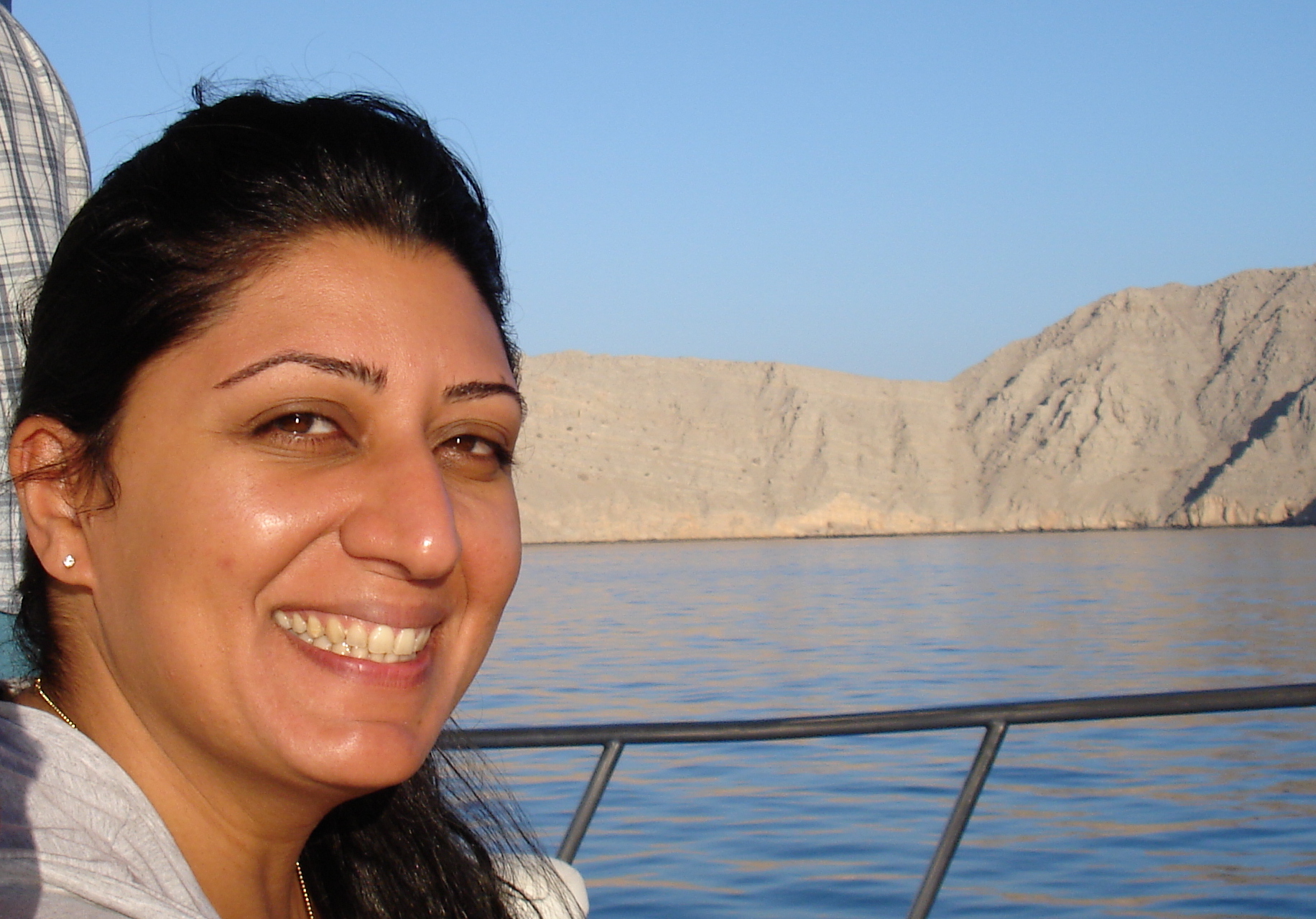
Jenan Al Asfoor on the Musandam Peninsula diving expedition, Oman
In 2017 Biosphere Expeditions’ involvement around the Musandam Peninsula of Oman concluded with the declaration of two protected areas in the region. Jenan was the perfect steward to protect these achievements. She quit her corporate job and devoted herself full-time to diving and reef conservation, launching community-based reef conservation efforts, becoming Oman’s first Omani Reef Check Trainer, and to top it all off, starting Reef Check Oman, an offshoot of the NGO that originally qualified here as a survey diver, as well as her own consultancy. All this was not easy either. ‘My friends and family were surprised,’ she recalls. ‘Diving as a woman in Oman is unusual – it’s not seen as a field for females. People don’t see diving as something with a career related to it. People think it’s not a job, that there’s nothing there to learn, so quitting my job was really challenging, as it was not acceptable to my family. Finding encouragement was hard.’
Jenan about her achievements, hopes and aspirations in reef conservation
‘Without the encouragement of the people I met on the expeditions, I wouldn’t have made it,’ says Jenan. ‘When you don’t get support in your regular life, you need it elsewhere – that’s why Biosphere Expeditions had such a big impact.’
Proving almost everyone wrong, she is now an experienced diver and trains others – including delegates from the Omani government, who are learning how to protect the country’s precious corals. ‘I want to share all the beautiful, life-changing experiences I had being part of Biosphere Expeditions. I want to demonstrate the impact of knowledge sharing and community engagement.’ Working with Biosphere Expeditions meant Jenan learned ‘to face challenges on a daily basis. You don’t need to be a scientist to make a difference; even as citizens there’s so much we can do.’
When she stepped foot on Arabian soil back in 2006, Malika Fettak had no idea how influential and life-changing it would become. Starting as a citizen scientist with Biosphere Expeditions, she eventually landed a job with them, initially as part of their marketing team. However, she craved being back in the field and so jumped at the chance of becoming an expedition leader, taking on the responsibility for teams of citizen and professional scientists as well as a handful of staff and helpers; mastering to be empathetic towards people she may otherwise have trouble getting on with and helping people achieve their dreams. Malika Fettak tells her own story.
‘Back in the early 2000s I was looking for a different way to explore the world. As a single woman wanting to travel alone, it can be scary not knowing who to trust. I was searching for a worthwhile holiday to do something more adventurous. And Biosphere Expeditions sounded perfect: you’re in a group, you’re safe, and you get to do unique things out in nature that you can’t do on your own: not as tourists, but as a team on a mission, working together in conservation. You are also pushed beyond your comfort zone: you don’t know what people you’ll be with, what the work will be like and how hard it will be. On my first expedition, my English was not as good as it is now and I was worried that I would not be able to understand my team mates, the expedition leader or the scientists. Luckily, since team members come from all over the world, the English was very accessible and I had no problems. I instantly fell in love with the simplicity of expedition life. Before the expedition, I remember worrying about how I would cope with not having a hot shower for two weeks! But it didn’t take long for those thoughts to dissipate. You learn not to be afraid and to trust your own abilities and resilience.’
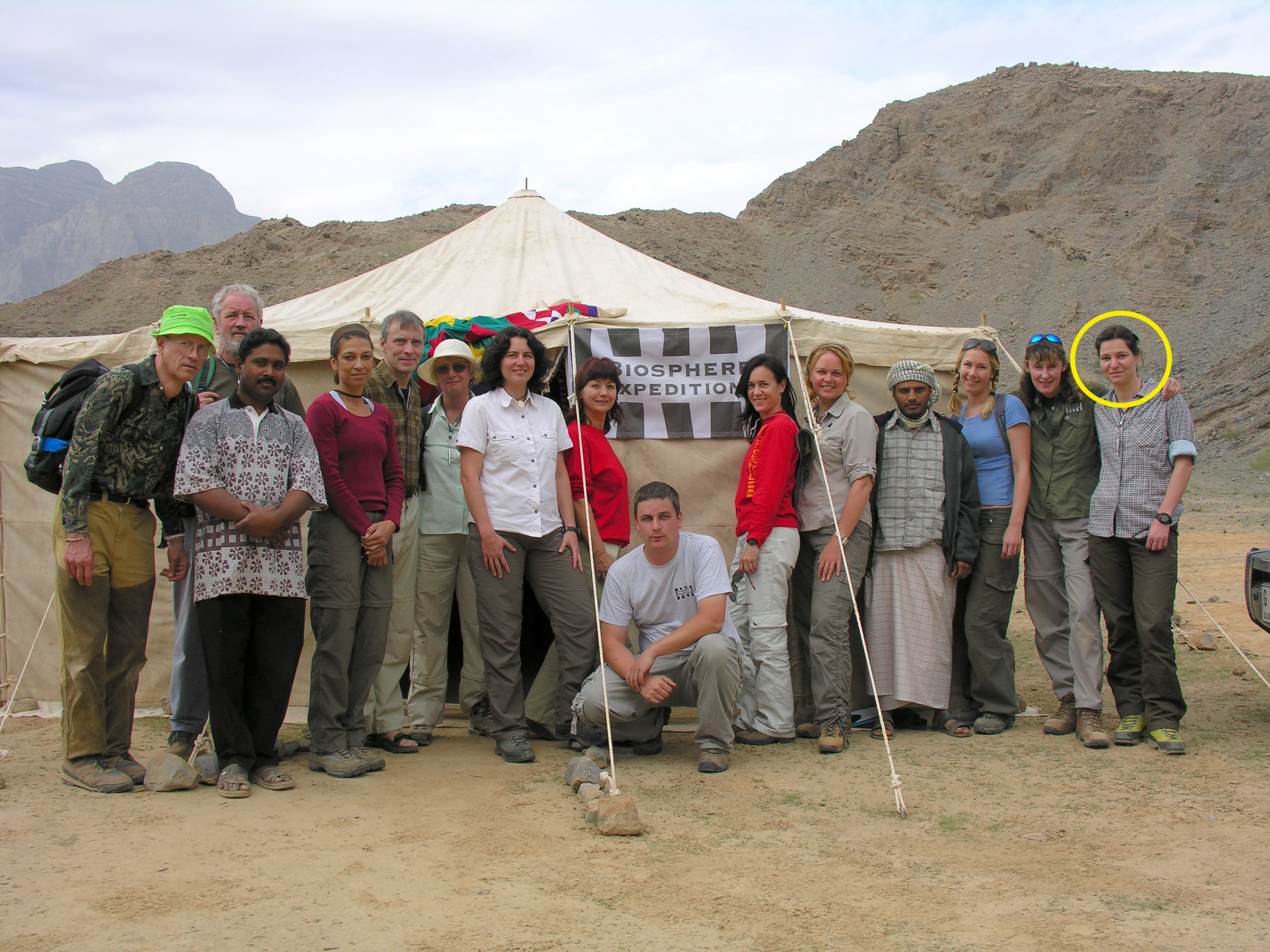
Malika Fettak (yellow circle) with her expedition team in Oman
‘It opened my eyes to the possibilities of another way of living. Out in nature, you actually need less to be happy and fulfilled. If you’re warm, dry, fed and have a place to sleep, that’s enough. And it calms your mind. You don’t have to worry about material luxuries, because in nature, on a fundamental level, it’s not important. A lot of people are overwhelmed in their lives. For example, there may be constant streams of information through phones that don’t actually have anything to do with your day-to-day life. Out in nature, especially away from phone coverage, things become simple. Things become easy. It’s not complicated out in the wild.’
‘After my first experience in Oman, I continued following Biosphere Expeditions across the globe all the way to the Altai Mountains in Russia. By this point, I’d been thinking about a career change, but I lacked a sense of direction. Matthias, Biosphere Expeditions founder and an expedition leader himself, and I had become well acquainted on expedition over the years; making me seriously consider a step into the unknown . He just said: ‘Why don’t you work for us?’ This was in 2006, seven years after Biosphere Expeditions was founded. I kind of created my own job by writing an essay about what I could contribute to the organisation. Having a degree in marketing and communications, I could see a lot of opportunities, so I began working full-time in the background.’
Leading in the Altai Mountains
‘Soon, however, I craved the expedition life again. Being out in nature, in the middle of nowhere, with nothing else but the expanse of the environment. So I signed myself for expedition leader training. It was a huge challenge at first, especially in a foreign language, but it was also extremely fun. I learned a lot. Once I started leading expeditions, that was it – I knew I’d found my place. Working in the wild, weathering the elements whilst leading people: everything that’s missing in contemporary city life, Biosphere Expeditions brings to you.’
Malika Fettak in between countries as an expedition leader
Starting as a citizen scientist, I loved the shift in perspective I got as an expedition leader. Not only was I suddenly responsible for all those people on the expedition; I also found myself in unimaginable situations. I learned how to solve problems, figuring it out as I went along. I felt a sense of accomplishment taking people out there, encouraging people to leave their comfort zones and helping to change people’s self-limiting beliefs – not in theory, but in reality. It really was a life-changing journey.’
Expedition leader Malika Fettak
In more recent years, I took a step further in my career again and qualified as a systematic coach and trainer in order to encourage and support personal development of people and empower teams outside expedition life – but I still lead expeditions. This has allowed me to look at the work Biosphere Expeditions does from a different perspective yet again. It has become all too clear for me that people are a lot more comfortable speaking about the things they want to achieve in their lives, rather than actually taking action. Biosphere Expeditions requires action. A lot of people talk about nature conservation, but never do anything about it. They think there’s no way I could do that! Then you find out: I actually can!’
‘The great thing about Biosphere Expeditions is that a formative personal experience of simply existing ias part of nature is almost built in. You’re there not to save the world all by yourself – for this is impossible – but learn and make experiences for your own sake and for the world around you. Biosphere Expeditions has made me appreciate the importance of every living thing on the planet. Even the smallest animals have successfully found a niche to live in; they all have an impact on each other, starting with a bug or ant, their presence is vital for, say, the top predator to have a healthy ecosystem to live in; that’s what I’ve understood and learned and experienced. The jaguar depends on the ant.’
Eve Hills is a PhD student at the University of Brighton currently working on leopard prey and habitat preferences in the Meru Conservation Area, Kenya. Big cats have always fascinated Eve – ever since coming on expedition with Biosphere Expeditions. So, what was so significant about this first experience?
‘I went to Africa for the first time in as a young child and instantly fell in love with the continent and wanted to come back,’ Eve Hills recounts. ‘I had a passion for big cats from a young age and did everything in my power to include them in any school projects.’ Five years later, she came across Biosphere Expeditions, ‘via one of the first expeditions to Poland to research wolves. In those days, Matthias (Dr. Matthias Hammer, Biosphere Expeditions’ founder and executive director) ran most of the show, so I was able to talk to him about my dreams of wanting to do something with big cats. In the end, I was sick and could not make the wolf project. Then, in 2002, a cheetah project came up in Namibia and I was really excited. I saved all my money and wanted to do the whole thing, which lasted two months.’
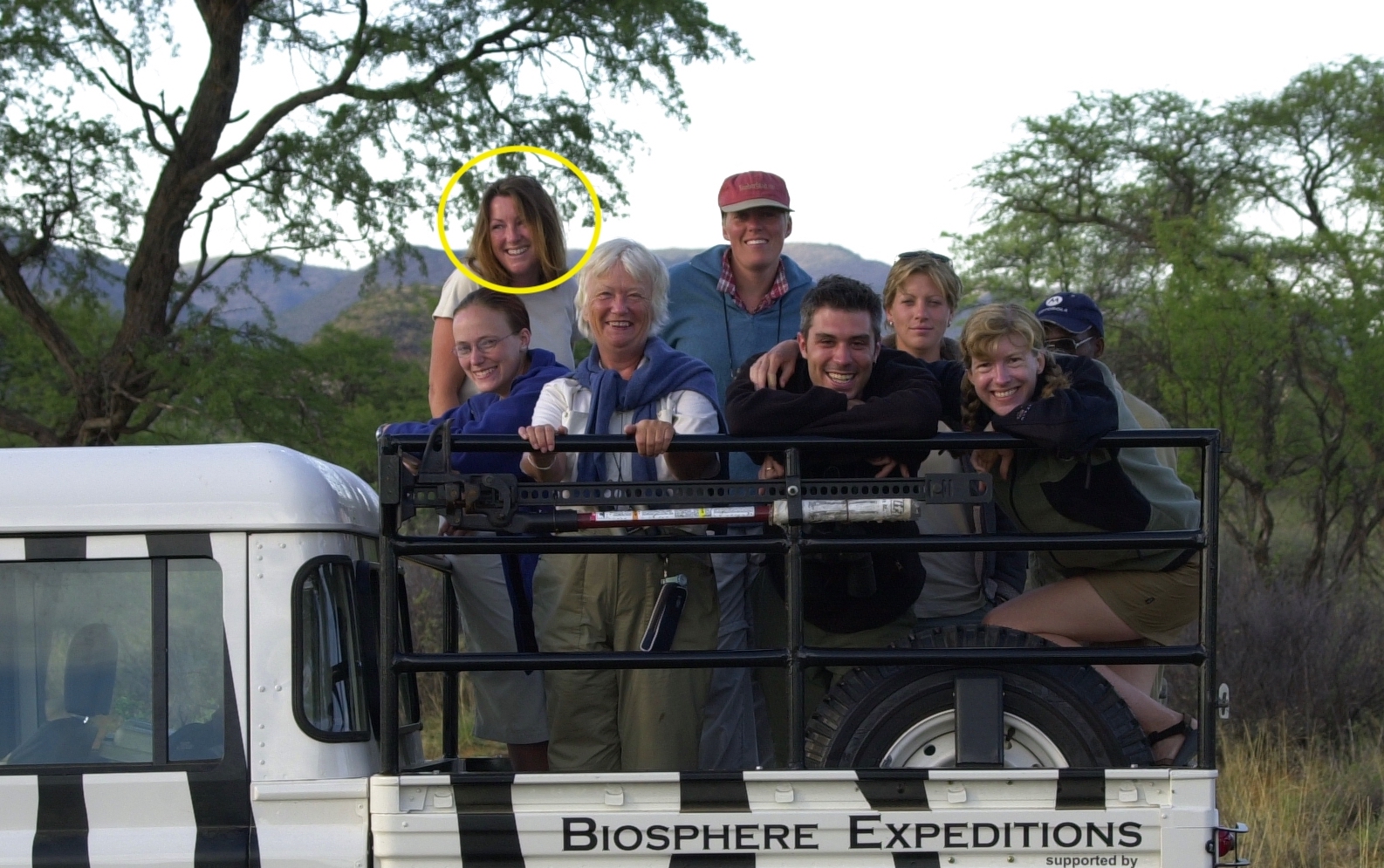
Eve Hills (yellow circle) with her expedition team in Namibia in 2002
Eve immediately fell in love with the entire experience. Staying for two months gave her a unique perspective. ‘I think this allowed me to immerse myself completely. It was an incredible place and the landscapes were so different. I just loved sharing my environment with big cats, knowing they were there. I don’t really need to see them. One of the most special things for me was when we tracked leopard prints and it was just incredible following in the animal’s footsteps. I remember collecting all the sand from one of its paw prints. It was really amazing. I loved feeling part of something. ’
After Eve came home, as with so many people, life got busy and she was ‘side-tracked by a job that had nothing to do with conservation.’ She also had to contend with a partner who thought she ‘should get a real job.’ However, she never forgot about those beautiful moments on expedition and did whatever she could at university to include big cats in her projects. She continued pursuing this passion into her master’s degree when she, ‘ linked up with some cheetah conservation organisations based in Kenya and intended to do a cat project.’
So now Eve is a PhD student studying leopards. As for the future of her relationship with Biosphere Expeditions, she says, ‘I’m hoping to get involved with another project and I’m keeping my eye out for any leopard-related projects.
Eve Hills (and others) talking about her expedition experience in Namibia
Whale watching can be undertaken in a matter of hours, but monitoring cetaceans to better understand their spatial and temporal use of different areas of our oceans – takes years. Biosphere Expeditions has just completed their latest expedition in the Azores, and is rapidly approaching two decades of monitoring, in an area of the Atlantic Ocean supporting over 25 different cetacean species.
Cetacean research questions cannot often be addressed (with any certainty) in a month or a single year. Data collection may take a decade or longer, to reveal meaningful patterns and this is the case with the cetaceans of the Azores. The true value may not always be in the ‘here and now’, but be realized as future questions or challenges arise. Such a data bank will only accrue value over time.
Some feedback is more immediate. Images of sperm whales and blue whales taken this year, have already be matched to other locations in the Azores, and northern Europe, across more than two decades. Some blue whales have not only been matched but never been recoded so early in previous years. yut many more whales have still yet to be matched, revealing range of their movements and importance of different parts of the oceans. Some individuals have only been recorded for the first time, again contributing to our understanding of population dynamics.
This year’s project still has a lot of data to process, from over 125 cetacean encounters over 15 days at sea, sighting over 1500 individuals. But some species are absent from this year’s research findings (e.g Sei whales) and dolphins have been found in lower numbers. On the upside, a few rarer records were noted such as orca, minke and Sowerby’s beaked whale.
With the expedition fieldwork continuing to commence in March, “it has also been great to extend the data collection beyond the normal tourism season”, says expedition scientist Lisa Steiner, “and collect data on a range of species, across a broader time span. The value of this work is huge as we wouldn’t have documented the range of species, including several sei, humpback, fin and blue whales, since there are fewer tour boats out at this time of year”.
Understanding spatial and temporal patterns of so many cetaceans is key to their long-term protection and conservation. And undertaking field research when others are not often at sea reveals new information such as species being absent or present in lower or higher numbers compared to other years.
“The ability to collect such data is greatly enhanced by the annual contribution of the Biosphere Expeditions citizen scientists”, says expedition leader Craig Turner, “and underlines the value of long-term data sets in illustrating the importance of the Azores for many cetacean species”.
This data-collection approach is being applied to other species of whale, along with dolphin species, such as bottlenose and Risso’s. The scale of the data collection both in terms of time and space serves to demonstrate the importance of the Azores for several cetacean species. And highlights the importance of appropriate conservation management, to ensure these species continue to thrive not just in Azorean waters, but elsewhere in the wider Atlantic Ocean.
Citizen scientist feedback:
The expeditions was very well organised. Craig & Lisa work very well together and you could tell they enjoy what they do. They cope very well when plans change, flights are delayed, weather changes etc . Amazing Nicola B, Switzerland.
Our first day on the boat (also my birthday) I will never forget. I wished for a blue whale and I think we had six sightings that day (plus seven orcas!). Seeing the blow, seeing it just at the water surface and the beautiful turquoise colour before it dives. It was an experience way beyond what I expected. Accommodation was excellent. We were so lucky to have a view over the seas and Pico beyond. Great positive atmosphere of all the group members Anne Clarke, UK.
The group dynamic was excellent and the leader really helped to create this. The expectations were handled well and we knew flexibility (weather etc) needed. So no frustrations or disappointments. Meals etc were excellent, science presentations very informative. Peter S., Canada.
We found everything to be very well organised. A big compliment to our expedition leader Craig – what a wonderful guy – he kept everything going and the spirits up ; and to Lisa, our great scientist from whom we learned a lot. Loved the lectures from the Portuguese scientists who came to explain about their work on cetaceans. Loved to listen to Lisa who shared her unbelievable knowledge with us. Gitta V., Netherlands.
This was a wonderful experience for me. Lisa & Craig are top notch organisers and kept things flowing. Briefing every day after outings and evenings were perfect. Selections of vegetarian options was excellent for me Mita P., USA.
That’s all folks. It is time for final diary entry. The end of the expedition is suddenly upon us, and five weeks seems to have flown by, with the international team now gone. Before I wrap the expedition, let me first recap the last few days:
Our final day at sea presented yet more great sightings. Most notably was another fin whale and not one, but two more humpbacks – one far easier to photograph than the other, but still a favourite amongst many. Add to this, more sperm whales, common and bottlenose dolphins and it was another great data haul. Sea conditions and our continued search for more sightings put us close to Capelinhos – the most recent volcano to erupt in the Azores – at the west end of Faial. This presented an opportunity for another first in 2025 – a circumnavigation of Faial – as the seas were easier to navigate to the north. Our 2025 data collection ended with our final loggerhead turtle.
This ocean-based tour of the island gave the group a better feel of where to visit on their day off – with many heading back to Capelinhos. But on our last day we were thwarted at the final hurdle, in our effort to go to sea, by bad weather, but this presented another opportunity to sort more data. Not how we would wish to end, but you can’t argue with the Atlantic Ocean – just accept that plans may often change. So that concluded our data collection and sorting, on another really successful expedition in the Azores.
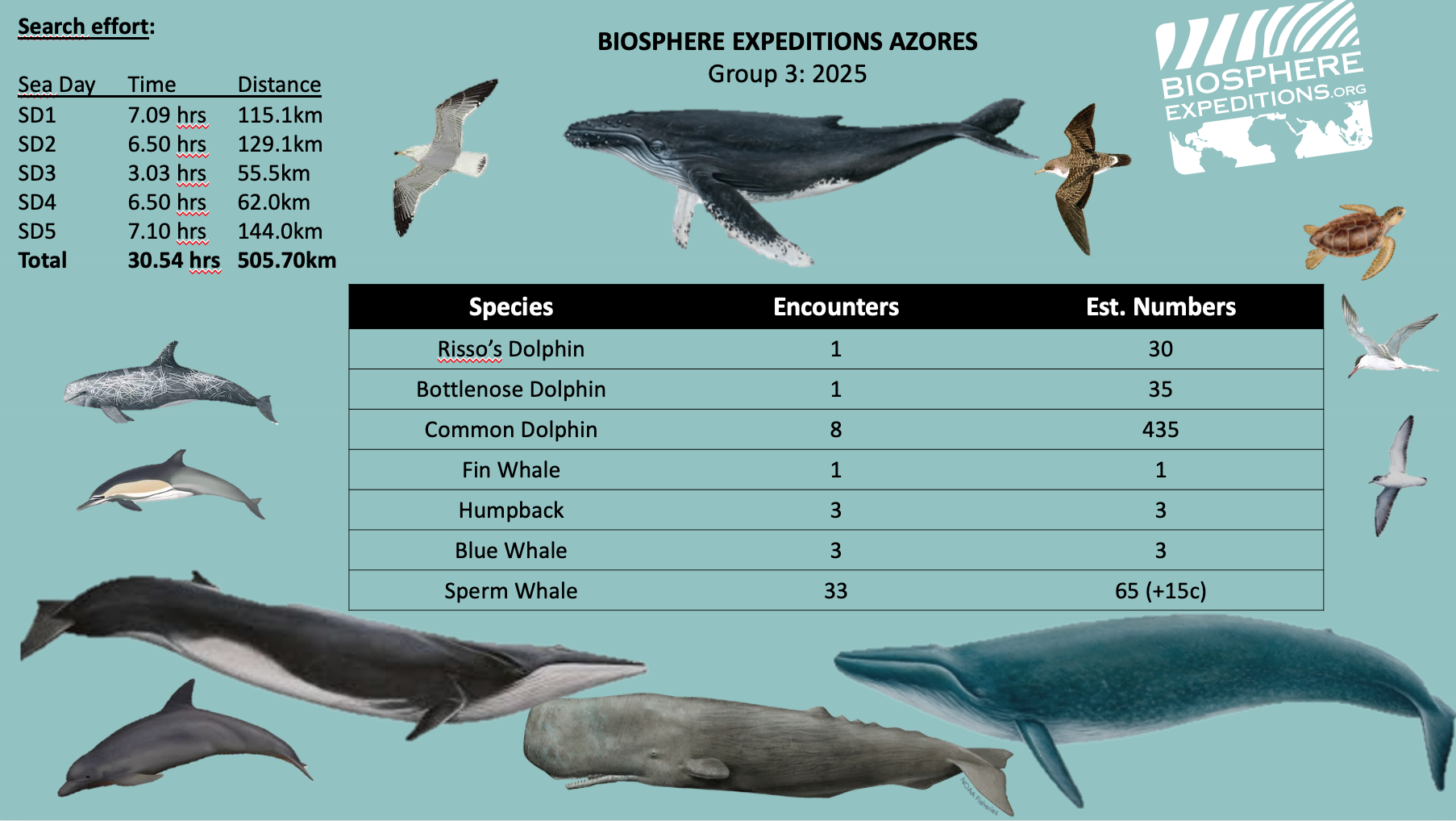
This year we’ve again documented an impressive array of records that without Biosphere Expeditions, would not have been collected. Here are just some of our highlights. We have
deployed three teams into the field, comprising 8 different nations, spanning multiple decades
completed in excess of 84 hours of surveys, covering over 1400 km of the ocean
collected data on at least eleven different cetacean species (six whale and five dolphin species), one turtle species and numerous birds
encountered more than 125 cetaceans,
confirmed some positive whale IDs, and several re-sights, but also have numerous new flukes – i.e. individuals never recorded before
Data in isolation can be a bit ‘dry’, and lack context, as field research rarely gives us instant results (though fluke matches are coming through) or fast answers to our bigger questions. But we’ve collected another great baseline of data and the full results will become clearer in the expedition report. The power of this simple field data builds over time, as has been illustrated by our excellent invited speakers (thank you, to all).
Whilst we comb the see and learn about the cetaceans and contribute to the ongoing data collection on this project (19 years and counting), it is not always all about the project. What also makes the project so special is the people. So let me initially offer some thanks. First off, to our three groups, who stepped up to the daily challenge of data collection to achieve our goals of better understanding the spatial and temporal distributions of the cetaceans and turtles of the Azores. You’ve not only all contributed to advancing this knowledge and making this expedition a success – you have also been great fun to work with and not given the expedition leader too much stress!
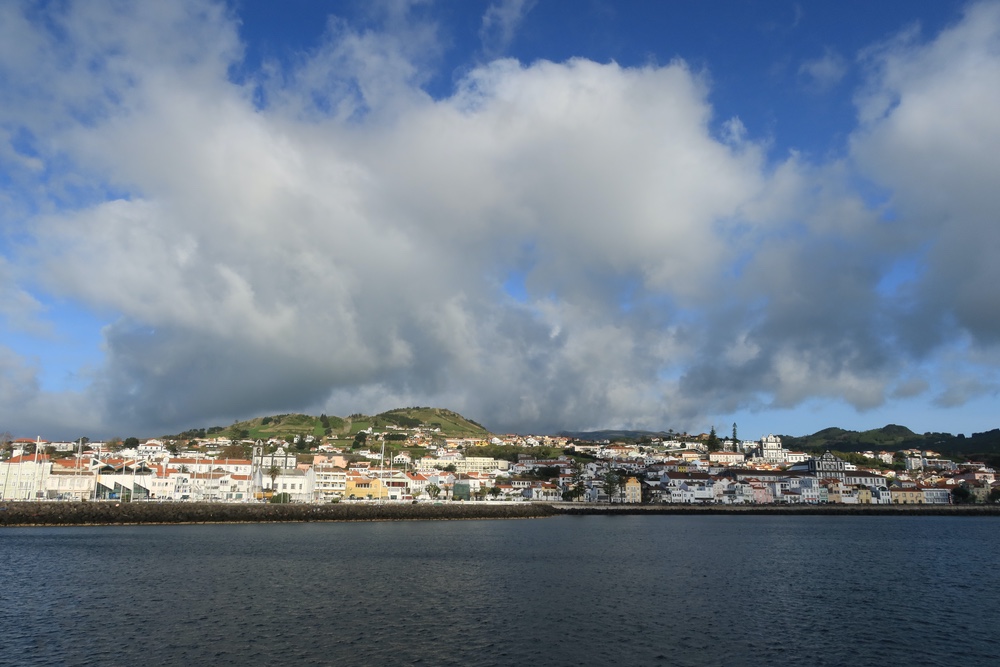
We also thank the wider Biosphere Expeditions team, as this project can’t happen without the unseen preparation, often months before we even set foot on a boat. I also extend thanks to all in Horta who have supported us, particularly Norberto Divers, the lookouts and our various caterers – whose food has more than sustained us! We also extend our thanks to our hosts (Silvia & Mario) and the project base, of course to Lenita (our housekeeper) who ensured we were more than comfortable. I (like many) can also not forget our skippers (‘Pico’ Pedro & Pedro 2), who not only took us to sea, but ensured the team knew the sea state, wind direction, cetacean locations and always got us back to port safely – thank you gentlemen. Finally, our collective thanks go to Lisa. A constant force for knowledge and our leader in all things scientific. It is always a privilege to share in your world of cetacean fieldwork.
We have also had the great privilege of briefly experiencing life in Azores. As I mentioned in my very first diary entry (if you remember!), who doesn’t want to live on a volcano, in the middle of an ocean, searching for a diverse array of charismatic cetaceans. The allure of this fascinating archipelago is strong, and I don’t doubt that some of us will return, in the not too distant future – there are many reasons to come back.
For me personally it has been great to have the opportunity to return to the Azores, work on the project, in this wonderful place and meet old and make new friends. It has been a blast, but all good things come to end and now I too must make my way home. Time to head to my place in Scotland, catch up with my own family and see what projects we take on next.
The early part of the week brought a change in the winds, and a change of direction for our surveys. We initially headed north to follow up a report of a humpback whale in the area. This was our first time north of Faial this year, and heading into a north-westerly wind and building waves made the search harder than we wanted, but the humpback was finally located – a favourite species for many.
Staying with it brought more challenges, and having briefly lost it, the team spotted what we initially thought were the characteristic white pectoral fins in the waves, but this turned out to be a random sighting of Risso’s dolphins – doing their best to distract us. They achieved this briefly before the humpback was re-found and ID photos secured.
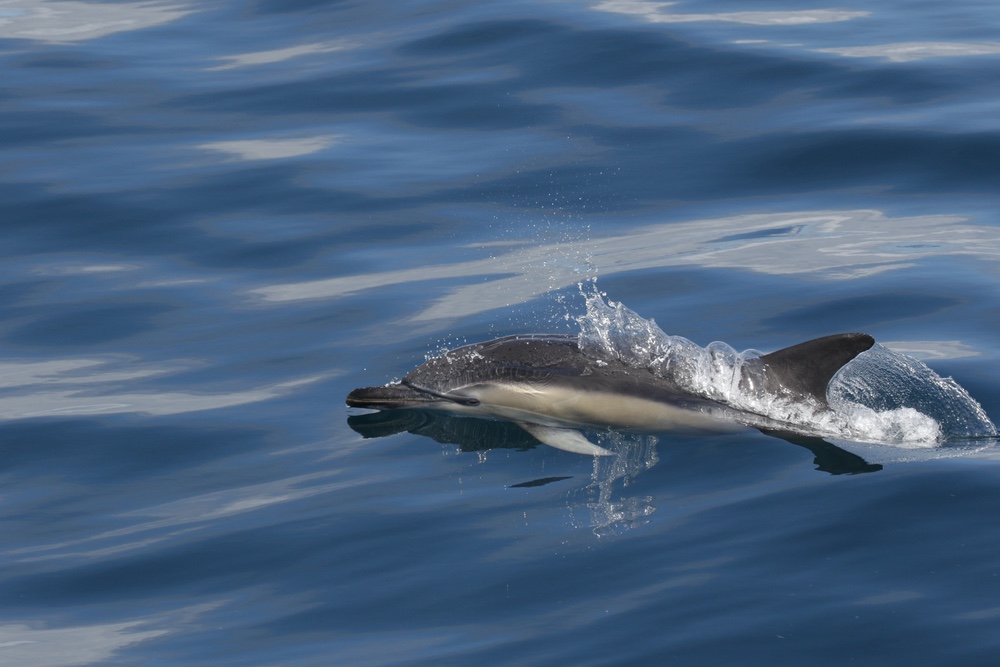
Subsequent surveys and sightings brought more dolphins in the form of common and bottlenose, the latter being less frequently sighted, but have now been located by all three expedition groups. So more dorsal fin ID images to process and catalogue.
We also spent a day south of Pico (very familiar territory) tracking sperm whales. It is still surprisingly easy to lose these magnificent beasts, as they can dive for 45 minutes. This gave us an excuse to deploy our hydrophone – a sophisticated underwater microphone – so we can listen in on the underwater world, and hopefully locate sperm whales and other species. It wasn’t as effective as we hoped, but our lookouts were able to locate more whales – with ‘eyes all around’.
Using the hydrophone kit was timely, as we welcomed Sarah Kather for dinner. She studied sperm whale vocalisations for her Master’s Thesis (at the University of the Azores) and gave a fascinating insight into the importance of sound-based communication (and noise pollution) for various cetacean species.
Amongst all this, Lisa also managed to match some of the sperm whale flukes documented from our earlier sightings, showing three individual females had been repeatedly recorded up to ten times over a sixteen year period. This further highlights the importance of the Azores to this species.
Fingers crossed for our final days on the 2025 expedition.










 Biosphere Expeditions: blogs from the frontline of wildlife conservation and the fight for a more sustainable planet