Arabia: Group 1 summary

Time has flown by and team 1 is done. It’s been a great week. We collected a lot of data and I am confident in saying that the team all really enjoyed their experience here in the Arabian desert.

Yesterday we collected in the small mammal traps and the memory cards from the camera traps that were set at the beginning of the week. Team 2 will deploy the small mammal traps in three new locations. The camera traps have been left in place and we will retrieve the second set of memory cards at the end of next week.

The camera traps recorded over 6,000 (!) images this week (not including the 11,700 images of tree branches blowing in the wind caught on a single camera trap, which we will re-position next week). Species recorde included Arabian red fox, oryx, both gazelle species, sand grouse, pallid harrier and brown-necked raven. There was also a great shot of a southern grey shrike catching an insect. Greg and Moayyed will undertake a detailed analysis of the camera trap results over the next few weeks.

The large mammal traps did not catch anything, so will try with a different type of bait next week.

The small mammal traps were more successful with captures of Egyptian spiny mouse on the rocky outcrop in the north of the reserve and Cheesman’s gerbil in the south of the reserve. The team also made observations of jerboa and jird during daylight, which is unusual. At the southern trap grid location, we also recorded cat tracks.

Fox den surveys went well with 49 dens checked for activity, including the discovery of 14 new fox den locations. There were also several sightings of Arabian red fox during the week.

The team managed to undertake circular observations in 35 of the reserve’s 64 2×2 kmquadrants. This leaves 27 quadrants for the team 2 to survey next week. Circular observations recorded 285 oryx, 112 Arabian gazelle and 114 sand gazelle.

The team’s random observation data yielded 470 records, including 1,829 oryx, 566 Arabian gazelle and 90 sand gazelle. Also 4 MacQueen’s bustard, 10 lappet-faced vulture, 4 desert eagle owl and 2 Bonelli’s eagle.

Last night we were treated to dinner at the Arabian Adventures camp, where some of the team had a go at sand boarding, camel riding and henna painting.

I would like to thank the team 1 for all their hard work this week and also for being such great company. I know that Greg and Moayyed are really appreciative of everyone’s hard work and the data will be of significant long-term benefit to the DDCR, enabling comparisons with other expedition years where data has been collected in the same way. A special thanks also to Mohamed, a UAE national, who was part of the team 1 and enriched the experience by sharing his knowledge and experience of living in Dubai, as well as his great enthusiasm for the wildlife and habitats of his country.

We wish all of this week’s team a safe journey and are looking forward to meeting next week’s team.

Safe travels everyone.

Kenya: Opener

Dear Kenya expeditioners

Welcome to the first diary entry of our inaugural Kenya expedition. Our expedition scientist Rebekah Karimi and her team of rangers are eager to meet you all and get going, as are we, your expedition leader Malika Fettak and our executive director Dr. Matthias Hammer.

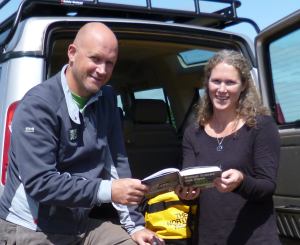
Dr. Matthias Hammer (left) and Malika Fettak (right).

It’s taken us around two years of preparation to get to this juncture and it’s always great to see a project come together. Most of the documents are written (we hope you have downloaded and printed your manual & field guide), procedures set, equipment bought, etc. And soon we will be heading out to Kenya to put the finishing touches to the expedition, a week or so ahead of group 1. We will be in touch again from the ground with final details (weather, last minute adjustments, pictures, emergency number, etc.).

For now suffice it to say that the weather has been very atypical, as almost everywhere else we work on the planet. Rebekah tells us that “there has been some unseasonable rain recently, which makes driving conditions challenging, but also fun. There are rain showers most afternoons or evenings. The sunsets have been amazing with rainbows, green grass, and wildlife galore”.

With this in mind, we hope you are as excited as we are, and proud to be trailblazers. By now we are sure you have realised that you are not about to embark on a cushy safari holiday, but on a serious citizen science project. Everything will be new for everyone. Bear with us through the teething problems and help us build an expedition to protect the biodiversity of the beautiful Maasai Mara, one of the crown jewels of our beleaguered natural world, for many years to come.

Arabia: Training & working hard

We (Moayyed, Paul and Greg) met the team on Saturday at the Premier Inn in Dubai and we arrived at the DDCR at 10:00. We got started straight away with Greg’s introductory presentation about the history, fauna, flora and conservation objectives of the DDCR, as well as the importance and reasons for the data collection the team will be doing over the next week. We then did round the table introductions for everyone to learn names and something about why people had come. It is always interesting to hear of the diverse backgrounds, which make up our citizen science teams. We have four nationalities in this team including the UK, Germany, France and Mohamed who is from Dubai and was telling me on the drive back to DDCR how much he loves being out in the desert with wildlife and how if he goes out on trips into the desert with his friends, they will all be sitting around the fire checking their phones while he is off searching for interesting creatures. I have also since discovered that his other passion is for English football, so when he is not out in the desert, he is checking his phone for the footie scores.

Following my expedition introduction we ran through the risk assessment before getting started on the survey training. We managed an introduction to the most essential equipment and data sheets before lunch. Seven of the team were keen to drive the vehicles on the expedition, so went for a 4×4 training session in the Arabian Adventures Landcruisers.

Finally we headed off to the campsite to put up tents and get settled in. Greg joined us later in the afternoon and took the drivers for practical sand driving training on one of the trickier sections of tracks in the reserve. All the drivers picked it up really well and managed to get up a track going over quite a steep dune. It’s really good having quite a few drivers, as it gives us more flexibility during the expedition.

On Sunday we continued the science training, starting with use of the GPS. This is an essential piece of kit on this desert expedition. We use GPS to locate all our survey points, live traps and the fox dens we are recording. They are mounted in the vehicles when we are driving to navigate along the various tracks in the reserve to reach the required survey quadrant. Then we use the GPS to mark the vehicle as a waypoint before setting off on foot, so that it can easily be relocated even though not visible across the dunes. Then it’s a navigation tool while walking on foot through the desert and gives us the latitude and longitude co-ordinates to record observations on the data sheets. As part of the expedition preparation Greg had already loaded all the essential survey waypoints onto the GPS such as fox dens, trap locations and circular observation points, as well as the base mapping for the track network.

Training continued on Sunday morning with the team’s first foray into the desert. We went as one group with Greg and Moayyed to learn how to find and record fox dens, how to make the circular observations and how to identify the main large tree and shrub species on the reserve. Then came the last main part of the training on how to set the live traps, rodent raps and camera traps.

Sunday afternoon the team were let loose. Dividing into three groups of four, we went out to set traps, one team heading into the north section, one team central and one team south. After a long day, all the groups managed to navigate safely back to the campsite where we met Greg for our debrief of the day’s activities.

Monday was the first full day of data collection. Again we split into three groups (north, central and south) and each team headed out , following a briefing with Greg. The first job was checking live traps and rodent traps, then each team had three circular observation points to cover and three or four fox dens to check, as well as the random recordings, which are observations of all the key species sighted while driving or walking during the day. The last field task of the day was to reset the rodent traps before returning to the campsite for data entry and debrief.

During the debrief we all sit around the campfire (although the fire is not actually alight at that time of day) and each team recounts its experiences of the day. This includes recounting what the team did, interesting wildlife observations as well as some often amusing stories.  We had one successful rodent capture of a spiny mouse in the rocky northern sections, good observations of Arabian oryx, Arabian gazelle, sand gazelle and lappet faced vulture. Also various good reptile and bird sightings. As well as filling out the data sheets, we keep a record of all the species we see during the week. I was pleased to learn that one of the team is a keen bird watcher, so that should help us get a good bird list. The hoopoe lark was heard today, which is one of my favourites because of its amazing call and flight display that it does from the top of dunes.

In the debrief, I now include a confessions section and a most interesting thing learnt section. In the confessions section we learned one group had forgotten to take spare GPS batteries (tut tut! Mary, Marilyn and Juliane) and another group got their vehicle a bit stuck and had to be rescued by Greg. Good lessons learned included smoothing the sand around the rodent traps so fresh tracks can be easily seen the next day and how to take compass bearings so that if you forget your spare GPS batteries you can still navigate!
I get the feeling that the whole team are really enjoying this experience in the desert, it truly is a very special place. As Deborah said “the desert is my happy place”.

Arabia: Almost ready

I arrived in Dubai yesterday evening and was picked up at the airport by Moayyed. The hour-long drive to the DDCR gave us an opportunity to get acquainted and to start discussing some of the logistics and science objectives of this year’s expedition. As well as our annual expedition count of the ungulate species (Arabian oryx, Arabian gazelle and sand gazelle), we will be doing some small mammal live trapping to determine population densities of the prey species that sustain the red fox, sand fox and Gordon’s wildcat.
Today (Thursday) was an early start. Following a quick catch-up with Greg, we drove into the city to collect the expedition vehicles (Toyota Landcruisers) from the office of Arabian Adventures.
Left to right: Jorg Schaffler, Operations Manager, Arabian Adventures; Paul Franklin, Expedition Leader, Biosphere Expeditions; Moayyed Sher Shah, Conservation Officer, DDCR; Suhaib Vayyakkarth, Reserve Attendant, DDCR; Greg Simkins, Conservation Manager, DDCR
Then it was off to take my chances on the Dubai road system to buy essential supplies (tents, tea, coffee, biscuits, toilet rolls, etc) for base camp. Thanks to my sat nav, I got back to the DDCR early afternoon, which left some daylight to start getting everything organised out at basecamp. Before leaving the DDCR office, I let some air out of the vehicles tyres to aid traction in the soft sand, we normally run the tyres at about half the normal tarmac driving pressure when driving on the reserve’s sand tracks. The camp is about a 15 minute drive from the DDCR office in a very pleasant spot among Ghaf trees, one of the tree species you will learn to recognise for our vegetation surveys.
Ghaf trees (*Prosopis cineraria*) near base
Tomorrow Moayyed and I will finish preparing base camp, organising the scientific equipment and make sure we have plenty of copies of the data sheets on which the science of our citizen scientists will be recorded.
We are looking forward to meeting the team on Saturday morning (09:00 in the lobby of the Premier Inn). The weather forecast is for sunny skies and day temperatures in the 20s C.
Once at the DDCR, there will be introductions (to each other and the research), teaching of survey skills and methodologies and some training in off-road driving and an opportunity to practice. Safe travels to Dubai and we’ll see you all soon!

Arabia: Opener for 2019 expedition

Dear Arabia 2019 expedition team

This is the first diary entry for this year’s Arabia expedition and an opportunity for some introductions and to let you know what has been going on behind the scenes to prepare for the expedition.

I am Paul Franklin and will be your expedition leader this year. I led my first expedition with Biosphere Expeditions back in 2005 and this is my second year on the Arabia expedition. I am a professional ecologist and have also been lucky enough to travel to many of the world’s different environments.

Paul Franklin

It always fascinates me how fauna and flora has managed to adapt so well to different environments and in the Dubai Desert Conservation Reserve (DDCR) we will witness many examples of superb adaptation, to what seems to us, harsh conditions. One of my favourite wildlife sightings from last year was the toad-headed agama, which is definitely a creature built for desert life.

Toad-headed agama

At the DDCR preparation for the expedition has been happening for the last few weeks. Greg Simkins is the DDCR Manager and knows the reserve like the back of his hand. Greg has defined the scientific objectives for this year’s expedition and will focus on planning and allocation of daily work.

Moayyed Sher Shah is the Conservation Officer at DDCR and will be out in the field with the expedition survey teams most days. Moayyed and Greg will jointly lead the scientific part of the expedition.

Moayyed Sher Shah

Moayyed has recently joined the team at DDCR. He was born in Saudi Arabia and started his conservation career with Saudi Wildlife Authority at the age of 18. He has a BSc in Zoology and is currently finishing his Masters in Environmental Sciences from the University of South Africa (UNISA).
His first project was on the re-introduction and monitoring of Asian houbara in Saudi protected areas and he has worked on the sand cat project studying population status, home range, den use and morphology. Moayyed has worked on several re-introduction projects including Arabian gazelles and Arabian hares. Before joining the team at DDCR he was part of Mahazat as-Sayd Protected Area management team managing ungulate populations, including Arabian oryx, ostrich, Arabian and sand gazelle.  Moayyed is a member of the re-introduction specialist group (RSG) and the IUCN Commission of Ecosystem management (CEM). His primary role at DDCR is to plan, control, develop and regularly monitor the conservation practices and environmental work within the 225 square km reserve.

Greg and his team at the DDCR have been busy preparing the base camp and checking the scientific equipment, including GPS units and camera traps. We will use four wheel drive vehicles to access the study areas on the reserve. One of our project supporters, Arabian Adventures, has kindly provided us with three vehicles to use on the expedition this year.

Expedition vehicle, courtesy of Arabian Adventures

Arabian Adventures provide desert experiences for visitors to the local Al Maha resort, also a project supporter, and will also host us for an evening of local food and star gazing.

We encourage expedition members to drive the vehicles and will provide some training on desert driving. Of course the vehicles can only get us so far and there is plenty of opportunity for trekking through the desert to the survey vantage points, often located on higher dunes that enable us to complete 360 degrees counts of the Arabian oryx, Arabian gazelle and sand gazelle; and to map vegetation communities.

I will travel to the desert very soon and continue to set up things ahead of you. When I get to Dubai, I will also share weather and other news, as well as my local number for emergency purposes. Watch this space for updates

The team and I look forward to meeting group 1 on 19 January at 9:00 in the Premier Inn and wish you all a safe journey.

I leave you with some impressions of the expedition you are about to join. Do swot up on the recently published expedition reports too. The more you know before you arrive, the easier you will find the training.

Best wishes

Paul

20 years of Biosphere Expeditions 1999 – 2019

“Life can only be understood backwards; but it must be lived forwards.”
Søren Kierkegaard

Kierkegaard was right in many ways, as by looking back over the last twenty years we can see what Biosphere Expeditions is all about. Having started in a small way with only two expeditions, we have – through our participants, staff and partners – contributed hundreds of thousands of days to conservation all over the world, supporting many NGOs and scientists to acquire the data and funding they need to make an impact. You can read in the anniversary issue of our annual magazine about the difference that this work has made to many places and people.

And what about the planet, the living biosphere, what difference have we made to that? We have spent the last twenty years helping to build the data that improves the chances for wildlife. And we will continue to do this essential work, as without the science underpinning our understanding of the world, we cannot make rational choices in support of its future. But we need to do more, especially these days, when it is difficult sometimes to be positive about the global environment. So for the next twenty years we are also going to be doing more campaigning – talking about limits to growth and new economic/environmental models that might work better for the long-term health of our planet. We will be talking about vegetarianism and making your flights matter – travelling with a purpose, in fact, living more thoughtfully. And this talking will make a difference as the answers are in our hands and through discussion and collaboration, we can effect positive change. Everything that we do now, in this anthropocene, this time of humans, matters. The latest science shows that things need to change now, and Biosphere Expeditions will play its part.

Watch this space/blog for further developments as our anniversary year progresses.

Dr. Matthias Hammer | Kathy Gill
Executive Director | Strategy Adviser


Thailand: Roundup, pictures, videos

From 12 – 20 Nov 2018 Biosphere Expeditions & Kindred Spirit Elephant Sanctuary (KSES) ran their second Asian elephant conservation expedition within a Karen hilltribe community in Mae Chaem region in the mountains of northern Thailand. Eight citizen scientists from Canada, Germany, UK and the US helped gather data and spent a total of 107 hours in the forest following the elephants.

The overall long-term goal of the research is to contribute to welfare initiatives in Thailand by collecting data on elephant behavior in a natural setting. Almost 3,500 elephants are currently kept in captivity working for their survival in tourist camps. The goal of the study is to create an official guideline regulating daily practice and management of captive elephants to ensure the highest degree of welfare standards. Expedition scientist Talia Gale explains that “this year we were thrilled to gather complete datasets on activity budgeting, association and foraging, thanks to the hard working citizen scientists.”

Preliminary results are: 80 hours were spent on recording activity & behaviour, 16 hours looking at social relationships and closeness, and 11 hours on foraging preferences. The elephants spent their time on foraging (64%), followed by walking (12%), standing (7%), scratching and dusting (6%). During six survey days they consumed 32 plant species from 18 different families, with the majority of their diet consisting of two species of bamboo (40%). The data gathered by the expedition by and large corroborate previous studies on wild Asian elephants.

KSES is a non-profit foundation founded in 2016 working together with local communities to bring elephants home to the forest. Kerri McCrea, co-founder of KSES: “What makes our program unique is the very close relationship we have with our local community. The whole village works together to run this project, everyone with their own role whether it’s homestays, driving or looking after us and the elephants in the field, it literally takes a village to get it all done. Thank you to Biosphere Expeditions for bringing us motivated citizen scientists to progress our science projects. Working together is the only way to work towards creating a more promising future for the elephants in Thailand.”

Some pictures and videos of the expedition are below.

This slideshow requires JavaScript.

Tien Shan: Roundup, pictures, video

After five years of research in the Kyrgyz Alatoo range of the Tien Shan mountains of Kyrgyzstan, Biosphere Expeditions has proved the presence of the snow leopard in a location previously thought devoid of the top level predator. Two night-time camera trap images taken on 24 July 2018 show a snow leopard walking across a trail commonly used by local shepherds high in the mountains.

“It may have taken five years, but all our efforts have finally paid off with these two images”, says Dr. Volodymyr Tytar, research scientist of the Tien Shan project. Tytar has been researching the snow leopard for more than 15 years, but this year was special. “When we first arrived here in Kyrgyzstan to begin our work in 2014, we kept being told that we would not find anything in this region. In fact, over the past five years we have recorded quite a number of animals that no one expected, including the snow leopard.”

Dr Tytar (right) with members of the NABU Grupa Bars. Image courtesy of Noel van Bemmel.

The Biosphere Expeditions project originated at the Global Snow Leopard and Ecosystem Protection Programme, where, in 2013, representatives from all twelve Asian countries where the snow leopard roams made a historic pledge to conserve and protect snow leopards and the high mountain habitats they call their home. The pledge was made in Bishkek, the capital of Kyrgyzstan. Biosphere Expeditions was part of this significant event and pledged in turn to carry out annual snow leopard conservation expeditions, involving ordinary people from around the world as citizen scientists, as well as building capacity with local people. NABU Kyrgyzstan, funded by Germany’s largest nature conservation organisation NABU (Natuschutzbund = nature conservation association), is the local project partner, with its local anti-poaching unit ‘Grupa Bars’ (group snow leopard) heavily involved in the annual expeditions.

Cited on the IUCN Red List, the snow leopard, like many species, is threatened by poaching, retaliatory killings and habitat loss. It is estimated that fewer than 7,500 snow leopards remain in the wild. One goal formulated in Bishkek is the 20/20 pledge – to protect 20 snow leopard landscapes that have over 100 breeding adults by 2020, and to promote sustainable development in areas where the species lives.

“This is as big as it gets in terms of top-level conservation news”, says Dr. Tytar, “and it is a privilege to be part of the challenge, together with my colleagues in field science and many others, to preserve this iconic cat. But what we do goes far beyond a single cat species, beautiful as it is in its own right, because successful species conservation is all about creating positive impact well beyond the target species, namely for those people that share their daily lives and landscapes with the snow leopard. As specified in the Conservation Strategy for Snow Leopard in Russia, 2012-2022, much can be achieved in the socio-economic context of snow leopard conservation by ‘…developing collaborations with such internationally known organisations as Biosphere Expeditions…’ (p.81). And this is exactly what we have achieved with our annual citizen science expeditions”.

“Four of the key themes at the Bishkek conference as ways forward in snow leopard conservation were private conservation initiatives, local involvement, capacity-building and ecotourism”, says Dr. Hammer, executive director of Biosphere Expeditions. “Our Tien Shan project ticks all those boxes. Funded by the private donations of our citizen science participants, we involve local people and organisations and bring benefits to herders and other people on the ground. For us, these are the key factors to ensure the future of the snow leopard in Kyrgyzstan and elsewhere”.

Some pictures and videos of the expedition are below. Thank you to Ralf Brueglin, Noel van Bemmel, Fraeulein Draussen and others for sharing them.

This slideshow requires JavaScript.

Malawi: Roundup, pictures, videos

An eight hour car ride north of Lilongwe, Malawi’s capital city, sits a little know Nature Reserve called Vwaza Marsh. The reserve is managed by The Department of National Parks and Wildlife (DNPW) and tourism infrastructure is very limited within the reserve and visitors are rare. Instead tourists are more likely to go to the better known National Parks of Liwonde and Majete, both which are managed by Africa Parks.

In 2017 the Lilongwe Wildlife Trust (LWT) and Conservation Research Africa (CRA) set up a research camp inside the reserve working closely with the DNPW to map and monitor the wildlife inside the reserve. The aim of the research is to better understand the biodiversity and abundance of the animals within the reserve so that management can be improved and wildlife can be better protected from poachers. “Most of the poachers inside the reserve are after smaller bush meat, but we do also occasionally get teams of poachers with big guns going after Elephants or Hippos for their tusks”, explains Amanda Harwood, the research manager for LWT. The ivory trade is a problem all over Africa, and while in other nations the poachers have sophisticated techniques and sometimes even use helicopters, poaching in Malawi is currently on a much smaller scale. This may be why Vwaza Marsh still boasts large populations of both elephants and hippos. “It is interesting to see that a fairly large number of the female elephants in the reserve are born without tusks, or with only one tusk. It appears that here evolution is happening at a fast rate. Those born without tusks are left alone by poachers and are therefore the ones who are still alive to breed, passing on the gene of being tuskless. It is likely we will continue to see more and more of the elephants being born without tusks” says LWT’s research assistant Alex Chalkley.

Biosphere Expeditions joined forces with LWT and CRA in 2018 by sending three separate teams of citizen scientists to Vwaza. “Much of our research requires a lot of manpower and by having teams of citizen scientists, we can collect a lot of data in a short time”, explains Karen Dylan, an entomologist with CRA.

During the six weeks that the Biosphere Expedition teams were in Vwaza, 28 new elephants were identified. This is a very significant number considering it took eight months to identify 117 elephants prior to the citizen scientists coming to help. By identifying elephants, population dynamics and abundance, long-term management can be improved.

The teams also set camera traps throughout the park. Forty-nine species were captured on camera; most notably a number of flagship species that had not been recorded within the reserve before. These were lion, caracal and serval. “When the caracal imaged came up on the screen, we all cheered with joy and I got goosebumps. This elusive cat is so rarely seen, it feels very special to get several images of one” says Ida Vincent, the Biosphere Expeditions project leader.

The team also identified one new order of insects – Embioptera – the only group of insects to spin silk through their forelegs. At the end of the six week expedition, Harwood concludes that “having Biosphere Expeditions here has made it possible for us to gather a lot of data in a short amount of time. Not only this, but we have also been able to survey parts of the reserve that we otherwise find it hard to get to. This has resulted in us discovering quite a few new species in the reserve which is very exciting, as well as providing critical information for the management and conservation Vwaza Marsh.”

In summary, the three  groups combined achieved this:

  • 53 large mammal vehicle and 12 large mammal walking transects with 72 sightings and 23 species  recorded
  • 6 hippo vehicle and 11 hippo walking transects counting a total of 3,359 hippos
  • 28 new elephants were identified
  • 11 primate surveys were conducted
  • 27 orders of insects were identified with one being new for Vwaza Marsh Reserve, the Embioptera
  • 72 new morpho species for Vwaza Marsh were also identified
  • 60 bats from six different species were captured and released
  • 69 camera traps were deployed during the expedition
  • 49 species were caught on these cameras
  • out of those species, three cat species had never before been recorded by conclusive camera trap images in Vwaza Marsh Reserve: lion, caracal and serval.

We leave you with lots of pictures and videos of the expedition. Thank you to Ng Kui Lai, Ida Vincent, Tom Bartel and John Haddon for sharing many of them.

This slideshow requires JavaScript.

Maldives: Roundup, pictures, videos

During the 2018 Maldives expedition citizen scientist SCUBA divers used the Reef Check methodology to record coral health, species and life forms from three inner sheltered reefs and three more outer reefs exposed to the open ocean. Results have shown that the outer reef sites are resilient to temperature-induced coral bleaching (from the warming event in April 2016). They also appear to attract the greatest number of recruits (young coral polyps living in the water settling down to start growing) from shallow to deeper waters. Inner reefs, by contrast, have been very badly affected by the bleaching, suffering almost total coral death since the 2016 warming event. Some sites are now dominated completely by macroalgae, others by sponges and turfs. Alarmingly, once reefs have undergone this ‘phase shift’ from coral to algae, sponges or turf, the ‘rainforest of the seas’ with high underwater biodiversity and beauty has gone and is unlikely to return.

Snapper, grouper and other commercial fish species were absent, small, or at low densities on all dives, suggesting that there remains heavy fishing pressure throughout the atolls. Although the prospect for many reefs is poor, particularly around the sheltered house reefs of inner atolls, there remain remarkable wildlife spectacles at some channel reef sites, and well-known dive sites. Sharks (grey reef, black tip and white-tip; manta and whale shark were all seen on the expedition), and some of the diving in more remote areas (away from resorts and inhabited islands) is still excellent. The overall outlook, however, is deeply concerning. The new Maldives government, which has made positive noises in terms of reef conservation, must act now to prevent a collapse of the reef ecosystem, which forms the very bedrock of the Maldivian geography, economy and culture.

Below are some pictures and videos of the expedition. Thank you to Gemma Thompson for sharing many of them.

This slideshow requires JavaScript.