Award-winning, non-profit and ethical wildlife conservation volunteering. Advancing citizen science and conservation since 1999 – for nature, not profit.
On Monday the lookout said there were more whales than the group of six that has been here for over a week. So off we went to the south again.
The first few whales we encountered appeared to be socialising, but did not show us their flukes and , one even breached out of the water (no photo unfortunately). The next group, however, settled into a nice rhythm of up and fluke. I don’t think we had more than ten minutes without a whale at the surface. I think at one point we had nine individuals up at the same time spread over half a mile.
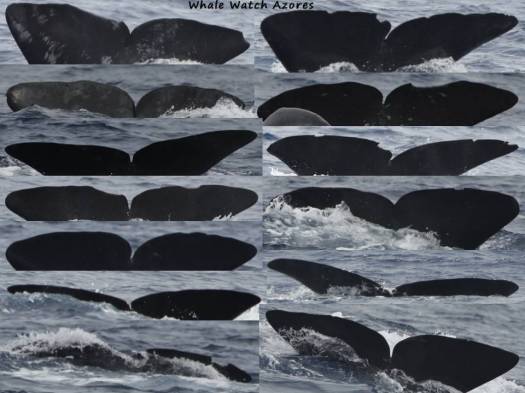
After sorting out the photos, I could discern 13 different individuals. So far there is only one match going back to 2009, but I still have a few more individuals to check.
The weather is looking good for the coming week, so hopefully the animals will continue to co-operate.
Sperm whales and only sperm whales on Saturday. Something interesting is going on with the “1019” group. There was another whale seen in the area, which has never been seen with this group before. “3768”, the “newbie” was first seen in 2009 and then again last year, by me. In between, though, it has been seen a few times in Sao Miguel. So I guess only time will tell if another individual is going to join this group. Female sperm whales normally stay with the same group they were born into, while males will eventually leave when they reach their late teens. This group, however, seems to be a bit flexible. For a long time it was only “1019” and “3186”, but then a few years ago “1198”, “2234” and 2402″ joined them.
Sunday out a bit grey, but this lifted as we left the harbour. The lookout had reported sperm whales and Risso’s dolphin! He lost the Risso’s before we got to the area, but as we were passing through, I caught sight of a dorsal fin and we had found them again. This is the first time Risso’s dolphin have been sighted in 2020. We spent a bit of time getting some ID photos and then headed towards the sperm whales, only to be stopped by the lookout. “Stop, I see a shape in the water. There must be a whale close by”. So stop we did and surprise, surprise, a humpback whale appeared! It is a bit late in the year to be seeing a humpback, but not unheard of. They are usually feeding further north at this time of year. This whale was on a mission, travelling fairly quickly to the northwest, close to the coast of Pico. Unfortunately, it did not show a fluke for the ID photo, but we did get a photo of the dorsal fin, so will have to hope someone recognises it.
Finally it was time to head to the sperm whales. The lookout sent us off São João, quite a way to the east. We put the hydrophone in and found that the whales were behind us! Oh well, it is very unusual for the lookout to get it wrong, but I guess the whales changed their mind on the direction they wanted to go to. So we had to head back the way we came. Along the way, we came across a second group of Risso’s dolphin! So maybe it is like the bus, you wait a long time and then two turn up at once 🙂
We did eventually make it to the sperm whales and they were the same group as we saw yesterday. “3768” was still there, today with a juvenile and we also saw “1198”. We didn’t have enough time to wait for the other individuals, hopefully tomorrow there will be more.
Thursday morning the lookout had a “small” surprise for us! A couple of sei whales travelling to the west. Unfortunately the wind and the waves made it difficult to get photos. But I did manage to get one of the dorsal fin ID pics.
Sei whales often pass the Azores a little bit later than the other baleen whales and have actually been seen from April – September. The name sei whale comes from “seje” the Norwegian word for pollock or coalfish, which appear off the coast of Norway at the same time as the sei whales.
We didn’t stay too long with the sei whales, because sperm whales were spotted a little bit further out. Off we went and once again, it was “Whitehead’s” group, although no sign of the lady herself.
It was not the easiest working conditions, blows were difficult to spot, so we had a bumpy ride back to the harbour a bit early, after snapping a photo of “2578” again.
Today is the holiday of São João in the Azores (St John’s). Usually there is a big festival up by the chapel on the way to the caldeira. Not this year.
We had a lovely sunny day, even if there was a bit more breeze than forecast. We headed once again to the south of Pico, since the vigia had spotted a couple of groups of sperm whales there. We started off the lighthouse at São Mateus and arrived just after one whale had fluked, so we had to wait a bit for the next one to surface.
It was worth the wait, because as she dove, I identified her as 2578, who is part of the “Whitehead” group, one of our very well known groups of sperm whales. Unfortunately, she was heading into the wind and waves, so we decided to head towards the other groups further down the coast. But as we were about to leave, another whale surfaced. This time it was “2776”. It looks like she may be pregnant, since her shape was a bit “rounder” than normal. This would make sense, since her last calf was born in 2014 and they have a calf about every six years. Hopefully we will see a calf soon. “Whitehead” herself will have to wait for another day.
On the way to the other group of sperm whales, we came across a group of striped dolphin. They were not very interested in the boats and decided to go off at speed. This behaviour gives us the opportunity to get some amazing photos as they go. We do not chase the animals to get them to do this behaviour. Just before the dolphins, we spotted a loggerhead turtle basking at the surface.
Then it was time for some more sperm whales. There were two groups, one closer to the coast and one further offshore. We stopped by the offshore group and got two flukes before it was time to head for home. This group I do not know off the top of my head, so will have to run them through the matching program.
The weather looks good, so hopefully we will be out a few more times in the next few days. Maybe will even photograph “Whitehead’s” fluke!
Experts call for legislation and trade deals worldwide to encourage green recovery
Pandemics such as coronavirus are the result of humanity’s destruction of nature, according to leaders at the UN, WHO and WWF International, and the world has been ignoring this stark reality for decades.
The illegal and unsustainable wildlife trade as well as the devastation of forests and other wild places were still the driving forces behind the increasing number of diseases leaping from wildlife to humans, the leaders told the Guardian.
It bit choppier than expected yesterday (Thursday), but the lookout had seen sperm whales, so off we went. Once again, we were headed to the south of Pico, off the town of São João.
We stopped and put the hydrophone in just to make sure and, yup, we were close. The whales we could hear were a bit farther to the southeast, so we headed that way, only to have the lookout shout “Blow, behind you”! And sure enough about 300 m behind us, a sperm whale had surfaced. When they are getting ready to come up to the surface they stop clicking, which is why it wasn’t detected on the hydrophone. As we maneuvered to get around behind the whale, I thought I recognised the white marks on the dorsal from the other day. Sure enough when it fluked, it was “1198”, one of our well known females that had first been seen in 1989. This was very promising, “1019” has been seen with her the last few years and we missed her the other day. The second and third whales were also well known: “3186” aka “Bearpaw” and “2234”. We then spotted “1198” again, this time she had a calf with her, displaying suckling behaviour; arching up and diving next to the female’s dorsal fin. Then we saw “3186” once again. We decided we would watch one more, before heading back to Horta. Blow, this time a little closer to the shore. The dorsal fin was different to the others we had seen and looked familiar. “1019”!!! Yes! She was first seen in 1988, the same year that I started studying the whales and dolphins in the Azores. So she and “1198” are at least 40 years old, because when they were first sighted, they were identified as adults, rather than juveniles.
This slideshow requires JavaScript.
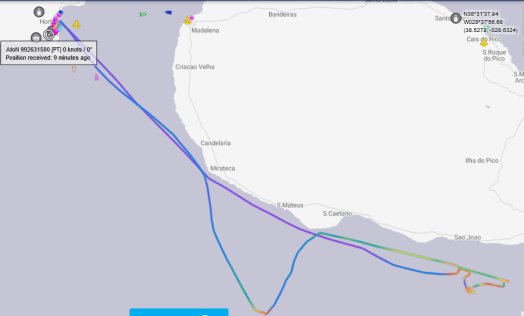
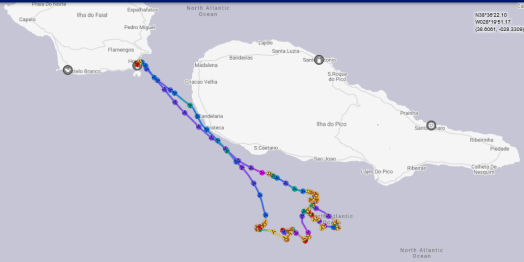
So off we headed back to Horta, with the lookout trying to find dolphins. And find them he eventually did! You can see from the track of the boat when we took a “hard left”! A couple miles further offshore from our course we found a group of spotted dolphin. These were the first spotted dolphin of 2020!! There were some very small calves in the group and they were riding the bow as they travelled towards the west against the waves. What a finale!
This slideshow requires JavaScript.
What will the next trip bring? Watch this space. Thank you once more to Biosphere Expeditions, and everyone who has contributed to their appeal, for the funding to make these outings possible!
As the coronavirus pandemic has a stranglehold on the planet, travel plans have had to be cancelled everywhere. Even those where people help nature conservationists during their holiday time as citizen scientists.
Dr. Matthias Hammer, Executive Director of Biosphere Expeditions
Laufmann: The corona pandemic seems to be giving nature some breathing space. That must please you as a nature conservationists, right?
Dr Hammer: Of course! I am very happy about nature being given a chance to recover for a change, instead of the continuous assault of the last decades. There is also the hope that humanity as a whole will stop to ponder for a while. That we realize it is possible to work from home, to fly around less, etc.
What’s the situation like in nature conservation?
Well, for us, for our citizen science / wildlife conservation expeditions, the effect is of course that we won’t be able to carry out any projects in 2020. But that is the lesser of two evils. The bigger evil is the situation of our local partners.
How come?
It is much worse for our local partner organisations. In the developed world, we can apply for state aid. Besides, we are a very lean organization. We don’t have large offices which we have to pay rent for and the like. Our running costs are very low. State aid, as limited as it may be, helps us a lot. But our local partners are in a difficult situation. There, there are by and large no such programs. And much of their income has disappeared. For example in Enonkishu, a conservancy in Kenya, their main income is the fees that tourists pay when they come into the reserve. This has dropped to zero practically overnight, so they now have a reall challenge on their hands to keep paying their rangers and other staff. And if no rangers are being paid, how do they fight poaching? Not only that: the increasing poverty through the crisis also increases the pressure from poaching as cash-strapped people go in search for bushmeat, for example.
So what does this mean?
There are two sides to it: It’s both a chance and a challenge. On the one hand, it’s a chance for nature to recover, because there are no visitors. In the Red Sea, for example, the water is clear and the reefs are recovering, as the ecosystem remains largely on its own, because of course there are no divers or tourists causing disturbance. On the other hand, the lack of money is a real problem, as I explained earlier. Conservation costs money.
How can we counteract this? Both on a large scale and you with Biosphere Expeditions?
We are a relatively small organisation. Our influence is correspondingly small. At best we can do something on the ground with our partners and bring money and, of course, manpower to advance their conservation projects. But since this has now ground to a halt, we have also started a fundraising campaign. Our project partners have written a few lines about what they currently need money for; where their need is greatest. And I have been surprised by how generous people are despite, and perhaps because of the crisis. For our partners this really is a godsend in their hour of need.
How does Biosphere Expeditions deal with the fact that there are now those calling for a fundamental change in the way we travel?
Air travel in itself is of course bad for the environment. There is no question about that. If there are no contrails in the sky, everyone has a basic understanding that this must be good for the planet.
How does Biosphere Expeditions deal with this dilemma?
We have several approaches. First, it is a fundamental concern of ours to eliminate ourselves in the long run. In other words, we want to advance projects to a point where we are no longer needed. Take the Maldives, for example: via expeditions there for eight years, we have established a non-profit organisation (www.reefcheckmaldives.org), which is now entirely run by locals. The reef research that we have done with volunteers is now under their leadership. Point two is that we encourage our participants to offset their carbon footprint. I am aware that this is also under criticism, but as part of the mix, I believe it is a positive thing. We as an organisation naturally compensate for the CO2 our activities produce as well. Thirdly, we must not forget that the alternative to tourism is often the chainsaw or total overfishing. In other words, nature conservation takes place because there’s an economic benefit for local people to intact wildlife and wild places. This is what we conservationists call the ‘what pays, stays’ principle, whether it is via safari tourists or through citizen science projects. It’s too shortsighted to reduce everything down to CO2 exclusively, although we must keep an eye on this. The world is more complicated than just CO2 budgets.
How will the pandemic influence your citizen scientist projects?
That’s a difficult question to answer. The crisis will be with us for a long time; years rather than months. We have contingency plans in case expeditions are still impossible right through to 2022. How people’s behaviour will change… I wouldn’t want to predict this as this is not my area of expertise. But I do believe that the desire to do something useful in your holiday time will keep increasing in people. This was already evident before the pandemic and will hopefully get a further boost now.
Is this the end of tourism?
I am afraid not. As soon as lockdown restrictions are relaxed, people will by and large fall back into old habits. Still, it would be nice if humankind could become significantly more mindful through this crisis.
What should politicians do to support nature conservation and environmental protection in times like these?
On no account lower environmental standards! Under no circumstances save the big polluters. The money that is saved by not bailing out destructive corporations should be put to good use elsewhere in combating climate, the other and more dangerous challenge humanity faces, and preventing destruction of wildlife and wild places. We need the planet as the basis of all life and economic activity. For on a run-down planet, there will be no life worth living and no economy to speak of.
How does someone use their time during lockdown?
There are lots of ways to help from home as well. Citizen science also works during lockdown. You could for example analyze photos of animals or galaxies, or provide computing power for virus research. The possibilities are endless.
This year everything is different. The country is effectively closed and so are all its beaches. This means there are no international volunteers or citizen scientists with us this year.
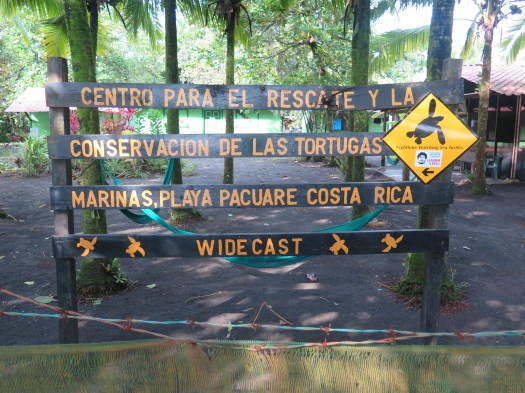
The main threat for our sea turtle nesting beaches is through illegal poaching. But COVID-19 has stopped us dead in our tracks and we currently have just our key local staff of one biologist and two research assistants struggling to patrol 7 km of beach to save as many nests as possible. But our funding, which comes from expedition contributions, is now lacking too, so we are struggling to pay our local staff. We are grateful to a couple of our local guides who have offered to work for free for the peak nesting season. Another piece of good news amongst all the mayhem is that our lobbying and education work with the government is finally paying of. So this year, just in time, we also have more support from the coastguards, who are also more available because all beaches are closed to the public.
So all in all, we are surviving here. So far we have managed to save round half of all nests overall. This is a far cry from the around 70% we can achieve with volunteers and underlines how critically important they are in what we do, but it is nevertheless impressive, given the very difficult circumstances.
Here are the latest figures from Pacuare:
125 leatherback nests this year – 67 protected in hatchery (54%)
53 females identified
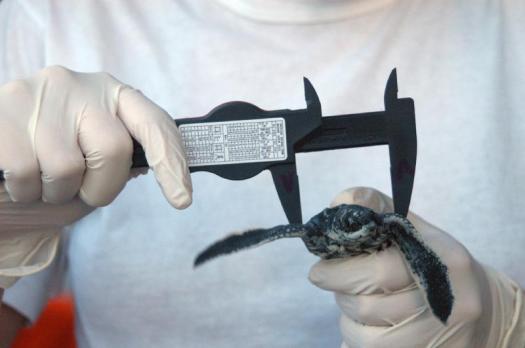
740 hatchlings released from 15 nests so far
Emergence success rate 73%
5 green turtle nesting activities with 2 nests protected in hatchery (40%)
1 green turtle killed by poachers
Overall percentage of leatherback and green turtle nests saved so far 47%
By comparison, 67% of leatherback and green nests were saved in 2019 with the help of citizen scientists
Thank you to everyone who has supported the Biosphere Expeditions fundraiser so far. This is a crucial component to our success in spite of the pandemic this year. Please keep giving, if you can. The peak nesting season is still to come and every cent or penny will count!
Nicki Wheeler
Volunteer Coordinator
Latin American Sea Turtles
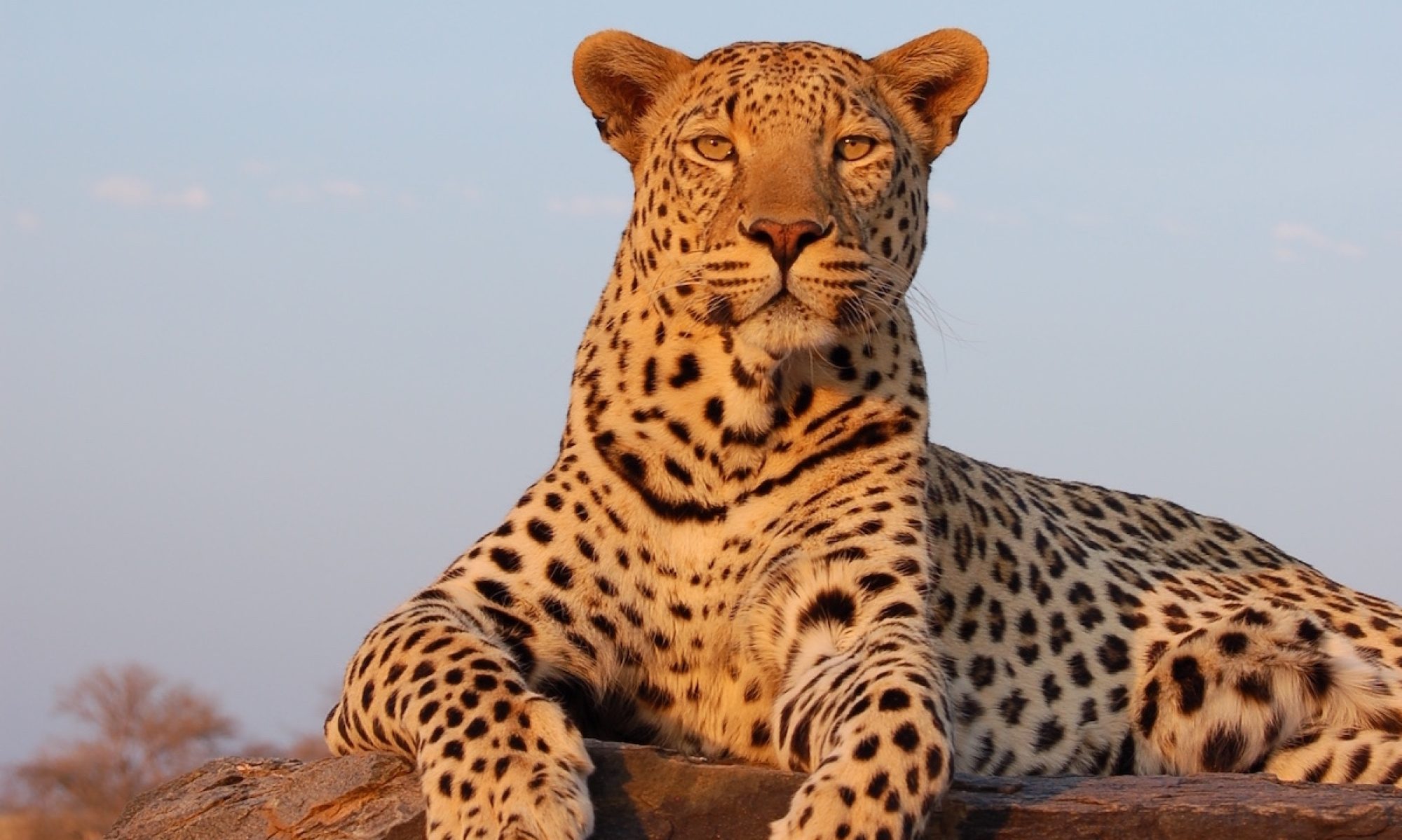
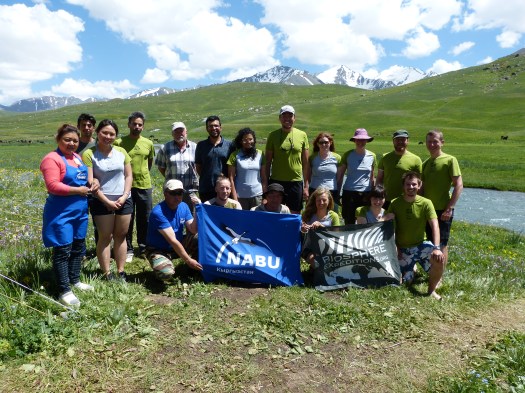
Usually by this time of the summer we’re already getting started with our expedition here in the Tien Shan mountains of Kyrgyzstan. In fact, mid-June is my favourite time to be up in our study area as the wildflowers are in full bloom and the mountains are at their most beautiful. More importantly for our research though, the number of shepherds is minimal, which increases the potential of seeing our study animals. This year though is obviously very different. It is increasingly challenging to create plans too far in the future, and as such, we were not sure that the lockdown in Kyrgyzstan would be lifted by this time of the summer. So instead, our community expedition will be taking place at the end of July for a total of eight days with the main goal of camera trapping and extending our community-based conservation work. Without our international citizen scientists, there won’t be much time for us to do the normal surveys that are a big part of the project year after year.
One of the first teams, in 2017
Both the people and the data they collect will be sorely missed! It makes you realise the importance of people from around the world coming to join us each year, working hard towards the goal of snow leopard conservation. It will be a very different expedition without them.
Saturday morning started a bit grey and damp, but the south of Pico was looking brighter. First we spotted a Cory’s shearwater with a damaged wing, at one point it looked like some monofilament was wrapped around it. We called the university and they said someone would come to collect it. But as we fuelled the boat, the bird came closer so once we finished, with no sign yet of the people from the university, we decided to catch it. Using a net, normally used to collect skin or poo samples from whales, we managed on the second attempt. Luckily for us, there was a bird box from the rescue campaign in the autumn, when the young birds can be found on the roads, at the police office in the marina. So we boxed up the bird and left it to be collected later. The bird will be transferred to Pico where hopefully it can be re-rehabilitated and released.
Off we went, just ahead of the rain showers. The lookout, Antero, had seen a sperm whale in front of the vigia at São Mateus, before we left, so that was our destination. As we reached the south, the wind dropped off and the sun came out. It was summer! Removing a couple of layers of clothing, we were scanning the horizon looking for a blow the lookout had directed us to. We found the whale and got the camera out just in time for the fluke. As it dived, I shouted “1198”!! She is one of our very well known females, first seen in 1989. Her group had been seen a few days previously closer to Lajes on Pico. The lookout then said we should go a few miles ahead where there were more whales. I did think this was strange, since usually the “family” of 1198 tend to swim fairly close together. But you don’t disagree with the lookout, so off we went. We just missed a mother & juvenile diving, but soon found another few whales, then another one and so on! We even saw what I think were two young males. By the end of the day, we had 13 different flukes from 16 encounters, but not another member of the 1198 family. So I will just have to wait a little while longer to see “1019”, one of my favorites, first seen in 1988. Apart from one of the animals I suspected were male, all of the other flukes were new to the catalogue. The “male” had been seen by the university in 2004. I will be in contact with them to see if it was identified as a male at the time. I doubt it, because the animal we saw was not a “mega” male, which are the very large, up to 18 m, animals. This was maybe 14 or 15 m most, so in 2004, it would have still been with its family group most likely.
In between some of the sperm whale sightings, we also saw a very energetic group of bottlenose dolphin, with at least one very small calf. We didn’t spend very long with them, because a sperm whale came up to the surface. As we were trying to leave the dolphin, two of them raced in front of the boat and did some amazing, 5-6 m leaps into the air!
About 45 min after the bottlenose dolphin, we came across a group of pilot whales. The group was split into a group of three large animals and another of five or six smaller ones. The three large ones just rested at the surface about 50 m from the boat, waiting for the others to catch up. And when they did, the whole group moved off and dived.
We kept following sperm whales and just as we started to see repeat whales and were thinking of heading for home, I spotted another blow. As we headed over a second whale appeared and they headed towards each other. Heads were coming out of the water, mouths were open and we saw what at first glance appeared to be a turtle that they were playing with. That turtle turned into something much more dangerous, a big tangle of rope. The two juveniles continued to play with if for another five minutes, before moving off, leaving the rope behind. On the boat, we gave a collective sigh of relief. It would have been disastrous if the rope had gotten stuck in one or both of their mouths. Although there is a knife on board as well as a mask, disentangling a whale can be quite dangerous.
Another four whales had come to the surface in the meantime and our two juveniles went over to join the adults, maybe complaining that we had removed their “toy” from the water. It appeared that the group was going to socialise and since the wind had started to pick up, we headed for home. We arrived home, happy and tired after 56.5 miles and 6 hours at sea.







 Biosphere Expeditions: blogs from the frontline of wildlife conservation and the fight for a more sustainable planet