Award-winning, non-profit and ethical wildlife conservation volunteering. Advancing citizen science and conservation since 1999 – for nature, not profit.
The juvenile hyaena we have caught in a box trap twice already seems to like them. Last caught on Tuesday, she was in the box trap again Wednesday morning. We let her go and then decided to remove the trap from Bergposten.
Anja and the two Susannes found an emaciated kudu at one of our waterholes on Wednesday. By Thursday nature had taken its course and the kudu had turned into a carcass, already half eaten by predators. We decided to set up the box trap next to it (see below), but no action so far.
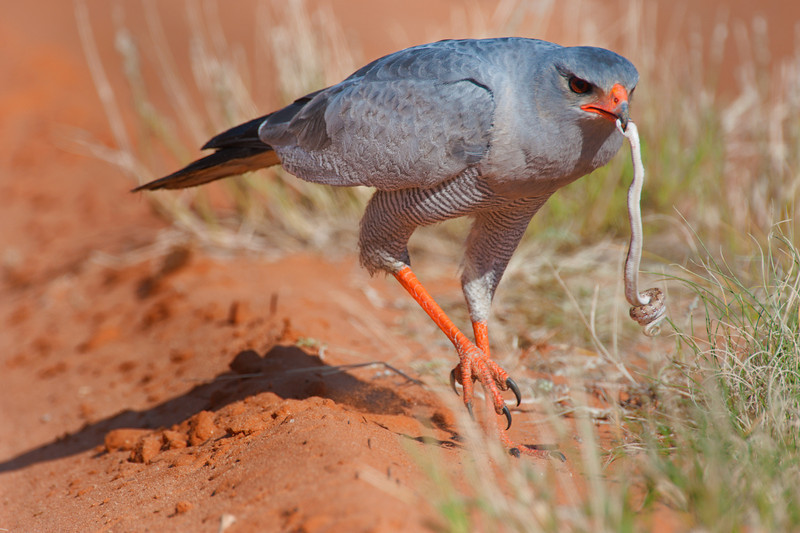
Stephanie, Eva, Michael and Julia were very lucky when surveying the waterhole on Thursday. A honey badger came along, but realised after a few seconds that human eyes were watching and disappeared. On their way back they also witnessed a Southern pale chanting goshawk catching a snake…another great sighting!
Goshwak & snake
Bob had the job of cleaning a box trap yesterday; to make up for it we went out for a night drive after dinner 😉
Have you ever wondered what an expedition packed up looks like? Probably not. And yet the answer is below.
Musandam expedition boxed up and ready to go
Adam (my sidekick) and I have arrived in Dubai and spent the morning going through the kit list and checking everything is there. It was, so our shopping list for this afternoon is simply a laminator, HP 121 printer cartridge, bungees, Nurofen, zinc oxide tape, nasal spray, antihistamine cream. Exciting – not!
Our scientist Rita has also just arrived at our hotel and as I type this, she is going through the emergency numbers and procedures with Adam, updating things as necessary. It’s all the usual pre-expedition fun and games.
The weather? Have a wild guess. Blue skies and temperatures of around 30 degrees Centigrade. Welcome to the Middle East.
See you tomorrow in the lobby at 09:00 and let’s go check those reefs!
Last month, Biosphere Expeditions returned from another successful wildlife conservation project in the Altai Mountains of Asia with some very exciting findings.
Biosphere Expeditions is an international not-for-profit organisation which co-ordinates regular wildlife conservation projects where volunteers from around the globe can take part – enabling them to see parts of the world they might not otherwise be able to, while giving something back.
Their latest expedition to the Altai Mountains was primarily focused on gathering information about the endangered Snow Leopard. However, this year they made a rather significant discovery. By laying camera traps and tracking scrapes, they found that the Pallas’ Cat climbs to much higher altitudes than previously thought.
Pallas’ Cat camera-trapped by Biosphere Expeditions research team at 3100 metres
This information will enable local conservation groups such as WWF Russia and Arkhar NGO to gain a better understanding of the behaviour of the local wildlife in a mountainous habitat, where many threatened or endangered species live.
The Pallas’ Cat has been classified as “Near Threatened” by the IUCN since 2002, so any new information that can be compiled about them will contribute to better conservation of the species and their habitat.
The expedition to Altai sent five groups of volunteers for two weeks at a time to support Biosphere and the local conservation teams.
Eleven people for group 5 have arrived. Poor Bob is the only native English speaker in the whole team amongst seven Germans, two French and a Swiss. But Bob is coping very well so far. I feel like we have made a trip back in time to group 3: the non-driving group (Catherine, Stephanie, Susanne & Eva ) went out Sunday afternoon and activated the box trap at Bergposten while everyone else was busy learning how to drive our Land Rovers.
Then on Tuesday, our first day with research activities after the training phase, the box trap group had to check Bergposten and found a hyaena in it. On our first day! Does this sound familiar, group 3? If it is, then wait until you hear that it was the same juvenile hyaena we caught and took blood samples of in your group. So we let her go straight away.
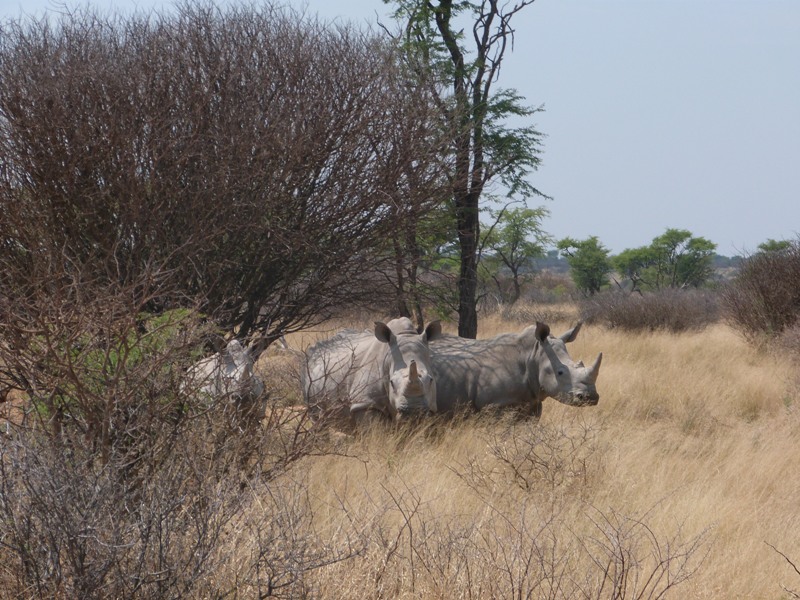
Also very lucky were the groups that were on elephant survey yesterday as both groups came across the white rhino family with their offspring. We don’t see them very often!
White rhino family
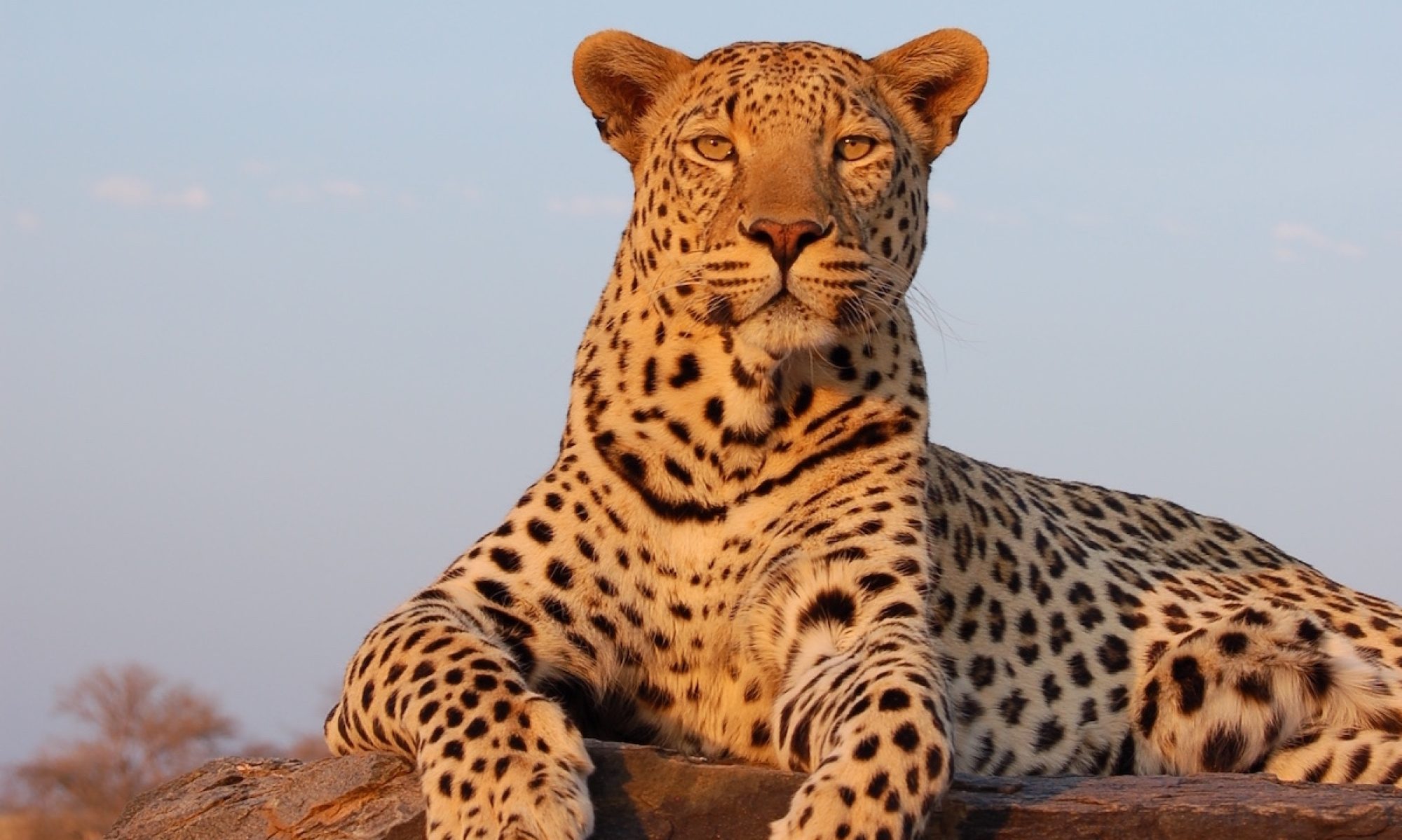
Another great piece of news was delivered by Christian (the landowner) who rang Kristina on Monday to tell her about two leopards (a female and a male) he observed for about ten minutes not far from his house in the morning. Guess where we set up the next box trap…
The last few days have been very busy. On Tuesday morning we checked the box traps on our vehicle game count and in box trap number 3 (where we caught our big male leopard) we found a small juvenile hyaena. We first thought that this might be the female we had caught at Bergposten three weeks ago, but when she turned out to be a he, we decided to get some blood samples and measurements on Saturday. He was sedated, weighed, measured and then placed back into the box trap and finally released when he was fully awake just before dinner.
Hyaena capture & processing
We didn’t expect to find so many different hyaenas in this study area and this is very interesting additional data about the other predators on the farm, thanks to all of you being our constant eyes, ears and data collectors in the field. Yesterday was group four’s last day. We spent it cleaning up, entering data and having a few farewell drinks in the evening. Thanks to all of you for your help and your kind words. Safe travels back home. Roll in group five.
Good news from Muscat, where I have had some high-level meetings with goverment decision-makers about creating a Musandam Marine Protected Area. It’s early days and I can tell you more about it when we meet, but it was an important step forward. The next step is you collecting more data!
Other than that we are pretty much ready for you. T-shirts and Reef Check materials printed, MS Sindbad is being made ready, supplies are being bought and I have done most of my packing.
This slideshow requires JavaScript.
I’ll be on the A380 from London next Friday. My UAE number (on Sat/Sun 6/7 October) will be xxx and my Oman number (from 7 October p.m. onwards) will be xxx. Remember these are for emergency purposes (such as missing assembly) only.
On Friday morning we had an early start to count prey animals just after sunset. Soon group 1 (Jesaja, Linda, Allyson and I) came across a very fresh leopard track close to where we caught our male two weeks ago. Then, just after we had finished our vehicle game count, Allyson and Linda spotted a freshly killed impala next to the road. We decided to set up a camera trap on the spot straight away. On our way back to camp after setting the trap, we found more fresh tracks: cheetah this time.
The new camera trap yielded great pictures straight away (see below) with two different leopards feeding on the carcass at different times. A female leopard was there first and a few hours later our recently collared leopard male “Omusamani” took over. It seems the kill is the perfect new spot for live trapping. As I write this one trap is already set up. The second one is being set up as I type by our research team, who decided to give up their free day. Thank you.
Our first days in the field started with car checks before breakfast, so we got up very early to be ready to leave camp at 07.30.
Checking the Land Rovers
Ginny and Susan went for “Tracks & Scats” with Jesaja yesterday and bumped into a group of new-born ostriches. When they spotted the mum close by, they wisely decided to make a detour.
The elephant survey teams on Tuesday had some close encounters with their study objects and on Wednesday we had a hairy moment of hearing a juvenile trumpeting and chasing the Land Rover.
Elephants
All quiet on the trapping front, though, so we thought we’d show you some slides of lots of traffic at one of our traps with one of “our” leopards walking into the trap at the end.
Hello everyone and welcome to the first diary entry for Biosphere Expeditions’ first ever Emirates desert
expedition. My name is Malika Fettak and I will be your expedition leader. You will also meet Dr. Matthias Hammer, our founder & executive director, Greg Simkins and Steve Bell, from the Dubai Desert Conservation Reserve, as well as a host of other people, which I will introduce to you as things progress.
Matthias and I are about a week ahead of you, blazing the way for you trailblazers. I am writing this from the airport and there is also a video of us:
I’ll write once or twice from the Emirates to tell you how preparations are going. Once I have confirmed my mobile number, I will also e-mail that through. Remember that this is for emergency purposes only (such as being late for assembly, for example).
Best wishes for now from the airport
Malika
12 January
Guess what. It’s blueskies and very pleasant temperatures in the 20s here in Dubai. The oryxes, sand
gazelles and all sorts of other wildlife are out, including a large number of humans running back and forth between shopping trips in Dubai, putting up the base camp
organising supply lines and food, datasheets and all the millions of other things that need to be done beforean expedition team arrives. We have a camp, we have three shiny new Land Rovers for you, we have datasheets (almost) for you to fill in, we have a cook, we have cold showers and we have fancy flush toilets (with a water saving function).
Two days to go and we should be ready for you, Insha’Allah. “Insha’Allah”, by the way, is a phrase you are about to become very familiar with. I usually introduce new expeditioners to this phrase right from the start, so I’ll do it again in this diary entry: Insha’Allah translates roughly as… ‘If Allah wills it’ and is a marvelously useful term of complete fatalism and one which has no direct English equivalent. The nearest thing would probably be ‘…but on the other hand I might get hit by a number 73 bus tomorrow’ -uttered in tones of sodden dejection by a clinical depressive with a strong Solihull accent.
See you soon.
Malika
14 January
Done! Everything is ready and waiting for the arrival of our first research team to study oryx, Gordon’s wildcat and other species in the Dubai Desert Conservation Reserve. Who would have thought that just 50 km outside of the hustle and bustle of Dubai, there is tucked away this tranquil oasis of Arabian wildlife. What a great place to conduct a wildlife conservation expedition in. Thank you Greg & Steve of the DDCR for sharing some of your workload with us.
It’s been windy for the past couple of days, so everything is covered in a thin layer of sand. Temperatures are around 30 deg during the day and around 20 deg at night. The moonrise last night was spectacular as was the sunrise this morning
See you tomorrow.
16 January
Yesterday, after picking up the team in Dubai, we went straight out into the desert and into our training. How to read maps, use binoculars, spotting scopes, rangefinders, set up camera and live traps, drive a Land Rover through the dunes, tell juvenile from adult oryx, etc., etc. This crash course in how to be a field biologist eventually had everyone’s head spinning. But the stars were bright, the fire was flickering, the food good and it was all sinking in by the evening.
This morning we woke up to a cold 9 deg. There was a bustle around camp well before sunrise as teams were getting ready. We were soon on our way to set camera and live traps all day in three teams, but not before some more driving instructions. Once inthe dunes trying to locate our pre-assigned GPS points to set the traps, our baptism of sand was swift and unforgiving.
My team and others got stuck more than once. But such is the life of Dr. Livingstone in the desert, I presume…
Malika
18 January
Call it beginner’s luck: we caught a cat during our first trapping night. Evelyn, Peter, Steven and I found a 4.5 kg male hybrid sitting in trap 17. Three drug doses were still not enough to put the ‘beast’ to sleep, but drunken as he was we managed to hold him down to do the measurements. We marked him and also took a DNA sample to illucidate the proportions of Gordon’s wildcat and feral cat in him.
Most of day two was taken up with checking and closing traps, so we postponed the reopening to the next day. Oryx herd survey was the task for all teams in the afternoon. Equipped with binoculars and spotting scopes, we headed out to different areas of the Reserve. On the way our species encounter datasheets were seeing some action too as all teams came across lots of animals, mainly Arabian gazelle and sand gazelle, but also sand fox and golden eagle.
Shovels also saw a lot of action during the last coupleof days although digging Land Rovers out of the sand didn’t really appear on our activities list! Everyone has shown great team spirit during our first trailblazing days, though. Another positive side effect of the project: we’ve all become experts in dunedriving! ;).
19 January
16 empty traps this morning, but all traps will be rebaited and set live again on Friday afternoon-wish us
luck! The bait of choice is sardines in tomato sauce with chilli -reportedly the intensive smell attracts cats and rodents evenly…
As I write this, teams are out on oryx surveys while I catch up on admin and take the chance to let you know how expedition life is in the Emirates.
22 January
Today was the day to check the camera traps we set a week ago; 18 cameras evenly spread over 227 sqm of the Reserve. Pictures we found were of the ‘easy to see’ Arabian gazelle, sand gazelle and oryx, but also of more elusive animals such as Arabian hare, redfox and … a cat!. You can tell with a glance that it’s not a pure Gordon’s wildcat as she doesn’t have black feet.
Later in the afternoon the time had come to review the first-ever Emirates desert project. We sat around the fireplace as Steven summarised our species sightings and records. Not only mammals, but also some of the local birders community most wanted such as leopard-faced vulture, golden eagle and desert eagle owl were seen. Steve thanked us for our contribution and DDCR staff reckoned thatwe have done well over a month’s work for them.
23 January
With everyone helping, we broke camp and did the last sand dune driving video shot in amazing morning
light before we left the desert. At our original meeting point in Silicon Oasis, Steven and I said goodbye to Anne, Evelyn, Ingrid, Tess, Peter and Yan.
You’ve been an amazing team. Thank you again for being fantastic trailblazers, great researchers and
mates! I hope you’ve enjoyed the week as much as I have and take back home a unique experience, desert wildlife knowledge, navigation & sand dune driving skills and good memories. A big thank you also goes to Greg, Steven and Pete of the DDCR for their support and rescue service at all times ;).
Hope to see some of you again some time!
Malika
P.S. The day after you all left, Pete trapped a not yet registered pretty much pure Gordon’s wildcat with one of the traps we set up. She’s now measured and microchipped.
With a couple of weeks to go until our Musandam expedition, I thought I would introduce myself and make you familiar with some changes (remember nothing is as constant as the change of plan on expedition ;).
My name is Matthias and I am the founder & executive director of Biosphere Expeditions and also your expedition leader. There’s a short video of me and why I am your leader (and not Rossella Meloni as per the dossier) below.
Change 1: I am your expedition leader.
Change 2: I will be on UAE mobile number xxx and not the expedition leader mobile advertised in the dossier. Since we have a good crew and have done this expedition for several years now, I will only arrive in Dubai 30 hours before we meet at the Holiday Inn Express Jumeirah. If you are late for assembly or if there is any other urgent matter, please ring me on this phone. Once we get to Oman and onto our liveaboard, I will switch to Oman mobile number xxx for the rest of the expedition.
No change: to the assembly point or time or to the fact that you are joining a research expedition, not a cushy dive holiday 😉 I hope you have all done your swatting up on Reef Check and are ready to help us with our reef research. Here’s an old 2011 survey itinerary. As you can see it’s early mornings and mostly survey dives, but we usually get in a few “lazy dives”, i.e. dives when you don’t have to fill in any datasheets. So please come rested and with your heads clear for all the Reef Check information we’re going to hit you with (and test you on) before you are allowed to collect data.
But enough of the scaremongering! I hope your preparations and packing is taking shape. Remember there is NO dive hire gear in Musandam, so please bring all your own stuff or arrange hire gear in Dubai in advance (see page 19 of your dossier).
I may write once more from Dubai before we all meet at 09:00 at the Holiday Inn Express Jumeirah on 7 October. Safe travels and I look forward to meeting you soon.
Regards
Dr. Matthias Hammer
Executive Director
Biosphere Expeditions





 Biosphere Expeditions: blogs from the frontline of wildlife conservation and the fight for a more sustainable planet