Award-winning, non-profit and ethical wildlife conservation volunteering. Advancing citizen science and conservation since 1999 – for nature, not profit.
Preparations at base are going well. The river levels have dropped because we are now well into the dry season, but we have access to a fleet of smaller boats. Febri is intending to extend his camera-trapping work and also has more ideas about further survey tasks that the team can perform.
We are also talking to the local communities about hosting us on our overnighters and other activities that are designed to integrate local communities into our work. So far, so good. The trailblazing continues. Remember that this is our inaugural year and that tiger conservation in particular needs long-term solutions. We will keep plugging away patiently, building relationships and conducting our surveys. Thank you everyone for helping with this. You could have gone to the beach or a petting zoo or an easy safari. Instead you have chosen to be trailblazers in search of sustainable solutions to tiger conservation and the elusive animal itself. Thank you for this and we look forward to meeting team 4 tomorrow. Febri will meet you at the assembly point in Pekanbaru and Anthony will see you at Subayang base.
Not long to go now. This is Anthony Lyons, your expedition leader for the post-Ramadan Sumatra tiger slots. Our 4th slot will be with me on Sunday, 26 July, and hopefully raring to go forth into the jungle and the project ahead.
I arrived in Pekanbaru a couple of days ago. There’s a busy week ahead of final preparations. At the moment the plan is for slot 4 to be met by WWF staff in Pekanbaru and then to be transferred to Subayang base, where I will be. But this plan may change – remember that on expedition nothing is as constant as adapting the plan 😉
I’m really looking forward to meeting the team on Sunday and continuing the hard work and effort that the 1st, 2nd and 3rd slots have already put in.
A week of re-org in Bishkek is almost over. I’ve spent some time with our partners from the NABU at their office reviewing the past four weeks and planning ahead for the next two slots. Quite some time was spent at the desk working through a long list of e-mails piled up in my inbox, doing the accounting, printing, laminating – all exciting stuff. I quite enjoyed doing my laundry! 😉
Kurmanbek, Volodya and I went for a reconnaissance drive to Chok Kemin valley on Wednesday. Around this valley, running parallel to the north edge of the Issyk Kol glacier lake, the Grupa Bars has been very successful with camera trapping snow leopard, wolf and bear. We met with Marat, one of the rangers of Chon Kemin National State Park and drove almost all the way up to the valley’s end. Various base camp locations were visited before we were invited for a meal at Marat’s house. It was in the evening when we returned back to Bishkek after a 3 1/2 hours drive.
This slideshow requires JavaScript.
Today Kurmanbek, Aman, Volodya, Emma and I head off into the Kyrgyz Alatoo mountains again to set up base camp II. We’ve spent the whole day yesterday with food shopping. Two cars will take all supplies today. Once we’ve set up the yurt, mess & kitchen tent, etc., Aman and I will drive back to Bishkek tomorrow and meet team three on Monday morning 8:00 at the Grand Hotel. One more driver will then be requested from the team – please be prepared and bring your driving licences!
Here’s the diary for the second group (22 June – 4 July)
On Monday, 22 June, the second expedition team assembled at the Grand Hotel in Bishkek: John from Canada, Peter from Germany, Yvonne from Switzerland are well-acclimatised after two weeks of travelling in the south of Kyrgyzstan. Then there are Sue and Ben from the UK, Neus from Spain and once more Carolyn & Charlie from New Zealand on their second expedition slot. Two local placements are also joining the expedition team: Rahat, born in the Naryn region, but living in Bishkek, and Amadeus, who has a Canadian passport, but lives and works in Bishkek since 2007. Emma, our cook is present as well as Kurmanbek, head of the ‘Grupa Bars’, NABU’s snow leopard patrol accompanied by his 16 year old son Azim and his colleague Aman. Last minute shopping must be done before we can head off to base. Peter’s luggage has not arrived so Aman, Kurmanbek and I hurry off quickly to get a rucksack. Well done him for packing all other essential gear in his hand luggage!
The convoy of four cars – two of them fully loaded with food 😉 – is then led through the Bishkek city traffic by our locals and after a few stops on the way, we arrive at base at 17:00 in the afternoon. Thanks to team 1 all tents are already pitched so that everyone can move in straight away. We have borscht, a famous local soup, for dinner, kindly prepared by our scientist Volodya who guarded the camp over the weekend. I then talk everyone through the risk assessment – always top on the list of training sessions during the first couple of days.
As usual we start late on the second expedition day, breakfast is at 8:00. Volodya then delivers a comprehensive introduction about the science and research in our study area. He talks about snow leopards being opportunistic predators, classifies ibex and argali as their primary prey and marmot, mountain hare and other smaller animals as secondary prey species. Taking into account that the cat follows its prey, the survey will be focussed on finding prey species and then set up camera traps in the most promising spots. Team members also learn about the Global Snow Leopard Conference held 2012 in Bishkek and a governmental agreement between all attending countries signed in order to streamline efforts to save the endangered cats. Gaining information about the distribution and numbers of snow leopard in the wild has been declared the main aim. Having been amongst the conference attendees, Biosphere Expedtions has taken on the responsibility of developing a research plan together with snow leopard specialist Volodya Tytar and NABU’s Grupa bars.
This slideshow requires JavaScript.
Kurmanbek then continues with some background information about NABU’s snow leopard patrol, their work on the ground, the snow leopard rehabilitation centre, where injured animals are kept until they can be released into the wild again. At the sanctuary one lynx, one eagle and four snow leopards are currently hosted. The cats have all been saved from leg traps and are so badly injured that they are no longer able to survive in the wild. He also talks about NABU’s other departments such as environmental awareness, monitoring, ecological education and anti-poaching. Enough of the theory – we go straight into equipment training and the datasheets. Aman explains the work with camera traps and we get to see some fascinating camera trap pictures and videos that have been taken over the last couple of years. Amadeus then gives a short introduction to his butterfly project. He is currently working on his PhD, but at the same time is involved with the development of an interactive app for smartphones. Citizen scientists will be using the app for identifying butterfly species, but also help with enlarging the database by uploading own findings. During the expedition the recording of butterflies will be included in the surveys.
The sky is cloudy when we set off with the whole group on Wednesday morning for the first practising survey walk. Once again we head off by foot into Choloktor valley behind base. After three hours we reach the meadow giving us a perfect view into the rocky arena rising in front of us. Only patches of snow are left from what was a huge snow field two weeks ago. Leaving the heavy rucksacks behind, we spread out in all directions for further investigation. Ibex scat is found in the mud – given that the snow melt is continuing we might set up some camera traps in this area with slot 3 or 4. It starts raining on the way back, but still we spot a roe deer track, a rare occasion. And there is another finding: Torsten (slot 1), in case you read this you’ll be happy to hear that we found your lens hood that was lost two weeks ago! I’ll bring it to Germany…
The rain stops in the evening but starts again right at breakfast time on Thursday. Amadeus spreads the news from Bishkek he received via satellite phone: An SMS saying that the bad mountain weather is going to continue for three more days. No one wants to think about it, so we get busy. In a convoy of three cars we leave base following the road further into Choloktor valley towards the river confluence. From what we have seen yesterday, the cars should now be able to make it over the snow avalanches still blocking part of the road and then through the river. It’s a bumpy ride but everyone seems to enjoy true off-road driving. Sighs of relief, though, after the river crossing ;). Volodya’s group leaves the car soon after and continues on foot. Aman and I drive further on as far as the cars can take us. We then walk together with Carolyn, Charlie, Rahat, Sue, Neus and Azim towards the steep & rocky cliffs forming the valley’s end. Using feet, hands and walking poles we climb up entering ibex terrain – signs such as droppings and hoof prints are seen all around. Soaking wet and with numb fingers we assist Aman setting up three camera traps facing obvious animal trails. Back on safe terrain we’re quite worn out, but still no one wants to get their lunch boxes out in the ever pouring rain. After another 90 minutes we reach the car, have a very quick, but at least dry lunch before we head back. We find Volodya’s team seeking shelter in their car for quite a while before the meeting time. Not much has been found on their survey walk, the usual signs of fox and badger – the snow leopard prey is hiding from the rain too. Back at base the yurt stove is started up quickly, washing lines zigzag what has become the drying room and the stove is surrounded by a dozen pairs of soaking wet walking boots and rucksacks. Well done everyone for coping with the rain and cold. In the evening two plans for either good or bad weather are set up for the next day – hope dies last…
We must opt in for the bad weather plan on Friday. Near constant cloud cover and rain forces us into thick layers of clothing and waterproofs again. We go for a reccee drive up the valley towards the Krakol mountain pass. A few more herders have moved in during the last week. On the road we find an Eurasian hobby unwilling to fly as we approach him sitting in the middle of the road. He must be starving and tired – the guess is that he has not had a proper insect meal for days due to the bad weather. Most curious he watches quite a few of us surrounding him and taking pictures before he finally decides to fly off. At the mountain pass we spread out in all four directions for a survey walk in the clouds. We find livestock and fox tracks, but also notice that the snow cover has shrunk a lot. Still closed for cars, the pass is already open for herders to bring in smaller livestock such as sheep and goat. On the way back we pick up some ‘fuel’ for our stove at an abandoned herder’s place – friends of the NABU staff. ‘Fuel’ is compressed cattle dung stored in tile-like pieces, 100% organic! 😉 It’s only 14:00 in the afternoon when we return to camp. With the stove going, we assemble in the yurt for a slide show: a trip around the world to other Biosphere Expeditions projects in sunnier places makes us forget about the pouring rain outside for a while.
Saturday morning: lying in my tent I don’t hear the sound of rain… really? I could be still dreaming. But no – the rain has stopped! The team can’t wait to go out. Ala Archa valley is on the schedule again. This time we want to make it further towards the end into both left and right sidearms. By the end of the day both teams have walked around 20 km each. On one side the valley is crowded with livestock – cattle, horses, sheep – no chance to see any wildlife. On the other side right at the snow line at about 3450 m Carolyn spots 7-8 ibex. Her second name has become ‘Eagle Eye II’ (after Aman being ‘Eagle Eye I’) reflecting her extraordinary spotting skills. Whenever we are able to see ibex it is from a distance of at least a couple of hundred metres. The colour of their fur blends in perfectly with the rocks, movement alone allows us to notice their presence.
Another second is on Sunday. We visit Chon Chikon again, the petroglyphs valley. Thanks to the snow melt over the last two weeks, we are now able to climb far up – one team makes it to about 3700 m – where ibex are sighted and obvious animal trails and fresh tracks are found. Three camera traps are set. Since his walking boots are still soaking wet, John volunteers to go to interviewing herders. Together with Kurmanbek, well known by many people in the valley, Azim and Rahat as local interpreters they make a perfect team. John’s communication skills gained over years of practice as a psychologist is what makes the day. Kurmanbek is full of praise when we sit in the evening listening to John’s entertaining report. Four families were visited, quite a few bowls of Kumiz (fermented horse milk) have been drunk bravely and John’s been made to sit on a horse while people were talking openly about whatever questions were asked. Overall the local people have great admiration for the snow leopard, it is known that they are protected but none of the interview partners has ever seen one. But most of them know someone who has…
We are rewarded with sunshine on the day off. Yvonne and Neus go for a bath up the Choloktor road. A traditional Kyrgyz meal has been arranged at our neighbour herder’s yurt. Rahat, Kurmanbek and Aman leave early in the morning to help with preparing the food. Dressed up Volodya (he hasn’t been seen wearing long trousers before), Peter, Yvonne, Amadeus, Neus and Emma follow at lunchtime. They come back after four hours holding their tummies after an opulent meal. Believing that the sun will be back we once more make overnighter plans for the next day – the whole team wants to go!
The scene is somewhat similar to moving out of camp when the cars are packed for the overnighter on Tuesday morning, 1 July. One car is stuffed with food, another with tents, mats and sleeping bags. We drive towards the mountain pass again to survey Issyk-Ata and Saryk-Kol valley not yet accessible for livestock. During a 10 km walk in and out of Saryk-Kol valley up to almost 3600 m altitude two male ibex are spotted. The team’s walk is accompanied by noisy marmot warning calls. From the number of active holes found off the path, a huge marmot colony must live there – two of us manage to see at least one individual. At Issyk-Ata valley the results are about the same: ibex spotting (7-8 individuals, female & young ones) and many, many marmots. We meet back at the cars in the late afternoon, drive to our camping spot and set up tents for the night. Sue, Yvonne and Charlie find a spot to spend the night under the stars in their bivi bags. We go to bed early when the admittedly very small campfire dies. Located right at the entrance of both Kashka-Ter and Takir-Ter valleys, the overnighter camp allows for an early survey start on Wednesday morning.
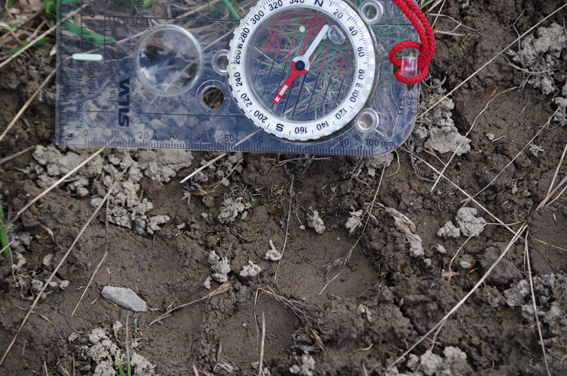
Both valleys are breathtakingly beautiful. Facing north, the mountain ridge of Takir-Ter is still completely covered in snow and ice. The valley is surveyed for the first time this year. A snow leopard attack on a fowl was reported last year in Kashka-Ter valley. Pictures were provided from local people for documentation. This, of course, has led our scientist to the decision to survey both neighbouring valleys in hope of finding more evidence of snow leopard presence in this area. And indeed, we find fresh snow leopard tracks in the mud! They are a series of footprints that must be no older than two or three days, left behind after the heavy rainfalls. Excitement is in all our eyes when we scan the area for more evidence, while Aman installs another camera trap. The finding makes all our day – the mountain ghost is out there!
Snow leopard track (c) Peter Sporrer
On team 2’s last full survey day on Thursday, we pick up a former plan to research both side valleys of Don Galamish. Postponed because of wet terrain conditions, the ground is now dry enough for driving up grassy meadows to a starting point that allows both teams to reach the valley’s end in a day’s survey walk. It is still a long way to go before ibex terrain is reached. Volodya’s team reaches the peak of the partly snow-covered ridge at 3877 m and walks about 21 km, but also is one hour late due to a miscalculation! They are seen coming down the ridge by team 2, so nothing but a loooong waiting time before all drive back to camp together. Overall, this day’s sightings are rewarding, though: Himalayan griffon, snow cock and fox. Another camera trap is set where many fresh ibex tracks are found.
Breakfast time on Friday. Two options for short surveys are put on the whiteboard but no one has put in their name yet. What’s this all about? Looking around I see tired faces hoping for a less strenuous activity today. Sorry, guys – there is no other option. No interviews today, the staff will start with breaking down the yurt and camp after breakfast. A group of six – Ben, Sue, Neus, Rahat, Peter and Amadeus finally pack a set of equipment and head off. What was supposed to be an easy team survey turns into a kind of stress test as people forget to work as a team. Getting out of one’s individual comfort zone is a good learning experience, though.
After a bath in the stream or a warm bucket shower back at base everyone listens intently to Volodya’s slot review. Team 2 has visited 50 cells. The highlights are the discovery of snow leopard tracks and possibly a lynx scat at Sary-Kol valley, supposedly left over from winter time. Lynx is recorded for the very first time in this area. The number of ibex sightings is extraordinary. This most probably is also because many, many herders haven’t moved in yet into the valley. It also indicates that wildlife recovers quickly when undisturbed. This, of course will be included in the final scientific report’s findings. Nine more camera traps have been installed hopefully clicking as we sit and celebrate our last evening in camp. Thanks to Sue & Ben’s extraordinary bird watching skills the number of species on the bird list has doubled. As to the butterflies, Amadeus then sums up that seven different species have been recorded, five of which have not yet been recorded in the study area. Thank yous go to the team for two weeks of quick learning and great scientific work. After dinner we raise our glasses when toasts are brought out. A taste of local vodka seals the team’s happy reunion while we stand around the campfire.
Thank you team 2 – you’ve been exceptionally great coping with difficult weather conditions and terrain. Thanks for your great spirits and putting your special skills, time and money into this project. Safe travels back home or enjoy your ongoing travelling. I hope to see some of you again someday, somewhere.
Franz’s article has now also appeared in Swiss “Tierwelt” (animal world) magazine. We have now put the three articles about the expedition on our Issuu account, if you want to share them that way.
Groups 1 – 3, we hope you have good memories. Groups 4 – 6, we hope your preparations are going well.
==============
SUMMARY
Rimbang Bukit Bukit Baling landscape is a priority landscapes the Sumatran tiger conservation efforts (Panthera tigris sumatrae) and has been included in the Tiger Conservation Landscape (TCL) so getting global attention to the conservation of endangered species. Constitute lowland rainforest hills that keep diversity high biological as well as a water tower for dozens of counties underneath. This landscape is also populated by people who are still use natural resources wisely. Because of its potential high, one of the activities that are very relevant to be applied in this landscape is activity-based biodiversity and ecotourism local culture. WWF – Indonesia, Biosphere Expeditions, and Groups Work Batudinding work together to initiate tourist activities. The second component is based on the locale. With participants are foreign communities of various continents in the world, citizen scientist become the focus in this ecotourism activities. This activity is titled expedition tiger Sumatra held throughout the 6 (six) slots each – each two week of the month from May to June 2015 and from July to September 2015. Scientific Aspects become the main focus in the implementation of this expedition where we have a goal or a big goal because research on tiger expedition Sumatra is a crucial activity that through this activity able to provide a lot of information related to tigers and is also related with their biological information for conservation and management Rimbang Bukit Bukit Baling landscape. Initial results on the 3 (three) slot tops the period of May – June 2015 that it had conducted three core activities, namely survey both signs of the existence of wildlife as well as the installation of a camera trap, survey of social aspects related to the protection and human-tiger conflict, and environmental education at several elementary and secondary school level. This activity has a positive impact on wildlife conservation efforts as well as habitat, empowerment of local communities, as well as the development of activities ecotourism special interest in landscape Baling and Bukit Bukit Rimbang surroundings.
Here, at last, is the diary for slot 1 of our Tien Shan expedition. We could not get it to you because there is a big mountain range blocking the sat phone signal in the south. Calls can get through, but data can’t. Since this mountain range is unlikely to move over the next couple of months, please assume that field updates will only come every two weeks, as we switch teams and go back to Bishkek. Unless we haul the sat phone up the mountain with us on one of our surveys. You never know 😉
12 June (Friday)
A collective sigh of relief could be heard last Monday, when the team left Bishkek. The city heat – temperatures beyond 30 degrees – were happily left behind as was dust and heavy traffic. Snacks were picked up in a supermarket on the way and the convoy of three cars stopped for lunch when the tunnel was passed at 3200 m altitude. Overall it took us about 7 hours to get to base camp, so teams 2 – 4 please be prepared for a long journey.
08:00 o’clock. It’s a fresh and clear morning. The warming rays of sunlight haven’t yet made it over the eastern ridge sheltering base camp, nestled in a small side valley of the Karakol river. We’ve seen all four seasons since team 1 arrived four days ago. Rain made us seek shelter in the mess tent for the first expedition day’s training sessions, while the surrounding peaks were covered with a fresh layer of snow. Carolyn, Susan, Theresa, Charlie, Robert and Thorsten learned how to use GPSs, maps, compasses and radios, went through safety briefings and off-road driving lessons. After a practice survey walk with the whole team including Volodya, the scientist on this expedition, as well as Shailoo and Aman from NABU’s snow leopard patrol, and Kathy, one of Biosphere Expeditions’ senior staff joining the first slot, they have now all left camp in smaller teams for today’s surveys.
So far eleven cells have been surveyed in two days in Choloktor and Chon Chikan valleys. I will be talking a lot about cells – a grid of 2 x 2 km laid over the study area map in the Tien Shan mountains divides the terrain into these cells, which will be surveyed systematically.
No camera traps have been set yet. Snow is still covering the most promising spots. Over the next few days we’ll continue to explore the area hoping for a lot of sun to melt the snow away. Findings so far were wolf scat (a lot) and an ibex skull and horns, a red fox and marmot were sighted as well as quite a few golden eagles, just to mention a few.
P.S. Please remember to bring insect repellent, there are some mosquitoes around 😉
15 June (Monday)
We’ve continued exploring the valleys around base camp. On the third survey day, Susan, Robert & Theresa went together with Aman to the other side of the main valley and up the mountains we look at from base. The day’s motto was “slowly, slowly” since everyone was feeling a bit worn out after three days of going up and down lots of hills. Not so Aman, who was briefed intensively the night before about what “slow” means to us. 😉 The second group consisting of Volodya, Carolyn, Charlie and myself walked up what the locals call the “boar stream” pretty close to camp. We’ve crossed alpine meadows, scree fields and climbed up rocks before reaching the ridge at 3792 m altitude. Most animals signs such as ibex scat, argali footprints and snow cock scat, feathers and dust holes were found within the rocky habitat well above 3400 m. Further down, abundant marmot holes were spotted, a big colony of them must once have lived there.
This slideshow requires JavaScript.
The weather changed overnight from sun to rain and wind. Leaving Carolyn & Charlie, Susan & Robert behind, two cars left camp in the morning for a shopping trip to Suusamyr. Not a quick one since the town at the entry of the Karakol valley is about a 2½ hour drive away. The tasks on our list were: 1) buy bread, 2) buy milk and 3) buy a chimney for the yurt stove. Doesn’t sound complicated at all, but we failed with two out of three. Instead of milk we could have bought a great variety of vodka (even from the smallest shop) and for the chimney a local herder suggested to go back all the way to Kara Balta close to Bishkek on the other side of the Kyrgyz Alatoo mountain range. But bread we got! And also a taste of yoghurt cakes, a local specialty recommended by Emma, our cook. But to be honest, this was probably the most disgusting flavour Kathy, Torsten and I have ever tried. I guess you can also tell that from Torsten’s face on the picture. ϑ
At breakfast this morning our hopes for better weather seemed to be nothing but wishful thinking. But just when we decided to stay half a day at camp, the sun came out and everyone was ready, dressed and packed up in record time for another survey walk. This year’s first interview was held with a very friendly herder offering Kathy a ride on his horse, which was thankfully accepted 😉 Being a cattle herder he didn’t have any problems with snow leopards in the past, not even wolves because the cattle can defend themselves. A woolly ball was brought back to camp and analysed during the review session after dinner. We learned that these remains are produced by birds of prey regurgitating bones, feathers and other parts of their meal that can’t be digested.
16 June (Tuesday)
The sun laughs at us again! It’s been a clear night, the water drops on my tent were frozen this morning. Everyone is excited to finally go out for an overnighter. Camp is as busy as an ant’s nest. Emma is preparing food boxes, Aman and Shailoo are preparing cooking gear and packing up cars, everyone else is gathering equipment and packing their sleeping gear. Kathy and I wave them goodbye as they leave. We will go through some re-org in the next couple of days.
18 June (Thursday)
SNOW LEOPARD TRACKS! The overnighter team is back, exhausted, but thrilled about two exceptional survey days and a “night out”. The camping spot was chosen close to the mountain pass connecting the Eastern and Western Karakol at an altitude of 3500 m. Still partly covered in patches of snow and therefore not crossable for herders and their livestock from the Eastern side, this area would be worth a check before the cattle, sheep and horses will move in for the summer. Well done, everyone! The snow leopard tracks found were not fresh, but still clear enough for identification without any doubt. Two camera traps were placed, now everyone is hoping for some good results.
20 June (Saturday)
Slot one is ready to leave base camp. We did a reccee walk yesterday researching more overnighter possibilities in order to reach more promising rocky mountain areas at the far end of some of the valleys. Aman has suggested we follow an old track leading uphill over grassy hills not knowing where it would lead us to. So we drove as far as the cars would take us and continued on foot split up in two teams. An old herder’s place was found – an optional overnight camping spot close to a mountain stream. A badger was spotted as well as ibex far away on the rocky peaks of the mountain range. It was early in the afternoon when we returned to camp leaving us some time for final checks on the cars, the tents, the equipment and a detailed review of the results of what the team has achieved over the last two weeks. 26 cells have been surveyed – an impressive number considering the small number of citizen scientist on the first slot. We’ve spotted or found tracks of all snow leopard prey species such as ibex, argali and marmot. Tracks and scats of wolf, fox, badger and snow cock were also found and quite an impressive number of different bird species is already on the bird list, which will be continued until we leave in August. But most excitingly the presence of snow leopard was proven by tracks. This success was celebrated after Volodya’s review and another delicious dinner with quite a few toasts and some local vodka.
21 June (Sunday)
The first two weeks of this year’s Tien Shan expedition went in a flash. While Carolyn and Charlie will stay for two more weeks, I had to say good-bye to Kathy, Theresa, Sue, Robert and Torsten after a final dinner in Bishkek. Thank you everyone – you’ve been a special and a great team! Thanks for putting your time, sweat, mountaineering expertise and excitement into this project. Safe travels back home. I hope we meet again some day in the future!
We’ve had a call from base camp. They are having trouble with the satellite connection. They can phone us, but the data connection for diaries and photos is not working, so this is just a short message to say that everyone is safe and doing well. We’ll send a diary entry as soon as we can, but it may only be at the changeover 20 – 22 June.




 Biosphere Expeditions: blogs from the frontline of wildlife conservation and the fight for a more sustainable planet