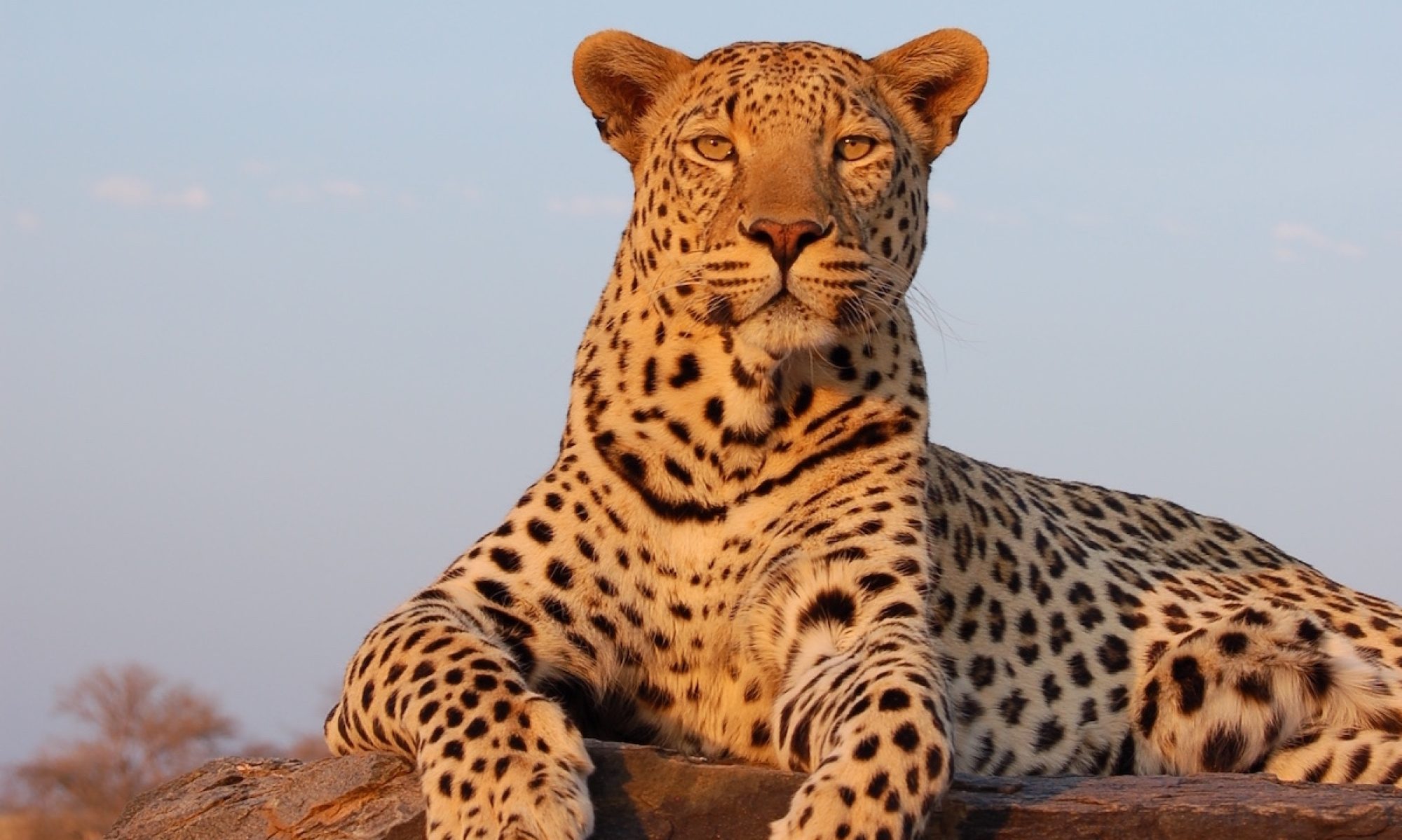
From our working holiday volunteering with leopards, caracals and Cape biodiversity in South Africa (www.biosphere-expeditions.org/southafrica)

We are here to find predators, as the title of this project may suggest – ‘Carnivores of the Cape Floral Kingdom’. Trying to track down leopards, caracals and even wild cats, would normally involve a combination of hard work, patience and luck.

So no easy task; and only the ‘lucky’ will encounter them face to face. However, we have technology on our side, in the form of camera traps. These clever boxes can be deployed to a range of locations and left to merrily take images of whatever happens to walk by them. That way, we can have ‘eyes’ in the field in multiple locations, over a huge area and every hour of the day or night.

One of the jobs of the team has been to deploy yet more camera traps to add to the existing network, collect in others, and begin to analyse several thousand photos already taken. This digital imagery is a gold mine of data.

Once species in images have been identified, and hopefully sexed and aged, we begin to open a new window on the fynbos world. We can begin to deduce what species occur where, their relative numbers and how this changes over time. A large catalogue of images can enable us to deduce patterns of activity over 24 hour periods, and distributions over wider spatial and temporal scales.

Our team have already analysed over 2500 images in the first few days. All providing vital data and insight into the ecology of this unique environment. Yes, the cameras have recorded many of our target species, including grysbok, rhebok and duiker, but they have also revealed lesser known species such as aardvark, honey badger and porcupine.

And one of the recently collected cameras has already documented one of our target predators – African wildcat, whilst we’ve been on expedition. Our knowledge will only advance as we capture and process more images between now and the end of the expedition.

Camera traps are a great tool for conservation, but there is still no escaping the need for fieldwork (fortunately), and the need for hard work, patience and luck.

This slideshow requires JavaScript.


From our working holiday volunteering with leopards, caracals and Cape biodiversity in South Africa.

From our working holiday volunteering with leopards, caracals and Cape biodiversity in South Africa (www.biosphere-expeditions.org/southafrica)

Let the science commence! With the training completed on the various methods, our surveys could begin for real. For the next few days we’ll be ‘hunting’ high and low to find the mammal fauna of the of the fynbos.

The first job of the day is always the leopard trap – a large cage trap, which will hopefully tell us which of the cat species is moving through the local area. But we’ll also get some interesting by-catc, and the last couple of mornings we have trapped grysbok – a small antelope almost entirely restricted to the fynbos vegetation. All are released to continue on their way.

Our day yesterday then continued with flush surveys. Basically a large transect survey, with multiple people, whereby we can document the mammal and birdlife in a specific area. Our first survey was in the Welbedacht section of Baviaanskloof. It also gave the team an opportunity to deploy a few more camera traps to hopefully catch the elusive and wide-ranging leopard.

Whilst the science went to plan, the transportation was a different matter. Our local ranger, Eksteen decided that he and Christine would take the vehicle to meet us at an entirely different point to one agreed with our scientist, Alan. The upshot meant a long walk out of the survey area and a late lunch. Though we took the opportunity to drive through the Nuwekloof pass – a stunning rock canyon where stumbled across two leopard tortoises in a rather noisy embrace!

In addition to getting the flush surveys underway, we also now have 50 Sherman traps deployed with half of them up the now infamous protea slope. Locating the pre-marked trapping points in head height protea bushes is certainly a challenge – think needle in a haystack on a 40 degree slope. But as with much scientific survey work, hard graft usually pays off. We’ve already been rewarded with several captures, including a species not on our provisional list, though we await confirmation.

This slideshow requires JavaScript.


From our working holiday volunteering with leopards, caracals and Cape biodiversity in South Africa.

From our working holiday volunteering with leopards, caracals and Cape biodiversity in South Africa (www.biosphere-expeditions.org/southafrica)

The first volunteers of the inaugural ‘Carnivores of the Cape Floral Kingdom’ expedition all arrived on Sunday with only a minor glitch of getting one vehicle stuck just a couple of miles from the expedition base. Welcome to expedition life!

With initial introductions, risks assessments and briefings completed by Sunday afternoon, we stretched our legs with a brief orientation walk around Blue Hill Nature Reserve – our base for the next 12 days. We passed by (and checked) the leopard trap, which will form a key part of the survey work, and enjoyed some of the local wildlife whilst on route. Sightings included klipspringer, jackal buzzards and an ancient relative of the elephant – the dassie or rock hyrax. This was followed by another orientation walk up a ridge behind our base. The climb rewards you not only with a great view over the fynbos landscape, but also with a mobile phone signal. I have a feeling the path will be well–trodden by some!

Rested and recuperated from Sunday’s travel and briefing exertions, the science training than began in earnest on Monday, with camera trapping analysis and mammal ID work. Practical session came in the form of off-road 4WD training. Our three transport options on the project are either by foot, by 4WD or by mountain bike. All vehicles and drivers returned to base in one piece. So far there have been no riders.

With equipment briefings completed and after-dinner lectures from our project scientist (Dr. Alan Lee) digested, we put things into action on Tuesday. The sunrise activity of trap checking yielded a klipspringer in the trap, which was promptly released. Unfortunately it broke a horn in the box trap, something that happens very rarely, but did this time. Alan was worried, but the klipspringer seems to have been fine. Later in the morning we practised setting 50 small mammal traps in a big group. It took us about three hours, so a couple of people should manage in an afternoon, especially because we have already marked and recorded the fifty locations now, covering a big rectangle of 250 x 1000 m. In the afternoon we conducted our first ‘flush survey’ in a group of seven walking all abreast and 2 m apart, recording vegetation and any animals that are disturbed and ‘flushed’ out of the undergrowth. Christine, who had twisted her ankle just before the expedition, and her husband Prasadu stayed back to go through camera trap pictures collected by Alan in the past. This will be another key activity where we can help Alan do things that he would not be able to do without willing volunteers, in this case because he simply lacks the time to go through 3000-odd camera trap photographs. But split over two weeks amongst seven volunteers working in shifting pairs this task become manageable and the end result, Alan hopes, will be a peer-reviewed scientific publication on “temporal patterns of abundance of medium to large-size mammals from camera trap records” (that already sounds very scientific, doesn’t it ;).

This slideshow requires JavaScript.


From our working holiday volunteering with leopards, caracals and Cape biodiversity in South Africa.

From our working holiday volunteering with leopards, caracals and Cape biodiversity in South Africa (www.biosphere-expeditions.org/southafrica)

When Matthias and I touched down in George on Wednesday, it was horizontal rain, 13 deg C out of the wind, grey skies and freezing in the wind. The drive to base was wet and long and we were late.

Today the skies are blue and it is 25 deg C outside. This changeable weather is nothing unusal for the Cape fynbos mountains. The forecast matches this: a mixture of sunny days and rain. Alan says it’s impossible to predict for more than two days anyway as the mountain weather is so variable. But even with blue skies and warm temperatures outside, the stone houses of our base are cold, and the stone floors are freezing, so do come prepared with slippers.

This slideshow requires JavaScript.

Anyway, we’ve spent the last two days getting ready for you. Finishing the day-to-day plans, research activity schedules, orientation briefings, equipment, rooms, etc. We are aiming to be all done by tomorrow lunchtime. Matthias will come out and meet you in George and make sure the transfer to base goes as smoothly as possible. Alan, Anja (his wife), Eli & Charlie (their children), the rest of the staff and I are looking forward to meeting you in a couple of days.