Group 2 is now safely at base camp, after a 9 hour journey on progressively smaller to no roads. Today training begins.
Following a successful first group, we hope now to get more local interviews, more cells surveyed and camera traps serviced and set and we will hopefully be reporting back with more positive data at the next opportunity.
Group 1 is back from the field – and what a start it was, exceeding all expectations of what the 18 camera traps left in the field by last year’s expedition would yield. Almost every camera we toiled up to at around 4000 m caught snow leopards. Preliminary analysis of pelt patterns yields 8+ individuals, a result we can hardly believe ourselves (and have enquired with colleagues about for confirmation). One camera in particular yielded a spectacular photo:
But there were many others too:
Of course the camera traps not only caught snow leopards, but also many other species such as this rare manul / Pallas cat
A probably even rarer (because they have all been poached out) argali mountain sheep
Ibex
Wolf
An incredibly hardy “yeti” marmot up at 4000 m
Fox
Yak
A curious red-billed cough
Many Himalayan snow cock prancing about
And a lammergeyer photographed by a camera trap that was knocked over (by what we don’t know) and recorded over 10,000 pictures of moving clouds (thanks for going through all of them Aurélie), but also this vulture
But it was not just all about camera traps. We also surveyed cells lower down, conducted interviews and re-affirmed good relations with the local people, ran overnighter surveys and reconnaissance trips into the neighbouring valleys and so much more, yielding this quick summary of results, presented to the team by our local scientist Emil at the end of group 1’s efforts
And what an effort it was! None of this could have been achieved without our 14-strong team of citizen and professional scientists and staff. Thank you to you all and so very well done.
I leave you with impressions of our work, camp and the mountains, as well as feedback from some group 1 participants, and hand the expedition leader baton over to Jonny, who will meet group 2 at the Futuro on Monday.
Yet another two successful weeks of wolf monitoring in Lower Saxony have come to an end. Group 2 left the NaturCampus base on Friday morning headed in different directions after a late night with lots of laughter and bread-on-a-stick around the fireplace.
Once more the teams were hit again and again by rain showers on our last survey day on Thursday but determination to find and collect wolf scat prevailed. Two of us established a new record of walking 22.2 km in ongoing rain!
Within 4 survey days group 2 covered 394 km of forest trails and collected 30 more (possible) wolf scat samples for further analysis two of which fresh enough for DNA analysis. Sightings on the survey walks included hare, red deer, roe deer, wild boar with 10 piglets, various butterflies and birds of prey… and a naked man walking the nudist trail in the Schneverdingen area. The survey team has been warned during Lotte’s briefing but it was still a surprise to run into someone wearing nothing but socks, boots and a hat while oneself was fully geared against rain and cold.
Thanks to two groups a total number of 75 wolf scats and 13 genetic samples are now secured, labelled and packed to be handed over together with the database entries to the LJN authorities. They are an enormous addition to the Lower Saxony wolf monitoring efforts and will be included in their official yearly report, as well as territory statistics, maps, etc. to be published on their website. We have covered a total number of 26 cells (10 x 10 km) of the survey grid by walking 650 km in 12 survey days.
For Lotte & I it’s been a great pleasure meeting and working with all of you for a week respectively. We’d like to thank you again for your time, efforts, input and being great companions in every aspect. A special thanks goes to the drivers and NaturCampus staff that made us feel comfortable and at home. I hope you’ve enjoyed your time as much as Lotte an I did. We’re hoping to see some of you again some time and wish you all safe travels back home!
Group 2 – a team of ten people from 5 different countries – started off on Sunday with a practical training survey walk nearby NaturCampus following up on a wolf scat finding two days before. We were surprised by a once in a year biking event taking place on the military grounds we were exploring. The terrain is usually closed for the public. Bikers didn’t interfere with our training walk but a heavy downpour did just when we were practicing data recording with the tablets. Despite rain gear and backup umbrellas we all ended up being soaking wet. I like to frame it as an ultimate field test. 😉
Sunshine and rain took turns during the following three survey days in various wolf territories. That didn’t hold us back from long walks and intensive surveys. Unfortunately we didn’t find anything wolf-like in the Suesing forest on Monday which made us wonder what neighbouring area the pack has moved to.
On Tuesday we were more successful in terms of findings. 22 wolf scat samples were brought back to base one of which had a total length of 82 cm! I think this is a first. Speculating about causes for the exceptional big amount of shit, we came up with quite a few creative ideas during the very entertaining daily de-brief – ranging from constipation for a week to making a statement to impress possible intruders.
And finally we secured another fresh DNA sample in the Goehrde forest on Wednesday. During the de-brief we all got a first-hand experience with the undeniable deterrent smell of fresh wolf scat. I must say that scat & its attributes (we now refer to as “beautiful, nice, perfect,…”) have become one main topic of conversation – even during dinner. Just like a bunch of very serious citizen scientists we surely are. Still, we had a good laugh realising that and not at all problems with moving on to more sophisticated dinner table talk.
Everyone is out in the field for one last survey day today. Time is flying….
Peter Thoem, a retiree from Canada, has participated in six expeditions so far. ‘I have time in my life, the health and the resources – so why not’ is his go-getter attitude in all this. This is why he started with expeditions and what he experienced on them.
‘Back in the day, when I was thinking about joining my first expedition to the Tien Shan mountains to study snow leopards, it was the opportunity to get into a really wild area. I could see that few westerners would ever get to see or experience the Tien Shan mountains and that the expedition might yield exciting results’, recounts Peter, ‘it was simply too good an opportunity to miss.’
And since then? ‘Tien Shan was just so thrilling’, says Peter, ‘and then the year after – in 2019 – there was the chance to do something equally useful in places as fascinating as the Dubai Desert Conservation Reserve and Kenya’s Masai Mara. It deeply interested me’. So off he went to the Dubai Desert Conservation Reserve first and then a few months later to Africa for back-to-back expeditions in 2019 and 2020, just before the Covid pandemic brought everything to a standstill for a couple of years.
Peter with local rangers on the Kenya Masai Mara expedition
His most recent expedition was to the Azores archipelago, studying whales & dolphins from a catamaran.
When asked about lessons learnt on expedition, Peter’s answers are swift and precise, showing his enthusiasm. He believes that with good planning, an open mind, health and resources, you can do it, because ‘it’s a fascinating world out there’. And further that even if ‘our western comforts make us think that everywhere else is scary, it’s not. Yes, some places can be risky, even dangerous, but not everywhere else.’
When asked to summarise his experiences, Peter takes some time to think, smiling to himself and then says: ‘Sometimes it’s rigorous – we have work to do and protocols to follow, we have to understand what’s expected. We have to coalesce as a team and appreciate each other’s strengths and not-so-strengths. Then we have to find ways to work with the less committed – some are day-dreamers, others are bloggers who don’t always contribute much.’ But it always works out in the end: ‘We come from all corners of the world, some of us have even met before, because we’re committed to the Biosphere Expeditions ethic. And when I return, I always feel richer and profoundly privileged for having been to places and done things that I used to believe only existed in an Attenborough world.’
Peter’s most abiding memories include standing on the slope of a remote valley in Kyrgyzstan with a clear blue sky. ‘It’s just warm enough to unzip my jacket. I’m surrounded by yellow expanses of spring flowers, there’s rushing meltwater cascading off snow-draped mountains around me and I had to pinch myself. Is THIS really me? Am I really here?’
Or there is the time when Peter was on his middle-of-the-night-shift keeping watch over a waterhole in Kenya’s Masai Mara. There are elephants around and hippos lie in the waterhole, but it’s quiet except for the odd grunt, splash or snuffle. Then from across the valley comes a strange upside-down bark, like indrawn breath ‘EEeeeeYiP’. What’s that, Peter asks the ranger. ‘Hyaena’, the ranger replies and Peter’s spine tingles.
And most recently, in 2024, on the expedition boat off Faial, one of the islands of the Azores archipelago: ‘The sea is lively and we have to hold on white-knuckle tight’, remembers Peter, ‘we’re all doing our tasks as assigned when a blue whale is sighted. We slow down and carefully approach – again everyone does as instructed – gathering data: time, water temperature, sea-state; taking photos, watching, counting and more. And then we’re spell-bound. There in front of us, all but immersed, visible yet almost invisible is the world’s largest mammal. It blows a couple of times, then dives to depths that take it out of the realm of human comprehension.’
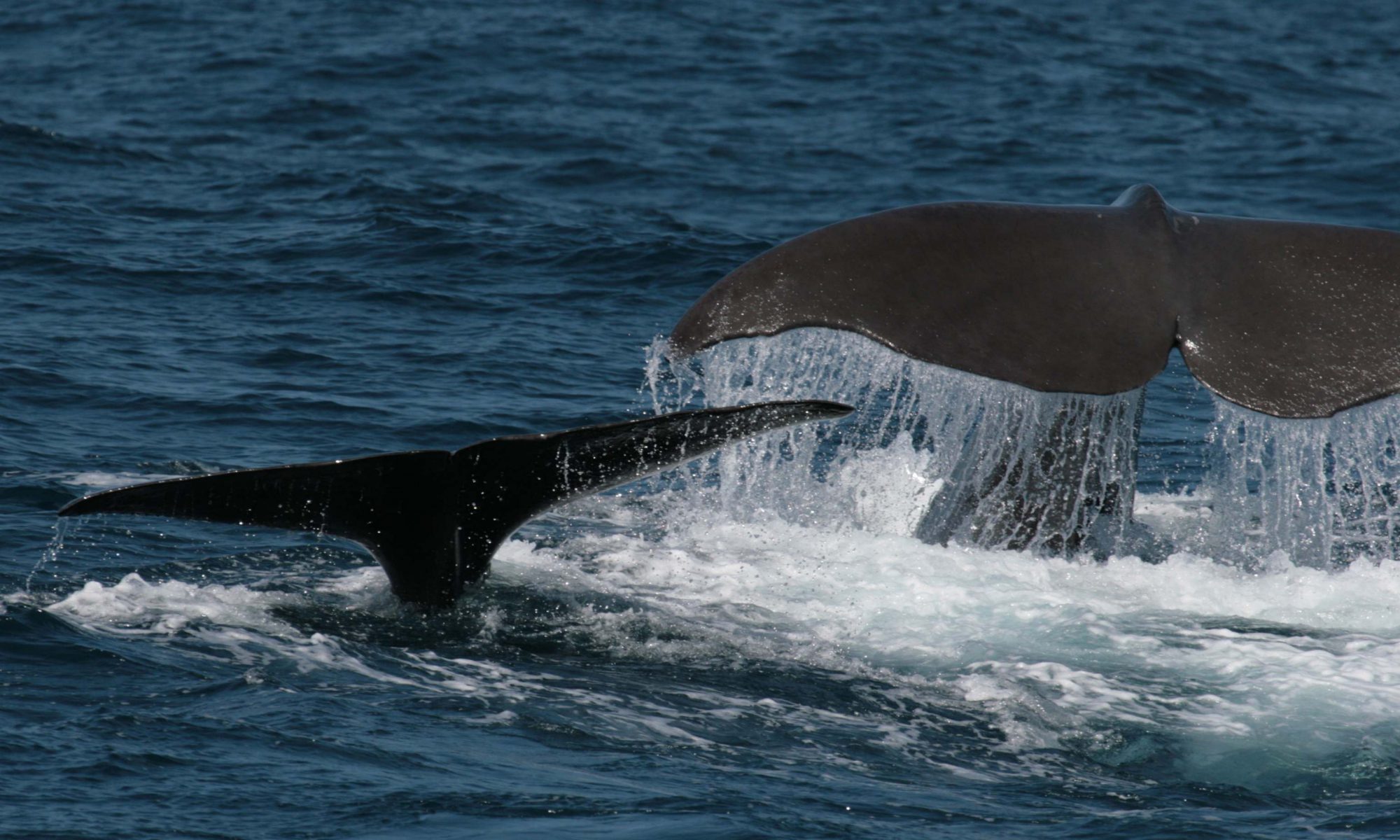
A blue whale: a spell-binding animal for Peter
With all those experiences, what impact have the expeditions had on Peter’s daily life, away from expeditions? Again, Peter does not hesitate: ‘I’m seen and known for having just come back from another exotic place. Where are you going next, people ask. I have a greater understanding and appreciation of the value of citizen science’. An appreciation that has contributed to a structured long-term project on bird populations close to Peter’s home (now in its 10th year).
And what about Peter’s connection to nature? Has this changed through the expedition experiences he’s made? ‘My connection with nature has always been strong’, Peter responds, ‘and I feel that I have a reasonable understanding of how the balance of nature all weaves together. The expeditions give me the chance to see some of those interactions and inter-relationships’. And Peter adds an example of this: ‘With Alan, our expedition scientist in Kenya, we watched a small group of impala ingesting mineral-rich soils. Alan was ecstatic, it was, he said, the first known-to-science example of geophagy (animals eating soil, usually for its mineral content) by impalas. My photos made it a publishable observation‘.
Impala geophagy at the Memusi mineral (salt) lick, photo courtesy of Peter Thoem.
The interview ends with the question of what Peter would tell others who are thinking about joining their first expedition. Peter laughs and just says: ‘If it appeals to you, then set aside your fears and just go do it’.
Find an overview of all upcoming expeditions here.
Also see Peter’s birding blog entries for Kenya and Arabia
The 2025 expedition is done. Over 10 expedition days and with the help of ten citizen and professional scientists from six countries (Australia, Canada, France, Germany, Spain, UK), we found and recorded 51 dens (17 anthill, 4 anthill/soil, 6 nest, 16 rock and 8 soil dens). We also collected 11 first scats at dens, which is a record that Dr. Andrea Friebe, the expedition scientist, called “sensational”. We also removed three camera traps and entered all the data into the database. This has once again been a very significant contribution to the Scandinavian Brown Bear Research Project’s database and studies and we are expecting scientific publications that use these data soon (as well as the usual annual expedition report).
Thank you so much to all our citizen scientists who have made this possible by contributing their time and funds. Without you, there would be no expedition. You have been an exceptionally effective and determined team and we take our hats off to you for the effort you have put in.
Team 2025
So, since 2019, this expedition has developed into an essential data collection part of the Scandinavian Brown Bear Research Project, because it collects – over a relatively short period each year – large amounts of den and scat data through the concentrated efforts of citizen scientists. For example, in 2019 the expedition visited 28 bear den sites and mapped 24, found 10 scats at 15 bear cluster sites, recovered a bear skeleton from a bog for further analysis, recovered a valuable transmitter, covered over 2,000 km of the study site and had two bear encounters, increasing the SBBRP’s bear den database by between a third and a half. After an unwanted Covid-break, the 2023 expedition visited 68 sites, including 38 winter dens and 35 scat collections, ten of which were ‘first scats of the season’ (especially valuable samples that can reveal what a bear has eaten before and during hibernation). The 2024 expedition surveyed 27 dens, and collected 56 scat samples including three samples of ‘first scats of the season’. The 2025 expedition surveyed 51 dens, and collected a record 11 first scats. The SBBRP expedition scientist has called the contributions of the expeditions over the years “invaluable” and “sensational”.
So I leave you with some impressions of the last few days and some citizen scientist feedback. Thank you so much again and safe travels onwards or home. We hope to meet you again on an expedition, somewhere, somewhen on this fragile planet of ours.
I really liked how we were able to go out independently in small groups and were trusted to conduct our fieldwork to a high standard. It was all amazing. Keira W., Australia
I really enjoyed the satisfaction of helping to gather data so scientists can makes sense of how climate breakdown is affecting flagship species. Also the age of participants – I’ve been on a number of projects with other organisations where everyone around me was below 25. Chai H., UK
I really enjoyed staying here and I am not sure whether anything can match the experience I had here. The work with our local scientist Andrea was so joyful and fantastic. I also learnt a lot about bears. I hope I can join the expedition again in another year. Sarah H., Germany
Over the past week, we’ve been checking the hell out of the dens within an hour’s drive of the base in all directions. We’ve studied and recorded soil, rock, anthill, nest and all manner of weird and wonderful dens, crawled into almost all of them (thank you Keira and Sarah for being the pre-eminent den crawlers) to measure and study the inside, found evidence of cubs and feeding and preying and playing.
Here’s a den gallery:
To get to the dens, we’ve negotiated broken ground, bogs, steep hills, gentle slopes, beautiful meadows, rock falls, woods and forests, plantations and clear-cuts, as well as lakes and waterways.
Highlights included coming across a bear crossing the road (“we were all too busy screaming to take pictures”), fox, moose, capercaillie and various other birdlife, crossing a lake on a paddle board to get to a den on a small island, and the team meeting at a local beauty spot for lunch.
Island den-checking
Tomorrow is our last survey day. It’ll be more dens and retrieving some camera traps. Our scientist Andrea will also present some preliminary results. I will share this all in the next diary entry, before we part, ready for a holiday after this research expedition. Thank you for den-checking your guts out team! You deserve a holiday 😉
After two days of training and recording den data as one group, we have been let loose and are now on our second day of collecting den data by ourselves, in three groups of two or three people.
Each morning Andrea assigns dens to us, hidden in the forest. We get their GPS position and some background information and then have to work out how to get there, first in the car, mainly on forest roads to advance as close to the den as we can. Then it’s on foot through enchanted, pathless forests, picking our way through wetlands, bolder fields, carpets of moss, over rocks, birds for company. Sunshine and light through the clouds change as we walk and clamber through quiet groves, past springs and fallen trees to our object of desire: a bear den. Sometimes we only have a few hundred metres to go, sometimes one or two kilometres. It’s slow going. You have to pick a path through the trees, watch your direction on the GPS. It slows you down. It’s not a race. You sink into the forest. Deceleration. Sometimes it’s only a few minutes to the den, sometimes an hour or more.
Once at the den, which wants to be found first too, lots of measurements need to be taken. How big is the den and its inside chamber (crawl inside for this)? What bedding did the bear use? What trees make up the surrounding forest? Are there any scratch marks around or scat (collect this). Are there signs of cubs, such as small scratch marks low down on trees, and more. This takes about another hour and is all meticulously recorded. Then back to the car and onto the next den. A group manages between a couple and half a dozen a day, depending how far apart they are in the forest and on the roads.
Measuring the inside of a den
Back to base in the afternoon for a de-brief session where each group tells the others what they found. Tips & tricks are exchanged, Andrea asks questions, wants to know more. Then data entry into the computer and a well-deserved hot dinner. Some fireplace conversations perhaps, for those who haven’t crashed already. Ready for the next day.
We’re off with everyone here. After some “express-incheckning” in Mora we proceeded to the expedition base and went straight into training for the rest of the morning and early afternoon: What the project is about, why citizen science is so important to it, how the bears are doing, what we will be doing, how to use a GPS & compass, how to pack your research bag and more.
In the afternoon, we checked out some old dens to see what a rock and anthill den look like, as well as an open hibernation nest (the big males just make one of those and let themselves get snowed in). Then a short lecture, dinner with the fire roaring, crash.
More of the same tomorrow. Boring, this life of a field biologist 😉
Sweden is as beautiful as ever, so is our expedition base and the surrounding forest. Note that it snowed today.
Snow in May
The bears have not fared too well over the past 12 months. The government has slashed the number of bears it wants alive in Sweden from 2800 to 1400. This has meant that over the past year lots of bears have been killed in the study site, many of them with collars. At the same time the SBBRP has been starved of funds. How all this impacts what we do on the expedition this year, Andrea will explain when you get here. Suffice it to say that your contribution will be as important as ever, if not more.
On the bright side, we’ll be getting everything ready for you over the next few days. The weather forecast says the weather should improve and get warmer by the time you arrive, but come prepared for fours seasons anyway.
So safe travels and I’ll leave you with some impressions from today…